The Iliad by Homer: Free EPUB, AZW3 & KEPUB Download
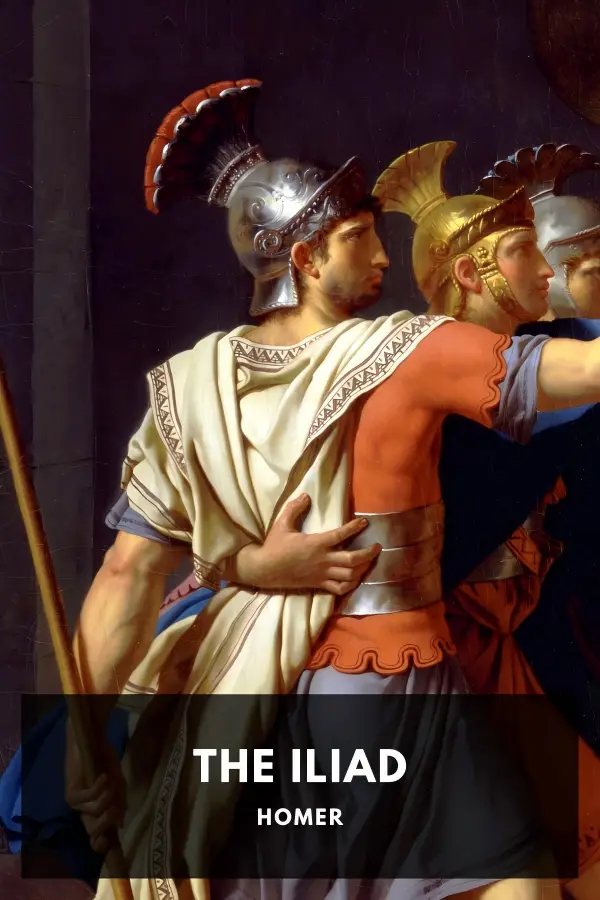
The Iliad
📖 Click to Read Book I Online Preview
Book I — The Wrath of Achilles
The visit of Chryses, Priest of Apollo, to Agamemnon, asking the ransom of his daughter—Refusal of Agamemnon—A pestilence sent by Apollo upon the Greek army—A Council called by Achilles—The cause of the pestilence declared by the Seer Calchas—Dispute between Agamemnon and Achilles, which ends with the taking away of Briseis from Achilles—The daughter of Chryses restored to him—Visit of Thetis to Jupiter, who promises to avenge Achilles—Mutual chiding of Jupiter and Juno.
O Goddess! Sing the wrath of Peleus’ son, Achilles; sing the deadly wrath that brought Woes numberless upon the Greeks, and swept To Hades many a valiant soul, and gave Their limbs a prey to dogs and birds of air— For so had Jove appointed—from the time When the two chiefs, Atrides, king of men, And great Achilles, parted first as foes.
Which of the gods put strife between the chiefs, That they should thus contend? Latona’s son And Jove’s. Incensed against the king, he bade A deadly pestilence appear among The army, and the men were perishing. For Atreus’ son with insult had received Chryses the priest, who to the Grecian fleet Came to redeem his daughter, offering Uncounted ransom. In his hand he bore The fillets of Apollo, archer-god, Upon the golden sceptre, and he sued To all the Greeks, but chiefly to the sons Of Atreus, the two leaders of the host:—
A quarrel over a captive woman, a plague sent by a god, and the beginning of a war that will outlast everyone in it. Download the complete poem, all twenty-four books, for your e-reader.
Download Full EPUBc. 750 BC (written form)
~156,000 words (estimated)
Approx. 8.7 hours
William Cullen Bryant, 1870
EPUB · AZW3 · KEPUB
0.77 MB (EPUB) · 1.30 MB (AZW3) · 0.79 MB (KEPUB)
Public domain in the United States
Standard Ebooks edition
The Iliad is Homer’s epic of the Trojan War, composed somewhere around the middle of the eighth century BC and here presented in the blank-verse translation William Cullen Bryant published in 1870. It does not tell the whole war. It covers a few weeks in the tenth year of the siege, and its subject is announced in the first line: the wrath of Achilles, and the deaths that wrath costs.
Agamemnon insults a priest of Apollo, the Greek camp is struck by plague, and the king takes the girl Briseis from Achilles to replace what he has lost. Achilles withdraws from the fighting, and the Greeks begin to lose without him — until his closest companion, Patroclus, dies in his armour, and the poem turns from a quarrel into a tragedy of grief. This edition is the unabridged William Cullen Bryant translation of 1870, in the public domain in the United States. The text is available via Standard Ebooks.
The Iliad by Homer: Summary, Characters & Themes
The Iliad is Homer’s epic poem in twenty-four books, and this summary and analysis treats it as the single continuous work the tradition has always taken it to be: a few weeks of the tenth year of the siege of Troy, framed by a quarrel among the Greeks and closed by an act of mercy. It is the oldest surviving work of European literature, older than the Odyssey it was always paired with, and the poem from which tragedy, epic and the idea of the heroic death all descend.
The action turns on a slight that is also a question of honour. Chryses, a priest of Apollo, comes to the Greek camp to ransom his captured daughter, and Agamemnon, the commander of the expedition, refuses him with an insult. Apollo sends a plague. The seer Calchas explains why, and Agamemnon agrees to return the girl — but takes Briseis, the captive Achilles prizes, in compensation. Achilles, the best of the Greek fighters, withdraws from the war, and asks his mother Thetis to have Zeus grant the Trojans victory until the Greeks come to him. They do come, and he refuses them.
What follows is the poem’s long middle: the Trojans, led by Hector, push the Greeks back to their ships; Diomedes and Ajax hold the line; Odysseus and Phoenix and Ajax the Greater come to Achilles’ tent with gifts and persuasions and are sent away. Patroclus, Achilles’ companion, takes his armour and leads the Myrmidons out to save the ships, kills Sarpedon, and is killed by Hector. The last third of the poem is the revenge: Achilles returns, kills Hector before the walls of Troy, drags the body behind his chariot, and refuses it burial — until Priam, Hector’s father, comes to him by night with a ransom, and the two men weep together. The poem ends with Hector’s funeral, and no fall of Troy.
Its method is as important as its story. Homer works in a fixed metre and a fixed vocabulary of epithets — swift-footed Achilles, Hector of the shining helm, the wine-dark sea — repeated because the poem was made to be performed, not read, and the repetitions become a kind of music. Against that formality he sets the similes: a fire on a hillside, a lion among cattle, a woman at her loom, a child building sandcastles, all drawn from peace and brought into the middle of a battle. The gods are present throughout, quarrelling on Olympus and cheating on the field, and their indifference is part of the poem’s argument about what a human life is worth.
This edition is William Cullen Bryant’s blank-verse translation, first published in 1870 and still one of the few English versions written by a poet of the first rank. Bryant keeps the movement of the Greek line rather than translating it into prose or into a rhyme the original does not have, and he does not soften the poem’s cruelty or its grief. The text is based on the Standard Ebooks edition, which was transcribed from scans of an early printed text held at the Internet Archive and normalised for modern reading. Readers who want the sequel can find the Odyssey in the same translation on this site. The poem is in the public domain in the United States; readers elsewhere should check their own law.
Historical Context
The Iliad was composed in the eighth century BC, in the oral tradition of Greek hexameter poetry that had been performed by singers for centuries before anyone wrote it down. Whether one poet named Homer made the poem, or whether a tradition of singers shaped it over generations, is the oldest argument in classical scholarship and one this page does not need to settle: the text we have was fixed at Athens in the sixth century BC, edited at Alexandria in the third and second, and has come down through medieval manuscripts to the printed editions of the Renaissance.
Its subject is a war that may or may not have happened. Troy was a real city on the coast of Anatolia, destroyed and rebuilt many times, and the level known as Troy VIIa shows signs of violent destruction in the late Bronze Age. Whether Greeks besieged it for ten years over a woman is a question archaeology cannot answer. What the poem does with the material is another matter: it takes a legendary war and makes it a study of two men — one who cannot accept dishonour and one who cannot avoid his city’s fall — and of the ordinary soldiers on both sides who die in between.
Bryant’s translation belongs to a particular moment in American letters. Bryant was a poet and a newspaper editor in New York, and he began the Iliad in the 1860s, in the aftermath of the Civil War, when American readers were looking for a national literature that could stand beside the European. His version was the first complete American translation in blank verse, and it was read for a century as the plain, honest English Homer: less musical than Chapman, less elaborate than Pope, and closer to the Greek in its refusal to decorate.
Key Characters & Literary Archetypes
- Achilles (the hero as grievance): The best fighter at Troy, and the poem’s engine: he is insulted, he withdraws, and thousands die because he will not be talked round. His rage is both the poem’s subject and its warning.
- Hector (the hero as duty): Troy’s defender, who fights for a city he knows will fall, and whose love for his wife and son is the poem’s clearest picture of what war destroys.
- Agamemnon (the king as insult): The commander whose refusal to be slighted starts the quarrel, and who is never quite forgiven for it, by his army or by the poem.
- Priam (the enemy as father): The old king who comes to Achilles’ tent at night to beg for his son’s body — the scene in which the poem’s two sides finally see each other.
- Patroclus (the friend as cost): Achilles’ companion, who wears his armour and dies in it; the death that turns a quarrel into a tragedy.
- Helen (the cause, and a person): The woman the war is fought over, given little space and one of the poem’s most painful scenes, in which she wishes she had died before she came to Troy.
- Andromache and Briseis (the women the war happens to): Hector’s wife, who loses her husband and knows what will follow for her son; and the captive woman whose loss of status begins the quarrel.
- The gods (the divine audience): Zeus, Hera, Athena, Apollo, Aphrodite and the rest take sides, cheat, and treat the war as a stage for their own quarrels — part comedy, part terrible indifference.
Core Literary Themes
- Wrath and honour: The poem’s first word is wrath, and the whole action follows from a question about status — what a man is owed, and what he will destroy to be given it.
- Glory and death: The heroes choose a short glorious life over a long obscure one, and the poem never lets the reader forget what that choice costs the people around them.
- Pity and supplication: The Iliad is full of people asking for mercy — and the moments when it is granted, above all the last book, are the poem’s moral centre.
- The gods as comedy and as fate: Olympus is a parody of the human world and also the source of the deaths below it; the poem holds both views at once.
- War as work: The poem is exact about armour, wounds, chariots and rations, and about the boredom and exhaustion between battles.
- The similes of peace: Again and again the fighting is interrupted by an image of ordinary life — a mother, a farmer, a fire, a child — and the interruption is the poem’s judgement on the war.
Why Download Our Custom E-Reader Edition of The Iliad?
The Iliad is a poem that rewards re-reading, and it is a poem that many readers first meet in fragments: the wrath, the shield, the death of Hector, the ransoming of the body. An e-reader is a good place to meet it whole. Twenty-four books, a single continuous argument, and a text you can leave and return to without losing your place in the catalogue of ships.
Translation matters here more than for almost any other classic. Bryant’s 1870 blank verse keeps the long line and the repeated epithets, and it does not turn the poem into prose for the sake of speed. If you have tried the Iliad in a Victorian prose version and found it heavy, or in a modern colloquial version and found it thin, Bryant is the middle path: a poet’s translation, in plain English, from a poet who knew what he was doing.
This edition is DRM-free, unabridged and structured for a reading device rather than a printer. It contains all twenty-four books, the book arguments that summarise each one, and the text as Standard Ebooks normalised it from the early printed source.
- Based on the Standard Ebooks Edition, via Standard Ebooks: the text is the Standard Ebooks transcription of Bryant’s 1870 translation, checked and corrected against the printed source.
- Granular Architectural NCX/Nav Structural Navigation: all twenty-four books are individually addressable, so you can jump straight to the embassy to Achilles, the death of Patroclus or the night in Priam’s tent.
- Calibrated Typographical Layout for Long Verse: the body text is set in a readable serif at a comfortable size with the line breaks of the translation preserved, so the verse reads as verse and not as a wall of prose.
- Verified Public Domain Sources: the translation is in the public domain in the United States, and the text was checked against the printed source before this edition was made. The Standard Ebooks edition can be compared page for page by anyone who wants to check it.
- The Odyssey by Homer — free EPUB, AZW3 & KEPUB
- War and Peace by Leo Tolstoy — free EPUB, AZW3 & KEPUB
- Don Quixote by Miguel de Cervantes Saavedra — free EPUB, AZW3 & KEPUB
Chapter summaries
Twenty-four books, grouped here into twelve movements: the quarrel, the Trojan advance, the death of Patroclus, and the return of Achilles.
- Books I–II: Apollo’s plague, the quarrel between Agamemnon and Achilles, and the promise of Zeus to Thetis that the Greeks will lose until they honour her son. Odysseus and Achilles restrain the army; Thersites is beaten for saying what everyone thinks; the catalogue of ships and the muster of the Trojan allies fill the second book.
- Books III–IV: A truce and a duel: Paris and Menelaus fight for Helen, and Aphrodite carries Paris away before he can be killed. The truce is broken by a Trojan archer, and Agamemnon’s review of the Greek line begins the general battle.
- Books V–VI: The aristeia of Diomedes, who wounds Aphrodite and Ares and holds the field until Hector rallies the Trojans. In Troy, Hector finds Andromache and their son at the wall; the scene between them is the poem’s most intimate picture of what the war will destroy.
- Books VII–VIII: Hector’s challenge is answered by Ajax, and the duel ends in a draw and a gift-exchange. Zeus forbids the gods to intervene and the Greeks are driven back to their fortifications; nightfall saves them.
- Books IX–X: The embassy: Odysseus, Phoenix and Ajax offer Achilles gifts and an apology, and he refuses them all, saying he will sail home. A night raid by Odysseus and Diomedes into the Trojan camp follows, cold and brutal and almost comic.
- Books XI–XII: Agamemnon, Diomedes and Odysseus are all wounded and the Greek line breaks. Hector storms the wall and the gate, and the Trojans camp on the plain with their fires burning, certain of victory.
- Books XIII–XV: Poseidon rallies the Greeks in disguise; the fighting over the ships becomes a grinding, close-quarters battle. Zeus is distracted by Hera, the Greeks hold, and Hector is wounded and carried out of the line.
- Books XVI–XVII: Patroclus takes Achilles’ armour and leads the Myrmidons out, saves the ships and kills Sarpedon; Apollo and Hector kill him, and the fight over his body is the poem’s bitterest passage of violence.
- Books XVIII–XIX: Achilles learns of the death and his grief is terrible; Thetis brings him new armour made by Hephaestus, whose shield carries the whole world — the city at war and the city at peace, the fields, the vintage and the dance. Achilles renounces his anger at Agamemnon, but not his rage at Hector.
- Books XX–XXI: The gods join the battle openly and are matched against each other. Achilles drives the Trojans into the river Scamander and fights the river itself; the poem’s violence becomes almost elemental.
- Books XXII–XXIII: Hector waits outside the walls, is deceived by Athena, and is killed by Achilles, who drags his body behind the chariot. Patroclus’ funeral is followed by the games, a long, calm passage of foot races, wrestling and prizes.
- Book XXIV: Priam comes to Achilles’ tent by night, with a ransom and the help of Hermes, and asks for his son’s body. The two men weep together; the body is returned, and the poem ends with Hector’s funeral and the mourning of Troy.
The Iliad: Frequently Asked Questions
What kind of poem is the Iliad?
What is the Iliad about?
Who translated this edition?
Does the Iliad tell the story of the Trojan Horse?
Who are the main characters?
What are the main themes of the Iliad?
Is the Iliad difficult to read in translation?
Where can I download the Iliad as a free EPUB, AZW3, or KEPUB?
Part of: Poetry & Epics · Classic books by word count