The Murder of Roger Ackroyd by Agatha Christie: Free EPUB, AZW3 & KEPUB Download
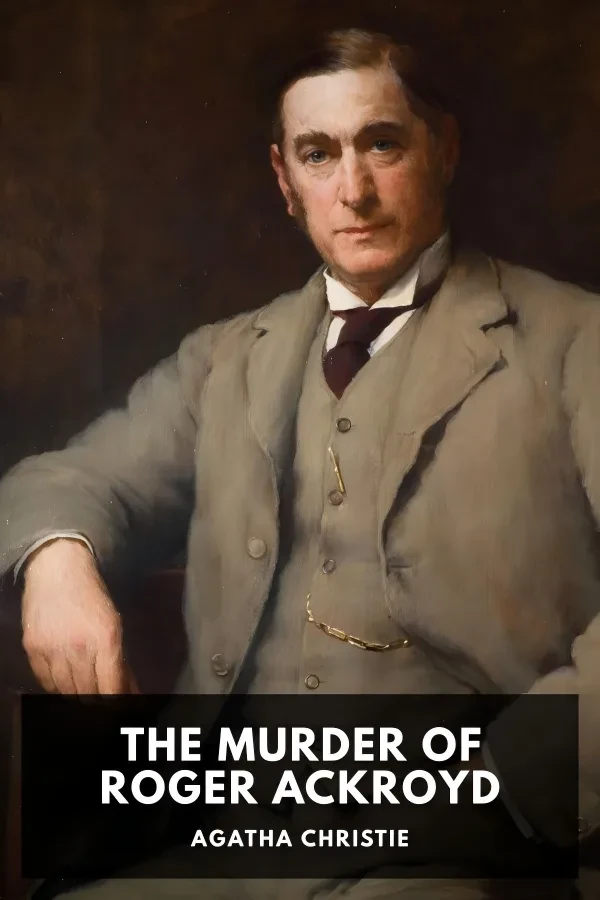
The Murder of Roger Ackroyd
📖 Click to Read the Opening Pages Online Preview
The death of Mrs Ferrars, and the opinion of Caroline
Mrs. Ferrars died on the night of the 16th–17th September—a Thursday. I was sent for at eight o’clock on the morning of Friday the 17th. There was nothing to be done. She had been dead some hours.
It was just a few minutes after nine when I reached home once more. I opened the front door with my latch-key, and purposely delayed a few moments in the hall, hanging up my hat and the light overcoat that I had deemed a wise precaution against the chill of an early autumn morning. To tell the truth, I was considerably upset and worried. I am not going to pretend that at that moment I foresaw the events of the next few weeks. I emphatically did not do so. But my instinct told me that there were stirring times ahead.
From the dining-room on my left there came the rattle of tea-cups and the short, dry cough of my sister Caroline.
The preview stops after the opening of Chapter I. The complete text is in the free download below.
Download Full EPUB1926
~70,000 words (estimated)
Approx. 3.9 hours
Hercule Poirot, book 3
King’s Abbot, a village nine miles from Cranchester
27 chapters in 12 groups
EPUB · AZW3 · KEPUB
0.83 MB (EPUB) · 0.96 MB (AZW3) · 0.88 MB (KEPUB)
Public domain in the United States
Project Gutenberg #69087
The Murder of Roger Ackroyd is Agatha Christie’s Poirot novel of 1926, and the book that made the country-house murder into a puzzle about the people who describe it. Hercule Poirot has retired to the village of King’s Abbot to grow vegetable marrows; the widow at King’s Paddock dies of an overdose, a wealthy neighbour is stabbed in his study, and the doctor who narrates the case finds himself working for a detective who refuses to believe the obvious answer. Money, a blue letter, a missing young man and the gossip of a doctor’s sister all count as evidence.
It is also a book about evidence and about who gets to arrange it: a first-person account that plays fair with every fact it gives and still keeps one thing back, and a detective whose method is to distrust the story he is being told. Around the puzzle Christie builds a working village — a butler with a savings book, a housekeeper who reads about drugs, a secretary with racing debts, a big-game hunter who cannot say what he means. The Murder of Roger Ackroyd has been argued over since its first month in print. The text is available via Project Gutenberg #69087.
The Murder of Roger Ackroyd by Agatha Christie: Summary, Characters & Themes
This is a summary and analysis of Agatha Christie’s The Murder of Roger Ackroyd, the Poirot novel she published in June 1926. Hercule Poirot has retired to the village of King’s Abbot to grow vegetable marrows, and the story is told by his neighbour, Dr James Sheppard, a country doctor with a sister who knows everything before anybody else does. Mrs Ferrars, the widow at King’s Paddock, dies of an overdose; a day later Roger Ackroyd, the wagon-wheel manufacturer at Fernly Park, is found stabbed in his study. The local police settle on Ackroyd’s missing stepson, and the doctor’s sister’s gossip turns out to be more use than the fingerprints. Poirot takes the case at the request of Ackroyd’s niece, and Dr Sheppard agrees to be his eyes and ears in the village.
The case has more moving parts than a village can hold. There is a blue letter that arrives with the evening post and is never read aloud, a chair pulled out from the wall and pushed back again, footprints under a study window that the reader is invited to check, and a telephone call put through from the station at a quarter past ten by somebody who was not there. The suspects are the household at Fernly: a butler with a bank book, a housekeeper with an interest in poisons, a secretary with a gambling debt, a big-game hunter who says almost nothing, and a niece who stands to inherit twenty thousand pounds. Beyond them are a young man who has disappeared, a parlourmaid who gives notice, and a stranger who asked the way to the house at nine o’clock.
Agatha Christie was in her mid-thirties when she wrote the book, with five novels behind her and Poirot already established in The Mysterious Affair at Styles and The Murder on the Links. She had learned the trade in a hospital dispensary during the war, in the short stories she sold to magazines, and in the five novels she had published since 1920; by 1926 she was bringing out a book a year and living in Berkshire. This manuscript is the work of a writer who has stopped treating the detective story as a bag of tricks and started treating it as a form that can be built. The device of a narrator who withholds had been used before; it had not been used at this length, or with this much patience.
The book’s reputation rests on a piece of construction that reviewers are still asked not to describe, and the puzzle is fair: every fact the reader needs is on the page, in the order Christie chose to give it. What surrounds the puzzle is a working village rather than a stage set — the doctor’s rounds, the servants’ hall, the joint inquest at Cranchester, a Mah Jong evening interrupted by gossip. Christie had been writing Poirot as a foreigner among the English since The Murder on the Links, and here the trick is to put him in a garden and let the neighbours underestimate him. Readers who like the village at this pace can go on to The Man in the Brown Suit, or to The Big Four for the conspiracy novel she wrote next.
This edition follows the Project Gutenberg #69087 transcription, which keeps the twenty-seven numbered chapters and prints no chapter titles beyond the numerals. That is how the novel was set in 1926 and how it reads best: no editorial labels, no plot headings, nothing on the page to warn a first-time reader where the story is going. Spelling and punctuation are the transcription’s; the dialogue, including Poirot’s French and the doctor’s dry asides, is left as it stands. The summaries below walk through the book in twelve groups and stop where the last explanations begin, so the final pages are left to the reader. Word count, reading time and file sizes are measured from the files on this page, and all three downloads carry the same text.
Historical Context
The country-house murder was a formula by 1926, and Christie knew exactly how much of it she could use. A closed circle of servants and relatives, a body in the study, a local policeman out of his depth, an amateur who sees what the professionals miss: the pattern had been fixed by Conan Doyle and refined by a generation of writers who published in the same magazines. What Christie adds is a working knowledge of how a village runs. The doctor knows which houses have telephones, the servants know who was in the passage, and a piece of information travels through the kitchen before it reaches the police.
The props are the decade’s. Veronal, the barbiturate that kills Mrs Ferrars, had been sold since 1903 and was among the commonest sleeping draughts in English medicine cabinets, so a doctor’s opinion on the dose is worth having. The telephone is still a public instrument: the call that starts the case is put through from a call office at King’s Abbot station, where three local trains meet the night express to the north, and a man can be lost in the crowd in the four minutes between arrival and departure. The dictaphone, a cylinder machine sold by the Dictaphone Company, was an office luxury rather than a household object, which is exactly why it makes a good hiding place.
Christie published the novel in June 1926, in the year her first marriage came apart; by December she had disappeared for eleven days and the search for her had reached the front pages. None of that is in the book, which is cool, orderly and quietly funny about village life. Its reputation grew with the decade: it was the title that made her name in America, and it has been argued over ever since. In 2013 the Crime Writers’ Association voted it the best crime novel ever written, a judgment that says as much about the pleasure of being fooled as about the prose.
Key Characters & Literary Archetypes
- Hercule Poirot: A small Belgian with an egg-shaped head, suspiciously black hair and a waxed moustache, retired to The Larches to grow vegetable marrows and to throw the biggest one over the wall. He takes the case only because Flora asks him, and works by order: a list of every person in the house, a question for each, and the assumption that a tidy answer is more suspicious than a muddled one. He is vain, courteous and much less comfortable than he looks.
- Dr James Sheppard: The narrator: a country doctor in King’s Abbot, unmarried, methodical, and fond of his sister in a dry way. He is called to Mrs Ferrars in the morning, dines at Fernly Park that night, and is in the study a few minutes before the murder. He keeps a written account of the case at Poirot’s suggestion and prides himself on being a reliable witness, which is what makes the book’s arrangement interesting. He is also, by his own admission, a man who once risked the substance for the shadow.
- Caroline Sheppard: The doctor’s sister, who runs the household and the village intelligence service from an armchair. She hears everything, works out more, and repeats it before her brother gets home; her motto, borrowed from Kipling’s mongoose, is ‘Go and find out.’ The men treat her as a joke and she is right about most of the people in the book. Her brother’s fondness for her is one of the warmest things in the novel, and her guesses are the sharpest.
- Flora Ackroyd: Roger Ackroyd’s niece, twenty-one, with pale gold hair and a direct way of asking for what she wants. She is engaged to Ralph Paton, stands to inherit twenty thousand pounds, and is the one who brings Poirot into the case when the police settle on her fiancé. She is braver than the men around her and better at keeping a secret than she is given credit for. Her scenes with Major Blunt are the book’s generous comedy of people who cannot say the plain thing.
- Ralph Paton: Ackroyd’s adopted son, twenty-five, good-looking, charming and in debt. He was brought up at Fernly after his mother drank herself to death, expects to inherit the business, and has been staying at the Three Boars rather than at the house. His disappearance makes him the obvious suspect, and the case against him is strong; the novel’s interest is in what he was doing instead. He is not a bad young man, only a weak one who has been cornered.
- Major Hector Blunt: A big-game hunter staying at Fernly, with a mahogany face, few words and no small talk. He has known Ackroyd for years, is in love with Flora, and is the only member of the household who gains nothing from the will. Christie uses him to keep a room quiet, and his silences are worth watching: he is on the terrace at half past nine, and he sees more than he can bring himself to say. His legacy from a year earlier was close upon twenty thousand pounds.
Core Literary Themes
- Who tells the story: Christie builds the book on the convention that the detective’s friend writes the case down, and then makes the writing itself the subject. The narrator is careful, dates his entries, quotes conversations and admits his own mistakes; he is also the only person who decides what goes in. The novel’s reputation rests on what that arrangement allows, and on the fact that the account is truthful as far as it goes. It is the most discussed piece of construction in detective fiction, and it works because the reader is never lied to, only trusted too far.
- The village as an information system: King’s Abbot runs on gossip. Caroline Sheppard can report a secret engagement, a quarrel in the wood and the contents of a stranger’s suitcase without leaving her chair, and the doctor’s rounds give him a reason to be inside every house in the parish. Christie uses this the way a modern writer uses a database: information arrives early, incomplete and from the wrong direction, and the detective’s job is to sort it. The novel is unusually honest about how much a small community knows and how little it understands.
- Money and respectable men: Almost everyone in the book needs money. Ackroyd’s will divides twenty thousand pounds, an income, a business and a cottage; Raymond has gambling debts, Mrs Ackroyd has an allowance, Ralph has creditors, and the blackmail that begins the story has already taken a fortune from a widow. Christie is not a moralist, but she is precise about the way a debt softens a man’s principles. The crime, when it comes, is a matter of arithmetic rather than of passion, and the book is careful to show how ordinary the arithmetic looks from outside.
- The foreign eye: Poirot is an outsider in a village that has never seen a Belgian, and Christie makes the foreignness useful. He asks about vegetable marrows, treats English reticence as evidence rather than manners, and refuses to accept a story because it is the story everyone tells. Where the police want an answer that fits, he wants a list that is complete. The comedy comes from the collision between his method and the village’s habit of not saying things, and the pathos comes from the fact that he likes these people and does not want to be right about them.
- Fair play and the reader’s trust: The book is a formal game and says so. The clues are given in the order the narrator notices them, the plan of the study is drawn, the times are tabulated, and the reader is invited to do the arithmetic. What makes the game unusual is that Christie hides nothing and still wins, because the reader has been given a witness rather than a camera. The novel is taught in writing courses as an example of a convention turned inside out without being broken, and it is still the book people mean when they say a detective story fooled them.
Why Download Our Custom E-Reader Edition of The Murder of Roger Ackroyd?
Because the book is a puzzle that can be checked. Everything needed is on the page: the plan of the study, the times, the shoes, the chair, the letter, and the voices heard through an open window. Read it once for the story and a second time to see how the trick was worked, and the second reading is the better one, because the small sentences turn out to be doing two jobs at once. The text here is complete and unabridged, with the twenty-seven chapters in order and the dialogue as Christie wrote it.
The files are built for reading rather than for archiving: a working table of contents, chapter breaks that survive a change of font, no page images and no scanning errors. Poirot’s French, the servants’ speech and the 1926 punctuation are left alone, the italicised titles stay italic, and the paragraphing follows the book. The same text opens on a phone, a Kindle, a Kobo or an old e-ink reader, and nothing is locked: no account, no sample chapter, no email address, no conversion.
Read it beside this page rather than instead of it. The summary, the character notes and the context above are meant to be useful before and after the novel, not to replace the last chapters; they stop where the explanations begin. If you already know the ending, the second reading is the interesting one, because Christie’s fairness is easier to admire when you are watching for it. If you do not know it, avoid the reviews, and do not read the last chapter first.
- Project Gutenberg transcription, via Project Gutenberg #69087, the source used for this edition, transcribed from the 1926 text and checked against the chapter divisions of the printing, with the twenty-seven numerals kept and no chapter titles invented.
- Complete twenty-seven-chapter text No abridgement, no modernised spelling and no silent rewriting; the novel as the transcription gives it, from the death of Mrs Ferrars to the manuscript’s last page, with the dialogue, the French and the punctuation of the period intact.
- EPUB, AZW3 and KEPUB One download per format, so the book opens on Kindle, Kobo, Apple Books and every other reader without conversion, with a table of contents that works on all of them, including older devices that dislike nested navigation.
- Free and DRM-free Public domain in the United States, with no account, no sample chapter and no lock on the file; download it once and it is yours to keep, to move between devices and to reread, with nothing to renew and nothing to lose.
- The Murder on the Links — free EPUB, AZW3 & KEPUB
- The Man in the Brown Suit — free EPUB, AZW3 & KEPUB
- The Big Four — free EPUB, AZW3 & KEPUB
Chapter summaries
Twenty-seven short numbered chapters, with no titles beyond the numerals. These twelve summaries follow the book in order, from the death of Mrs Ferrars to the last page of the manuscript.
- Chapters I–II: Mrs Ferrars dies in the night and Dr Sheppard is sent for at eight; by breakfast his sister has decided it was suicide and found her a motive. The village is laid out: King’s Abbot nine miles from Cranchester, King’s Paddock and Fernly Park, the Three Boars, and a new neighbour at The Larches who grows marrows. Ackroyd meets the doctor in the street, says Ralph is in London, and asks him to dine at half past seven. Miss Russell comes to the surgery with a bad knee and asks about drug cures.
- Chapters III–IV: Ralph Paton is staying at the Three Boars, not at Fernly, and Caroline has already decided who he was out with. The new neighbour turns out to be Hercule Poirot, retired and growing marrows, who throws one over the wall by way of introduction and asks about the young man with the dark eyes. At dinner Ackroyd is nervous and the household is assembled; afterwards he tells the doctor that Mrs Ferrars confessed to poisoning her husband, and that somebody has been blackmailing her for a year. The evening post brings a blue letter.
- Chapters V–VI: A telephone call at a quarter past ten sends the doctor back to Fernly, where Parker denies making it. The study door is locked on the inside and it takes an oak chair to open it: Ackroyd is in his chair with a Tunisian dagger in his back and the window open. The police arrive, the household is questioned, and the doctor gives an account of his evening. The dagger is identified as a curio Major Blunt brought back from Tunis, and the fingerprints on the hilt belong to the dead man.
- Chapters VII–VIII: Flora Ackroyd comes to the surgery to ask for help: the police think Ralph did it, and she wants the truth whatever it costs. Poirot agrees, on condition that nobody holds anything back. At the police station Inspector Raglan reads out where everybody was between half past nine and ten, and the lodge keeper puts Ralph at the gate at twenty-five minutes past nine, taking the path to the terrace. Poirot notices a chair that was pulled out and pushed back, and tells the doctor that everybody in the case is hiding something.
- Chapters IX–X: Poirot walks the garden with the doctor and asks who inherits Fernly Park. In the grounds he fishes a woman’s wedding ring out of the ornamental pond, inscribed ‘From R., March 13th’, and says nothing about it. Flora and Major Blunt talk by the water while the detectives pretend not to listen. Afterwards the lawyer reads the will: a thousand pounds to Miss Russell, five hundred to Raymond, the income on ten thousand pounds to Mrs Ackroyd for life, twenty thousand to Flora, and the residue, with the business, to Ralph.
- Chapters XI–XII: The doctor is sent to Marby Grange to ask Mrs Folliott about a reference, and finds a woman who does not want to answer questions. Caroline reports that Poirot has been to the surgery asking about her brother’s patients, which is unsettling. The inquest is held on the Monday and says as little as it can. Poirot, having failed to produce Ralph, asks the family to give him two days; nobody in the room admits to knowing where Ralph is, and Poirot tells them that each of them is concealing something, himself included.
- Chapters XIII–XIV: An empty goose quill found in the summer-house turns out to be the sign of a drug taker, and a scrap of starched cambric points at a maid’s apron. Poirot lays out three possible motives and admits that there are too many. Mrs Ackroyd then confesses her own small crime: she went through her brother-in-law’s desk looking for the will and left the silver table open. The doctor begins to see that the summer-house had two visitors that night, and a question from Caroline about the colour of Ralph’s boots changes what Poirot thinks he knows.
- Chapters XV–XVI: Geoffrey Raymond admits that he owes money and that his employer’s death is a release. Poirot tests the butler with a tray and two glasses, and gets an answer that satisfies nobody. That evening the village plays Mah Jong and the case is discussed over the cards: the wedding ring, the rumours about Flora and Ralph, the theory that Ackroyd meant to marry Mrs Ferrars or the housekeeper. Caroline delivers the judgment that matters — Flora does not care a penny for Ralph — and Poirot’s question is beginning to have an answer.
- Chapters XVII–XVIII: The two funerals are held together, and afterwards Poirot goes to work on the servants. Parker’s savings book and his tale of a drugged master in Bermuda are put on the table, and the sums paid to Mrs Ferrars over the past year come to twenty thousand pounds. Poirot observes that Major Blunt’s legacy was almost exactly that figure. Then he takes the train to Liverpool, where a young man with an American accent and a hoarse voice is being held, and shows him the goose quill.
- Chapters XIX–XX: The barmaid at the Dog and Whistle gives the stranger an alibi for a quarter to ten, and the forty pounds that vanished from a collar box turn up in Flora’s handbag, along with a story she tells badly. Major Blunt tries to take the blame for her. Poirot then plants a paragraph in the newspaper saying Ralph has been found, and sits down with the housekeeper. Miss Russell breaks: the man at the summer-house was her son, and she had given him every penny she had.
- Chapters XXI–XXIII: Caroline sees a muffled man arrive at The Larches in a closed car and decides he is a Home Office expert. Poirot asks the doctor for the manuscript of the case so far, reads it, and remarks on what it leaves out. Then the parlourmaid Ursula Bourne is brought in, and the truth comes out: she is Ursula Paton, married to Ralph since March, and the girl in the wood. Poirot announces a meeting at his house for nine o’clock, and says that everybody concerned will be there.
- Chapters XXIV–XXVII: The household gathers. Poirot produces Ralph from the next room, announces the marriage, and goes through the evidence: the dictaphone bought two days before the murder, the chair pulled out to hide it, the shoes taken from the Three Boars, the ten minutes between the study and the lodge gates. Then he tells the company that the murderer is in the room and that the truth goes to the police in the morning. The last chapter is four pages long, dated five o’clock, and it changes the book.
The Murder of Roger Ackroyd: Frequently Asked Questions
What is The Murder of Roger Ackroyd about?
Is Poirot the detective, and does he do the work?
Do I need to read the earlier Poirot books first?
Where is the novel set?
How long does it take to read?
Is the book fair to the reader?
Why is it considered one of Christie’s best?
Where can I read the full text online?
Part of: Detective & Mystery Classics · The Murder on the Links