Don Quixote by Miguel de Cervantes Saavedra: Free EPUB, AZW3 & KEPUB Download
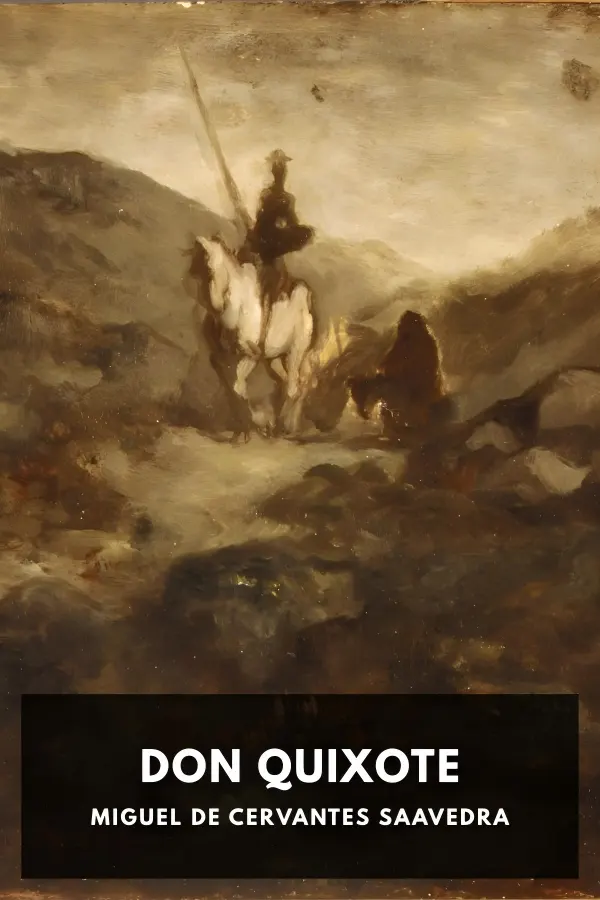
Don Quixote
📖 Click to Read the Opening Pages Online Preview
Chapter I — Which Treats of the Character and Pursuits of the Famous Gentleman Don Quixote of La Mancha
In a village of La Mancha, the name of which I have no desire to call to mind, there lived not long since one of those gentlemen that keep a lance in the lance-rack, an old buckler, a lean hack, and a greyhound for coursing. An olla of rather more beef than mutton, a salad on most nights, scraps on Saturdays, lentils on Fridays, and a pigeon or so extra on Sundays, made away with three-quarters of his income. The rest of it went in a doublet of fine cloth and velvet breeches and shoes to match for holidays, while on week-days he made a brave figure in his best homespun. He had in his house a housekeeper past forty, a niece under twenty, and a lad for the field and market-place, who used to saddle the hack as well as handle the bill-hook. The age of this gentleman of ours was bordering on fifty; he was of a hardy habit, spare, gaunt-featured, a very early riser and a great sportsman. They will have it his surname was Quixada or Quesada (for here there is some difference of opinion among the authors who write on the subject), although from reasonable conjectures it seems plain that he was called Quexana. This, however, is of but little importance to our tale; it will be enough not to stray a hair’s breadth from the truth in the telling of it.
You must know, then, that the above-named gentleman whenever he was at leisure (which was mostly all the year round) gave himself up to reading books of chivalry with such ardour and avidity that he almost entirely neglected the pursuit of his field-sports, and even the management of his property; and to such a pitch did his eagerness and infatuation go that he sold many an acre of tillageland to buy books of chivalry to read, and brought home as many of them as he could get. But of all there were none he liked so well as those of the famous Feliciano de Silva’s composition, for their lucidity of style and complicated conceits were as pearls in his sight, particularly when in his reading he came upon courtships and cartels, where he often found passages like “the reason of the unreason with which my reason is afflicted so weakens my reason that with reason I murmur at your beauty;” or again, “the high heavens, that of your divinity divinely fortify you with the stars, render you deserving of the desert your greatness deserves.” Over conceits of this sort the poor gentleman lost his wits, and used to lie awake striving to understand them and worm the meaning out of them; what Aristotle himself could not have made out or extracted had he come to life again for that special purpose. He was not at all easy about the wounds which Don Belianis gave and took, because it seemed to him that, great as were the surgeons who had cured him, he must have had his face and body covered all over with seams and scars. He commended, however, the author’s way of ending his book with the promise of that interminable adventure, and many a time was he tempted to take up his pen and finish it properly as is there proposed, which no doubt he would have done, and made a successful piece of work of it too, had not greater and more absorbing thoughts prevented him.
Many an argument did he have with the curate of his village (a learned man, and a graduate of Siguenza) as to which had been the better knight, Palmerin of England or Amadis of Gaul. Master Nicholas, the village barber, however, used to say that neither of them came up to the Knight of Phœbus, and that if there was any that could compare with him it was Don Galaor, the brother of Amadis of Gaul, because he had a spirit that was equal to every occasion, and was no finikin knight, nor lachrymose like his brother, while in the matter of valour he was not a whit behind him. In short, he became so absorbed in his books that he spent his nights from sunset to sunrise, and his days from dawn to dark, poring over them; and what with little sleep and much reading his brains got so dry that he lost his wits. His fancy grew full of what he used to read about in his books, enchantments, quarrels, battles, challenges, wounds, wooings, loves, agonies, and all sorts of impossible nonsense; and it so possessed his mind that the whole fabric of invention and fancy he read of was true, that to him no history in the world had more reality in it. He used to say the Cid Ruy Diaz was a very good knight, but that he was not to be compared with the Knight of the Burning Sword who with one back-stroke cut in half two fierce and monstrous giants. He thought more of Bernardo del Carpio because at Roncesvalles he slew Roland in spite of enchantments, availing himself of the artifice of Hercules when he strangled Antæus the son of Terra in his arms. He approved highly of the giant Morgante, because, although of the giant breed which is always arrogant and ill-conditioned, he alone was affable and well-bred. But above all he admired Reinaldos of Montalban, especially when he saw him sallying forth from his castle and robbing everyone he met, and when beyond the seas he stole that image of Mahomet which, as his history says, was entirely of gold. To have a bout of kicking at that traitor of a Ganelon he would have given his housekeeper, and his niece into the bargain.
The preview stops after the opening of Chapter I. The complete Ormsby translation, both parts and all 126 chapter headings, is in the free download below.
Download Full EPUB1605
~424,000 words (estimated)
Approx. 23.5 hours
Two parts, 1605 and 1615
La Mancha, the Sierra Morena and Catalonia, c. 1600
126 chapters: Part I 52, Part II 74
EPUB · AZW3 · KEPUB
43.96 MB (EPUB) · 44.21 MB (AZW3) · 44.08 MB (KEPUB)
Public domain in the United States
Project Gutenberg #996
Don Quixote is the book that taught the novel to notice itself. Alonso Quixano, a gentleman of La Mancha, reads so many romances of chivalry that he renames himself Don Quixote, appoints a farm girl as his lady without her knowledge, and rides out to restore an order of knights that has been extinct for a century. Cervantes published Part I in 1605 and Part II in 1615, after a rival had printed a false sequel. The two parts run to 126 chapters. This edition is John Ormsby’s 1885 translation, unabridged. See Wikipedia’s article on Don Quixote for the publication history.
The comedy is exact and inexhaustible: windmills taken for giants, an inn taken for a castle, sheep mistaken for armies, a barber’s basin worn as the helmet of Mambrino, wine-skins hacked apart in a bedroom. Under the farce runs a harder question, whether a man’s idea of the world deserves respect when the world has stopped agreeing with him. Part II puts the book inside the book: its characters have read Part I and argue with it. All 126 chapters are here. The text is available via Project Gutenberg #996.
Don Quixote by Miguel de Cervantes Saavedra: Summary, Characters & Themes
This summary and analysis of Don Quixote treats the two parts as one book, because that is how they are read now, though Cervantes published them a decade apart. Part I (1605) follows a hidalgo of La Mancha who has read himself into the belief that he is a knight-errant; Part II (1615) follows the same man after his adventures have been printed and strangers recognise him. Between the two lies the joke that made the novel modern: a hero who has read the book he is in, and a world that has read it too. The plot is a chain of departures, beatings and hospitality; the interest is in the talk, which is better than the plot. Cervantes wrote as a soldier, a captive, a tax collector and a debtor, and the road in the book is crowded with people handled roughly by institutions.
Sancho Panza joins in Chapter VII of Part I on the promise of an island to govern, a promise kept in Part II only as a joke. The pair are not opposites so much as two kinds of credulity: Quixote believes what books tell him, Sancho believes his eyes and his stomach, and both are wrong often enough to keep the comedy moving. Around them Cervantes assembles curates, barbers, goatherds, galley slaves, duennas and dukes, each with a story that interrupts the road. The technique is old, since the journey with inserted tales goes back to The Odyssey, but the voices are new, and the narrators are unreliable in ways Homer never was. The dialogue between master and squire is the engine of the thing: it runs for hundreds of pages and never repeats itself.
Part I appeared in Madrid in 1605, printed by Juan de la Cuesta for the bookseller Francisco de Robles, and was reprinted within the year in Lisbon and Valencia. Spain was living through the end of its imperial confidence: the roads are empty, the villages poor, and gentlemen have incomes too small for their dignity. Cervantes had been at Lepanto in 1571, where a gunshot cost him the use of his left hand, and had spent five years as a captive in Algiers before he was ransomed in 1580. The account of his life on Wikipedia fills in the years as a purchasing agent and tax collector that supply the book’s officials, its muleteers and its suspicion of paperwork. The prologue, which praises the book in the voice of a helpful friend, sets the tone for the jokes about authorship that take over Part II.
Part II answers Avellaneda, the pseudonymous author of a false sequel printed at Tarragona in 1614. Cervantes makes his characters hear about the impostor, refuse his inventions, and travel to Barcelona instead of Zaragoza; he also kills his hero at the end so that no one can borrow him again. The second part is funnier and crueller. The Duke and Duchess have read Part I and turn hospitality into a long experiment on two guests who cannot tell when they are being mocked. Readers who enjoy that machinery, a traveller whose reports are doubted and a host who stages wonders, will find it again in Gulliver’s Travels, published a century later, although Swift’s traveller ends in a stable and Cervantes’s knight ends in his own bed.
The novel’s afterlife is a history of misreadings worth having. Romantic critics made Quixote a martyr of idealism; later readers noticed that the book laughs at him and with him in the same sentence, and that Sancho does most of the laughing. The adjective quixotic entered English from this book and still carries Cervantes’s double judgement. Readers still come for the comedy and stay for the deathbed, where the man who has been a fiction for two volumes becomes a person again. If you want the same road story with a harder, more solitary hero and no squire to talk to, Robinson Crusoe is the next shelf along. This text is the Project Gutenberg transcription (#996) of John Ormsby’s 1885 translation, in the public domain in the United States.
Historical Context
The first part was printed in Madrid at the end of 1604 and sold from the start of 1605; nine editions appeared before Cervantes died, in Madrid, Lisbon, Valencia and Brussels. The landscape is the Spain of the peace with England and the long drain of the Dutch war: roads without traffic, villages with more hidalgos than harvests, and a crown that sold offices to pay its debts. Cervantes had been a soldier at Lepanto, a captive in Algiers for five years and a purchasing agent whose accounts landed him in prison, and the officials, innkeepers and prisoners in the book are drawn from that life. Part I carries a dedication to the Duke of Bejar, a grandee whom Cervantes addresses with the same mock humility he gives his prologue.
The books Quixote reads were a real industry. Amadis of Gaul, Palmerin, Belianis and their sequels poured from presses in Seville, Zaragoza and Lisbon through the sixteenth century, and the Church tried to regulate them. The scrutiny of the library in Chapter VI, where the curate and the barber condemn some volumes and save others, parodies an inquisitorial index. By 1605 the fashion was fading, which is why the satire could be both topical and affectionate: Cervantes mocks a genre he had read with pleasure, and the Golden Age speech he gives his hero is written in its highest style. The bonfire in the library is also a bookseller’s inventory, naming titles and authors his first readers knew, and the chapter doubles as a review of the genre.
In 1614 a second part appeared at Tarragona under the name Alonso Fernandez de Avellaneda, a writer who mocked Cervantes’s age, his maimed hand and his poverty. Cervantes answered inside his own fiction: in Part II his characters have read Part I, meet people who have read it, and hear the false sequel discussed at an inn. He also hurried to finish, and the book closes with Quixote’s recovery, confession and death, which shuts the property to further sequels. The result is a novel about authorship as well as about chivalry, and the reason Part II is often called the first modern novel rather than Part I. Avellaneda’s book is now read mainly as a footnote, but it changed the ending of the novel everyone reads.
Key Characters & Literary Archetypes
- Don Quixote (Alonso Quixano): A gentleman near fifty with a lance, an old buckler, a lean hack and a greyhound, who sells land to buy romances until the line between book and road disappears. He is brave, courteous and unable to see what is in front of him, and his speeches on arms and letters are the sanest things in the book. His madness is not stupidity: he argues like a theologian and usually wins. By Part II he knows he has readers. He dies as Alonso Quixano the Good.
- Sancho Panza: A poor labourer and neighbour who follows for the promise of an island and gets a joke instead. He talks in proverbs, eats when he can and is afraid of the dark, but his judgements as governor of Barataria are better than his master’s, and he invents the enchantment of Dulcinea to cover a lie. Cervantes gives him the novel’s most human moments, including the tears for his ass Dapple. He has a wife, Teresa Panza, and a daughter, Sanchica, and he is the only character in the book who visibly changes.
- Dulcinea del Toboso (Aldonza Lorenzo): The lady Quixote serves is a name he invented. Behind it stands Aldonza Lorenzo, a farm girl of El Toboso whom he has loved for twelve years and seen, by his own count, not four times; she can neither read nor write, and so far as is known she never knew. Her parents keep her out of sight, and she never speaks for herself. In Part II Sancho convinces him that she has been enchanted into a peasant girl, and the joke turns into a loss nothing repairs.
- Sansón Carrasco: A bachelor of Salamanca, small, sallow and sharp, who has read the printed Part I and tells Quixote he is famous. He tries to cure him by beating him at his own game, first as the Knight of the Mirrors, where he loses, then as the Knight of the White Moon, where he wins on a beach and sends his neighbour home to die. He is the novel’s first critic as well as its last antagonist.
- The Duke and Duchess: Aristocrats who have read Part I and cannot resist staging it. They give Sancho an island, dress a majordomo as the Countess Trifaldi, send a wooden horse to fly two blindfolded men, and let cats with bells loose in Quixote’s bedroom. Their hospitality is the book’s coldest study of cruelty as entertainment, and Cervantes never lets the reader forget that the hosts are enjoying themselves at a guest’s expense. They pay for everything, which is part of the humiliation.
- Cide Hamete Benengeli: The Arab historian whose manuscript Cervantes claims to have bought in Toledo for half a real and had translated by a Morisco for raisins and wheat. He is the book’s invented source, a device that lets Cervantes doubt his own story, mock historians and change the subject when the plot becomes inconvenient. In Part II the translator and the author argue in the margins, and the found manuscript itself becomes part of the comedy. His name mocks historians and gives the book a second memory.
Core Literary Themes
- Idealism and the world’s reply: Every adventure is an argument between a description and a fact: giants or windmills, armies or sheep, a castle or an inn. Cervantes never settles it in favour of either side. The world is usually right about what things are, and Quixote is usually right about what they ought to be, and the comedy lives in the gap. The barber’s basin is the purest case: it is a basin, and it is also a helmet, and each man has evidence for his answer. By Part II the gap has narrowed: the people he meets have read the description and play along, which is funnier and much worse.
- Madness as a reading disease: Quixote’s insanity is given a precise cause: too little sleep and too much reading of romances, until fiction replaces memory and perception. Cervantes treats this as a joke and as a diagnosis. The book was written when print was making old stories cheap and plentiful, and its hero is the first reader to be ruined by a genre. The innkeepers and goatherds he meets take his madness as a kind of entertainment, which is how the book teaches the reader to take it too. The cure, when it comes, is not argument but exhaustion and illness, and it takes the character away with the delusion.
- The book that knows it is a book: Part II is built on the fact that Part I exists. Characters recognise the pair from the printed book, discuss its errors and meet a man who has read the false sequel; Quixote hears his own story argued about and goes to Barcelona to disprove it. Cervantes even kills his hero partly to stop other writers using him. This self-consciousness, fiction about fiction, is the technical innovation later novelists kept borrowing. The novel even reviews itself: Carrasco points out the errors in Part I, down to an ass that appears in two places at once.
- Cruelty staged as hospitality: The Duke and Duchess are not villains in the ordinary sense; they are hosts. Their jokes need the consent of guests who do not know they are jokes, and the novel lets us watch the pleasure the hosts take. Earlier, the galley slaves stone the man who freed them, and a funeral is interrupted by a woman defending herself. Cervantes keeps showing kindness and humiliation arriving in the same carriage, and he does not explain which is which. The joke is always at someone’s expense, and the bill is presented to the guest, politely, at the end of the evening.
- Freedom and the right to refuse: Marcela tells the shepherds that her beauty was not her choice and that she owes no one love; the galley slaves are freed in the name of liberty and prove unworthy of it; Sancho gives up his island because he prefers his own life. These are the same argument in three keys, about who may decide for whom. The novel is sceptical of grand freedom and fond of small refusals: a woman walking away from a funeral, a squire walking away from a palace. Marcela’s speech is the clearest statement of it, and the novel gives her the last word at Chrysostom’s funeral.
Why Download Our Custom E-Reader Edition of Don Quixote?
Don Quixote is long, and the length is the point: the jokes accumulate, the characters change, and Part II can only work because the reader has spent so many pages in Part I. A device handles that length better than paper does. This edition contains both parts in one file, with the chapter headings Cervantes wrote, so you can leave the book for a week and come back to the exact adventure you abandoned. The two parts are separate books, but they share one pair of characters, one road and one argument, and they are best read in that order.
Translation matters more here than for most classics. Ormsby worked from the Spanish and deliberately kept the long sentences, the proverbs and the shifts into the language of chivalry; he also kept the digressions that Victorian editors liked to cut. The result is a nineteenth-century English that has aged into something like the book’s own archaic flavour. If a modern abridgement has made the novel seem merely silly, this is the text to try instead. The long speeches and the inserted novels are kept in place, and abridgements usually drop them.
The Project Gutenberg transcription supplies the full text, including the poems, the academicians’ verses and the marginal jokes of Part II, along with the Doré engravings that the edition’s editor attached to Ormsby’s version. It is DRM-free, unabridged and readable on any e-reader, with both parts and all 126 chapters individually addressable, which is what a book of this size needs if it is going to be read rather than admired. The file is small enough to keep on a phone and long enough to last a winter.
- Project Gutenberg transcription, via Project Gutenberg #996 — the complete Ormsby text, unabridged, with both parts and every chapter heading.
- Formats included EPUB, AZW3 and KEPUB, DRM-free, each with a linked table of contents.
- Reading time about twenty-two hours at a steady pace, or one chapter a night for four months.
- Chapter marks 126 chapters in two parts, with Cervantes’s own long descriptive headings kept intact.
- Gulliver’s Travels — free EPUB, AZW3 & KEPUB
- The Odyssey — free EPUB, AZW3 & KEPUB
- Robinson Crusoe — free EPUB, AZW3 & KEPUB
Chapter summaries
Cervantes wrote 126 chapters in two parts, each with a long descriptive heading. The summaries below follow the road in twelve movements, six for each part, and stop where each movement turns.
- Part I, Chapters I–VI — The gentleman, the dubbing and the library: Alonso Quixano, a gentleman near fifty with a lance, an old buckler and a lean hack, sells land to buy romances until he believes he is a knight. He cleans his great-grandfather’s armour, names himself Don Quixote, his horse Rocinante, and a farm girl of El Toboso Dulcinea; he is dubbed at an inn he takes for a castle, frees a shepherd boy who is beaten harder for it, and is left in the road by merchants. The curate and the barber burn his library.
- Part I, Chapters VII–XIV — Sancho, the windmills and the goatherds: A neighbour, Sancho Panza, joins him for the promise of an island, and on the plain they come upon thirty or forty windmills that Quixote calls giants. He fights a Biscayan squire over a lady’s courtesy and the narrative breaks off; Cervantes then finds an Arabic manuscript by Cid Hamete Benengeli and has it translated for raisins and wheat. The pair spend a night with goatherds and reach the funeral of the student Chrysostom, where Marcela defends her freedom.
- Part I, Chapters XV–XXII — The inn, the sheep and the galley slaves: A fight with Yanguesan carriers over their mares leaves both men beaten, and at an inn the balsam of Fierabras purges Sancho while Quixote refuses to pay; Sancho is tossed in a blanket. Quixote takes two flocks of sheep for the armies of Alifanfaron and Pentapolín, mistakes a barber’s brass basin for the helmet of Mambrino, and frees a chain of galley slaves, who stone him and strip him before morning.
- Part I, Chapters XXIII–XXXIII — Sierra Morena, the letter and Micomicona: In the Sierra Morena the pair meet Cardenio, a nobleman mad for love, and Quixote sends Sancho to Dulcinea with a letter while he does penance among the rocks. The letter survives only in Sancho’s memory, and the curate and the barber dress a damsel’s part to bring the knight home. Dorotea, betrayed by Don Fernando, agrees to play the Princess Micomicona, and the party returns to the inn where the stories catch up with one another.
- Part I, Chapters XXXIV–XLII — The wine-skins, the captive and the basin: Quixote wakes and hacks the landlord’s wine-skins, believing he is killing a giant, and the inn fills with Luscinda, Don Fernando and the wronged lovers they have been looking for. A captive returned from Algiers arrives with a Moorish lady, Zoraida, and tells how she threw notes from her father’s house and paid a renegade to carry them to Spain. By morning the inn holds a judge, his daughter, a lovesick muleteer and the captive’s family, and the stories have begun to resolve.
- Part I, Chapters XLIII–LII — The cage, the canon and the penitents: After a night in which Maritornes ties Quixote’s wrist to a door-bolt and leaves him hanging, officers of the Holy Brotherhood try to arrest him for freeing the galley slaves. The curate persuades them he is mad, and the company carries him home in an ox-cart cage. On the road a canon of Toledo argues with him about romances, a goatherd tells of Leandra, and Quixote attacks a procession of penitents and is knocked down; he reaches home, and Teresa Panza hears of islands that have not yet arrived.
- Part II, Chapters I–XII — The printed book and the enchanted Dulcinea: Part II opens with Quixote at home and the bachelor Sansón Carrasco reporting that a book about him is in print, more than twelve thousand volumes of it. The housekeeper and niece try to keep him in, Sancho is promised wages, and the pair set out for El Toboso, where Sancho, who never delivered the letter, presents three farm girls on asses as the enchanted Dulcinea. A cart of strolling players crosses the road, and a Knight of the Mirrors challenges him to a duel.
- Part II, Chapters XIII–XXI — The Knight of the Mirrors, the lions and a wedding: Quixote defeats the Knight of the Mirrors and makes him confess that Dulcinea outshines his own lady; the stranger is Carrasco, and his squire wears a pasteboard nose. The pair stay with Don Diego de Miranda, whose son writes poetry, and Quixote insists that a keeper open the cages of the king’s lions; the lion yawns and turns its back. At the wedding of the rich Camacho, the poor Basilio wins Quiteria by falling on a hidden cane and rising married.
- Part II, Chapters XXII–XXXIII — The cave, the puppets and the Duke’s castle: Quixote is lowered into the cave of Montesinos and comes back with a tale of Durandarte’s heart, the lady Belerma and Dulcinea in rustic dress; the narrator declines to swear it is true. At an inn Master Pedro shows a puppet play of Melisendra and Gaiferos, which Quixote ends by cutting the puppets to pieces. A braying village brawl, an enchanted bark on the Ebro and a hunting duchess lead the pair to a castle where the jokes are being prepared.
- Part II, Chapters XXXIV–XLIII — Merlin’s lashes, the wooden horse and the counsels: Merlin’s masque requires Sancho to give himself three thousand three hundred lashes before Dulcinea can be disenchanted, and Sancho agrees under duress. The Countess Trifaldi begs the knight to free her and twelve bearded duennas from the giant Malambruno, and the two men are blindfolded on the wooden horse Clavileño for a flight that never leaves the garden. Before Sancho leaves for his government, Quixote gives him two sets of counsels about fear of God, mercy, garlic and not chewing on both sides.
- Part II, Chapters XLIV–LVII — Barataria, the doctor and the bell: Sancho governs the island of Barataria for ten days, settling disputes over a cane with gold in it, a tailor’s five caps and a bridge with a fatal condition, while the doctor Pedro Recio removes every dish from his table. Quixote, in the castle, is set upon by cats with bells and visited at night by Doña Rodriguez. A mock assault ends the government; a Morisco neighbour, Ricote, appears disguised as a pilgrim, and Sancho falls into a pit with Dapple.
- Part II, Chapters LVIII–LXXIV — Barcelona, the White Moon and home: The road takes them through a herd of bulls, the bandit Roque Guinart and Barcelona, where Don Antonio Moreno’s talking head answers questions and a printing press is turning out the false sequel. On the beach the Knight of the White Moon, Carrasco again, defeats Quixote and makes him promise to stay home a year. They return past pigs and omens; Altisidora dies and revives for a joke; Quixote falls ill, recovers his reason, makes his will and dies as Alonso Quixano.
Don Quixote: Frequently Asked Questions
What is Don Quixote about?
Is it one book or two?
Who translated this edition?
Is Don Quixote a comedy or a tragedy?
Who are the main characters?
What does quixotic mean?
Do I need to read both parts?
Where can I download Don Quixote as a free EPUB, AZW3 or KEPUB?
Part of: Classic Fiction · Gulliver’s Travels