Songs of Innocence and of Experience by William Blake: Free EPUB, AZW3 & KEPUB Download
Songs of Innocence and of Experience
📖 Click to Read the Opening Pages Online Preview
The Introduction to Songs of Innocence
Piping down the valleys wild, Piping songs of pleasant glee, On a cloud I saw a child, And he laughing said to me:
‘Pipe a song about a Lamb!’ So I piped with merry cheer. ‘Piper, pipe that song again.’ So I piped: he wept to hear.
‘Drop thy pipe, thy happy pipe; Sing thy songs of happy cheer!’ So I sung the same again, While he wept with joy to hear.
‘Piper, sit thee down and write In a book, that all may read.’ So he vanished from my sight; And I plucked a hollow reed,
And I made a rural pen, And I stained the water clear, And I wrote my happy songs Every child may joy to hear.
The excerpt below is the whole of the Introduction to Songs of Innocence, all five stanzas. A piper in the valleys sees a child on a cloud, who asks for a song about a lamb and then asks again; at the third asking the child tells him to write it in a book that all may read, and vanishes. The piper makes a pen from a hollow reed.
Download Full EPUB1794
Verse
~6,000 words (estimated)
Approx. 20 minutes
Standalone
London and the green it gives onto: the echoing green, the chartered Thames, the dome of Paul’s on a holy Thursday, and the desert where Lyca lies asleep among the beasts.
Songs of Innocence and of Experience, in eleven movements
EPUB · AZW3 · KEPUB
0.12 MB (EPUB) · 0.15 MB (AZW3) · 0.13 MB (KEPUB)
Public domain in the United States
Project Gutenberg #1934
Songs of Innocence and of Experience is two series of short poems printed as one book. The first is spoken mostly by children, mothers, shepherds and a piper, and it ends with a blessing; the second is spoken by a bard who sees present, past and future, and by children who have been badly used. Innocence has the lamb, the echoing green, the cradle and the chimney sweeper’s dream of an angel with a bright key. Experience answers with the tiger, the sick rose, the garden turned to graves and the mind-forged manacles of London.
The poems come one to a page and most are short, from a single stanza up to eight, with the two poems of Lyca running to thirteen stanzas each. The metres are the metres of songs, the rhymes are plain, and the words are mostly those of the nursery and the Bible; the difficulty is in the turn a poem takes in its last stanza. Wikipedia on Songs of Innocence and of Experience sets out the two series and the pairing of the poems. The text is available via Project Gutenberg #1934.
Songs of Innocence and of Experience by William Blake: Summary, Voices & Forms
This page gives a summary and analysis of Songs of Innocence and of Experience, with the poems in the order the edition prints them, the two series kept apart, and the poems that share a title left where they fall. William Blake is the name on the title page. The text follows a transcription of an edition printed at the Astolaf Press in Guildford, with R. Brimley Johnson in London and A. C. Curtis in Guildford on the imprint. The poems are given whole, one to a document, with no preface and no notes between them. It belongs with the Poetry & Epics shelf on this site.
The first series opens with a piper who is asked to pipe, then to sing, then to write, and the poems after him keep his register: a shepherd, a mother, a nurse, a child. Most end on a blessing or a rest, and the green they are set on is the green of a summer evening. The second series opens with a bard who has heard the Holy Word walking among the ancient trees and calls the earth to return; the poems after him are prophecy and complaint.
Some titles are used twice, once in each half: the Introduction, Holy Thursday, Nurse’s Song, The Chimney-Sweeper and A Cradle Song. The second Holy Thursday asks whether a fruitful land can be holy while its babes are in misery; the second Nurse’s Song has the nurse remember her own youth instead of watching the children at play; the second Chimney-Sweeper speaks in the child’s own voice and ends with parents who made up a heaven of our misery. The Divine Image of Innocence has its counterpart in A Divine Image, where the human heart is a hungry gorge.
The London poems are the hardest. Holy Thursday of Innocence watches the children walk two and two into the high dome of Paul’s, like Thames water; London of Experience walks the chartered streets and hears the mind-forged manacles in every cry, with the chimney-sweeper’s cry, the soldier’s sigh and the harlot’s curse. The Little Vagabond would trade a cold church for ale, The Garden of Love finds a chapel where the children played, and The Schoolboy compares a child to a bird in a cage. None of these poems argues; each turns on an image and stops.
The book is short enough for one sitting and hard enough to keep for years, because the forms are simple and the last stanza so often reverses what the first three have built. Readers coming to Blake from Milton can set the bard of Experience beside the Paradise Lost on this site, and both put the Holy Word among the ancient trees. Readers who want the plain line and the short song carried further can go on to Leaves of Grass. The transcription follows the Project Gutenberg #1934 text.
Historical Context
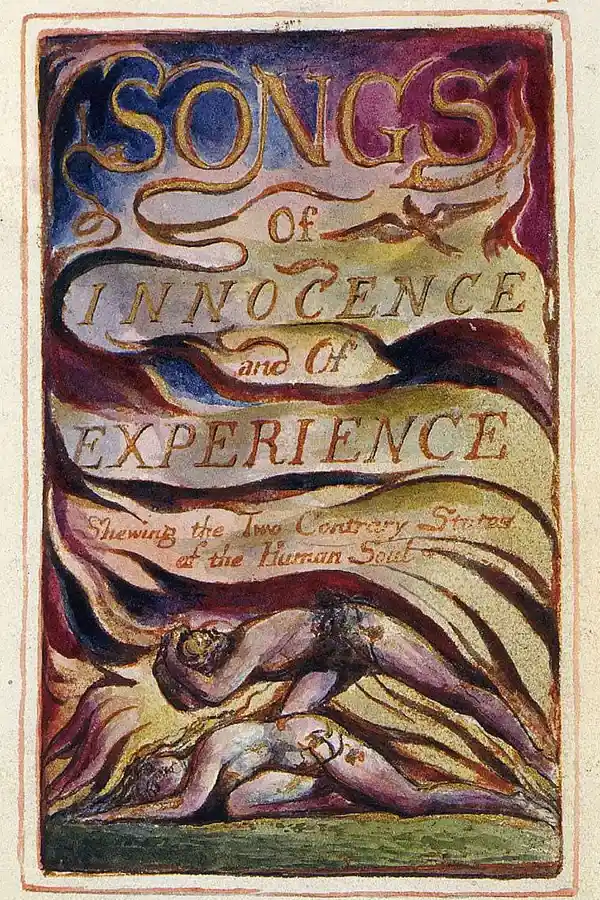
The text transcribed here comes from an edition printed in 1901, the date given in Roman numerals on the title page, at the Astolaf Press in Guildford, with R. Brimley Johnson in London and A. C. Curtis in Guildford named on the imprint. Its pages carry the words of the poems and nothing else: no preface, no notes, no designs. These songs were made to be seen as well as read; this book gives only what can be set in type, and the poems have to hold their own without anything beside them.
The world the poems name is London and the country round it. There are chartered streets and a chartered Thames, the high dome of Paul’s, beadles with wands as white as snow, sweepers who sleep in soot, a soldier’s sigh, a harlot’s curse and a schoolroom under a cruel eye. Outside the city there is the echoing green, the shepherd’s lot, the dews of night, the lonely fen, and the desert where Lyca sleeps among lions and tigers. The two are not kept apart: the chapel is built in the middle of the garden where the children played.
The poems take the forms that were already in every household: the hymn, the ballad quatrain, the lullaby, the catechism question and answer, the chorus with a refrain. Little lamb, who made thee is a question a child would be asked in either case, and the answer given here is the one the child is expected to supply. What the book does with those forms is to let the answer stand in one series and refuse to come in the other, so that the same tune carries a blessing in Innocence and a doubt in Experience.
Voices & Forms
- The piper: The voice of the Introduction to Innocence, who is asked three times for a song and ends by writing it down. He is the only figure in the book given a pen, and the song he writes is the one we are reading. The last line names the audience.
- The bard: The voice of the Introduction to Experience, who sees present, past and future and has heard the Holy Word walking among the ancient trees. He calls the earth to arise from the dewy grass and turn away no more. Where the piper asks, the bard commands.
- The child speaker: Children speak in some poems and are spoken for in others. The chimney sweeper of Innocence consoles Tom Dacre with a dream; the sweeper of Experience answers for himself. The little black boy repeats his mother’s teaching, and the infant of Infant Sorrow is born like a fiend hid in a cloud.
- The nurse: One occasion, children playing on the green at dusk, is given two endings. In Innocence the nurse gives way and the hills echo with the children’s laughter. In Experience she looks at them and remembers that her own spring and day were wasted in play.
- The lamb and the tiger: Two poems built on one question. Little lamb, who made thee is answered by naming the maker, who calls himself a lamb and became a little child. The tiger poem asks what immortal hand could frame such symmetry and stops with the question open.
- Song forms: Most poems are short quatrains, rhymed in couplets or alternately, in the measure of the ballad and the hymn, and several carry a refrain: merrily, merrily, or ha ha he, or the repetitions of the cradle songs. The Lyca poems use a shorter line throughout.
Core Themes
- Innocence and experience as two states: The book does not set childhood against adulthood, and it does not say that one series is true and the other false. The same titles come back in both halves with the same occasions and opposite conclusions, so that the shepherd’s green and the chapel in the garden are the same green. What changes is the voice that looks at it.
- Mercy, pity, peace and love: The Divine Image names the four virtues as God and as man and finds God wherever they dwell. On Another’s Sorrow makes the same case from grief: a maker who became an infant and a man of woe cannot sit apart from a crying child. A Divine Image turns the same four places in the body into cruelty, jealousy, terror and secrecy.
- The green and the city: The Echoing Green ends with the darkening green and children ready for rest; London ends with a marriage hearse. Between them stand Holy Thursday, where the children flow into Paul’s like Thames water, and The Garden of Love, where a chapel is built on the ground where the children played. The book keeps the same ground under both lights.
- Authority over children: Parents, priests, beadles and schoolmasters appear mostly as obstacles. A father sells his son, a priest seizes a boy by the hair and burns him, a schoolroom is ruled by a cruel eye, and the church is cold while the alehouse is warm. The poems do not propose a remedy; they show what the child sees and let the last line fall.
- Secrecy and restraint: The Sick Rose and A Poison Tree both turn on something kept hidden: a worm in the dark, a wrath not told. Thou shalt not is written over the chapel door, and briars bind the joys and desires in the garden. The Angel loses the maiden because she hid her heart’s delight. What is concealed in these poems grows, and what grows is not good.
Why Download Our Custom E-Reader Edition of Songs of Innocence and of Experience?
The download is the whole book: every poem of Innocence and of Experience in the edition’s order, one to a document, from the Introduction that begins Piping down the valleys wild to The Voice of the Ancient Bard that closes the second series. Nothing is cut, and no poem is summarised in place of itself.
The page is arranged to be read beside the text. Eleven groups follow the two series; six notes describe the voices and the forms; five themes follow the pairs, the virtues, the city, the child under authority and the thing kept hidden. A short historical section gives the world the poems name and the edition they come from.
The files come in three formats with the same text and the same divisions. The EPUB opens in Apple Books, Calibre and most Android readers; the AZW3 is the file for a Kindle; the KEPUB is the one Kobo devices read best. No account is needed for any of them, and nothing in the downloads is locked, watermarked or time limited.
- Project Gutenberg transcription, via Project Gutenberg #1934 — the complete text of both series in the order the edition prints them, the poems alone, with no editorial preface and no notes.
- Both series in one file Innocence and Experience are kept apart as the edition keeps them, each with its own Introduction and its own run of poems, so that the pairs can be read at the distance the book sets between them.
- Eleven groups, one for each movement Every group has its own summary, from the piper’s Introduction to The Voice of the Ancient Bard, and each names the poems it covers by their own titles rather than by a description.
- EPUB, AZW3 and KEPUB files The same text in three formats, for Apple Books, Kindle and Kobo, with the poem divisions intact and nothing to install beyond the reading app you already use.
- Milton’s epic of the fall, and the poem behind the Holy Word that walked among the ancient trees in the second Introduction. Long, but the first two books are enough for the comparison. — free EPUB, AZW3 & KEPUB
- Whitman’s book of short numbered songs, published sixty years later and just as willing to make a poem out of a street or a cry. Read it after London to hear a city in another voice. — free EPUB, AZW3 & KEPUB
- The shelf where this edition sits, with the rest of the free poetry in EPUB, AZW3 and KEPUB, including Paradise Lost and Leaves of Grass. — free EPUB, AZW3 & KEPUB
Canto & book summaries
The eleven groups below follow the edition’s order: the nineteen poems of Innocence from its Introduction to On Another’s Sorrow, then the poems of Experience from its Introduction to The Voice of the Ancient Bard. Poems that share a title are left where they fall, so the second Holy Thursday comes after the first, with the whole of Lyca’s story between them.
- Part 1 — Songs of Innocence, the Introduction and the first pastorals: The piper is asked to pipe, then to sing, then to write his songs in a book. The Shepherd follows his sheep and hears the lambs’ innocent call. The Echoing Green rings with bells and children’s sport until sundown. The Lamb answers its own question.
- Part 2 — The Little Black Boy, The Blossom and The Chimney-Sweeper: A mother teaches her black child that the body is a cloud and the soul white, and he promises to shade the English boy. The Blossom hears a sparrow and a robin. The Chimney-Sweeper tells how his father sold him, and comforts Tom Dacre with a dream.
- Part 3 — Two lost children, a laughing song and a cradle song: The Little Boy Lost calls after his father into the dark; The Little Boy Found has God appear like his father in white. Laughing Song makes the woods and meadows laugh. A Cradle Song keeps watch over a sleeping child and finds the maker’s image in its face.
- Part 4 — The Divine Image, Holy Thursday and Night: Mercy, Pity, Peace and Love are named as God and as man. Holy Thursday watches the children walk into the dome of Paul’s. Night sends angels through the dark to keep birds and beasts from harm, and ends with the lion’s tears of gold.
- Part 5 — Spring, Nurse’s Song, Infant Joy, A Dream and On Another’s Sorrow: Spring is all refrain, welcoming the year with flute and lamb. The nurse calls the children home, then lets them play till the light fades. Infant Joy has no name but joy. A Dream sends an emmet and a glow-worm through the night. On Another’s Sorrow asks whether a maker can hear grief unmoved.
- Part 6 — Songs of Experience, the Introduction, Earth’s Answer and The Clod and the Pebble: The bard calls the earth to return, and Earth answers from a prison of starry jealousy, asking to have her heavy chain broken. The Clod and the Pebble give two answers to one question: one builds a heaven in hell’s despair, the other a hell in heaven’s despite.
- Part 7 — Holy Thursday, and the two poems of Lyca: The second Holy Thursday asks whether a rich land can be holy while its babes are in misery. The Little Girl Lost sets Lyca asleep in a desert among lions and tigers; The Little Girl Found brings her parents to a lion who leads them to her.
- Part 8 — The Chimney-Sweeper, Nurse’s Song, The Sick Rose, The Fly, The Angel and The Tiger: The sweeper speaks for himself and says his parents made a heaven of his misery. The nurse remembers her own wasted youth. A worm finds the rose’s bed of crimson joy. The Fly weighs a brushed wing against a life. The Tiger asks what hand could frame it.
- Part 9 — My Pretty Rose Tree, Ah Sunflower, The Lily, The Garden of Love, The Little Vagabond and London: A flower is passed over for a rose tree that turns jealous. The sunflower counts the steps of the sun. The Lily puts no thorn beside its love. The Garden of Love has a chapel where the children played, and graves where flowers should be. The Little Vagabond would trade a cold church for ale. London hears mind-forged manacles in every cry.
- Part 10 — The Human Abstract, Infant Sorrow, A Poison Tree and two poems of lost children: Pity and mercy are shown to depend on poverty, and the tree of mystery grows in the human brain. Infant Sorrow is born fighting its swaddling bands. A Poison Tree waters anger in tears until an apple grows. A Little Boy Lost is burned by a priest; A Little Girl Lost speaks of love thought a crime.
- Part 11 — A Divine Image, A Cradle Song, To Tirzah, The Schoolboy and The Voice of the Ancient Bard: The human dress is forged iron and the heart a hungry gorge. The second cradle song sees the sorrow waiting in a sleeping child. To Tirzah asks what the mortal mother has to do with the soul. The Schoolboy compares a child under a cruel eye to a bird in a cage. The Ancient Bard calls the youth of delight.
Songs of Innocence and of Experience: Frequently Asked Questions
What is Songs of Innocence and of Experience about?
Are these two books or one?
Which poems appear in both series?
What is the difference between the lamb and the tiger?
Who is Lyca?
Why are there two Holy Thursday poems?
What are the forms of the poems?
How do I read the free downloads?
Part of: Poetry & Epics · William Blake