Leaves of Grass by Walt Whitman: Free EPUB, AZW3 & KEPUB Download
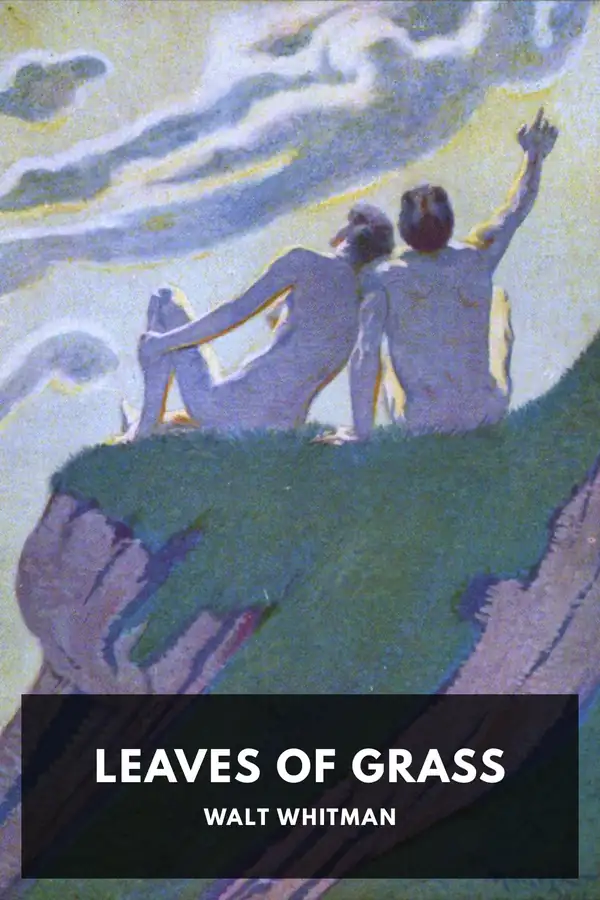
Leaves of Grass
📖 Click to Read the Opening Pages Online Preview
One’s-self I sing, a simple separate person: the opening of Inscriptions
One’s-self I sing, a simple separate person, Yet utter the word Democratic, the word En-Masse.
Of physiology from top to toe I sing, Not physiognomy alone nor brain alone is worthy for the Muse, I say the Form complete is worthier far, The Female equally with the Male I sing.
Of Life immense in passion, pulse, and power, Cheerful, for freest action form’d under the laws divine, The Modern Man I sing.
The preview stops after the opening lines of the third poem, In Cabin’d Ships at Sea. The complete text is in the free download below.
Download Full EPUB1855
~122,000 words (estimated)
Approx. 6.8 hours
Standalone
New York, the American interior and the Civil War hospitals
36 clusters in 14 groups
EPUB · AZW3 · KEPUB
0.90 MB (EPUB) · 1.27 MB (AZW3) · 1.05 MB (KEPUB)
Public domain in the United States
Project Gutenberg #1322 · Standard Ebooks
Leaves of Grass is Walt Whitman’s book of poems, printed in Brooklyn in 1855 as a thin volume of twelve untitled pieces and enlarged and rearranged until the year of his death. Its centre is Song of Myself, fifty-two sections in which a poet loiters on the grass and invites the reader to loiter with his soul, and around it Whitman built clusters with names like Children of Adam, Calamus, Drum-Taps and Sea-Drift. He wrote about the body with a frankness that startled his first readers, about democracy as a fact of the nerves rather than a platform, and about the American continent as something to be walked, ferried and heard.
Whitman kept rewriting the book for thirty-seven years, so the Leaves of Grass most readers meet is the 1891–92 deathbed arrangement: twelve poems grown into more than three hundred, sorted into clusters and corrected line by line. Read Wikipedia’s article on Leaves of Grass for the seven editions and the Emerson letter. The poems are public domain and easy to find; the difficulty is choosing a text. This edition follows the Standard Ebooks transcription of the final arrangement, which keeps the clusters and the late ordering. The text is available via Project Gutenberg #1322 and Standard Ebooks.
Leaves of Grass by Walt Whitman: Summary, Characters & Themes
This page is a summary and analysis of Walt Whitman’s Leaves of Grass, the book that changed what American poetry was allowed to sound like. The first edition appeared in Brooklyn in the summer of 1855: ninety-five pages, twelve untitled poems, a green cloth cover stamped with leaves and grass, and no author’s name on the title page, only a portrait of a man in an open shirt. Whitman set some of the type himself and paid for the printing. The twelve poems included a long one that began “I celebrate myself” and would later be called Song of Myself. Everything he wrote for the next thirty-seven years grew out of that pamphlet, and the book kept changing shape as he added, cut, retitled and regrouped.
The reading experience is unlike that of any other nineteenth-century poet in English. The lines are long and unrhymed, the sentences often run past the line, and the poems move by accumulation rather than argument: a list of trades, a list of states, a list of sounds heard on a ferry, and then a single image that stops the list dead. Whitman’s subject is the ordinary life of a republic — work, travel, meals, the body, the crowd on Broadway — and his method is to name things until they become strange and large. He can be sentimental, repetitive and wildly uneven, and the best passages still have the force of a man talking directly to one reader in a room.
Walt Whitman was born in 1819 on Long Island, the second of nine children in a family of farmers and carpenters, and he left school at eleven. He worked as a printer’s apprentice, a country schoolteacher, a journalist and the editor of the Brooklyn Eagle, and by 1855 he had been dismissed from that paper, built houses with his father and filled notebooks with drafts. Emerson read the book that summer and wrote him a letter; Whitman printed it without permission and carried the praise for the rest of his life. During the Civil War he nursed wounded soldiers in Washington, and the poems that came out of those wards are among the plainest and least forgiving things he wrote.
The ambition behind the book is epic, and it is worth measuring against the older epics on this site. Where The Divine Comedy maps the soul’s journey through three realms, The Odyssey maps a voyage home, and The Iliad maps a war, Whitman’s book maps a country that has no agreed form yet. He wanted a poetry that could hold a continent without a hero at its centre, and he found his structure in the cluster rather than the plot: a group of poems that circle a subject until it is seen from several sides. That is why the book can be entered almost anywhere, and why readers who begin in the middle are rarely lost for long.
The text on this page follows the Project Gutenberg #1322 transcription as edited by Standard Ebooks, which prints the deathbed arrangement of 1891–92 and keeps the clusters in the order Whitman settled on. Nothing has been modernized: the contractions, the odd spellings and the long catalogues stand as the transcription gives them, and the poems are complete rather than excerpted. The summaries below follow the same fourteen groups, from Inscriptions to Old Age Echoes, and they stop short of the end of the poems they describe, so the reading is left to you. The file is set for comfortable reading on phones, e-readers and tablets alike, with a linked table of contents for the thirty-six clusters.
Historical Context
Whitman published the first edition himself in 1855, after failing to find a publisher, and the timing was deliberate: the book appeared in the first days of July, and its preface argued that the United States had never yet had a poet because it had been too busy making the country. Fowler & Wells, a New York firm of phrenologists and water-cure publishers, printed it. Ralph Waldo Emerson, then the most respected literary figure in America, read the copy Whitman sent and answered on 21 July with a letter beginning “I greet you at the beginning of a great career.” Whitman let the letter reach the New York Tribune that autumn and printed it in the 1856 edition without asking permission; Emerson was embarrassed, and the gesture made the book famous.
Six more editions followed in Whitman’s lifetime, and each one is a different book. The 1856 volume grew to thirty-two poems and printed a long open letter to Emerson; the 1860 edition, set in Boston, brought in the Calamus poems and the Children of Adam cluster; the 1867 edition folded in the war poems and reordered everything. The 1871–72 version added Passage to India and the Lincoln poems, and the 1881 edition, published by James R. Osgood in Boston, was withdrawn after a district attorney threatened prosecution and reissued by a Philadelphia firm. The seventh, assembled as Whitman was dying, is the arrangement every modern text prints.
The war changed the book from the inside. In December 1862 Whitman read a casualty list from Fredericksburg and feared he had found his brother George’s name on it, and went south; he stayed in Washington three years, dressing wounds, writing letters and sitting with the dying. Drum-Taps appeared in 1865, and the sequel that followed carried the elegy for Lincoln. Those short, factual poems sit in the middle of a book that had argued for joy. The last arrangement was made in Camden, where Whitman lived from 1873, partly paralysed, with David McKay as his publisher: the 1891–92 edition, called the deathbed edition, added Sands at Seventy and Good-bye My Fancy and closed the book for good. He died in March 1892.
Key Characters & Literary Archetypes
- The poet of Song of Myself: A loafer, a lover of the open air and a man who says “I am large, I contain multitudes.” He is not Whitman exactly, though the book invites the confusion: he is a voice built to include contradictions, at ease with the learned and the illiterate, the slave and the president, the body and the soul. Across fifty-two sections he watches, remembers, argues and finally stops and waits, leaving the reader to take what is wanted. He is the book’s great invention and its most demanding company.
- The child who went forth: The boy of There Was a Child Went Forth, who becomes the things he sees: early lilacs, grass, the morning-glories, the drunkard in the street, the schoolmistress, the friendly boys, the quarrelsome boys, and finally his own parents. He is the book’s clearest figure for how a self is made, and the poem’s long sentence, which keeps adding without a full stop, is the process it describes. He returns in Song of Myself as the child who hands the poet handfuls of grass.
- The ferry passengers: The crowd on the Brooklyn boat in Crossing Brooklyn Ferry: clerks, carpenters, boatmen, young men in their working clothes, a girl leaning on the rail. Whitman watches them from the deck at sunset and then addresses the people who will cross fifty years later, claiming the same tide and the same light for them. The passengers are his proof of continuity, a republic of strangers who will never meet and are nevertheless promised to one another by the water.
- Abraham Lincoln: The president who appears through Memories of President Lincoln as a coffin drawn across the states, a star in the western sky and a lilac blooming in a dooryard. Whitman never knew him well, but he had seen him in the streets of Washington, and the elegy When Lilacs Last in the Dooryard Bloom’d gives the country’s grief to a hermit thrush singing in the swamp. He is also the captain of the shorter, more public poem, and the figure the late war poems keep returning to.
- The wounded soldiers: The men in the wards of Washington: the Kansas soldier with his leg off, the boy with a bullet in his lung, the Brooklyn lad who asks for a letter home. Whitman visits them in The Wound-Dresser, an old man remembering the war, and they fill the short poems of Drum-Taps. They are not heroes in the book so much as patients, named by their wounds and their towns, and the poet’s tenderness toward them is the least rhetorical writing he did.
- The mother and the old poet: The mother appears quietly, at a window in There Was a Child Went Forth and in the childbirth passage of Song of Myself, as the body’s first fact. The old poet appears late, in Sands at Seventy and Good-bye My Fancy, lame, famous and unsentimental, counting his visitors and listening to a cricket. Together they close the circle of the book, which began with a young man shouting on the grass and ends with an old one saying goodbye to his fancy.
Core Literary Themes
- The body is the soul: Whitman’s most scandalous claim was not political but physical: that the body is not a lower subject to be tolerated by poetry but the substance of it. I Sing the Body Electric catalogues bodies at work, bodies for sale, the bodies of the sick and the dead, and refuses to rank them. For Victorian readers the frankness about sex and anatomy was obscenity; for the book it is a metaphysics, since a soul that begins as a body cannot despise the thing it comes from.
- Democracy as a daily practice: For Whitman democracy is not a constitution but a habit of attention: the poet looks at a carpenter, a prostitute, a president and a slave with the same steady eye, and the looking is the politics. Inscriptions states the programme and Song of Myself performs it, while For You O Democracy and By Blue Ontario’s Shore argue it in public. The book believes that a country which has abolished rank must also abolish the poetic hierarchy that keeps some lives out of literature, and that a poem which leaves anyone out has failed its own test.
- The self and the multitude: The characteristic Whitman sentence moves from “I” to “you” to “they” without changing its voice, and the catalogues are how the movement is made: a list of occupations, states or sounds holds many persons in one grammar. Song of Myself claims to contain multitudes, and the book is built to test that claim, since the reader is addressed directly and told that what the poet says of himself applies to them. The result is a self that is neither private nor dissolved but a meeting place.
- War, wounds and consolation: Drum-Taps is a war book written by a nurse rather than a soldier, and its subject is the cost of the war in individual bodies. The poems are short, flat and often without metaphor: a dressing station, a house hospital, a dead man’s face in the dark. When Lilacs Last in the Dooryard Bloom’d turns the same material into elegy, letting a bird and a flower carry grief rather than a public speech. Whitman does not console by saying the deaths were worth it; he consoles by insisting that the dead remain present.
- Time, death and continuance: The book is obsessed with what survives a person. Crossing Brooklyn Ferry promises the future reader the same water; To Think of Time argues that nothing is lost; Whispers of Heavenly Death faces the last thing without a doctrine. Whitman’s afterlife is not heaven but continuity, in grass, in children, in the poem, in the republic. This Compost makes the point with corpses, insisting that the earth which receives the dead is renewed rather than polluted. Grass grows out of graves; that is the whole argument, and it is offered without a single promise of reward.
Why Download Our Custom E-Reader Edition of Leaves of Grass?
Because the book exists in seven versions and the differences matter. An 1855 Song of Myself is a young man’s poem, raw and unafraid; the late text is the work of an editor who had been through a war and a stroke. This edition follows the deathbed arrangement, the version Whitman wanted remembered, and it is checked against the Project Gutenberg #1322 transcription, so a passage you look up will match the page.
The files are made for reading rather than archiving: a table of contents that lists every cluster and lets you jump to Song of Myself or to a single short poem, line breaks that survive a change of font, no page scans and no scanning errors. The long lines are set to break where the poem breaks rather than where a scanner’s margin fell, and the italics, the apostrophes and the occasional odd spelling are left as the edition gives them.
Read it beside this page rather than instead of it. The summary, the notes on the recurring figures and the context above are meant as company for a first reading, not as a substitute for the poems; the groups below stop before the poems end, and nothing here stands in for the verse itself. Poetry rewards rereading more than prose does, and Whitman rewards it most when a single section is read aloud. If a poem confuses you, skip it; the book is built for that.
- Based on the Standard Ebooks Edition, via Standard Ebooks, whose editors prepared this text from the Project Gutenberg transcription and kept the 1891–92 deathbed arrangement, with the clusters in Whitman’s final order and the punctuation of the late edition. The fourteen groups below follow their contents list, so the poems you read about here are the poems in the download.
- Complete text, all thirty-six clusters No abridgement and no selected poems: the book runs from Inscriptions to Old Age Echoes, with the long catalogues, the two annexes and the short late verses intact, and nothing cut because an editor thought a list had gone on too long.
- EPUB, AZW3 and KEPUB One download per format, so the book opens on Kindle, Kobo, Apple Books and other readers without conversion, with a contents list that works on all of them and a cover that survives being sent to a device.
- Free and DRM-free Public domain in the United States, with no account, no sample and no lock on the file; download it once and it is yours to keep, to move between devices and to read aloud, with nothing to renew and nothing that expires.
- The Divine Comedy — free EPUB, AZW3 & KEPUB
- The Odyssey — free EPUB, AZW3 & KEPUB
- The Iliad — free EPUB, AZW3 & KEPUB
Chapter summaries
Thirty-six clusters in fourteen groups, from Inscriptions to Old Age Echoes, following the deathbed arrangement rather than the order of the 1855 pamphlet.
- Poems 1–3 — Inscriptions; Starting from Paumanok; Song of Myself: The book opens with short dedications: a poet singing a simple separate person, the phantom of the old poets asking why he does not sing war, and a book sent out like a ship with its sails spread. Starting from Paumanok is a biographical chant from Long Island to the plains, naming the states and the trades in between. Then Song of Myself, fifty-two sections long, in which the poet loiters on the grass, watches a child, a runaway slave and a sea fight, and ends by waiting for the reader.
- Poems 4–5 — Children of Adam; Calamus: Children of Adam turns to love between men and women and to the body: I Sing the Body Electric catalogues bodies at work, bodies for sale and bodies in a sick ward without ranking them. Calamus holds a run of short poems about love between men, written mostly after 1859, some frankly erotic and most of them guarded about what they name. Together the two clusters make the book’s boldest argument, that the body is not a lower subject for poetry but the ground the poems stand on.
- Poems 6–7 — Salut au Monde!; Song of the Open Road: Salut au Monde! is a roll call of the planet: the poet salutes every land, people, trade and sound, and imagines hearing the globe all at once. Song of the Open Road answers with movement, a walk out of doors with the soul, refusing maps, conveniences and company that will not keep up. The two poems are the book at its most expansive and its most companionable, and both depend on the long line and the list to carry them.
- Poems 8–9 — Crossing Brooklyn Ferry; Song of the Answerer: Crossing Brooklyn Ferry is the great poem of the commute: the poet on the boat at sunset, the tide, the gulls, the faces of the crowd, and the claim that the same water and light will hold him and the readers fifty years later. Song of the Answerer follows a poet asked what he answers and replies that the answer is the man himself. One poem looks outward at a crowd, the other inward at a vocation, and they are the shortest route into the book.
- Poems 10–12 — Our Old Feuillage; A Song of Joys; Song of the Broad-Axe: Our Old Feuillage is a patriotic catalogue of landscape and people, from the coast of Maine to the Mississippi. A Song of Joys runs through every kind of joy the poet can name, from a man at work to a woman in childbirth, and refuses to rank them. Song of the Broad-Axe is the most physical of the three: an axe, a woodman, a settlement, a city, and a defense of the labor that built the republic. All three are lists, and all three are arguments about what deserves remembering.
- Poems 13–16 — Song of the Exposition; Song of the Redwood-Tree; A Song for Occupations; A Song of the Rolling Earth: Four poems about work and its materials. Song of the Exposition was written for the industrial exhibition held in New York in 1871 and calls for a poetry of machinery and invention. Song of the Redwood-Tree gives a California tree a dying speech as the axe arrives. A Song for Occupations insists that tools and trades are as fit for song as heroes, and A Song of the Rolling Earth finds the same argument in soil, rain and the round of the planet.
- Poems 17–20 — Birds of Passage; A Broadway Pageant; Sea-Drift; By the Roadside: Birds of Passage is a sequence of short poems about flight and departure. A Broadway Pageant describes the 1860 procession in New York for the Japanese embassy, a crowd watching envoys from a country most Americans knew only as a rumor. Sea-Drift is the cluster of shore and grief, with Out of the Cradle Endlessly Rocking at its centre, and By the Roadside collects short, hard poems: a Boston ballad, Europe in 1870, a lecture room, a farm picture, a child’s amazement at the stars.
- Poems 21–22 — Drum-Taps; Memories of President Lincoln: Drum-Taps is the war book, written out of Whitman’s years in the Washington hospitals and his brother’s wound at Fredericksburg: the recruiting, the camps, the wounded in the wagons, the drummer’s tap at night, the wound-dresser’s rounds. Memories of President Lincoln adds four poems from 1865–66, and it contains When Lilacs Last in the Dooryard Bloom’d, the elegy in which the coffin travels across the country while a lilac, a western star and a hermit thrush do the mourning.
- Poems 23–24 — By Blue Ontario’s Shore; Autumn Rivulets: By Blue Ontario’s Shore began as the 1855 preface turned into verse and is the book’s plainest statement of what a poet is for in a republic. Autumn Rivulets is a long, miscellaneous cluster, holding There Was a Child Went Forth, the boy who becomes everything he sees, along with This Compost, Miracles, The City Dead-House and the elegiac pieces of the 1870s. It is the section where the public poet gives way to a man watching a window, a wheel and a grave.
- Poems 25–27 — Proud Music of the Storm; Passage to India; Prayer of Columbus: Three long poems of arrival. Proud Music of the Storm dreams all the music of the world into one chord, from the organ and the orchestra to the drum, the boatman’s song and the wind. Passage to India treats the history of voyages as a single journey and ends with the soul’s passage beyond the map. Prayer of Columbus is a dramatic monologue in which the old admiral, wrecked off Jamaica and forgotten, asks that the world stay as large as he saw it.
- Poems 28–29 — The Sleepers; To Think of Time: The Sleepers is the book’s night poem: the poet walks through the dark and finds everyone asleep, the well and the sick, the bride and the widow, the swimmer, the drowned man, a president and a slave, all equal under sleep. To Think of Time meditates on death and continuity, arguing that nothing is lost and that the past and the unborn are present in the same busy hall. Both were in the 1855 pamphlet and both were cut back and reworked for decades.
- Poems 30–31 — Whispers of Heavenly Death; Thou Mother with Thy Equal Brood: Whispers of Heavenly Death gathers the late poems of last things: a noiseless patient spider throwing filament after filament into empty space, the night in its blackness, a skeptic’s doubt answered by the persistence of daylight. Thou Mother with Thy Equal Brood addresses a mother who is nature, democracy and death at once, holding every face and fate with the same hand. These are short-lined, quiet poems from the 1880s, and several of them are the best Whitman wrote.
- Poems 32–33 — From Noon to Starry Night; Songs of Parting: From Noon to Starry Night moves through the afternoon into the dark: a face in a crowd, a locomotive in a snowstorm, the mystic trumpeter, Mannahatta at evening, a clear midnight. Songs of Parting then closes the main body of the book with the poet saying goodbye, thanking the reader and imagining the two of them meeting again elsewhere. It is the end of the original design, and it is written as a farewell that is also an invitation to begin again.
- Poems 34–36 — Sands at Seventy; Good-bye My Fancy; Old Age Echoes: The annexes are the poems of the very old man. Sands at Seventy, written after the stroke that left him lame, is full of small observations: a canary, a dandelion, a ferry, the death of Grant, the sound of the sea at Navesink. Good-bye My Fancy is his farewell to the imagination, and Old Age Echoes gathers the verses his executors found in the margins. They are brief, plain and unsentimental, and they change the way the rest of the book reads.
Leaves of Grass: Frequently Asked Questions
What is Leaves of Grass about?
Is it one long poem or a collection?
Why is Song of Myself so famous?
Which text does this edition follow?
Do I have to read it in order?
What is the Calamus cluster about?
What did Emerson say about the book?
Where can I download the free EPUB, AZW3 and KEPUB?
Part of: Poetry & epics · Victorian books