The Monk by M. G. Lewis: Free EPUB, AZW3 & KEPUB Download
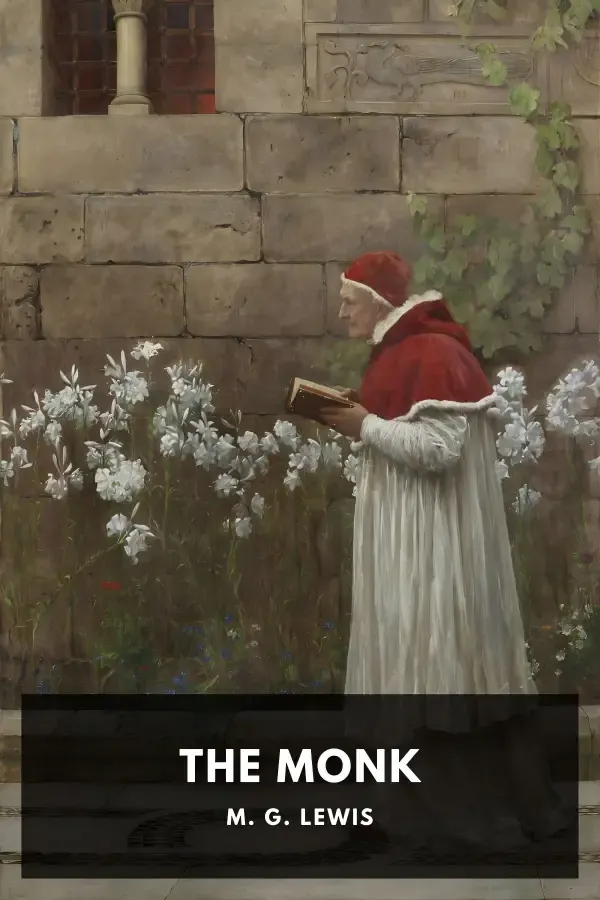
The Monk
📖 Click to Read the Opening Pages Online Preview
Read the opening pages
Scarcely had the Abbey Bell tolled for five minutes, and already was the Church of the Capuchins thronged with Auditors. Do not encourage the idea that the Crowd was assembled either from motives of piety or thirst of information. But very few were influenced by those reasons; and in a city where superstition reigns with such despotic sway as in Madrid, to seek for true devotion would be a fruitless attempt. The Audience now assembled in the Capuchin Church was collected by various causes, but all of them were foreign to the ostensible motive. The Women came to show themselves, the Men to see the Women: Some were attracted by curiosity to hear an Orator so celebrated; Some came because they had no better means of employing their time till the play began; Some, from being assured that it would be impossible to find places in the Church; and one half of Madrid was brought thither by expecting to meet the other half. The only persons truly anxious to hear the Preacher were a few antiquated devotees, and half a dozen rival Orators, determined to find fault with and ridicule the discourse. As to the remainder of the Audience, the Sermon might have been omitted altogether, certainly without their being disappointed, and very probably without their perceiving the omission.
Whatever was the occasion, it is at least certain that the Capuchin Church had never witnessed a more numerous assembly. Every corner was filled, every seat was occupied. The very Statues which ornamented the long aisles were pressed into the service. Boys suspended themselves upon the wings of Cherubims; St. Francis and St. Mark bore each a spectator on his shoulders; and St. Agatha found herself under the necessity of carrying double. The consequence was, that in spite of all their hurry and expedition, our two newcomers, on entering the Church, looked round in vain for places.
However, the old Woman continued to move forwards. In vain were exclamations of displeasure vented against her from all sides: In vain was She addressed with—“I assure you, Segnora, there are no places here.”—“I beg, Segnora, that you will not crowd me so intolerably!”—“Segnora, you cannot pass this way. Bless me! How can people be so troublesome!”—The old Woman was obstinate, and on She went. By dint of perseverance and two brawny arms She made a passage through the Crowd, and managed to bustle herself into the very body of the Church, at no great distance from the Pulpit. Her companion had followed her with timidity and in silence, profiting by the exertions of her conductress.
The preview ends here. Download the free EPUB, AZW3 or KEPUB edition to follow Ambrosio from the pulpit of the Capuchin church to the vaults beneath St. Clare.
Download Full EPUB1796
~137,000 words (estimated)
Approx. 7.6 hours
Standalone
Madrid, Spain
12 chapters in three volumes
EPUB · AZW3 · KEPUB
0.56 MB (EPUB) · 0.77 MB (AZW3) · 0.61 MB (KEPUB)
Public domain in the United States
Project Gutenberg #601
The Monk is Matthew Lewis’s 1796 Gothic novel about Ambrosio, the celebrated prior of the Capuchin monastery in Madrid, whose reputation for holiness collapses under his own vanity. A noblewoman disguised as a novice, Matilda de Villanegas, seduces him, and the affair leads him through sorcery, murder and rape to a pact with the devil. Around him Lewis weaves the stories of the young nobleman Lorenzo de Medina, the innocent Antonia, the imprisoned nun Agnes and the legend of the Bleeding Nun, a German ghost with a claim on the family. The novel ends with the Inquisition, a ruined convent and a fall from a cliff.
Published when Lewis was not yet twenty-one, The Monk caused a scandal for its monks, its Inquisition and its open treatment of desire; an expurgated edition followed in 1798, but the full text is the one that shaped later Gothic fiction. The novel’s mix of German horror, Spanish cloisters and diabolical stagecraft made it a model for Byron, Scott and the sensation writers of the next generation. It remains the most notorious English novel of its decade, and the most entertaining. See Wikipedia’s article on The Monk for its publication history. The text is available via Project Gutenberg #601.
The Monk by M. G. Lewis: Summary, Characters & Themes
This page is a summary and analysis of The Monk, Matthew Lewis’s 1796 Gothic novel set in Madrid. Ambrosio, the prior of the Capuchin monastery, is the most celebrated preacher in the city, a foundling raised by the monks and revered as a living saint. His reputation rests on thirty years of fasting and study, and the novel opens with a fashionable congregation fighting for seats and for the beads of his broken rosary. Into this hothouse of admiration come Antonia, a fifteen-year-old girl from Murcia, and her aunt Leonella, while the young nobleman Lorenzo de Medina falls in love at first sight. Lewis uses the crowd, the sermon and the convent to set out his real subject: how easily public holiness becomes private appetite. The novel then follows Ambrosio from vanity through seduction, rape, sorcery and murder to a pact with the devil, while the linked stories of Lorenzo, Antonia, Raymond and Agnes widen the book from one monk’s cell to the whole of Gothic Madrid.
Matthew Gregory Lewis (1775-1818) wrote The Monk at white heat while still in his early twenties, after schooling at Westminster and Christ Church, Oxford. He had already absorbed the German horror novels and ballads then circulating in translation, and the novel’s blend of cloister, crypt and demon came partly from that reading. Published in 1796, the book made him famous at once and gave him the nickname ‘Monk’ Lewis for the rest of his life. He followed it with the successful play The Castle Spectre, a career in Parliament and, later, a Jamaican travel journal; he died of yellow fever at sea in 1818. His early death and the notoriety of this first novel have kept The Monk attached to his name more firmly than any of his other works, and this page treats it as the book that made him.
The Monk is built from interlocking narratives rather than a single plot line. The central story of Ambrosio is framed by Lorenzo’s search for his sister Agnes, who has been seduced by Don Raymond, marquis de las Cisternas, and then imprisoned by the prioress of St. Clare. Raymond’s long account of his German journey, the haunted Castle of Lindenberg and the Bleeding Nun gives the novel its most famous set piece, while Agnes’s own history, told after her rescue, supplies a second voice from the vaults. Lewis alternates these stories with the monk’s descent, so that the convent, the gypsy’s prophecy and the Inquisition all converge on the same night. The effect is less a tidy plot than a Gothic machine: each tale adds a fresh pressure on Ambrosio, and the reader is asked to hold Madrid, the Rhineland, the convent and the sepulchre in one view, which is exactly the overload the form was designed to produce.
What made The Monk shocking in 1796 was not only its violence but its argument. Lewis shows a celibate priesthood producing not purity but hypocrisy, and he allows a monk to reason his way from vanity to rape in a series of plausible steps. The novel’s attitude to religion is satirical without being simply atheist: the Church provides the stage, the imagery and the moral vocabulary, and the devil turns out to be a very literal character with a taste for contracts. Contemporary reviewers condemned the book, and an expurgated fourth edition appeared in 1798. Yet the novel’s energy, its willingness to name what other Gothic romances only suggested, made it a model for later horror writing and a permanent exhibit in the history of the genre.
The Monk belongs with the other Gothic classics on this site: it shares with Ann Radcliffe’s The Mysteries of Udolpho a heroine in a foreign castle and a mystery that must be explained, though Lewis’s supernatural is real rather than explained away; with Oscar Wilde’s The Picture of Dorian Gray it shares an obsession with the corruption behind a beautiful surface; and with Bram Stoker’s Dracula it shares the pleasure of a story told through confessions and embedded narratives. This edition is a clean, complete text in the public domain in the United States, prepared for comfortable reading on e-ink and phone screens alike. It includes the preface, the advertisement and all twelve chapters, and the summaries below give a chapter-by-chapter map for readers who want one. The text is available via Project Gutenberg #601.
Historical Context
The Monk appeared in 1796, at the height of the British Gothic vogue. Horace Walpole’s The Castle of Otranto had opened the field in 1764, and Ann Radcliffe’s The Mysteries of Udolpho (1794) had made the form fashionable and respectable. Lewis wrote against both models: where Radcliffe explained her ghosts and kept her terrors decorous, he staged a real devil, a real ghost and a rape. The novel also draws on the German Schauerroman, the ‘shudder novel’, whose translated tales of robbers, monks and sorcerers were widely read in the 1790s. Its Madrid setting is less geography than a Protestant fantasy of southern Europe, a place where monasteries, confessionals and the Inquisition could be imagined at full power.
English readers of the 1790s were used to anti-Catholic writing, and the Spanish Inquisition was a standard figure of Protestant propaganda. Lewis uses that expectation but complicates it: his monks are not simply villains but men trained into a system that rewards display and punishes nature. The convent of St. Clare is a closed economy of rank, dowries and secrets, and its prioress exercises a cruelty that the novel treats as the logical product of absolute authority. The Inquisition, when it arrives, is both a real court and a theatrical machine of black cloth, torture and public penance. The French Revolution had given English readers vivid images of priests and aristocrats stripped of power, and The Monk turns that anxiety into a story about a man who has been treated as holy and is finally judged by other men.
The book was published in March 1796 and became a succès de scandale: it was praised for its power, condemned for its indecency and reprinted within the year. Lewis was already a Member of Parliament, and the combination of his office, his youth and his subject made the scandal more piquant. A revised fourth edition in 1798 cut some of the offending passages, but the unexpurgated text survived in later printings and is the one modern readers usually encounter. The novel’s reputation has risen and fallen with the fortunes of Gothic criticism: dismissed for a century as crude sensationalism, it is now read as a formally daring and morally serious book, one of the first English novels to put sexual desire and religious hypocrisy at the centre of its design.
Key Characters & Literary Archetypes
- Ambrosio: The prior or abbot of the Capuchin monastery in Madrid, about thirty years old, a foundling raised by the community and celebrated across Spain as the Man of Holiness. Eloquent, vain and convinced of his own virtue, he begins the novel at the height of his fame and ends it as a murderer and sorcerer. His fall is the book’s engine: each concession to desire makes the next one easier, until he has no ground left to stand on.
- Matilda de Villanegas: A noblewoman of the Villanegas family, educated by an uncle who taught her natural philosophy and magic. She enters the monastery as the veiled novice Rosario, revealing herself to Ambrosio as a woman in love with him. When she is poisoned in his place she turns to diabolism to save herself, and later gives him the enchanted myrtle and the dagger that carry his crimes forward. She is not a witch in the story’s own terms but a pact-maker and a strategist.
- Antonia: Lorenzo’s love and Ambrosio’s obsession: a girl of fifteen from Murcia, raised in poverty by her widowed mother Elvira. She is beautiful, devout and utterly inexperienced, and her simplicity defeats the monk’s sophistry until he resorts to magic and drugs. Her fate gathers the novel’s cruelty into one figure, and her death in the vaults is the moment the story turns from seduction to tragedy. Her mother’s warnings and her own prayers mark the moral distance between her and the men who desire her.
- Lorenzo de Medina: A young Spanish nobleman, nephew of the Duke of Medina Celi and brother of Agnes, whose search for his sister drives the novel’s secondary plot. He falls in love with Antonia in the first chapter and spends much of the book trying to protect her while pursuing his sister’s persecutors. Brave, loyal and a little slow to suspicion, he is the closest thing the novel offers to a conventional hero, and his rescue of Agnes from the dungeon supplies its one clear victory.
- Agnes de Medina: Lorenzo’s sister and a nun at St. Clare, who took the veil under family pressure and then fell in love with Raymond de las Cisternas. Her secret pregnancy gives the prioress the pretext to imprison her, and she is given an opiate, buried alive and left in the convent vaults to die. Her long narrative of survival after her rescue is one of the novel’s most affecting passages, and her marriage to Raymond closes the story of the Bleeding Nun’s family.
- Don Raymond: Don Raymond, marquis de las Cisternas, the heir whose arrival in Madrid sets the plot moving. He travels incognito as Alphonso d’Alvarada, survives bandits at a German woodcutter’s cottage, and is haunted by the Bleeding Nun before he wins Agnes. His embedded narrative gives the novel its German and Spanish colour, and his guilt at having seduced Agnes under the convent wall makes him a more honest penitent than Ambrosio.
Core Literary Themes
- Hypocrisy and the Fall of the Saint: The novel’s central subject is the gap between a holy reputation and a corrupt interior. Ambrosio is not a hypocrite in the ordinary sense: he believes his own publicity, and his first sin is the vanity he mistakes for virtue. Lewis shows how a system that rewards outward austerity produces a man with no practice in self-knowledge, so that the first real temptation arrives without any defence. The fall is not sudden but cumulative, and each stage is argued and excused by the sinner himself, which is what makes the book feel like a case study rather than a melodrama.
- Desire, Celibacy and Transgression: Lewis treats celibacy as a pressure cooker rather than a virtue. The monastery forbids desire and therefore gives it no ordinary outlet, and the novel follows the consequences through Ambrosio, Matilda and Agnes, each of whom breaks a vow in a different key. Matilda’s pursuit is open and deliberate, Ambrosio’s is rationalised and then violent, and Agnes’s is a love match ruined by the rule she cannot escape. The book’s frankness about sexual appetite was what most offended its first readers, and it remains the reason the novel is read as something more than a ghost story.
- The Supernatural and Diabolism: Unlike Radcliffe’s explained mysteries, The Monk puts real supernatural agents on the page. A shrouded figure shows Elvira’s face to her daughter, the Bleeding Nun walks with a dagger, and Lucifer appears in the sepulchre as a beautiful youth with a contract. The magic is not decorative: it is the mechanism by which the plot advances, from the myrtle that opens Antonia’s door to the book of spells at the trial. Lewis uses the supernatural to make visible what the characters will not admit, and the devil’s final revelation turns the whole story into a trap designed by forces the hero never understood.
- Confinement, Power and the Convent: The convent of St. Clare is a prison with a chapel attached, and the novel is full of locked doors, sealed vaults, buried women and keys that pass between the wrong hands. The prioress rules through dowries, silence and dread, and her dungeon is the logical extension of a community with no outside check. Agnes’s burial alive is the book’s most sustained image of institutional cruelty, and Lorenzo’s rescue of her is a literal breaking of the walls. Lewis links this enclosure to the Inquisition, another system of cells and interrogations, so that the whole of Madrid begins to look like one large convent.
- Retribution and the Gothic Ending: The last chapters turn the story into a reckoning, but the justice is neither human nor clean. The prioress is torn apart by a mob, Antonia dies in Lorenzo’s arms, Matilda escapes through a demonic bargain, and Ambrosio is destroyed by the same devil he trusted. Lewis refuses the comfort of a Providence that rewards the good in this world: Lorenzo and Agnes are married, yet the novel’s final address is to a haughty lady about mercy for the fallen. The ending’s violence has a moral shape, but it is the shape of tragedy, where the punishment confirms the crime rather than repairing it.
Why Download Our Custom E-Reader Edition of The Monk?
This edition is built for reading rather than for collecting. The text is complete, including the preface and the advertisement in which Lewis names his sources, and it has been checked against the Project Gutenberg transcription so that the chapter divisions and the poetry match the 1796 book. The file is generated here, not copied from a store, and every chapter is present in the order readers expect.
The EPUB and KEPUB versions use a reflowable layout with a working table of contents, so a phone, an e-reader and a tablet show the same text at their own comfortable size. The AZW3 file is included for Kindle owners who prefer to sideload, and the KEPUB adds Kobo’s chapter progress and page-turn handling. None of the files carries a watermark or a lock.
There is no account to create, no newsletter and no price. The downloads are direct links from this page, and the files remain yours to keep, move between devices or convert for a friend. Nothing phones home or asks for an email address. If you enjoy the book, the only request is that you support the hosting that keeps the library online.
- Project Gutenberg transcription, via Project Gutenberg #601 supplies the full text, its preface and its advertisement, and this edition follows that transcription chapter by chapter.
- EPUB, AZW3 and KEPUB files Three formats cover Apple Books, Calibre, Kindle and Kobo, and each file opens with a working table of contents.
- No DRM and no account Nothing is locked to a store or an app; the files can be copied, backed up and read offline.
- Chapter summaries on this page Twelve short summaries give the shape of each chapter without hiding the novel’s turns.
- The Mysteries of Udolpho — free EPUB, AZW3 & KEPUB
- The Picture of Dorian Gray — free EPUB, AZW3 & KEPUB
- Dracula — free EPUB, AZW3 & KEPUB
Chapter summaries
The novel has twelve chapters, printed here in the original order. The chapter headings in the 1796 text give only the number, so the labels below follow that numbering and the notes summarise what each chapter contains.
- Chapter I: Madrid crowds into the Capuchin church to hear Ambrosio, the famous preacher, and the young nobleman Lorenzo de Medina gives up his seat to Antonia and her aunt Leonella. Ambrosio’s rosary breaks and the congregation fights over the beads as relics. Lorenzo falls in love, then sees a muffled stranger hide a letter for his sister Agnes and challenges him to a duel. The stranger is Raymond de las Cisternas, travelling as Alphonso d’Alvarada, and he invites Lorenzo to the Hotel de las Cisternas. A gypsy fortune-teller ends the day with a prophecy about Antonia and a lustful man.
- Chapter II: Alone, Ambrosio indulges his vanity before a Madonna he has adored for years. The novice Rosario brings flowers, hints at a secret sorrow and then throws himself at the prior’s feet with the words ‘I am a Woman!’. She is Matilda de Villanegas, a rich orphan who heard Ambrosio preach and entered the monastery disguised as a man to be near him. He orders her away, but she threatens suicide and he yields. A poisonous serpent bites him in the abbey garden, and Matilda saves his life by sucking out the poison, leaving herself dying and him in her debt.
- Chapter III: Raymond explains his incognito and the malice of Lorenzo’s Aunt Rodolpha, who has told Lorenzo that Alphonso abandoned Agnes once her fortune failed him. His own narrative begins with his journey from Salamanca as a private gentleman, on his father’s advice to see how ordinary people live. In a German forest his carriage breaks down and he takes shelter with a woodcutter, Baptiste, whose young wife Marguerite secretly warns him about the bloodstained sheets. From the window he overhears Baptiste and the postillion, who is in league with bandits, planning to murder the guests for their baggage and jewels.
- Chapter IV: Raymond reaches Castle Lindenberg and falls in love with Agnes, the niece of the jealous Baroness Rodolpha. The Baroness declares her own passion, is refused, and takes revenge by confining Agnes and expelling him. Agnes tells him the legend of the Bleeding Nun, who walks the castle every fifth year, and plans to escape by dressing as the ghost on the anniversary. Raymond carries off the figure at the gate, but his carriage crashes and the real apparition haunts him. The Wandering Jew exorcises the ghost and tells the story of Beatrice de las Cisternas, whose bones lie unburied.
- Chapter V: Raymond returns to Madrid and finds Agnes pregnant and imprisoned in St. Clare; her letter, hidden under the statue of St. Francis, begs him to save her. Lorenzo forgives the seducer, learns that Donna Rodolpha is dead and agrees to help carry Agnes to the Cardinal’s house. He also visits Elvira and Antonia, whose proud mother allows his courtship only with the Duke’s consent. At midnight the friends wait at the convent garden with a coach, but Agnes does not come. The prioress declares her dead in childbirth and refuses to deliver the body, and Lorenzo suspects murder.
- Chapter VI: Ambrosio wakes in shame and disgust, and Matilda argues away his vows until he returns to her. She needs the key to the burying-ground shared with St. Clare and descends into the vaults at midnight; he waits above while light, music and an earthquake shake the building. She returns with new power, but will not explain. Ambrosio’s passion cools, and Antonia and Leonella come to the confessional to ask prayers for the dying Elvira. He resolves to be Elvira’s confessor, leaves the monastery in his cowl and becomes a daily visitor to the house he means to destroy.
- Chapter VII: Ambrosio tries to seduce Antonia with theological argument, and her simple honesty defeats him until Elvira overhears the attempt and dismisses him forever. In his cell he rages, and Matilda offers her help. She shows him a magic mirror in which Antonia undresses for her bath, then leads him to the vaults, where she draws a circle, burns fingers and an Agnus Dei, and cuts her arm. Lucifer appears as a naked youth with crimson wings and a silver myrtle branch, which Matilda wins for Ambrosio. The myrtle opens any door and brings a death-like sleep.
- Chapter VIII: Raymond is too ill to act, so his page Theodore disguises himself as a beggar at the convent gate and sings ‘The Water-King’ hoping Agnes will answer. A nun gives him a basket with a note in the lining: Agnes is alive and imprisoned, the Prioress means to kill her, and an order from the Cardinal must be served during the procession. Lorenzo rides for the Cardinal and returns with an order of arrest and an officer of the Inquisition. That night Ambrosio enters Antonia’s house with the myrtle, but Elvira interrupts him and he strangles her with the pillow.
- Chapter IX: Ambrosio’s remorse fades, and he longs for Antonia again, though he refuses a formal pact with the demons. Antonia finds her mother’s corpse and is left alone in the house; at three in the morning a shrouded figure points to the ground, shows Elvira’s face and says ‘Yet three days, and we meet again!’. Ambrosio promises the terrified landlady that he will watch the haunted room, and Matilda supplies a herb juice that counterfeits death. He drugs Antonia’s medicine, and she appears to die; she is buried in St. Clare’s vault, where he intends to revive and possess her.
- Chapter X: Lorenzo, the Duke and Don Ramirez surround St. Clare at midnight as the nuns process with torches. The Prioress is arrested, and Mother St. Ursula reveals that Agnes was not poisoned but buried alive beneath the statue of the saint. The mob drags the Prioress away and burns the convent, and Lorenzo, searching the sepulchre, hears groans under the pedestal. He wrenches it open and finds Agnes chained in the dungeon, half-starved, holding her dead child. Virginia de Villa-Franca takes Agnes to her father’s palace, and the fire destroys the cloister above the dungeon.
- Chapter XI: While the convent burns, Ambrosio enters the vault, wakes Antonia and ravishes her; Matilda warns that the Inquisition is searching the tombs, and when Antonia escapes and screams, Ambrosio stabs her with Matilda’s dagger. Lorenzo finds her dying and she names her murderer. Ambrosio and Matilda are arrested, and Agnes, recovering at the Villa-Franca palace, tells the story of her burial alive, her dead infant and her rescue. Raymond marries Agnes, Lorenzo marries Virginia, the surviving nuns are rewarded or punished, and the convent of St. Clare remains a blackened shell.
- Chapter XII: The Inquisition tries Ambrosio and Matilda. Matilda confesses sorcery and murder, is sentenced to the stake, sells her soul and vanishes in blue fire; Ambrosio is tortured but denies everything. Facing execution, he reads her book of spells backwards, summons Lucifer and signs a pact in blood. The devil carries him to a precipice in the Sierra Morena and reveals that Antonia was his sister and Elvira his mother, then throws him from the rock. He survives six days before a storm washes his body away, and the novel closes with an address to a haughty lady about mercy.
The Monk: Frequently Asked Questions
What is The Monk about?
Who is Ambrosio?
Who is Matilda in The Monk?
What is the Bleeding Nun story?
Is The Monk a Gothic novel?
Why was The Monk controversial?
How does The Monk end?
Where can I read The Monk for free?
Part of: Gothic & Horror Classics · Classic Fiction