The Legend of Sleepy Hollow by Washington Irving: Free EPUB, AZW3 & KEPUB Download
The Legend of Sleepy Hollow
📖 Click to Read the Opening Pages Online Preview
Read the opening of The Legend of Sleepy Hollow
In the bosom of one of those spacious coves which indent the eastern shore of the Hudson, at that broad expansion of the river denominated by the ancient Dutch navigators the Tappan Zee, and where they always prudently shortened sail and implored the protection of St. Nicholas when they crossed, there lies a small market town or rural port, which by some is called Greensburgh, but which is more generally and properly known by the name of Tarry Town. This name was given, we are told, in former days, by the good housewives of the adjacent country, from the inveterate propensity of their husbands to linger about the village tavern on market days. Be that as it may, I do not vouch for the fact, but merely advert to it, for the sake of being precise and authentic. Not far from this village, perhaps about two miles, there is a little valley or rather lap of land among high hills, which is one of the quietest places in the whole world. A small brook glides through it, with just murmur enough to lull one to repose; and the occasional whistle of a quail or tapping of a woodpecker is almost the only sound that ever breaks in upon the uniform tranquillity.
I recollect that, when a stripling, my first exploit in squirrel-shooting was in a grove of tall walnut-trees that shades one side of the valley. I had wandered into it at noontime, when all nature is peculiarly quiet, and was startled by the roar of my own gun, as it broke the Sabbath stillness around and was prolonged and reverberated by the angry echoes. If ever I should wish for a retreat whither I might steal from the world and its distractions, and dream quietly away the remnant of a troubled life, I know of none more promising than this little valley.
From the listless repose of the place, and the peculiar character of its inhabitants, who are descendants from the original Dutch settlers, this sequestered glen has long been known by the name of SLEEPY HOLLOW, and its rustic lads are called the Sleepy Hollow Boys throughout all the neighboring country. A drowsy, dreamy influence seems to hang over the land, and to pervade the very atmosphere. Some say that the place was bewitched by a High German doctor, during the early days of the settlement; others, that an old Indian chief, the prophet or wizard of his tribe, held his powwows there before the country was discovered by Master Hendrick Hudson. Certain it is, the place still continues under the sway of some witching power, that holds a spell over the minds of the good people, causing them to walk in a continual reverie. They are given to all kinds of marvellous beliefs, are subject to trances and visions, and frequently see strange sights, and hear music and voices in the air. The whole neighborhood abounds with local tales, haunted spots, and twilight superstitions; stars shoot and meteors glare oftener across the valley than in any other part of the country, and the nightmare, with her whole ninefold, seems to make it the favorite scene of her gambols.
The preview ends where the hollow gets its name; the schoolmaster, the frolic and the pumpkin come later.
Download Full EPUB1820
~12,000 words (estimated)
Approx. 40 minutes
The Sketch Book of Geoffrey Crayon, Gent.
The Hudson valley village of Tarry Town and the hollow beside it, around 1790
9 scenes
EPUB · AZW3 · KEPUB
0.27 MB (EPUB) · 0.32 MB (AZW3) · 0.28 MB (KEPUB)
Public domain in the United States
Project Gutenberg #41
The Legend of Sleepy Hollow is Washington Irving’s 1820 tale of a country schoolmaster who comes to a Dutch village on the Hudson and tries to marry the richest girl in it. Ichabod Crane sings in the church choir, reads Cotton Mather on witchcraft, and dreams of the Van Tassel farm becoming his. His rival is Brom Bones, a horseman and prankster. After a quilting frolic, Ichabod rides home through the hollow and meets a headless rider on the road; the next morning only a hat and a shattered pumpkin are found.
Irving tells it as local folklore found among the papers of Diedrich Knickerbocker, and the joke is that nobody, including the narrator, will say what really happened. The tale keeps two explanations alive at once: a Hessian ghost on the road, or a village prankster with a pumpkin. Its comedy is gentle and its fright is real, which is why the story survives as both a Halloween favourite and a study in how a community makes its own ghosts. Brom Bones marries Katrina, and laughs whenever the pumpkin is mentioned. See Wikipedia’s article on The Legend of Sleepy Hollow for its publication history. The text is available via Project Gutenberg #41.
The Legend of Sleepy Hollow by Washington Irving: Summary, Characters & Themes
This page is a summary and analysis of The Legend of Sleepy Hollow, following it from the papers of Diedrich Knickerbocker to the shattered pumpkin beside the bridge. Irving builds it as a frame narrative: a note claims the manuscript was found among the effects of a Dutch-American historian, and the tale itself is told by a narrator who admits that he does not believe half of it. The frame is not decoration. It lets Irving write a ghost story and a comedy of credulity at the same time, and it keeps the reader from ever learning whether the horseman was a Hessian trooper or Brom Bones with a pumpkin. The plot is simple; the telling is not, and the village, rather than the ghost, is the real subject.
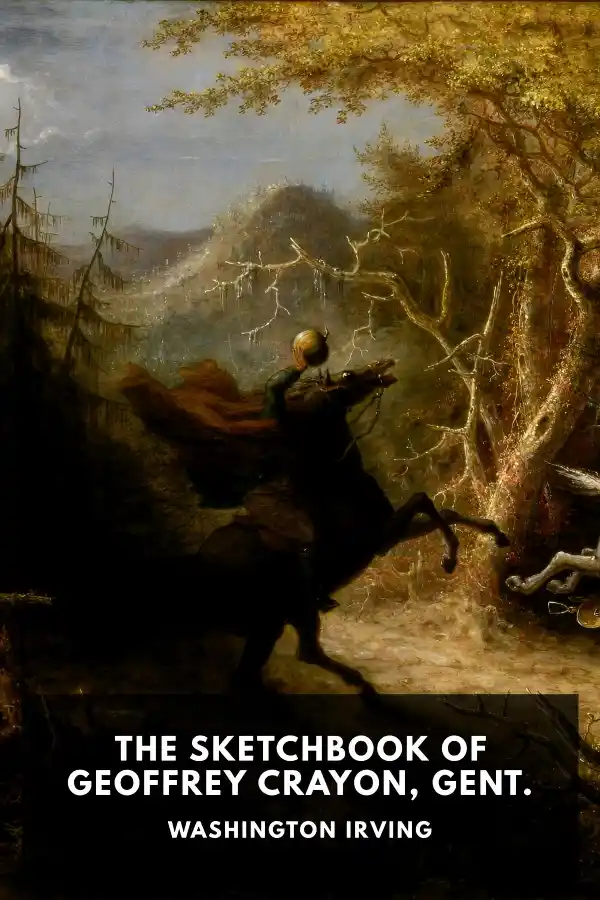
The author is Washington Irving, who published the story in 1820 in The Sketch Book of Geoffrey Crayon, Gent., the collection that made his reputation on both sides of the Atlantic. Irving had already invented Diedrich Knickerbocker for his comic History of New York in 1809, and he returned to the persona here as a way of writing American material in a mock-antiquarian voice. The Sketch Book appeared in serial parts in New York and London, which is why the story carries the marks of magazine publication: a short frame, a single incident, and a narrator who addresses the reader directly. Irving was the first American writer to live by his pen, and he wrote much of the book abroad in England.
The setting is the lower Hudson valley just after the Revolution, in a Dutch village that still keeps its old names, its church on the knoll and its tales of the war. The Hessian trooper of the legend belongs to that recent history: German mercenaries had fought for Britain, and a headless soldier looking for his head is exactly the kind of ghost a farming community would invent. Irving thickens the atmosphere with real local places, the Tappan Zee, the church bridge, the tree called Major André’s, and with the ordinary business of a village, haying, quilting, dancing and courtship. The horror works because the daylight world is so solid, and because the village half wants the ghost to be true.
The characters are drawn as comic types with sharp edges. Ichabod Crane is a New England schoolmaster among Dutch farmers, vain, greedy and genuinely frightened of the dark; his learning is real, but it does not protect him. Katrina Van Tassel is an heiress who knows her value and enjoys the rivalry she causes. Brom Bones is the local hero, a rider and fighter whose jokes are physical and whose courtship is patient. Baltus Van Tassel, her father, is a prosperous farmer who would rather not see what is happening under his roof. Irving gives each of them a dialect, a habit and an appetite, and the story turns on which of them understands the joke. The narrator does, and so does Brom.
The text here is the Project Gutenberg transcription of the story, Project Gutenberg #41, so the spelling and punctuation are the nineteenth-century ones, including the Dutch dialect and the narrator’s asides. The postscript, in which the antiquary is asked for the moral of the tale and answers with a shrug, is here in full, with its shrug intact. The story is short enough to read in a sitting, but it rewards a second visit: the second time, the pumpkin, the broken saddle girth and Brom’s laugh look different. Readers who want the collection it appeared in can take The Sketch Book of Geoffrey Crayon, Gent., and readers who want another tale of a plausible haunting can try The Turn of the Screw.
Historical Context
Tarry Town, the story’s Greensburgh, sat on the eastern shore of the Hudson where the river widens into the Tappan Zee. The region had been Dutch since the seventeenth century, and after the Revolution it was still Dutch in its church, its farm names and its speech. Westchester County had been the neutral ground of the war, raided by both sides, and the memories Irving uses are local ones: a Hessian soldier buried in a churchyard, a British officer taken on a road, a bridge that country people avoided after dark. The tavern on the post road is said to have given the town its name.
Irving wrote The Sketch Book while living in England, short of money after the family business failed, and he sent the pieces to New York and London in parts. The Knickerbocker frame let an American write about America for readers who expected English scenery, and the collection’s success made the 1820s the decade in which American fiction began to be read abroad. The story’s first readers met it as one item in a miscellany of essays and tales, not as a Halloween classic, and its fame grew slowly, through reprinting, staging and adaptation. Its first readers were buying scenery as much as story.
Ghosts without heads belong to older European folklore, and the tale of a dead soldier who must ride back to the field where he fell is the sort of story German and Dutch settlers brought with them. Irving had travelled in Europe and read its ballads; he also knew the Hudson valley’s own stories at first hand. The result is a hybrid: a German ghost in an American landscape. Stage, film and cartoons have made the pumpkin more famous than the prose, but the prose is where the ambiguity lives. That mixture of imported folklore and local ground is what later American ghost stories inherited.
Key Characters & Literary Archetypes
- Ichabod Crane: A Connecticut schoolmaster with a long snipe nose, green eyes and a hunger that fixes on food, land and heiresses in turn. He rules his one-room school with a birch rod and a psalm book, leads the church choir, and reads Cotton Mather until every owl and beetle seems a portent. Brave in daylight, he is a child in the dark, and his learning never helps him on the road.
- Katrina Van Tassel: Baltus Van Tassel’s only child, eighteen, plump and rosy, with a coquette’s sense of timing. She wears her great-grandmother’s yellow finery and keeps two suitors circling without committing herself to either. Irving gives her no scene alone and no confession; she is seen entirely through the men who want her, which is part of the joke and part of the point of the story.
- Brom Bones: Abraham Van Brunt, called Brom Bones, a broad-shouldered, double-jointed farmer’s son who rides Daredevil, wins at races and cockfights, and leads the young men of the hollow. His courtship of Katrina is patient and physical, and his jokes on the schoolmaster are rough: a stopped chimney, a wrecked schoolroom, a dog taught to whine. He is the story’s likely author and its final witness.
- Baltus Van Tassel: Katrina’s father, a rich, comfortable Dutch farmer whose barn, orchards, pigs and poultry are described with more loving detail than any character. He is hospitable, slow and content to let the schoolmaster court his daughter while his wife manages the poultry and the pies. His farm is the treasure Ichabod actually wants, and Irving lets the reader see it in the same way.
- The Headless Horseman: The ghost of a Hessian trooper whose head was carried off by a cannon-ball in an unnamed battle of the Revolution. He rides out at night to the field where he fell and hurries back to his grave before dawn. In the story he is both a belief the villagers share and a shape on the road, and Irving never lets the reader see him clearly enough to decide which he is.
- Diedrich Knickerbocker: The pretended author of the papers, a Dutch-American historian invented by Irving in 1809 and revived here. He is credulous, fussy, fond of genealogy, and apt to mention that he does not vouch for his facts. His voice wraps the story in mock scholarship, so that the ghost arrives through a haze of footnotes, hearsay and local gossip rather than through a novelist’s direct narration.
Core Literary Themes
- Superstition and the half-believing mind: Irving’s villagers believe everything and nothing. They tell ghost stories at the fireside for the pleasure of being frightened, then walk home past the churchyard. Ichabod, who has read more books than any of them, is the most superstitious man in the story, because his reading has stocked his imagination without steadying his nerves. The tale keeps two positions in view at once: the horseman is a real presence on the road and a story people tell, and the reader is never allowed to choose. That double vision is the method, not a weakness.
- Appetite and ambition: Ichabod’s desire is described in the language of food. He looks at the Van Tassel farm and sees hams, pies, orchards and a fortune, and he looks at Katrina and sees the farm. Irving makes the schoolmaster’s greed comic but not innocent: it is the greed of a poor man among people who own things, and it is what makes him ridiculous. Brom, who already belongs to the community, wants the girl; Ichabod wants the property. The difference decides the contest before the horseman ever appears.
- The joke on the teller: The story is framed as a manuscript found among the papers of a dead antiquary, and its narrator declines to settle the ending. He says that he does not believe half of it, and the sentence is the key to the whole performance. Irving writes a ghost story that keeps winking at its own machinery, inviting the reader to enjoy both the fright and the fraud. Brom’s laugh at the mention of the pumpkin is the last turn of the screw: the community knows, or thinks it knows, and says nothing.
- Old world and new: The hollow is an old Dutch place in a new republic. Its people keep their names, their church and their superstitions, while the Revolution has left a Hessian ghost in the churchyard and a British major’s name on a tree. Irving uses that layered landscape to write about inheritance: what the village passes down is not only farms and silver but stories, and the stories are the most durable property of all. The headless soldier is history returning as folklore, and the hollow is the place where the two meet.
- Rivalry and the local hero: Brom Bones is not a villain. He is the community’s champion, generous with his strength and quick with a joke, and the story treats his victory as natural. Ichabod is an outsider with pretensions, and the romance plot is settled by a horsemanship contest the reader never sees. Irving’s comedy is conservative: the village keeps its own, the newcomer is sent packing, and the tale is told afterwards by the winner’s friends. Even the ghost, if it is Brom, is the village protecting its own.
Why Download Our Custom E-Reader Edition of The Legend of Sleepy Hollow?
The Legend of Sleepy Hollow is short, and short books are easy to spoil. This edition gives you the whole tale as Irving wrote it, including the Knickerbocker frame and the postscript in which the narrator confesses his disbelief, rather than a retelling or an illustrated abridgement. The text is set for reading on a screen and on e-ink alike, with the paragraphs and the dialogue left where the nineteenth century put them, and the spelling of the Dutch names kept as the author had it.
The transcription follows the Project Gutenberg text of the story, so the dialect, the long comic sentences and the antiquarian asides arrive intact. Nothing has been modernised into current spelling, and nothing has been cut to make the story faster. If you are reading it for a class, the quotations you need are here; if you are reading it for Halloween, the pumpkin is still a pumpkin, and the horseman is still unexplained on the last page.
Three files come with one download: EPUB for phones and tablets, AZW3 for Kindle and KEPUB for Kobo. All three are DRM-free and unabridged, and each keeps the scene breaks so you can find your place again. There is no account to create and no shop to keep open, and the files can be moved between the devices you already own. Download once and the story stays with you.
- Project Gutenberg transcription, via Project Gutenberg #41 — the complete text, unabridged, with the chapter headings the author set.
- Unabridged the entire tale plus the Knickerbocker postscript, with nothing abridged or modernised.
- Three formats EPUB, AZW3 and KEPUB, DRM-free, in one download.
- Scene breaks that survive the nine movements of the story stay findable on any e-reader.
- The Sketch Book of Geoffrey Crayon, Gent. — free EPUB, AZW3 & KEPUB
- The Turn of the Screw — free EPUB, AZW3 & KEPUB
- The Yellow Wallpaper — free EPUB, AZW3 & KEPUB
Chapter summaries
The Legend of Sleepy Hollow is one unbroken narrative, so the nine groups below follow its scenes rather than numbered chapters, from the finding of the papers to the laughter in the village.
- The papers of Diedrich Knickerbocker: A note explains that the manuscript was found among the papers of a dead Dutch historian, and the tale opens with an epigraph from The Castle of Indolence. The narrator describes the Hudson valley, the village of Tarry Town and the drowsy hollow beside it, then admits that he does not vouch for a word of what follows. The tone is set there.
- The hollow and its spell: The valley is bewitched, by a High German doctor or an Indian prophet depending on who is telling it, and its people dream awake. The neighbourhood is full of haunted spots and twilight tales, and the chief of them is the Hessian trooper who rides back to the battlefield at night to look for his head. Nobody in the hollow doubts that he does.
- The schoolmaster: Ichabod Crane arrives from Connecticut: tall, thin, snub-nosed, with huge ears and a voice that leads the church choir. He boards with the farmers in turn, helps with the hay and the horses, and terrifies himself after school with Cotton Mather’s history of New England witchcraft. By winter he is the village expert on ghosts, and knows every road home better than he would like.
- Katrina and Brom: Ichabod falls in love with Katrina Van Tassel, the eighteen-year-old heiress of a rich farm, and with the farm itself, which he mentally devours room by room. Brom Bones, the strongest and wildest young man in the hollow, is already courting her, and the schoolmaster’s quiet visits become a rivalry that the whole village watches, and Brom knows it and enjoys it.
- The quilting frolic: An invitation arrives on a half-broken colt, and Ichabod borrows a plough horse named Gunpowder to ride to the Van Tassel party. The quilting frolic turns into a dance, with an old negro fiddler and a table of pies, doughnuts and smoked beef. Ichabod dances until the floor shakes, showing off steps he learned in Connecticut; Brom sulks in a corner and watches him.
- The ride home: The guests trade war stories and ghost stories on the porch, and Ichabod hears again about the headless horseman who patrols the road and tethers his horse among the graves. He leaves late, after an interview with Katrina that the narrator refuses to describe, and rides into the dark in a mood the story calls chapfallen, with the evening’s talk still in his ears.
- The headless horseman: On the road past Major André’s tree, Ichabod hears a whistle answered and meets a rider who keeps to the far side of the road. A flash of moonlight shows that the stranger carries his head before him on the saddle. Gunpowder bolts, the old saddle girth breaks under the strain, and the chase runs downhill toward the wooden bridge and the church beyond it.
- The pumpkin: At the bridge the goblin rises in the stirrups and hurls his head, which strikes the schoolmaster with a crash. The next morning Gunpowder stands at his master’s gate without saddle or rider, and searchers find the hat beside the brook and a shattered pumpkin in the mud. No body is ever found, and the brook is dragged without result.
- What became of Ichabod: Hans Van Ripper burns the schoolmaster’s books and refuses to send his children to school. Years later a farmer reports that Ichabod is alive in another county, reading law and electioneering. Brom Bones marries Katrina, and whenever the pumpkin is mentioned he laughs and looks exceedingly knowing, which the village takes as an answer, though he never gives it openly.
The Legend of Sleepy Hollow: Frequently Asked Questions
What is The Legend of Sleepy Hollow about?
Does Ichabod Crane die at the end?
Who is the Headless Horseman?
Is the story frightening or funny?
Who is Brom Bones?
What is the Major André reference?
How long is The Legend of Sleepy Hollow?
Where can I read the full text of The Legend of Sleepy Hollow?
Part of: Gothic and horror classics · Classic fiction