The Idiot by Fyodor Dostoevsky: Free EPUB, AZW3 & KEPUB Download
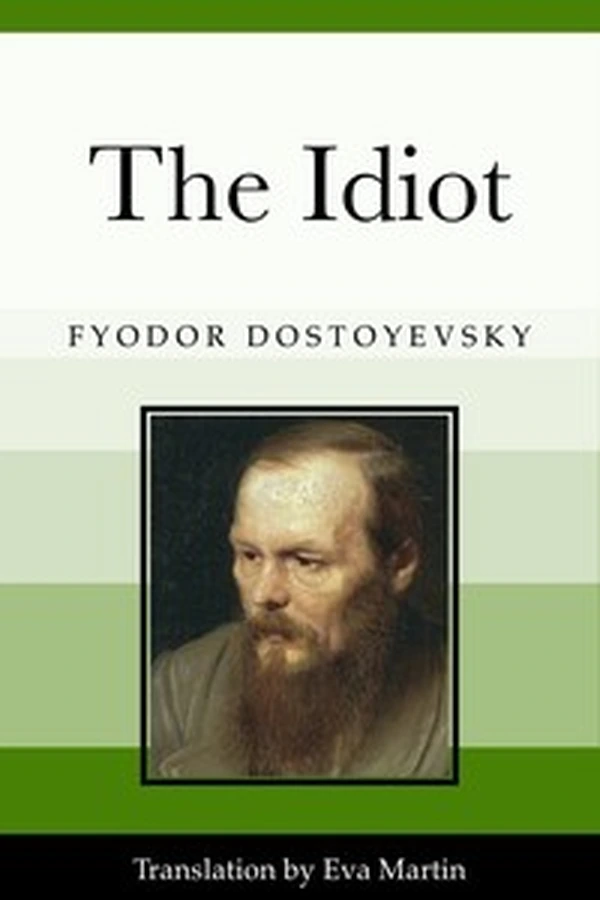
The Idiot
📖 Click to Read the Opening Pages Online Preview
The Idiot opens in a third-class railway carriage:
Towards the end of November, during a thaw, at nine o’clock one morning, a train on the Warsaw and Petersburg railway was approaching the latter city at full speed. The morning was so damp and misty that it was only with great difficulty that the day succeeded in breaking; and it was impossible to distinguish anything more than a few yards away from the carriage windows.
Some of the passengers by this particular train were returning from abroad; but the third-class carriages were the best filled, chiefly with insignificant persons of various occupations and degrees, picked up at the different stations nearer town. All of them seemed weary, and most of them had sleepy eyes and a shivering expression, while their complexions generally appeared to have taken on the colour of the fog outside.
When day dawned, two passengers in one of the third-class carriages found themselves opposite each other. Both were young fellows, both were rather poorly dressed, both had remarkable faces, and both were evidently anxious to start a conversation. If they had but known why, at this particular moment, they were both remarkable persons, they would undoubtedly have wondered at the strange chance which had set them down opposite to one another in a third-class carriage of the Warsaw Railway Company.
Two strangers in a third-class carriage are about to become the closest and most dangerous thing in each other’s lives. The novel runs to fifty chapters across four parts, and the complete text is in the EPUB below.
Download Full EPUB1869
~245,000 words (estimated)
Approx. 13.6 hours
Standalone
St Petersburg and the summer villas at Pavlovsk
4 parts · 50 chapters
EPUB · AZW3 · KEPUB
0.64 MB (EPUB) · 0.98 MB (AZW3) · 0.73 MB (KEPUB)
Public domain in the United States
Project Gutenberg #2638
Prince Lev Myshkin comes home to Russia after four years in a Swiss sanatorium: twenty-six years old, penniless, freshly declared cured of epilepsy, and without the social armour that everyone around him puts on as a matter of course. On the train he meets Parfen Rogozhin, whose father has just died leaving two and a half million roubles. In Petersburg he is taken up by the Yepanchin family, whose secretary Ganya is being paid seventy-five thousand roubles to marry Nastasya Filippovna, the woman old Totski has kept since she was a girl. Myshkin listens to all of it, tells the truth whenever he is asked, and kisses a photograph of Nastasya before he has ever met her.
Dostoevsky wrote The Idiot in Geneva and Florence, against deadlines, with creditors behind him and a young wife taking his dictation, and the book has the recklessness of those years: parties, scandals, a smashed Chinese vase, a wedding, and a hundred thousand roubles thrown into a fire to see whether a man will put in his hand. Readers in 1869 found it chaotic; critics have argued about it ever since, and the argument is part of its life. What holds it together is Myshkin, called an idiot by nearly everyone because they have no other word for a goodness that will not bargain. The text is available via Wikipedia’s article on the novel, and in full at Project Gutenberg #2638.
The Idiot by Fyodor Dostoevsky: Summary, Characters & Themes
A summary and analysis of The Idiot has to begin with a warning: the novel does not behave. Its subject is a man who is good without being clever about it, and Dostoevsky builds the book as a series of crowded rooms in which that goodness is tested by people who want something from it. Prince Myshkin arrives in Petersburg at the end of November carrying a bundle tied in a faded silk handkerchief, with four years of Swiss treatment behind him and no plan except to meet his distant relatives and perhaps find work copying documents in a beautiful hand. Dostoevsky had been sentenced to death in 1849 and reprieved at the last moment, and he gave Myshkin his own epilepsy, his own memories of the scaffold, and something of his own sense of being a stranger in his own country.
The plot is a marriage market seen from the inside. Ganya Ivolgin, the general’s secretary, is offered seventy-five thousand roubles to marry Nastasya Filippovna, the woman Afanasy Totski took up as a girl and is now paying to dispose of respectably; the general has bought her pearls; the whole of Petersburg knows the terms and most of it has an opinion about them. Myshkin, who does not know how to want anything, sits down in the middle of this bargaining, defends Ganya’s sister from her brother, and is slapped in the face for it. He apologises to Ganya afterwards. By the end of the evening he has proposed to Nastasya himself, learned from a solicitor’s letter that he is suddenly an heir, and watched her throw a hundred thousand roubles into the fire rather than let a man buy her in front of witnesses.
The two women at the centre of the book are arranged as rivals and as mirrors. Nastasya is beautiful, ruined, generous and theatrical, and she believes herself to be a fallen creature in a way no argument can touch; Aglaya Yepanchin is twenty, proud, clever and starved of any real world to be clever in, and she has read enough to know that she is being kept in a bottle and admired like a picture, and she has opinions of her own that nobody has asked for since she was fifteen. Their single meeting, in Daria Alexeyevna’s emptied house with Rogozhin bolting the door behind them, is the cruellest scene Dostoevsky wrote. Myshkin tries to pity them both at once, and in that moment loses the one he loves, because pity offered to the wrong person at the wrong moment is also a form of cruelty.
The other half of the novel belongs to Parfen Rogozhin, the black-haired young man from the train, who inherits two and a half million roubles and uses them as a crowbar on every door in Petersburg, including the ones that open inward. He and Myshkin exchange crosses and become brothers; he also keeps a garden knife inside a book and comes up a dark staircase with it. At the centre of their friendship is Holbein’s dead Christ, a painting in Rogozhin’s own house that shows a body so thoroughly destroyed that Myshkin says a man’s faith might be lost by looking at it, and Rogozhin answers that it is so. The novel’s last chapters keep that image: a body under a sheet, a fly settling on the pillow, four jars of disinfectant on a chair, and two men lying awake beside it until the door is opened and the house comes in.
The book that emerges is deliberately unfinished in its effects: it has a murder, a trial, a wedding that collapses at the church door and an ending that explains nothing, and its hero ends where he began, in a Swiss clinic, recognising no one who speaks to him. It is also the most Russian of Dostoevsky’s novels, full of arguments about Catholicism, socialism and the destiny of the country, and of a comedy of gossip that is easy to miss on a first reading, since the gossip is usually delivered by someone who is lying. Aglaya’s fate is disposed of in two sentences at the end, and Rogozhin’s mother is spared the news. This edition follows Eva Martin’s translation as printed in Project Gutenberg’s text. If you want the novel that came before it, try Crime and Punishment; the book that came after, with the same questions pushed further, is The Brothers Karamazov.
Historical Context
Dostoevsky began The Idiot in 1867 in Geneva, having fled Russia to escape creditors, and finished it in Florence in 1869, sending instalments to Mikhail Katkov’s Russian Messenger as they were written and needed. The plan survives in his notebooks: he wanted to draw a ‘positively good man’, and he knew the risk, since a good man is the hardest thing in the world to make interesting for six hundred pages. Everything of those years went into the book: money lost at roulette in Baden-Baden, his first child dead in Geneva, his wife Anna taking dictation in shorthand, deadlines that never let up. The first parts were read as a failure, Turgenev complained that the hero was unreal, and Dostoevsky himself thought the central idea had not been carried off.
The Petersburg of the novel is the city of the 1860s, after the emancipation of the serfs and in the middle of a railway and joint-stock boom. Money has become abstract and visible at the same time: IOUs, shares, dowries, mortgages, the moneylender Ptitsin rising from a copeck to sixty thousand roubles without anyone quite knowing how. The burning of the hundred thousand is a gesture against exactly this world: a public refusal to be a price, performed in a drawing room, in front of the people who set the price. The same decade produced the ‘woman question’ and the student radicals, and Dostoevsky put caricatures of them in the book as Burdovsky, Doktorenko and Keller, young men who announce that they do not beg but demand, and are answered in the end by a princess and a fool.
The title needs care. In Russian the word is an insult before it is a diagnosis, and Dostoevsky uses it as a social verdict: Ganya says it to Myshkin’s face, Aglaya whispers it at the bandstand, servants and doctors use it behind his back. Behind the insult stands an older Russian figure, the holy fool, the man whose unworldliness is treated as a kind of sanctity and a kind of scandal at once. The notebooks call Myshkin ‘Prince Christ’, and the novel tests that identification without ever settling it: the prince heals no one, the family he enters is destroyed around him, and the shapelessness readers complained of is exactly where the method lives — the book works by crowding and interruption rather than by plot, and it needs a hero who wants nothing for himself.
Key Characters & Literary Archetypes
- Prince Lev Myshkin: The last of a poor noble family, twenty-six or twenty-seven, epileptic, and back from four years with Dr Schneider in Switzerland. He is not stupid; he is unfashionably honest, and he reads faces better than anyone else in the book, including the faces of people who are lying to themselves. The title’s insult is other people’s word for him, and the novel never decides whether it is also true, which is what keeps him alive as a character.
- Nastasya Filippovna: Totski’s ward and victim, twenty-five at her birthday party, beautiful in a way the novel treats as a public event rather than a private fact. She refuses to be sold, refuses to be rescued on anyone else’s terms, and writes to Aglaya to arrange a marriage she will not allow herself to accept. Her self-accusation drives her cruelty, and her generosity, which is real, is the side of her that the plot keeps punishing.
- Parfen Rogozhin: Twenty-seven, black-haired, heir to two and a half million roubles, and in love with Nastasya to the point of violence. He bought diamond earrings for Nastasya while his father was still alive, and keeps a garden knife in a book, exchanges crosses with Myshkin, and calls him brother while planning to kill him. He is the novel’s most frightening figure and also its most pitiable, a man whose whole fortune turns out to be useless for getting what he wants.
- Aglaya Yepanchin: The general’s youngest daughter, twenty, the beauty of the family and the cleverest person in it. She wants a life larger than the drawing room, tests Myshkin with a hedgehog and with a note left on a green bench, and never forgives him for being more sorry for Nastasya than for her. Her intelligence has nowhere to go, and the novel is honest about what happens to a clever woman with no occupation except marriage.
- Ippolit Terentyev: A consumptive student of seventeen or eighteen who has been told he has weeks to live and intends to make the fact unignorable. His ‘Necessary Explanation’ mixes a dream of a scorpion, a story about a doctor’s dropped pocket-book and an argument with Providence. The pistol he fires at his temple has no cap in it, and the humiliation of that click is worse for him than the illness, because it makes him ridiculous at the one moment he meant to be sublime.
- Lebedyev: The red-nosed clerk who knows everything, rents Myshkin his villa, prays for the soul of the Comtesse du Barry, and explains the Apocalypse as a prophecy about railways. A buffoon and a parasite, and also the only person in the novel who consistently tells the truth about what is happening, usually while pretending to be drunk. His household of orphans and his sudden fits of genuine shame make him the book’s most accurate picture of ordinary human muddle.
Core Literary Themes
- The holy fool: The novel’s title is an insult that keeps turning into a question. Myshkin is called an idiot because he does not bargain, does not take offence at the right moments, and says what he means in rooms built on tact. Dostoevsky tests whether such a man can exist outside the monastery, and the answer is that he can, briefly, and that the test destroys the people around him rather than the man himself. The fool in this book is not the one who cannot read the room; he is the one who reads it exactly and cannot bring himself to use what he has understood.
- Beauty and its price: Nastasya’s beauty is displayed, photographed, bought and exhibited; Aglaya’s is guarded and used as a weapon against her family and her suitors. The novel keeps returning to the phrase that beauty will save the world, and then shows what beauty actually costs the women who own it. Both are admired, neither is allowed to be ordinary, and the forms their tragedy takes are completely different: one ruins herself in public, the other marries a fake count abroad and disappears into a cause that consumes her.
- Money as a language: Seventy-five thousand, a hundred thousand, a hundred and thirty-five thousand, ten thousand to a claimant who is not owed a copeck: sums are how these people say what they feel. The fire scene is the novel’s clearest thesis, since it turns a banknote into a test of nerve in front of an audience. Charity, in this book, is a way of humiliating someone while appearing to save them, and Myshkin’s gifts do as much damage as Rogozhin’s money, because both of them are offered without asking what the person on the other side wants.
- The dead Christ: Rogozhin’s copy of Holbein shows a body with nothing divine left in it, and Myshkin’s reaction to it sets the terms of the novel’s religious argument. Faith here is not a conclusion but a strain: the peasant who crosses himself before cutting a throat, the soldier selling his tin cross for fourpence, the mother whose baby smiles for the first time. Myshkin’s epileptic ecstasy is described as a foretaste of something, and then, in the same paragraph, as a disease, and the novel refuses to say which description is the true one.
- Doubles and the shared night: Myshkin and Rogozhin are set up as opposites who keep changing places: the same train, the same woman, the same cross, the same house, the same face in the crowd. The last chapter completes the exchange, with the prince lying on the floor beside the murderer, both of them unable to speak, one of them perhaps unable to think. The novel’s ending refuses consolation: what is left is a body, a fly settling on the pillow, and two men keeping watch together until the door is opened from outside.
Why Download Our Custom E-Reader Edition of The Idiot?
This page offers the complete novel, all four parts and fifty chapters, in the Eva Martin translation used by Project Gutenberg: the Petersburg parties, Lebedyev’s Apocalypse, Ippolit’s ‘Necessary Explanation’, the smashed vase and the last night in the Gorohovaya. Nothing is cut, and the long speeches are kept at their full length, because the length is part of how Dostoevsky makes a room feel crowded. The text has been checked against the printed edition, so the names and the sums are the ones Dostoevsky actually put there.
The edition is free in three formats: EPUB for most readers, AZW3 for older Kindles, and KEPUB.epub for Kobo, with no DRM and no account. At roughly 245,000 words it is a fortnight of evenings rather than one sitting, and the chapter list below divides it into twelve stretches that follow the novel’s own four parts, so you can stop at a boundary instead of in the middle of a scandal. The file is small enough for any reader and the typography is reflowable, which matters in a book with this many long speeches and this many characters speaking at once in the same room.
If you are reading it for a class or a book group, the historical section sets out the 1860s setting and the novel’s difficult reception, the character notes cover the six people who drive the plot, and the questions at the end take up what readers usually ask: whether Myshkin is really an idiot, why Nastasya destroys her own wedding, who the novel’s ‘poor knight’ is meant to be, and what that last chapter is supposed to leave you with. The summary above will get you through the first hundred pages, where almost nothing seems to happen and everyone talks at once.
- Project Gutenberg transcription, via Project Gutenberg #2638 — the complete novel in Eva Martin’s translation, checked against the printed text.
- All fifty chapters The four parts are complete, from the November train in Part I to the morning in Rogozhin’s flat that closes the book, with nothing skipped between them.
- E-reader typography Reflowable EPUB and AZW3, plus KEPUB.epub for Kobo: the parties, the confessions and the long arguments read as continuous prose rather than as a scan of a page.
- Free and DRM-free No payment, no registration, no copy protection and no account to maintain.
- Notes from the Underground — free EPUB, AZW3 & KEPUB
- War and Peace — free EPUB, AZW3 & KEPUB
- Anna Karenina — free EPUB, AZW3 & KEPUB
Chapter summaries
The novel in twelve instalments, following its four parts and fifty chapters.
- Part I, Chapters 1–4: A November train brings Myshkin and Rogozhin into Petersburg in the same third-class carriage. Rogozhin’s father died a month ago, leaving him two and a half million roubles; Myshkin has four years of Swiss treatment behind him and a bundle tied in a handkerchief. At the Yepanchins’ the general gives him twenty-five roubles and a lodging with his secretary Ganya, whose mother and sister are resisting a marriage that stinks of money. Myshkin’s medieval calligraphy delights the household; his talk of the death penalty does not.
- Part I, Chapters 5–8: In the Yepanchins’ drawing room Myshkin tells two stories nobody can answer: a man reprieved twenty minutes after sentence, and a Swiss village that stoned him for pitying a ruined girl. Aglaya mocks him and keeps listening. Left alone with Nastasya’s portrait he kisses it, then carries Ganya’s compromising note to Aglaya, who reads it, dictates a refusal into her album, and warns him that Ganya will not forgive him for being the messenger. The general’s wife decides that the prince is a child and feeds him lunch with a napkin under his chin.
- Part I, Chapters 9–12: Nastasya arrives unannounced at the Ivolgins’, mistakes the prince for a footman, and sets the flat alight with gossip. Ganya raises his hand to his sister; Myshkin catches it and is slapped for his trouble. Rogozhin’s gang then bursts in with money and calls Ganya a Judas. Afterwards Ganya weeps on the prince’s shoulder and admits he is marrying for money, then sends him on to Nastasya’s birthday with General Ivolgin, who is drunk and gets the address wrong.
- Part I, Chapters 13–16: At her birthday party Nastasya makes the guests confess the worst thing they have ever done, hears General Ivolgin’s poodle story demolished by the newspapers, refuses Ganya in public, and gives back Totski’s seventy-five thousand and the general’s pearls. Myshkin proposes; a solicitor’s letter makes him an heir. She throws Rogozhin’s hundred thousand into the fire and tells Ganya to pull it out with his hands. He faints. She fishes it out with the tongs, hands it over as compensation, and drives off with Rogozhin to Ekaterinhof; Gania brings the singed packet back before morning and insists it be returned.
- Part II, Chapters 1–4: Six months later Myshkin returns to Petersburg with a much smaller inheritance than the one reported, and hears that Nastasya is hiding, first in the city, then at Pavlovsk. He visits Rogozhin’s green house in the Gorohovaya, where the two men look at Holbein’s dead Christ, exchange crosses and call each other brothers, and Rogozhin admits the garden knife in the study is his. Myshkin, walking home through a thunderstorm, is certain he is being followed, is attacked on a dark staircase, and falls in the fit that has been coming since the first page.
- Part II, Chapters 5–7: Recovering at Lebedyev’s villa, Myshkin is visited by the Yepanchins, and Aglaya asks Lebedyev to explain the Apocalypse to her. Then comes the ‘poor knight’ scene: Aglaya recites Pushkin’s ballad with the initials changed to N. P. B., and only Evgenie Pavlovitch understands what she is doing. Four young visitors arrive to demand money for a claimant who says he is Pavlicheff’s son, bringing with them an article about Myshkin’s idiocy printed in a comic paper, and a demand for a share of a fortune that does not belong to them.
- Part II, Chapters 8–12: Ganya destroys the claim with letters and dates; Myshkin offers ten thousand roubles anyway and apologises so clumsily that Mrs. Yepanchin explodes. Hippolyte, dying of consumption, curses them all and then collapses sobbing in a woman’s arms. Days later a carriage draws up and Nastasya announces to the whole company that Rogozhin has bought up Evgenie’s IOUs. Mrs. Yepanchin comes to make peace, makes the prince swear he has not come to marry Nastasya, and drags him back to her house by the hand.
- Part III, Chapters 1–3: At Pavlovsk the family quarrels about Nihilists, and Evgenie tests Myshkin with a barrister’s plea for a man who murdered six people. Aglaya tells the prince she will never marry him and then takes his arm; at the band Nastasya appears with a party, announces that Evgenie’s uncle has shot himself, and whips a lieutenant across the face with a cane. Rogozhin, waiting on a park bench that night, brings word that Nastasya will marry him only after Myshkin marries Aglaya.
- Part III, Chapters 4–6: Myshkin’s birthday party turns into a reading. Lebedyev explains that the star called Wormwood is the railway network covering Europe, and Hippolyte delivers ‘A Necessary Explanation’ — his testament of rage, dreams and a hopeless pocket pistol — then fires the pistol at his temple and hears the click of an empty chamber. He swears it was an accident, and Keller threatens anyone in the room who doubts the young man’s courage or his sincerity.
- Part III, Chapters 7–10: At dawn Aglaya meets Myshkin on the green bench, asks him to be her friend, and ends by throwing Nastasya’s three letters at him and telling him to take them back to their writer. That night Nastasya kneels in the road outside the Yepanchins’ house, kisses his hand and asks whether he is happy, and Rogozhin waits in the carriage that has stood there since ten to take her away. Myshkin answers no, and the answer settles nothing for any of the three of them.
- Part IV, Chapters 1–7: Myshkin and Aglaya are engaged, and the family gathers for Princess Bielokonski. There Myshkin learns that Pavlicheff had become a Jesuit, delivers a speech about Rome and Antichrist, smashes the Chinese vase Aglaya told him to smash, and falls in a fit in front of the guests, who are kind about it in a way that stings him more than mockery. The engagement survives a few days longer, until Hippolyte arranges a meeting between the two women and warns the prince that Rogozhin will murder Aglaya rather than give her up.
- Part IV, Chapters 8–12: The two women meet in Daria Alexeyevna’s empty house, with Rogozhin bolting the door behind them. Aglaya’s indictment is cruel, Nastasya’s counter is worse, and Myshkin destroys everything by pitying the wrong one at the wrong moment. The wedding is set, the bride runs to Rogozhin at the church door, and Myshkin spends the last night in the Gorohovaya beside a body under a sheet, with the murderer raving on the floor next to him and four jars of disinfectant on a chair.
The Idiot: Frequently Asked Questions
Is the title an insult?
Who is Nastasya Filippovna?
Why does Nastasya throw the money into the fire?
How does The Idiot end?
Why is there so much about epilepsy in the novel?
Is Myshkin based on Dostoevsky himself?
Which translation is this text?
Where can I get the free EPUB?
Part of: Classic Fiction · Philosophy Classics