The Invisible Man by H. G. Wells: Free EPUB, AZW3 & KEPUB Download
The Invisible Man
📖 Click to Read Chapter I Online Preview
Chapter I — The Strange Man’s Arrival
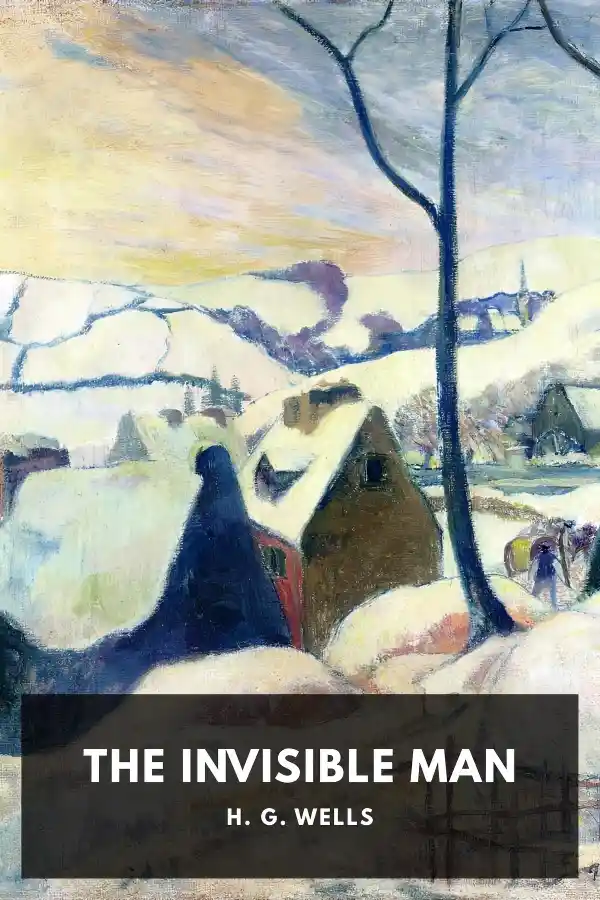
The stranger came early in February, one wintry day, through a biting wind and a driving snow, the last snowfall of the year, over the down, walking from Bramblehurst railway station.
He carried a little black portmanteau in his thickly gloved hand. He was wrapped up from head to foot, and the brim of his soft felt hat hid every inch of his face but the shiny tip of his nose; the snow had piled itself against his shoulders and chest, and added a white crest to the burden he carried.
He staggered into the “Coach and Horses” more dead than alive, and flung his portmanteau down. “A fire,” he cried, “in the name of human charity! A room and a fire!” And having shaken the snow from his shoulders, he stepped into the parlour where his horrific secret would soon confront the bewildered villagers.
Follow Griffin’s descent into paranoia, terror, and the Reign of Terror. Download the complete unabridged edition for your e-reader.
Download Full EPUBThe Invisible Man is an 1897 science fiction novel by H. G. Wells, following a scientist named Griffin who makes himself invisible and descends into paranoia, violence, and isolation in the English village of Iping. The novel explores scientific hubris, the limits of individual power, and the terror of being unseen yet unable to escape society. This Standard Ebooks edition is based on Project Gutenberg eBook #5230 and is in the public domain in the US.
About H. G. Wells’s The Invisible Man: Summary, Characters & Themes
The Invisible Man is an 1897 science fiction novel by H. G. Wells and the foundational work of the “mad scientist” archetype in world literature. This summary and analysis covers its plot, key characters, and core themes, based on the Standard Ebooks edition transcribed from Project Gutenberg eBook #5230.
Blending speculative optics with psychological horror, the story begins in the sleepy Sussex village of Iping. A mysterious stranger arrives wrapped in bandages, wearing blue spectacles and concealing his face beneath false whiskers and coats.
The stranger is Griffin, an extraordinarily gifted university researcher who unlocked the physics of light refraction. By altering the refractive index of living cells to match air exactly, he succeeded in making his own flesh invisible.
However, what seemed like the ultimate scientific triumph rapidly devolves into a nightmare. Invisible, Griffin finds himself shivering naked in the London cold, unable to eat without revealing food in his stomach, and stripped of all physical comfort.
Driven mad by cold, isolation, and megalomania, Griffin abandons basic ethics. He dreams of instituting a totalitarian “Reign of Terror,” forcing his former university colleague Dr. Kemp into a deadly manhunt across the English countryside.
Key Characters & Literary Archetypes
The novel’s characters function as archetypes, each embodying a distinct response to unchecked scientific power.
- Griffin (The Faustian Mad Scientist): Brilliant, albino, and arrogant, Griffin embodies intellect entirely unmoored from moral responsibility. His power grants him no ethical enlightenment, transforming him into an isolated, paranoid sociopath.
- Dr. Arthur Kemp (The Responsible Rationalist): A former university acquaintance of Griffin who pursues respectable, peer-reviewed science. Kemp acts as the moral foil, recognizing that private genius must be subordinate to public safety and civil law.
- Thomas Marvel (The Picaresque Accomplice): A tramp coerced by Griffin into carrying his stolen laboratory notebooks and money. Marvel represents common self-preservation and cunning, surviving the chaos and quietly keeping Griffin’s secret scientific books for himself.
- Mrs. Hall (The Provincial Matron): The pragmatic, inquisitive innkeeper of the “Coach and Horses” in Iping. She anchors the narrative in grounded Victorian reality, viewing Griffin’s bizarre behavior first as eccentric rudeness before the supernatural truth breaks out.
Core Literary Themes & Historical Significance
These themes are central to any analysis of the novel’s enduring significance.
- Untethered Power and Social Shame: Wells demonstrates that invisibility does not free man to do good, but strips away social shame and legal consequence, unleashing untamed primal cruelty.
- The Physical Reality of Scientific Miracle: Wells pioneered modern sci-fi realism by detailing the logistical miseries of invisibility: dirt sticking to transparent feet, rain forming an outline in the air, and the misery of walking barefoot over icy roads.
- Individual Megalomania vs. Collective Order: Griffin believes his invisible state makes him an invincible god; yet the novel concludes with society uniting through telegraphs, locked doors, and barking watchdogs to bring down the isolated rogue.
Why Download Our Custom E-Reader Edition of The Invisible Man?
The Invisible Man helped establish the tragic archetype of the amoral, megalomaniacal scientist.
Through Griffin, a brilliant former medical student who makes his own body invisible, Wells transformed an ancient folkloric trope into science fiction horror.
Standard automated conversions often alter this compact psychological thriller. They strip Wells’s scientific expositions, scramble Griffin’s monologues, and introduce formatting inconsistencies in dialogue-heavy scenes.
Our bespoke digital edition delivers an archival, unabridged reading experience calibrated for modern E-ink displays.
- Authoritative Text Fidelity: Sourced directly from the definitive text, preserving all twenty-eight chapters and the retrospective epilogue.
- Granular Architectural NCX/Nav Navigation: A comprehensively indexed table of contents maps Griffin’s accelerating breakdown. Jump instantly from his snowbound entrance at Iping to the siege of Dr. Kemp’s house.
- Calibrated Typographical Layout: Griffin’s extended optical explanations demand rigorous typographic treatment. Our edition uses calibrated blockquotes and high-contrast styling across Kindle Paperwhite (AZW3), Kobo Libra/Clara (KEPUB), and open EPUB devices.
- Verified Public Domain Sources: This edition is based on Project Gutenberg eBook #5230 and the Standard Ebooks transcription, with digital scans from Google Books. The text is in the public domain in the US.