The Gift of the Magi by O. Henry: Free EPUB, AZW3 & KEPUB Download
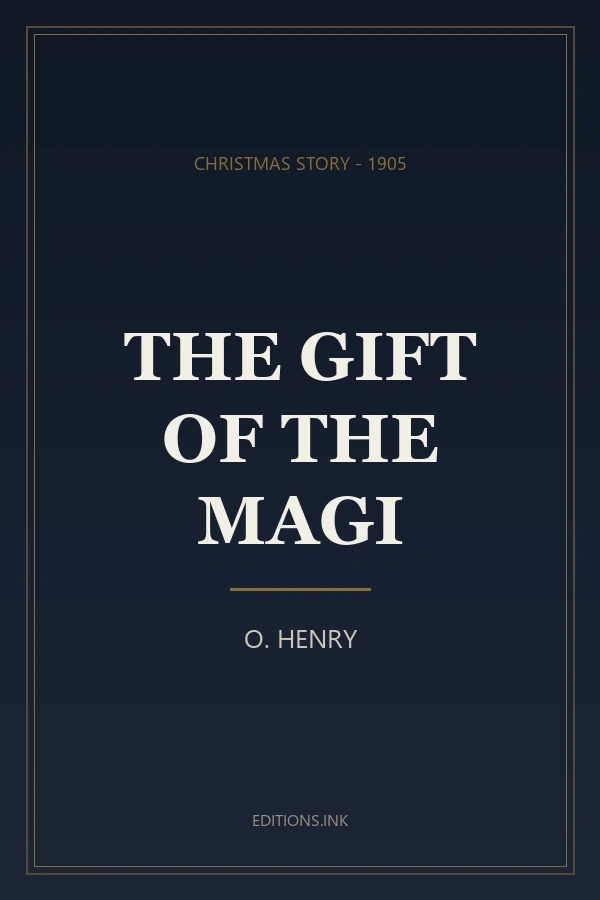
The Gift of the Magi
📖 Click to Read the Opening Pages Online Preview
The Gift of the Magi opens:
One dollar and eighty-seven cents. That was all. And sixty cents of it was in pennies. Pennies saved one and two at a time by bulldozing the grocer and the vegetable man and the butcher until one’s cheeks burned with the silent imputation of parsimony that such close dealing implied. Three times Della counted it. One dollar and eighty-seven cents. And the next day would be Christmas.
There was clearly nothing to do but flop down on the shabby little couch and howl. So Della did it. Which instigates the moral reflection that life is made up of sobs, sniffles, and smiles, with sniffles predominating.
While the mistress of the home is gradually subsiding from the first stage to the second, take a look at the home. A furnished flat at $8 per week. It did not exactly beggar description, but it certainly had that word on the lookout for the mendicancy squad.
One dollar and eighty-seven cents, two treasures, and a pair of gifts that turn out to be useless. Download the complete story as EPUB, AZW3 or KEPUB below.
Download Full EPUB1905
~2,000 words (estimated)
Approx. 5 minutes
O. Henry’s New York stories
New York, 1905 · a furnished flat at eight dollars a week
6 movements
EPUB · AZW3 · KEPUB
70 KB (EPUB) · 90 KB (AZW3) · 72 KB (KEPUB)
Public domain in the United States
Project Gutenberg transcription
Della Young has one dollar and eighty-seven cents, sixty of it in pennies, and tomorrow is Christmas Day. She and her husband Jim have two possessions they are proud of: his gold watch, which came from his father and grandfather, and her hair, which falls below her knee. Della sells the hair to a wigmaker for twenty dollars and buys a platinum fob chain for the watch; Jim comes home with a set of tortoise-shell combs for the hair that is gone. He has sold the watch to buy them. The story is O. Henry’s most famous and most imitated, and its ending is the reason.
The Gift of the Magi was published in December 1905, inside the New York Sunday World and collected the following year in The Four Million, The Gift of the Magi turned the twist ending into a respectable literary device and gave American magazine fiction one of its permanent Christmas stories. Its narrator is warm, ironic and directly present (‘Forget the hashed metaphor’), and the famous comparison of Della and Jim to the magi is made in the last line, not the first. The text is available via the Project Gutenberg #7256 transcription, and the complete story can be downloaded below.
The Gift of the Magi by O. Henry: Summary, Characters & Themes
A summary and analysis of The Gift of the Magi begins with a number: one dollar and eighty-seven cents. Everything in the story is measured in money that is not quite enough, and the opening pages are a small masterclass in making absence vivid. The flat costs eight dollars a week; Jim’s pay has shrunk from thirty dollars to twenty; Della has been bulldozing grocers and butchers for pennies until ‘one’s cheeks burned with the silent imputation of parsimony’. O. Henry’s narrator leans on the reader’s elbow throughout, joking, moralising and occasionally refusing to describe something (‘Forget the hashed metaphor’, ‘let us regard with discreet scrutiny some inconsequential object in the other direction’), and the effect is a story that feels told rather than merely written.
That narrator – and the O. Henry who perfected him – is one of the story’s two great technical achievements. The other is the symmetry of the gifts, which is prepared so carefully that the ending feels inevitable rather than clever. Della’s hair is introduced as a treasure in the same breath as Jim’s watch, and both are qualified by comparisons that are deliberately too large for the flat: the Queen of Sheba and King Solomon are brought in as neighbours. When Della sells her hair for twenty dollars and spends twenty-one on the chain, the story has already told us what the watch and hair are worth, and what they are worth is not money.
The combs are the story’s second reversal, and the one that makes the ending more than a trick. Della has wanted them in a Broadway window for months; Jim has bought them with the money from the watch. Neither gift can be used, and both are perfect, because each was bought by giving up exactly what the other was meant to adorn. The narrator’s final paragraph stops joking and addresses the reader directly: these two ‘foolish children in a flat’ who ‘most unwisely sacrificed’ their treasures are of all who give gifts the wisest. The word ‘magi’ arrives only at the end, after the story has earned it, and it recasts a comedy of poverty as a Nativity parallel.
O. Henry’s real name was William Sydney Porter, and by 1905 he was the most popular short-story writer in the United States, writing against a weekly deadline for the New York World. The Gift of the Magi was written fast and published for a mass readership, and it has the strengths and the limits of that market: a tight situation, two characters, one movement of plot, a narrator who performs. Its sentiment has been parodied for a century, but the construction has also been studied for a century, because the story does something difficult in two thousand words: it makes a coincidence feel like a moral.
The page below offers the complete text, not an extract, together with a short reading guide and the usual downloads. It is a very short story and it rewards being read twice in one sitting: once for the jokes, once for the machinery, which is visible only on the second pass. The text follows the Project Gutenberg #7256 transcription of the 1905 magazine version.
Historical Context
Christmas in the magazine market, 1905,December issues were the year’s biggest sellers, and American magazines competed for Christmas stories the way they competed for covers. O. Henry wrote for the New York World, a mass-circulation daily, and the story appeared in its Sunday magazine on 17 December 1905, eight days before Christmas. It was collected in The Four Million (1906), his second book, whose title refers to the population of New York and whose stories are mostly about people with almost no money.
New York prices and the eight-dollar flat,The numbers in the story are exact and period-accurate. Della and Jim pay eight dollars a week for a furnished flat; Jim earns twenty dollars a week; Della’s hair fetches twenty dollars and the platinum chain costs twenty-one. In 1905 a New York clerk’s salary of twenty dollars a week placed the couple just above poverty, in the same rented buildings as immigrants and shop workers, and the story’s comedy depends on that margin: not destitution, but nothing spare.
The twist ending as a craft problem,O. Henry did not invent the surprise ending, but he made it a commercial formula, and contemporary reviewers complained that his imitators turned it into a trick. The Gift of the Magi answers the complaint by making the twist structural rather than decorative: the two gifts are exchanged, not revealed, and the last paragraph converts the joke into an argument about value. It is the story most often cited when critics defend O. Henry against the charge of mere cleverness.
Key Characters & Literary Archetypes
- Della Young: The story’s centre. She is practical, proud, and given to sudden tears that she then manages; her decision to sell her hair is made in a single paragraph and carried out in the next. O. Henry gives her the story’s best comic line (‘If Jim doesn’t kill me… he’ll say I look like a Coney Island chorus girl’) and its most famous prayer: ‘Please God, make him think I am still pretty.’
- Jim Young: Twenty-two, thin, serious, and without gloves. He has almost no dialogue before the ending, and the story uses his silence as suspense: Della cannot read his face when he sees her hair, and the reader cannot either. His gift – the combs – is revealed only after hers, which is the story’s single, decisive piece of sequencing.
- Madame Sofronie: The wigmaker who buys Della’s hair, ‘large, too white, chilly’, and hardly the Sofronie of the sign. She is the story’s only other speaking character and its only professional, and her flat price of twenty dollars is the hinge on which the plot turns.
- The narrator: O. Henry’s voice is a character in its own right: knowing, affectionate, fond of addressing the reader as ‘dear friends’, and willing to stop the action to make a joke or a moral. The story’s final paragraph belongs to him rather than to Della or Jim, and that is the point.
Core Literary Themes
- Giving and the value of things: The story’s subject is not poverty but valuation. Hair and watch have prices – twenty dollars, twenty-one dollars – and worth that no price captures, and the plot works by converting one into the other and back again. The gifts are useless in the ordinary sense and priceless in the sense the story cares about, and the final word, ‘magi’, is a judgement on which sense wins.
- Irony and symmetry: Every detail is doubled: two treasures, two gifts, two sellers, two moments of revelation. The symmetry is so complete that the ending feels like a law of nature rather than a plot device, and the irony is gentle because neither character is punished for generosity; they are rewarded with a joke that is also a compliment.
- The Christmas story as a form: The story belongs to a genre with strong conventions – warmth, sacrifice, a child or a couple, a concluding gesture toward the Nativity – and it uses them without irony while keeping its narrator ironic. That combination is why it survives: it is sentimental and it knows exactly what it is doing.
Why Download Our Custom E-Reader Edition of The Gift of the Magi?
This page offers the complete 1905 text of The Gift of the Magi in three reflowable formats, not a summary and not an extract. The story is short enough to read in fifteen minutes and dense enough to reread, and the files are built for that.
The EPUB is hand-checked, with proper paragraph indents, curly quotation marks, and no dropped em dashes; the AZW3 is generated for Kindle sideloading; the KEPUB is built for Kobo, with its own chapter breaks and a cover that renders at full size.
The text is in the public domain, the downloads are free, and there is no account, no email and no paywall. If you want a clean copy for a class, a reading group or a Christmas Eve, take the EPUB; if you want to compare translations of the joke, take all three.
- Project Gutenberg transcription, via the Project Gutenberg #7256 text (1905 magazine version), with our own paragraph and punctuation pass.
- EPUB, AZW3 and KEPUB downloads direct links below, no account and no email required.
- A short reading guide summary, characters, themes and six movements, written for readers who want the machinery as well as the story.
- Public-domain status the story was published in 1905 and is free to copy, distribute and adapt in the United States and most other countries.
- A Christmas Carol — free EPUB, AZW3 & KEPUB
- The Yellow Wallpaper — free EPUB, AZW3 & KEPUB
- The Monkey’s Paw — free EPUB, AZW3 & KEPUB
Chapter summaries
The story in six movements.
- 1. One dollar and eighty-seven cents: Christmas Eve in an eight-dollar flat. Della counts her savings three times, cries, powders her cheeks, and looks out at a gray cat on a gray fence. The narrator inventories the flat’s deficiencies – a letter-box no letter will enter, a bell no finger can ring – and then names the couple’s two treasures: Jim’s gold watch and Della’s hair. Within a page Della is standing before the pier glass with her hair down, and the decision has been made.
- 2. Madame Sofronie buys hair: Della runs out in her old brown jacket and hat to a sign reading ‘Mme. Sofronie. Hair Goods of All Kinds.’ The transaction takes four lines of dialogue: ‘Will you buy my hair?’, ‘Take yer hat off’, ‘Twenty dollars’, ‘Give it to me quick.’ O. Henry does not linger, and the speed is the point – the sacrifice is made before the reader can object to it, and the story’s two hours of shopping pass in a sentence.
- 3. Twenty-one dollars of platinum: Della finds the fob chain: ‘simple and chaste in design, properly proclaiming its value by substance alone and not by meretricious ornamentation’. It costs twenty-one dollars, one more than she has, and she pays with the twenty and eighty-seven cents. The chain is bought for a watch the reader has not yet seen and will not see again until the last page, and the narrator’s praise of it is a warning in plain sight.
- 4. Waiting for Jim: Home again, Della curls her cropped hair with irons and worries that Jim will think she looks like a chorus girl. The coffee is made and the chops are ready. When Jim’s step sounds on the stairs she says a silent prayer – ‘Please God, make him think I am still pretty’ – and the story’s tone, comic until now, turns briefly serious. Jim stops inside the door and stares, and the narrator refuses to explain what his expression means.
- 5. The combs: Jim’s gift is the set of tortoise-shell combs Della has worshipped in a Broadway window. She screams, then cries, then hugs them; the tresses they were made for are gone. She holds out the chain, and Jim sits down on the couch and smiles: he sold the watch to buy the combs. The two useless gifts are on the table between them, and the story’s plot is complete with two paragraphs to spare.
- 6. They are the magi: The narrator steps forward. The magi were wise men who invented the art of giving Christmas presents, and these two ‘foolish children’ who ‘most unwisely sacrificed’ their treasures are of all givers the wisest. The comparison is not a decoration: it is the argument the story has been building, and it is made in the last two sentences, which is where O. Henry’s reputation as a craftsman rests.
The Gift of the Magi: Frequently Asked Questions
What is The Gift of the Magi about?
Who wrote The Gift of the Magi and when was it published?
Why is it called The Gift of the Magi?
What is the twist ending?
How long does it take to read?
Is The Gift of the Magi in the public domain?
What is the best-known line from the story?
Where can I download a free EPUB of The Gift of the Magi?
Part of: Classic Books by Length · Author Index