The Innocence of Father Brown by G. K. Chesterton: Free EPUB, AZW3 & KEPUB Download
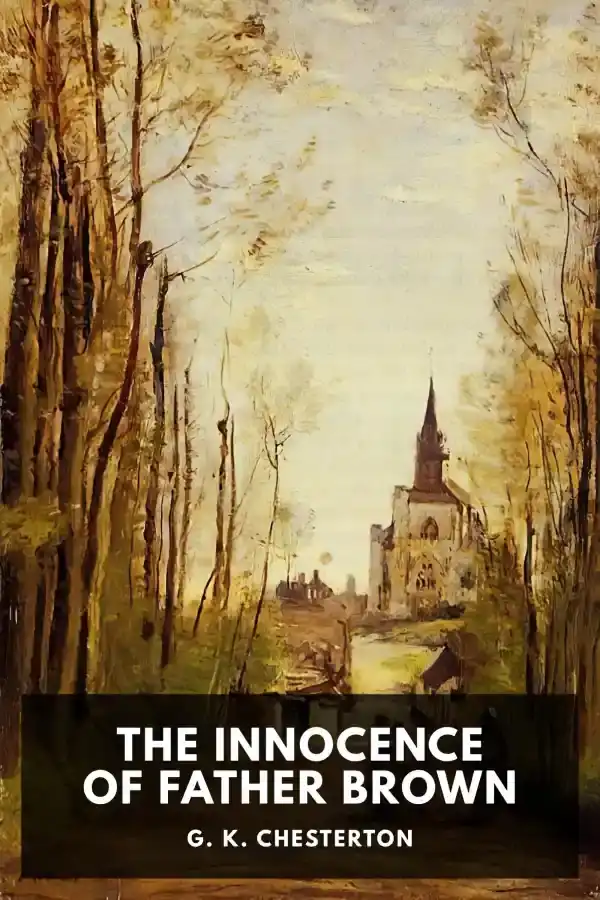
The Innocence of Father Brown
📖 Click to Read the Opening Pages Online Preview
The Blue Cross, the first story, opens:
Between the silver ribbon of morning and the green glittering ribbon of sea, the boat touched Harwich and let loose a swarm of folk like flies, among whom the man we must follow was by no means conspicuous—nor wished to be. There was nothing notable about him, except a slight contrast between the holiday gaiety of his clothes and the official gravity of his face. His clothes included a slight, pale grey jacket, a white waistcoat, and a silver straw hat with a grey-blue ribbon. His lean face was dark by contrast, and ended in a curt black beard that looked Spanish and suggested an Elizabethan ruff. He was smoking a cigarette with the seriousness of an idler. There was nothing about him to indicate the fact that the grey jacket covered a loaded revolver, that the white waistcoat covered a police card, or that the straw hat covered one of the most powerful intellects in Europe. For this was Valentin himself, the head of the Paris police and the most famous investigator of the world; and he was coming from Brussels to London to make the greatest arrest of the century.
Flambeau was in England. The police of three countries had tracked the great criminal at last from Ghent to Brussels, from Brussels to the Hook of Holland; and it was conjectured that he would take some advantage of the unfamiliarity and confusion of the Eucharistic Congress, then taking place in London. Probably he would travel as some minor clerk or secretary connected with it; but, of course, Valentin could not be certain; nobody could be certain about Flambeau.
It is many years now since this colossus of crime suddenly ceased keeping the world in a turmoil; and when he ceased, as they said after the death of Roland, there was a great quiet upon the earth. But in his best days (I mean, of course, his worst) Flambeau was a figure as statuesque and international as the Kaiser. Almost every morning the daily paper announced that he had escaped the consequences of one extraordinary crime by committing another. He was a Gascon of gigantic stature and bodily daring; and the wildest tales were told of his outbursts of athletic humour; how he turned the juge d’instruction upside down and stood him on his head, “to clear his mind”; how he ran down the Rue de Rivoli with a policeman under each arm. It is due to him to say that his fantastic physical strength was generally employed in such bloodless though undignified scenes; his real crimes were chiefly those of ingenious and wholesale robbery. But each of his thefts was almost a new sin, and would make a story by itself. It was he who ran the great Tyrolean Dairy Company in London, with no dairies, no cows, no carts, no milk, but with some thousand subscribers. These he served by the simple operation of moving the little milk cans outside people’s doors to the doors of his own customers. It was he who had kept up an unaccountable and close correspondence with a young lady whose whole letter-bag was intercepted, by the extraordinary trick of photographing his messages infinitesimally small upon the slides of a microscope. A sweeping simplicity, however, marked many of his experiments. It is said that he once repainted all the numbers in a street in the dead of night merely to divert one traveller into a trap. It is quite certain that he invented a portable pillar-box, which he put up at corners in quiet suburbs on the chance of strangers dropping postal orders into it. Lastly, he was known to be a startling acrobat; despite his huge figure, he could leap like a grasshopper and melt into the tree-tops like a monkey. Hence the great Valentin, when he set out to find Flambeau, was perfectly aware that his adventures would not end when he had found him.
That is only the first page of the pursuit. The twelve stories are complete in the free edition above, with their original titles and Chesterton’s own paragraph breaks.
Download Full EPUB1911
~78,000 words (estimated)
Approx. 4.3 hours
Father Brown stories
London, Paris and the English countryside, around 1900
12 stories
EPUB · AZW3 · KEPUB
0.44 MB (EPUB) · 0.56 MB (AZW3) · 0.46 MB (KEPUB)
Public domain in the United States
Project Gutenberg #204
The Innocence of Father Brown is the 1911 collection that introduced Chesterton’s small Catholic priest and set him against the most accomplished thief in Europe. Twelve stories carry the reader from a Harwich steamer and a London sweetshop to a Paris dinner table, a Norfolk island, a Scottish glen, a Hampstead attic and a Brazilian battlefield, and every one of them ends with an explanation that was in plain sight from the first page. Valentin, the great French policeman, is the first of several clever men to be beaten by a shabby priest with an umbrella. The book is a comedy about murder and a serious argument about how little confident eyes actually see.
Most of the stories appeared in magazines before Cassell collected them in 1911, when Chesterton was in his late thirties and already famous for paradox, argument and a comic epic about anarchists and policemen. This is the first of the five Father Brown volumes, and it establishes the pattern the later books refine: a crime that looks exotic and turns out to be domestic, an expert who is confidently wrong, a criminal who is charming, and a detective interested in ordinary consciences rather than in footprints. See Wikipedia’s article on The Innocence of Father Brown for its publication history, the magazine appearances and the growth of the priest’s reputation. The text is available via Project Gutenberg #204.
The Innocence of Father Brown by G. K. Chesterton: Summary, Characters & Themes
This page is a summary and analysis of The Innocence of Father Brown, the 1911 book in which G. K. Chesterton invented his clerical detective and, in the same twelve stories, invented the thief who becomes his friend. There is no continuing plot. A sapphire cross travels from Essex to London; a headless body turns up in a walled Paris garden; a fish dinner is interrupted by a theft; a Christmas charade ends in a blackout; a sealed flat in Camden Town produces a corpse; a Scottish castle is full of objects that will not add up; a poet is stabbed with his own garden dagger; a duel is fought on a Norfolk island; a hammer is found under a country church tower; a sun-worshipper is asked where he was at noon; a general’s reputation is taken apart in a churchyard; and a philanthropist falls from a Hampstead garden. What unites them is method, not plot: Brown solves cases by noticing what other people have already seen and misread.
Chesterton was born in Kensington in 1874, trained as an artist at the Slade and drifted into Fleet Street, where he wrote leaders, reviews, comic verse and arguments at a speed that alarmed his editors. By 1911 he had published The Man Who Was Thursday, a nightmare romance about anarchists and detectives, and Orthodoxy, a defence of Christian belief built out of jokes. He was not yet a Catholic, that came in 1922, but the priest at the centre of these stories was already modelled on Father John O’Connor, a parish priest from Bradford whom Chesterton had met in 1904. Chesterton always said the priest had been given to him rather than invented, and the debt is visible in the method as much as in the manner.
The method is the real invention. Brown has no laboratory, no fingerprint kit and no interest in the fashionable sciences of detection. He has heard confessions, which means he knows what temptation feels like from the inside, and he has spent his life among people who are not clever, which means he does not confuse cleverness with truth. Where Sherlock Holmes reads a room, Brown reads a conscience. Chesterton uses him to argue that the miraculous and the criminal are both ordinary, and that a mind which has decided in advance how the world works will misread the world. Valentin, in the first story, puts the danger himself: the criminal is the creative artist and the detective only the critic.
The settings are more various than the series’ reputation suggests. A Harwich steamer, a Paris house with a walled garden, a London hotel dining room, a Kensington drawing room, a Camden Town block of flats, a Scottish castle, a riverside villa, a Norfolk island, a country churchyard, a new block of flats in Westminster, a Brazilian battlefield and a Hampstead house on a railway bank each supply a different kind of stage, and several of the stories treat the world as a theatre with a curtain that can be pulled back. Chesterton is especially interested in respectable crime: the murderer is as likely to be a colonel, a doctor or a philanthropist as a burglar, and the police are usually the least useful people in the room. The book also carries the assumptions of its period about race, empire and foreign cults, and a modern reader will notice them.
The collection was well received and has never been out of print. It contains at least three stories that later anthologies treat as essential Father Brown, including the first meeting of the priest and the thief and the frozen churchyard conversation that is often called the best thing Chesterton wrote in the form. Readers who want the next volume can find The Wisdom of Father Brown on this site; for the detective of the neighbouring decade there is The Return of Sherlock Holmes, and for another crime story from the same years, The Man in the Brown Suit. The complete text is the Project Gutenberg transcription (#204), and Chesterton’s author page on this site lists his other books. For his life, see Wikipedia’s article on G. K. Chesterton.
Historical Context
The Innocence of Father Brown appeared in 1911, collected by Cassell after the stories had been written and published separately over the previous two or three years. The market for short detective fiction was enormous. The Strand Magazine had made Sherlock Holmes a national figure, and every monthly and weekly with space to fill wanted a series detective with a recognisable manner and an endless supply of puzzles. Chesterton, one of the most prolific journalists in London, wrote the Brown stories quickly and cheerfully, and the haste is part of their charm: they are full of digressions, jokes and loose ends that a more careful craftsman would have tidied away.
Edwardian Britain was a country that had recently discovered the machine. Motor-cars, telephones, ocean liners, cheap newspapers and the cinema were changing what people could do and what they thought other people were doing. Chesterton loved much of it and distrusted most of it. The stories are full of new machinery, from the ocean steamer that opens the book to the elaborate security of a Camden Town flat, and the machinery is usually wrong. Set against it is a priest who carries no equipment at all and who solves cases by looking at a hat, a parcel, a pair of boots, the way a man cuts bread or the hour at which the sun rises.
The book also belongs to the last years of the old Europe. Its duels, its little aristocracies, its gentlemen’s clubs and its confident talk of national character were all about to be tested by a war that began three years after publication. Chesterton’s own politics, a distributist suspicion of large states and large businesses, are visible in the distrust of officials and experts that runs through the collection, and so is a Catholic sense of sin that makes the stories darker than their comic surfaces. The first story is a farce about a conjurer, and the eleventh is a meditation on a war crime and a national lie; the distance between them is the distance the book travels.
Key Characters & Literary Archetypes
- Father Brown: Brown is short, round-faced, shabby and impossible to embarrass. He carries a large umbrella, several brown paper parcels and a hat that looks like a mushroom; he forgets names, spills things and is mistaken for a fool by almost everyone he meets. His method is moral rather than scientific: he asks what a person in a given temptation would actually do, and he notices clothing, food, weather and manners. He is also harder than he looks: he knows how much harm people do, and he does not pretend that the criminals are merely misunderstood.
- Flambeau: Flambeau is the giant Frenchman who begins the book as the most wanted thief in Europe and ends it as the priest’s friend. In the first story he is the pursued, a master of disguise who leaves a trail of deliberate absurdities; later he tells a story himself, in a highly moral old age, and by the end of the book he is a private detective with offices in Westminster. He is the reader’s second opinion, the practical man who laughs at the priest’s fancies and then discovers that the fancies were method.
- Aristide Valentin: Valentin is the head of the Paris police and the most famous investigator in Europe: lean, dark, courteous, with a reputation built on patience and a talent for thinking like the criminal he is hunting. He is the book’s first rationalist and its first lesson in the limits of rationalism. His pursuit of Flambeau is a masterpiece of method, and it fails because it cannot account for a man who behaves unreasonably on purpose. He reappears in The Secret Garden, where the impossibility he must explain is much closer to home.
- Paul Saradine: Paul Saradine is a prince with a small island, a large house full of mirrors and a manner that is charming, nervous and slightly wrong. He talks about his brother Stephen, invites strangers to dinner, keeps a butler who drinks and a wife who sulks, and lives in fear of a man in a boat. He is Chesterton’s study of the aristocrat as performance: every room he owns reflects him, and none of the reflections quite agree with the others.
- Julius K. Brayne: Brayne is the American millionaire of The Secret Garden, a philanthropist with a scheme for the world and a habit of announcing that he is the one man alive who can carry it out. He is large, bald, cheerful and entirely sure of himself, and his certainty is the thing the story examines. Chesterton uses him to mock the religion of progress, and then to make the reader feel the pathos of a man who has bought everything except the ability to be wrong.
- Israel Gow: Gow is the servant of Glengyle, a small grim Scotsman with a passion for exactness: he has inventoried every object in the castle, counted every coin and weighed every scrap, and he will not tell a lie even when the truth is ruinous. His honesty is the engine of the story. Chesterton makes him comic and then terrible, a man whose probity has become a kind of madness, and whose account books are more frightening than any ghost in the glen.
Core Literary Themes
- The obvious clue: Almost every story is built on something that was in plain view. Salt in the sugar basin, soup thrown at a restaurant wall, a parcel posted to the wrong address, a pair of feet heard in a passage, a sheet of paper with one corner cut off, a hammer too small for the work, a lift shaft with no lift in it. Chesterton’s detective does not find hidden evidence; he interprets evidence that the police, the experts and the reader have already seen. The theme is also a joke at the reader’s expense, since the clues are handed over and still missed.
- Respectable crime: The criminals here are colonels, doctors, philanthropists, princes and heads of police, and the detective’s job is usually to separate a man from his reputation rather than from his guilt. Chesterton is fascinated by the way a good name works as an alibi, and by how much damage can be done by someone who is never suspected because he is socially agreeable. The police, when they appear, are decent and slow; the real investigation is an inquiry into character. This is one of the respects in which the Brown stories differ most sharply from the Holmes stories.
- Paradox and the limits of reason: Chesterton wrote these stories to argue, gently, that the rationalist is often the most credulous man in the room. Brown does not reject reason; he insists that reason is not the same thing as a theory, and that a mind which has decided how the world works will misread the world. The collection is full of miracles that turn out to be mundane and mundanities that turn out to be appalling, and its favourite move is the reversal in which the safe explanation is more frightening than the supernatural one. Belief, in these pages, is a form of attention.
- Disguise and performance: These are stories about theatre. A thief dresses as a priest, a prince arranges his life as a tableau, a family stages a pantomime, a cult stages a sunrise, an officer stages a battle, and a man plays his own enemy so well that he can accuse himself. Chesterton keeps reminding us that the events of the book are being arranged for spectators, and that the detective’s task is to notice the stagecraft. The mirrors on Prince Saradine’s island are a parable of the whole collection: what looks like a monster is the observer reflected.
- Mercy and the seal of the confessional: Brown is a priest before he is a detective, and the two vocations collide. He hears confessions, and what he hears he cannot always use; he forgives people the law would hang, and he refuses to be sentimental about what they did. The last two stories in particular turn on mercy that looks like weakness and on judgement that looks like cruelty, and the book’s moral centre is the moment when the little priest, having understood everything, decides what to say out loud. That decision, not the solution, is usually the real ending.
Why Download Our Custom E-Reader Edition of The Innocence of Father Brown?
The Father Brown stories are usually read in anthologies, one famous case at a time, and that is a shame, because this book was arranged as a sequence. Read in order, the twelve stories show the series inventing itself: the first is a chase across London with a thief in disguise, the middle stories turn on clubs, inheritances and country houses, and the last two are as bleak as anything Chesterton wrote. The range is the point. A reader who knows only the famous first story has not met the Scottish inventory, the frozen churchyard or the philanthropist on the railway bank.
The text is a pleasure to have in a clean digital edition. Chesterton’s prose is fast, funny and full of argumentative asides, and his sentences are long in a way that careless typesetting often mangles. Here the stories keep their own paragraph breaks, their italics and their jokes, each one begins on a new page with its original title, and nothing has been modernised, abridged or silently corrected.
The files are built for the device you already own. EPUB works on most e-readers and tablets, AZW3 on Kindle and KEPUB on Kobo, and all three carry the same cover, a working table of contents and no digital rights management. There is no account to create and no sample to upgrade; the whole book is free, and it is in the public domain in the United States, so you can copy it, keep it and give it away. It also works offline, which is more than can be said for a page like this one.
- Project Gutenberg transcription, via Project Gutenberg #204 the complete 1911 text of all twelve stories, with the original titles, no cuts, no rewrites and no silent modernisation of Chesterton’s spelling or punctuation.
- Twelve stories in order every case from The Blue Cross to The Three Tools of Death, in the order Chesterton arranged them, each with a short summary that gives the setting, the people and the problem without giving away the solution.
- Real chapter marks each story is a separate chapter in the EPUB, with its own entry in the table of contents, so you can finish one case at bedtime and begin the next one tomorrow without losing your place.
- Three formats EPUB for most readers, AZW3 for Kindle and KEPUB for Kobo, built from the same source text, with the same cover and no digital rights management of any kind.
- The Wisdom of Father Brown — free EPUB, AZW3 & KEPUB
- The Man in the Brown Suit — free EPUB, AZW3 & KEPUB
- The Return of Sherlock Holmes — free EPUB, AZW3 & KEPUB
Chapter summaries
The twelve stories are listed in the order Chesterton placed them in 1911. Each entry sets up the case as the reader first meets it, and none of them gives away the solution.
- The Blue Cross: Aristide Valentin, head of the Paris police, crosses to England to arrest the thief Flambeau and at Harwich notices a short Essex priest with several brown paper parcels and a large shabby umbrella. The priest mentions a silver cross with blue stones, and Valentin loses sight of him. Then the trail begins: salt in the sugar basin, soup thrown at a restaurant wall, a shop window smashed with an umbrella, a parcel posted to an address in Westminster. Valentin follows the absurdities across London to a suburban villa, convinced that a criminal is being whimsical on purpose.
- The Secret Garden: At Valentin’s house in Paris, a dinner of notables ends with a corpse in the walled garden: a headless body, the gate locked, no footprints, no weapon, and a doctor who has just written a treatise on the subject. The guests include an Irish commandant, a famous surgeon, an American millionaire and Father Brown, who has come to Paris to see the sights. Valentin lists the impossibilities, weighs each theory in turn, and finds that the neatest explanation is the one nobody at the table wants to consider.
- The Queer Feet: It is the annual dinner of the Twelve True Fishermen at the Vernon Hotel, where the fish knives and forks are famous and the waiters move in a silent file. Father Brown, in the hotel on other business, is found standing in a passage with his head cocked, listening to footsteps. A diner’s silver has gone, the staff are searched, and a coat is found heavy with silver. Brown says he has heard twelve feet that were not twelve men, and that the crime was over before anyone knew it had been committed.
- The Flying Stars: A Kensington Christmas: Colonel Adams’s family performs an amateur pantomime, Flambeau plays Harlequin in borrowed costume, and the Adams diamonds, three stones known as the Flying Stars, are brought out of the safe to be admired. During the charade the lights go out and the stones vanish from the drawing room. The house is searched, the windows are tight, and the socialist poet next door who despises the family’s money is the obvious suspect. Brown, who has been watching the pantomime rather than the search, is the only person who is enjoying himself.
- The Invisible Man: Camden Town in blue twilight: John Turnbull Angus, a billiard marker turned shopkeeper, is in love with Laura Hope, who is being courted by Isidore Smythe, an inventor of clockwork figures who has made a fortune and lives in a new block of flats called Himylaya Mansions. Smythe has been receiving threatening letters from a man named Welkin and is guarded by three detectives. On a sleety evening Smythe is murdered in a room sealed by police, and nobody was seen to enter or leave. Brown asks what a man would do if he wanted to be invisible.
- The Honour of Israel Gow: Glengyle Castle stands at the end of a Scottish glen, and its owner, an old earl, has died. Father Brown comes north on holiday and finds the household in a strange mood: the heir is waiting, the servants have gone, and the estate is being inventoried by a grim little man named Israel Gow. The inventory makes no sense. Objects that should belong together do not, the accounts balance in ways that do not add up, and there is a body in the glen without its head. Gow’s honour, Brown discovers, is a very old and exact thing.
- The Wrong Shape: Leonard Quinton, a successful minor poet of the Decadence, writes his Oriental romances at a long table in a riverside house, surrounded by his wife, his doctor, and a young man in a red tie who has come to demand money. In the garden a dagger hangs from a tree and an Indian mystic sits under it, and Quinton is delighted by the effect. One afternoon the doctor finds him stabbed through the heart with a note in his hand that confesses suicide and murder at once, written on a sheet of paper whose shape is wrong.
- The Sins of Prince Saradine: Flambeau takes his holiday in a small sailing boat on the Norfolk rivers and asks Father Brown to come. A letter from Prince Paul Saradine invites them to Reed Island, a house full of mirrors where the prince lives with his brother Stephen, a sullen wife and a butler who drinks. The prince is charming, nervous and afraid of a man in a boat; an Italian duelist named Antonelli arrives demanding satisfaction for a father killed in a duel years before. In the mirrored house, every guest seems to be watching someone else.
- The Hammer of God: Bohun Beacon is a village with a smithy at the bottom of the hill, a church at the top, and two brothers who hate each other: Colonel Norman Bohun, who is carrying on with the blacksmith’s wife, and his brother Wilfred, the curate, a nervous ascetic who cannot look at his brother. One Sunday the colonel is found dead in the churchyard below the tower, his head crushed, and the only weapon is a small hammer from the forge, too light for the work. The curate’s theory, the doctor’s theory and the blacksmith’s alibi are all examined in turn.
- The Eye of Apollo: Flambeau, now a private detective with offices in a new block of flats above the Thames, shares his building with the Church of the Sun, a cult whose prophet Kalon wears a robe and looks at London as if it were a slum. The Stacey sisters live on the top floor: Pauline, blind, rich and serene, and Joan, who runs the household. Pauline takes the cult’s advice about her soul and her will, and then falls down an empty lift shaft in a building whose lift does not work. Brown asks what the sun-worshipper’s alibi actually proves.
- The Sign of the Broken Sword: On a frosty night Father Brown takes Flambeau to a village churchyard to look at the tomb of General Sir Arthur St. Clare, hero of the Black River, whose men were cut to pieces in Brazil and who was hanged with his own broken sword round his neck. Brown has visited every monument to the man in England and found one word missing from each. He tells it as they walk the frozen woods: a general who attacked when he should have waited, a Brazilian president who hanged one prisoner in a lifetime, and a major named Murray.
- The Three Tools of Death: Sir Aaron Armstrong, the cheeriest philanthropist in England, is found broken on the railway bank below his Hampstead house, and his servant Magnus stops a train to shout murder. Nothing in the house is quite what the official story says: the secretary Patrick Royce is drunk and accusing himself, the daughter Alice is pale and terrified, and three separate instruments of death lie about the attic room. The police have a theory about twenty thousand pounds. Father Brown, who dislikes professional cheerfulness, counts the weapons and finds too many.
The Innocence of Father Brown: Frequently Asked Questions
Is The Innocence of Father Brown a novel or a collection of stories?
Do I need to read the stories in the order Chesterton put them in?
Who is Flambeau?
Was Father Brown based on a real priest?
Which story in the collection is the most famous?
Is the book difficult to read?
Is The Innocence of Father Brown in the public domain?
Where can I download The Innocence of Father Brown for free?
Part of: Detective & Mystery Classics · Short Classic Novels