Plays by Susan Glaspell: Free EPUB, AZW3 & KEPUB Download

Plays
📖 Click to Read the Opening Pages Online Preview
A farm kitchen left in the middle of its work
SCENE: The kitchen is the now abandoned farmhouse of JOHN WRIGHT, a gloomy kitchen, and left without having been put in order—unwashed pans under the sink, a loaf of bread outside the bread-box, a dish-towel on the table—other signs of incompleted work. At the rear the outer door opens and the SHERIFF comes in followed by the COUNTY ATTORNEY and HALE. The SHERIFF and HALE are men in middle life, the COUNTY ATTORNEY is a young man; all are much bundled up and go at once to the stove. They are followed by the two women—the SHERIFF’s wife first; she is a slight wiry woman, a thin nervous face. MRS HALE is larger and would ordinarily be called more comfortable looking, but she is disturbed now and looks fearfully about as she enters. The women have come in slowly, and stand close together near the door.
COUNTY ATTORNEY: (rubbing his hands) This feels good. Come up to the fire, ladies.
MRS PETERS: (after taking a step forward) I’m not—cold.
The excerpt closes on Mrs Peters’ answer to the county attorney at the stove, before the men go upstairs and the two women begin to look about them.
Download Full EPUB1916-1921
Plays
~57,000 words (estimated)
Approx. 3.2 hours
Standalone
Provincetown and the American Midwest, 1916-1921
Four plays in nine parts
EPUB · AZW3 · KEPUB
0.19 MB (EPUB) · 0.31 MB (AZW3) · 0.23 MB (KEPUB)
Public domain in the United States
Project Gutenberg #10623
This volume prints four plays by Susan Glaspell in the order given here. Trifles is a single act in an abandoned farm kitchen, where a sheriff’s wife and a neighbour’s wife see what the men searching for evidence walk past. The Outside is a single act on the Cape Cod dunes, with a drowned man on the table and two women talking into the night. The Verge runs three acts around a plant breeder and the flower she has pushed past its kind. Inheritors runs four acts, from a pioneer’s gift of land in 1879 to a college town in 1920.
These are stage pieces, and the volume prints their staging notes as well as their dialogue: the first performance of Trifles at the Wharf Theatre in 1916, of The Outside at the Playwrights’ Theatre in 1917, of Inheritors and The Verge at the Provincetown Playhouse in 1921. Each play keeps to a small cast and one or two sets, and each turns on a person who will not say the expected thing. Background on the first of the plays is on the Susan Glaspell page. The text is available via Project Gutenberg #10623.
Plays by Susan Glaspell: Summary, Characters & Themes
This page is a reading guide, summary and analysis of Plays by Susan Glaspell, the four dramas printed together under that plain title: Trifles, The Outside, The Verge and Inheritors. They were written for small stages and small casts, and they share a habit of putting an argument on stage instead of a plot. A farm kitchen, a stretch of dune, a greenhouse, a college library: each room is a pressure chamber in which someone is asked to give up what she or he knows. The guide follows the printed order of the volume, describes what happens in each act, and points to the lines where the plays turn. Quotations are short, and this page does not replace the text. Because the volume carries no introduction and no notes, the guide also marks the places where background has to come from outside it.
Susan Glaspell (1876-1948) was a novelist, reporter and playwright from Iowa, and these plays belong to the years when she was writing for the Provincetown Players, the company that first staged them on Cape Cod. Nothing in this volume introduces her, and it prints no preface, dedication or note on the text; the plays simply follow one another. Her name appears on the title page as the author of all four, and the only other persons named in the volume are the characters and the actors implied by their lines. The Wikipedia entry on Susan Glaspell supplies the biography that the volume leaves out, including the Greenwich Village years and the novels that came later. Read the plays first; the entry is more useful afterward, when their questions have taken shape.
Trifles is the shortest and the most often anthologised. A sheriff, a county attorney and a neighbour tramp through a farmhouse looking for a motive, while their wives gather a few things to take to the woman in jail. The men see nothing; the women see everything, and the play ends on two words of kitchen talk. The Outside is stranger and slower, set in a life-saving station that the sand is burying, with a man drowned offshore and two women who have each lost something arguing about what the dunes are for. Both plays do their work in about half an hour, and both end without a verdict. Trifles is the kitchen-side answer to the marriage play, and A Doll’s House is the play it answers.
The Verge is the experimental piece and the longest single study. Claire Archer breeds plants in a greenhouse and has produced a flower that has gone past the form of its kind; the play watches her try the same thing with the people around her, and counts the cost. It has three acts and three settings: the greenhouse, the tower she bought for its shape, and the greenhouse again on the morning the flower opens. The language is broken, repetitious and violent on purpose, and the last act is one of the strangest in American drama of the period. Readers who know the stage comedy of these years will find the opposite of The Importance of Being Earnest here: the same years, the same stages, and no wit at all.
Inheritors is the most public of the four. Its first act is set on the Fourth of July in 1879, when Silas Morton gives away the hill above his farm for a college; the remaining three acts take place in 1920, in the college that gift built, where his granddaughter is arrested for defending two Indian students and a professor is asked to keep quiet. The play is about inheritance in the plain sense and in the harder one, and it is the reason the volume reads as a sequence rather than a collection. The full text is at Project Gutenberg #10623, and the other volumes on the shelf are gathered under Classic Fiction.
Historical Context
The volume prints four first performances, and they are the firmest dates in it. Trifles was given by the Provincetown Players at the Wharf Theatre in Provincetown, Massachusetts, on 8 August 1916. The Outside followed at the Playwrights’ Theatre on 28 December 1917. Inheritors opened at the Provincetown Playhouse on 27 April 1921, and The Verge at the same theatre on 14 November 1921. Those lines are all the stage history the book supplies; it prints no cast lists beyond the characters, no reviews, no photographs and no editor’s preface. Where a production is mentioned elsewhere on this page, it is this printed record that is being quoted, not a separate account.
These are the years of the little theatre and the one-act play in the United States, when companies performed in converted buildings and wrote for the audience in the room rather than for a Broadway house. Glaspell’s plays assume a stage a few feet deep: a kitchen table, a stove, a trap-door, a wall of books. The volume itself gives no account of that movement, and a reader who wants it must look outside the text. What the plays do show is the pressure of the period on the people in them, the war, the strikes, the deportations, and the argument over what an American is, which Inheritors stages directly in its second and third acts. The plays were written during those years and first staged while the argument was still going on.
One connection is often made and cannot be checked here. Before she wrote Trifles, Glaspell reported a murder trial in Iowa, and the play is usually said to grow out of that case; this volume never mentions it, and nothing in the text confirms the debt. Treat the link as background rather than as a key, because the play stands without it. Two of the four carry 1921 beside their first-performance lines and two carry dates from years before, so the volume gathers plays that had been on stage for some time. They were not written together and do not share a single occasion, which is part of why they read as a sequence rather than a set.
Key Characters & Literary Archetypes
- Claire Archer: The plant breeder of The Verge, who has made a flower that has gone past its kind and wants to make the same leap with the people around her. She talks in fragments, breaks whatever is nearest, and calls herself too sane rather than mad. She is the volume’s portrait of the artist as a destructive force, and her last scene takes place in front of a broken pane, with a hymn.
- Mrs Hale: The neighbour in Trifles who remembers Minnie Foster as a girl in a white dress with blue ribbons, singing in the choir. She is the one who reads the kitchen, and who decides, without ever saying so, what the county attorney will not be shown. She is the play’s memory and its judge, and her own marriage is in the room with her.
- Mrs Peters: The sheriff’s wife in Trifles, slight and nervous, who lost a baby in Dakota and says she knows what stillness is. She sits apart from the men’s questions, and it is her hand that finally reaches for the thing in the sewing basket. She has no authority in that house and uses the little she has.
- Silas Morton: The pioneer farmer of Inheritors, first seen in 1879 refusing to sell the hill above the town and then giving it away for a college. He speaks of a debt to the Indians and to the refugee who taught him what learning is for. He is the play’s founder and its conscience, and he is already dead when the second act opens.
- Madeline Fejevary Morton: Silas Morton’s granddaughter, a senior at the college in 1920, who strikes a policeman to stop him taking a student away and gives up her legacy rather than apologise. She is the play’s heir and its accuser at once, and the only character who has to decide what the family’s old words are worth.
- Professor Holden: The scholar of Inheritors who stayed at the college because Silas Morton asked him to, and who is now asked to be discreet about a conscientious objector and two Indian students. He is the play’s study of compromise, and its most honest voice, since he names his own reasons instead of dressing them up.
Core Literary Themes
- The trifle as evidence: Trifles turns on things a farmhouse keeps: a half-finished quilt, a broken stove, a cage with the door torn off, a bird with its neck wrung. The men are looking for a motive and cannot see the kitchen, because they have already decided it holds nothing worth seeing. The play’s argument is that the small and the domestic is evidence, and that the people who can read it are the ones nobody thought to ask. The title says as much, and so does the last line, which is two words long and settles everything without explaining anything. Glaspell never lets a character explain the symbolism; the objects do the work and the people in the room do the rest.
- What the outside holds: The Outside takes its name from the shore beyond the station, where the sand moves and the woods are being buried. Two women who have each lost a man argue about whether the outside is a thing to fight or a thing to meet. The play refuses to settle the question and lets the wind answer instead. In Glaspell’s work the outside is never scenery; it is the part of life that a room cannot hold, and the part that keeps pressing at the glass of the greenhouse in The Verge as well.
- Form and the breaking of it: Claire Archer breeds for a flower that goes past the form of its kind, and the three acts of The Verge ask whether a person can do the same. The plants carry the argument and the people are the test of it. What makes the play hard is that it does not admire the breaking without also showing what the breaking costs the ones standing nearby. Form is a prison in this play, but it is also the only shape a life has, which is why the ending is neither a triumph nor a defeat, and why Claire’s own account of what she wants comes out in broken sentences.
- Inheritance and the price of the land: Inheritors moves between a deed signed in 1879 and a college celebrating its fortieth year in 1920, and asks what was handed down and who paid for it. Silas Morton gives away the hill because he owes a debt to the people the land was taken from. His granddaughter inherits the debt rather than the land, and the play lets her choose it when the choice costs her everything. The word in the title carries both meanings at once, property and obligation, and the dates printed at the head of each act make the contrast the argument rather than a speech about it.
- Dissent and the American claim: The 1920 acts of Inheritors are full of the language of the period: radicals, deportations, the Legion, one hundred per cent American. Madeline answers a policeman with the claim that this is America, which is the same claim her grandfather made about a hill. The play does not settle the argument so much as show how quickly a country’s own slogans can be turned against the people who quote them. Holden’s private version of the same problem, whether to stay inside an institution that asks him to be quiet, is the quieter half of the theme, and he is not a villain, only tired.
Why Download Our Custom E-Reader Edition of Plays?
The text here is the complete Project Gutenberg transcription of the volume, not an excerpt or a single play pulled out of it. All four dramas are present in the printed order, with their character lists, their first-performance lines and their stage directions intact. Nothing is modernised, abridged or re-spelled, so a line quoted in a classroom or a review can be found where the volume puts it. Each play is complete, including the passages that anthologies of Trifles alone usually leave out, and the acts are not cut.
The file is built for reading rather than for scanning. Each play and each act begins as its own heading, so the nine parts of the volume are easy to find, and the dialogue keeps the printed line divisions instead of collapsing into paragraphs. It opens in any reader, on a phone, a tablet or a dedicated e-reader, and it stays small enough to keep on a device alongside a dozen other titles. There are no page images to wait for and no scans to zoom into, which matters with a text that turns on two words at the end of a line.
The volume itself has no notes, no introduction and no critical apparatus, and this edition does not invent any. What it adds is navigation and clean type, and nothing that would come between a reader and the page. If you want the source, the transcription used here was released as Project Gutenberg #10623, and the plays there are the same four, in the same order, with the same wording. A comparison of any paragraph will show that nothing has been rewritten to make the plays easier to teach.
- Project Gutenberg transcription, via Project Gutenberg #10623 is the complete text used for this edition, with the four plays in their printed order and every stage direction kept.
- Four plays, complete Trifles, The Outside, The Verge and Inheritors all appear here in full, with every act and every stage direction, rather than as extracts or a single acting text.
- Act and play headings Each play and each act opens as a heading, so the nine parts of the volume can be found at a tap and the act breaks do not blur into the dialogue.
- Small file, no scans The book is plain text, a few hundred kilobytes, with no page images, so it opens quickly, searches cleanly and keeps its place on any reader.
- Every Glaspell title on the shelf, with the four plays gathered in one place and the novels listed beside them. — free EPUB, AZW3 & KEPUB
- The wider shelf of free classics, from Ibsen and Wilde to the American writers of the same years, all in the same clean format. — free EPUB, AZW3 & KEPUB
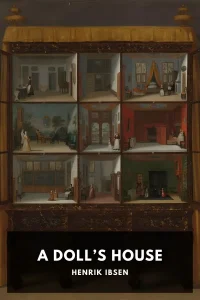
- Ibsen’s marriage play, the obvious companion to Trifles and the play that Glaspell’s kitchen answers from the other side of the door. — free EPUB, AZW3 & KEPUB
Chapter summaries
The volume prints four plays in one order and gives them no titles beyond their own. Each group below covers one act, or one whole one-act play, and keeps to what the printed stage directions and dialogue say. Short quotations are the characters’ own words, and no scene is described that the text does not put on the stage.
- Play 1 – Trifles, the kitchen and the dead bird: A winter morning in the abandoned Wright farmhouse. The sheriff, the county attorney and a neighbour come in to look for a motive, and the two wives who wait by the door notice what the men walk past: an unfinished quilt, the unwashed pans, a cage with its door torn off, and a bird with its neck wrung.
- Play 2 – The Outside, the dunes and the drowned man: A life-saving station on the outer shore, half buried in sand. A drowned man is carried in and the captain works over him while a city woman and a silent local woman wait. What they say to each other about the dunes, the woods and the sea is the whole action of the play, and nobody is saved.
- Play 3, Act I – The Verge, the greenhouse and the vine: Morning in Claire Archer’s greenhouse, where Anthony keeps the heat up and a strange vine is turning back on itself. Her husband, a painter and a friend who is sailing for India sit at breakfast. Her daughter comes home from Europe, and Claire, who has been breeding a flower past its kind, begins to break the room apart.
- Play 3, Act II – The Verge, the tower and the doctor: After dinner, in the tower Claire bought for its shape, her sister talks of unity and a nerve specialist is brought up. The talk turns to drawings, to a song on the gramophone and to a son who died. Tom is called up the stairs, refuses what she offers him, and she runs down to stop the music.
- Play 3, Act III – The Verge, Breath of Life: Next morning the new flower has opened and its form has held. Harry hunts Dick through the greenhouse with a revolver, Anthony stands between them, and Claire takes the gun away. Tom comes back to say he will stay, and Claire gives him her last gift with her hands. She fires once into the glass and sings.
- Play 4, Act I – Inheritors, the hill and the deed: Fourth of July, 1879, in the Morton farmhouse back from the Mississippi. A young man asks Silas Morton to sell the hill above the town; Silas refuses, then offers the deed away for a college, holding it out to Felix Fejevary, the refugee from Hungary, who does not take it. His mother objects that they were first here.
- Play 4, Act II – Inheritors, the anniversary and the handbills: Forty years on, in the library of Morton College, a state senator is shown the portrait of Silas Morton and asked for an appropriation. Two Indian students are handing out bills on the campus and Horace’s crowd breaks it up. Madeline Morton strikes a policeman with her tennis racket and is taken to the station.
- Play 4, Act III – Inheritors, the professor and the window: Holden sits with Emerson and Whitman and Fejevary comes to ask him to be discreet. The talk turns to Greece, to Silas Morton, to a conscientious objector in prison and to the Indian students, who are to be dismissed. Madeline is brought in and says she will give her legacy to them and go out to the crowd again.
- Play 4, Act IV – Inheritors and the land: A week later at the Morton place, on Madeline’s twenty-first birthday, her father turns over his corn and cannot let it go. Emil Johnson comes to take her to the commissioner, Aunt Isabel brings a tennis racket and a party, and Holden argues for staying inside. Madeline chalks the dimensions of a cell on the floor and stands in it.
Plays: Frequently Asked Questions
How many plays are in this volume?
In what order are the plays printed?
Which plays are one act?
What happens in Trifles?
What is The Verge about?
What is Inheritors about?
Is this a scholarly edition with notes?
Where can I read the full text?
Part of: Classic Fiction · Susan Glaspell