A Doll’s House by Henrik Ibsen: Free EPUB, AZW3 & KEPUB Download
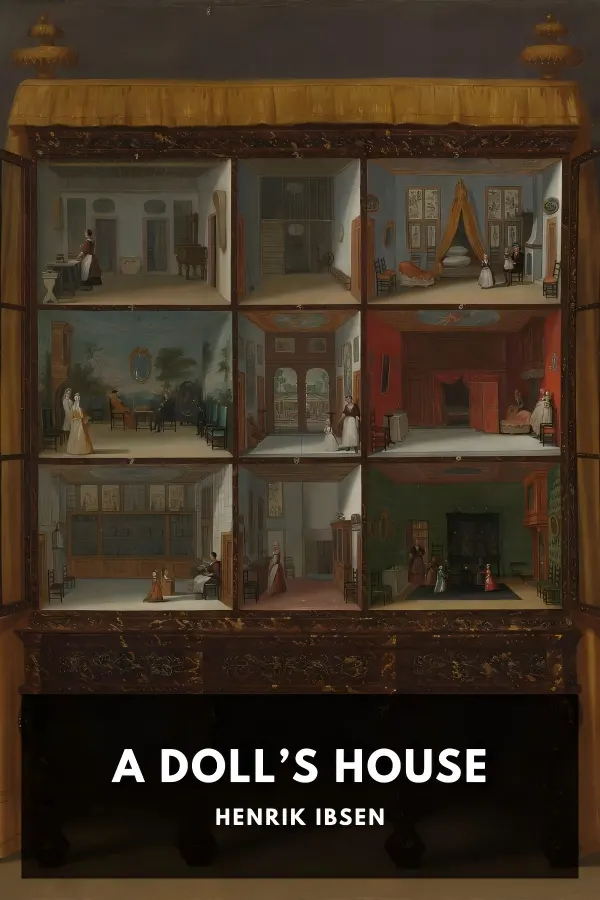
A Doll’s House
📖 Click to Read Act I Online Preview
Act I
Hide the Christmas Tree carefully, Helen. Be sure the children do not see it until this evening, when it is dressed. [To the Porter, taking out her purse.] How much?
Porter: Sixpence.
Nora: There is a shilling. No, keep the change. [The Porter thanks her, and goes out. Nora shuts the door. She moves about the room humming contentedly, takes off her cloak and hat, takes a packet of macaroons from her pocket and eats one or two, then goes cautiously to her husband’s door and listens.] Yes, he is in.
Read the complete, unabridged text of Henrik Ibsen’s masterpiece in your preferred format.
Download Full EPUBA Doll’s House is an 1879 realist play by Henrik Ibsen, a three-act drama set in a Norwegian town that follows Nora Helmer, a banker’s wife whose comfortable marriage unravels when a secret debt from her past resurfaces, exploring themes of marriage, duty, selfhood, and the gap between law and conscience. This Standard Ebooks edition, translated by R. Farquharson Sharp in 1910, is based on Project Gutenberg #2542 and Internet Archive scans, and is in the public domain in the United States; readers outside the US should check their local laws. The text is available via Standard Ebooks.
A Doll’s House by Henrik Ibsen: Summary, Characters & Themes
Henrik Ibsen published A Doll’s House in 1879, reshaping European realist theatre. This summary and analysis explores how the play challenges middle-class marriage and Victorian social decorum.
The drama unfolds in the Helmer household over Christmas. Nora Helmer secretly took an illegal loan years ago to finance a trip that saved her husband’s life. Her secret unravels when Torvald secures a promotion at the Joint Stock Bank.
Nils Krogstad, a disgraced bank clerk holding her forged promissory note, faces dismissal by Torvald. Desperate to protect his reputation, Krogstad blackmails Nora into securing his reinstatement. Nora conceals the escalating threat while struggling to preserve her domestic illusion.
When Torvald discovers the letter exposing her deception, he erupts with selfish fury over his social standing. A subsequent pardon arrives from Krogstad, yet Torvald’s instant relief fails to heal the rift. Nora realizes her husband never loved her as an independent human being.
Ibsen wrote several further realist masterworks, including Ghosts (1881) and Hedda Gabler (1890). Both dramas extend his rigorous critique of domestic hypocrisy and societal repression.
This digital edition presents the classic English translation by R. Farquharson Sharp, first published in 1910. The text derives from Project Gutenberg #2542 alongside scans from the Internet Archive. Readers can also inspect the source version on Standard Ebooks.
Historical Context
Premiering at Copenhagen’s Royal Theatre in December 1879, the play ignited fierce controversy across Europe. Victorian audiences recoiled at Nora’s rejection of parental and marital duties. Ibsen denied writing a feminist treatise, arguing instead for universal human self-realization.
Key Characters & Literary Archetypes
- Nora Helmer (The Doll-Wife): Nora transforms from a seemingly frivolous, dependent wife into a self-reliant woman who rejects societal servitude.
- Torvald Helmer (The Paternalistic Husband): A respectable bank director whose moral rectitude masks profound vanity, rigid conventionality, and cowardice under duress.
- Nils Krogstad (The Moral Antagonist): A desperate moneylender and social outcast whose blackmail exposes the fragility of bourgeois respectability.
- Mrs. Christine Linde (The Pragmatic Realist): A widowed schoolfriend whose hard-won financial independence and emotional honesty serve as Nora’s thematic foil.
- Dr. Rank (The Tragic Confidant): A terminally ill family friend whose fatal hereditary condition symbolizes latent corruption within society.
Core Literary Themes
- The Sacrificial Role of Women: Victorian legal and financial systems denied women institutional agency, forcing them to compromise their integrity to save their families.
- Appearance Versus Reality: The Helmer marriage functions as an elaborate performance designed to project middle-class respectability, concealing deep emotional estrangement.
- Moral Inheritance and Social Corruption: Characters grapple with hereditary illness, financial dishonor, and the crushing burden of societal expectations.
- Individual Self-Realization: True maturity requires stripping away socially assigned roles to discover personal autonomy and moral agency.
Why Download Our Custom E-Reader Edition of A Doll’s House?
First published in 1879, Henrik Ibsen’s landmark three-act social drama fundamentally altered modern European theatre. This release pairs R. Farquharson Sharp’s classic English translation with clean digital typography.
The plot tracks Nora Helmer’s hidden financial transgression as it threatens her comfortable middle-class household. What begins as a domestic crisis soon broadens into a powerful exploration of personal autonomy and bourgeois hypocrisy.
Ordinary public domain transcriptions of dramatic works frequently suffer from broken dialogue indentation, messy stage directions, and absent act navigation. We carefully corrected these recurring flaws to provide an intuitive reading flow across modern electronic screens.
- Based on the Standard Ebooks Edition, via Project Gutenberg #2542: Sourced from verified public domain files and historic print scans, ensuring authentic dramatic structure without editorial truncation.
- Granular Architectural NCX/Nav Structural Navigation: Includes an exhaustive multi-level table of contents linking directly to every act, stage direction shift, and dramatis personae entry.
- Calibrated Typographical Layout for Drama: Features custom CSS styling for character speaker tags, hanging character indents, and distinct italicized performance cues across all screen sizes.
- Verified Public Domain Sources: Formatted from transcription files hosted at Project Gutenberg and refined through open standards developed by Standard Ebooks. The text is in the public domain in the United States, and readers outside the US should check their local laws before downloading.