Reminiscences of a Stock Operator by Edwin Lefèvre: Free EPUB, AZW3 & KEPUB Download
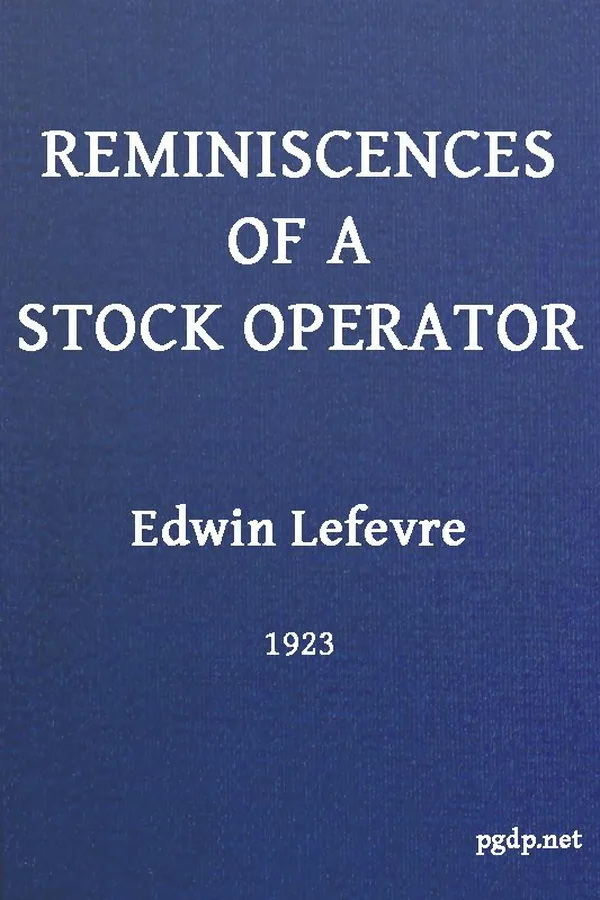
Reminiscences of a Stock Operator
📖 Click to Read the Opening Pages Online Preview
The quotation-board boy’s first morning
I went to work when I was just out of grammar school. I got a job as quotation-board boy in a stock-brokerage office. I was quick at figures. At school I did three years of arithmetic in one. I was particularly good at mental arithmetic. As quotation-board boy I posted the numbers on the big board in the customers’ room. One of the customers usually sat by the ticker and called out the prices. They couldn’t come too fast for me. I have always remembered figures. No trouble at all.
There were plenty of other employes in that office. Of course I made friends with the other fellows, but the work I did, if the market was active, kept me too busy from ten A.M. to three P.M. to let me do much talking. I don’t care for it, anyhow, during business hours.
The excerpt below is the opening of the narrative. The narrator, just out of grammar school, has taken a job as quotation-board boy in a brokerage office; he is quick at figures, having done three years of arithmetic in one, and he posts the prices on the big board and calls them out for a customer who sends his orders over the ticker. In the second paragraph he counts the other employees in the office and gives the market hours, ten to three, adding that he does not care for talking during business hours.
Download Full EPUB1923
Memoir
109,018 words
6.1 h
Standalone
New York and Wall Street from the 1890s into the 1920s, with the bucket shops of New England, St. Louis and Hoboken, and the Florida coast where the narrator fishes between campaigns.
Twenty-four chapters in ten parts
EPUB · AZW3 · KEPUB
0.36 MB (EPUB) · 0.50 MB (AZW3) · 0.40 MB (KEPUB)
Public domain in the United States
Project Gutenberg #60979
Reminiscences of a Stock Operator is a first-person memoir of a trader’s education, told as the recollections of a man who began as a quotation-board boy and ended as one of the Street’s large operators. He learns to read the tape in a broker’s office, makes and loses a fortune in the bucket shops, and comes to New York, where the same method fails because the ticker lags behind the floor. Out of those failures he builds a method: trade on the right side, buy on a rising scale, and hold for the big swing. The book is a portrait of a market and of the mistakes a man repeats.
After the early reverses the narrative settles into episodes: the Northern Pacific corner of 1901, the panic of 1907, a July cotton position the newspapers called a corner, the bankruptcy, and the comeback of 1915 into 1917. Around them the narrator sets out what he has learned about tips, hunches, manipulation and the public’s hope and fear. The book is as much a portrait of the Street as of the man. The Wikipedia article on Reminiscences of a Stock Operator gives the book’s publication history. The text is available via Project Gutenberg #60979.


Reminiscences of a Stock Operator by Edwin Lefèvre: Summary, Ideas & Arguments
This page offers a summary and analysis of Reminiscences of a Stock Operator, following the twenty-four chapters in order and setting out the market episodes the narrator describes and the rules he draws from them. The book appeared in 1923 under the name of Edwin Lefèvre, and it is written as the first-person recollections of a trader called Larry Livingston. He tells his story to an unnamed listener, from the brokerage office where he was a boy to the campaigns of 1917. The whole text is the Project Gutenberg #60979 transcription, and it sits on the Classic Fiction shelf here, beside The Picture of Dorian Gray and The Scarlet Letter, two other studies of a man and the world that made him. The book is a series of campaigns rather than a plot, and the order of the chapters is the order in which he lived them.
The first chapters are the education. A boy with a head for figures posts prices, keeps a notebook of how stocks behave, and takes an office boy’s Burlington tip into a bucket shop, where five dollars of margin on five shares returns a profit of three dollars and twelve cents. He is making a thousand dollars at fifteen and ten thousand at twenty, and the shops bar him one after another, until the Cosmopolitan takes his Sugar order and runs the price to 108 before he can reach the cashier. In New York, at A. R. Fullerton’s, the same reading of the tape fails: the price on the ticker is not the price on the floor, and he loses everything in six months, borrows five hundred dollars, and goes back to the bucket shops of St. Louis under another name.
The method comes out of those losses. The tape is not a fortune teller: it records the course of prices, and the trader’s business is to establish the points where selling has been stronger than buying and to trade along the line of least resistance once it declares itself. A man must be right about direction and about time, and he must back his opinion with money. The narrator buys in lots as the price rises, refuses to average down, and says that the big money is made by sitting rather than by trading. Old Partridge, who will not sell his stock on a tip, supplies the phrase the book returns to: it is a bull market. His own rule is that there is only one side to the market, the right side, and that the tape, not the opinion, has the last word.
The great episodes are given at length. In the spring of 1906 a hunch to sell Union Pacific is followed by the San Francisco earthquake, and the trade makes two hundred and fifty thousand dollars; a Saratoga tip he should have refused costs him, and teaches him to distrust them. On October 24, 1907, with the money market at a standstill, he covers his shorts and is worth over a million dollars, though the papers credit him with several millions. Then come the corn corner of Stratton, which he escapes by selling oats; the July cotton position of one hundred and forty thousand bales, which he sells ten minutes after the opening, once the World has called it a corner; and the bear campaign against Tropical Trading. He is not always modest about these episodes, and the book lets the boast stand beside the loss.
The last third is about the business of trading as a business. Daniel Williamson lends him twenty-five thousand dollars and uses him to carry his brother-in-law’s account; when the estate is liquidated the narrator is tied up and then bankrupt, owing over a million, with his friends signing releases and a schedule of about a hundred thousand dollars. He comes back through Bethlehem Steel, which crosses 98, and clears about three million dollars in 1916; a cotton purchase made just before the Unrestricted Warfare note of 1917 costs him four hundred thousand dollars, and he pays back every creditor early that year. The closing chapters turn to manipulation, to James R. Keene, to the Imperial Steel campaign and to Consolidated Stove, and end with the public that always wants to be told. What remains at the end is less a system than a set of warnings, offered by a man who has paid for each one.
Historical Context
The book is dated 1923 and is the work of Edwin Lefèvre; it is cast as a memoir rather than as reportage, and its narrator, Larry Livingston, is a created character, not a by-line. The twenty-four chapters follow one career in order, from a boyhood job in a brokerage office in the early 1890s to the trading campaigns of 1917, and the narrator often breaks off to address his listener directly. The market terms it uses are explained as he goes, and the book’s frame is a man looking back on a life spent in one business, with the failures kept in and the winnings counted out loud. The reader who comes to it for the history will find the history in the margins of a trading life.
The Wall Street of the book is named as it went. A. R. Fullerton’s commission house, the St. Louis bucket shops of J. G. Dolan and H. S. Teller, the Northern Pacific corner of May 1901, the money panic of October 24, 1907, when J. P. Morgan sent John T. Atterbury to the Money Post to announce ten million dollars, the closing of the Exchange in the summer of 1914, and the Unrestricted Warfare note of 1917 all appear. James R. Keene, Addison Cammack, Percy Thomas, Daniel Drew, Jacob Little and Jay Gould are named among the operators of the day. The book also names the New York World, the newspapers that made and unmade reputations, and the bucket-shop tickets that stood in for shares. It is generally read as a portrait of Jesse Livermore, though the text never names him.
The vocabulary is explained as it comes up, because the narrator assumes a listener who does not know the game: the tape, the bucket shop, margin, the short sale, the pool, the corner, the plunger. Prices are quoted in the fractions of the period, and orders are given in thousands of shares. Two institutions frame the story. In the bucket shop a customer bets on the price and never owns anything; in the commission house the order goes to the floor and comes back at a different price. The difference between them is the book’s first lesson, and the narrator loses his first fortune learning it. He says that the game does not change, and the vocabulary is his evidence.
Key Ideas & Arguments
- The right side: There is only one side to the stock market, the narrator says, and it is neither the bull side nor the bear side but the right side. Being right about direction is not enough: a man must be right about the time as well, and he must have money behind the opinion. The market does not argue and does not care what the trader thinks.
- The message of the tape: Prices, for this narrator, are habits rather than numbers. A stock that breaks after behaving in a certain way has done so before, and the tape records the contest between buyers and sellers. Reading it is a craft of comparison: the same resistance, the same failure to follow through. The tape can be right and still ruin a man who obeys it too late.
- The big swing: The large profits come from the large movement, not from the small fluctuations inside it. Old Partridge, who ignores a tip to sell, says that it is a bull market, and the narrator takes the lesson: study the general list and the money market rather than one stock, and be willing to sit through reactions instead of trading them.
- Buying on a rising scale: A position is built, not taken at a stroke. The narrator buys in lots as the price proves him right, first two thousand shares and then more, so that his average cost rises with the evidence. The cheap price is not the point; the right price is the one at which the stock shows it is going up. Waiting for a reaction can mean waiting for nothing.
- The line of least resistance: The market moves where it meets the least resistance, and the trader’s task is to find that line and stay on it. The idea grows out of the resistance points the tape prints: a stock that crosses a level where it has failed before is expected to keep going. The narrator offers it as a working rule, not a prophecy, and says a man who argues with the market is lost.
- Manipulation: Prices can be made as well as read. Pools, corners, calls and puts, and the marking up of a stock on small volume all appear, and the narrator both suffers from them and practises them for others. He insists that the old tricks have not changed, because fear and greed have not changed, and that the public is the last buyer in every scheme.
Core Arguments & Influence
- Speculation does not change: The book’s claim is that the game is the same in every generation. Bucket shops are closed and the Exchange is regulated, but the bucketeering house and the tip survive, and the public still loses in the same ways. The narrator quotes Thomas F. Woodlock’s remark that successful speculation rests on people continuing to make the mistakes they have made in the past, and the book is written to show what those mistakes look like from inside. Nothing here removes the risk; the most it offers is a way of being wrong less often. The number of listed stocks has grown, he notes, but the errors have not.
- Being right is not enough: The narrator is right about the Northern Pacific corner of 1901 and loses everything, because the ticker prints the price after the floor has moved. The same gap between what a man knows and what he can act on runs through the book: a good opinion is worthless without the margin to hold it, and a correct forecast is worthless if it is made too early. The market pays for being right at the right moment, and it charges for everything else. He meets the same lesson again in cotton, where he is right about the direction and buys before the line confirms it.
- Losses are the tuition: He is wiped out again and again, and each time he says the loss taught him something the profit could not. The four lean years, the debts to friends and brokers, the bankruptcy with releases signed on more than a million dollars, and the six weeks of waiting before Bethlehem Steel crosses 98 are the book’s real education. The comeback is not luck: it is the same method applied after the mistakes have been paid for, and the narrator says so plainly. He calls that stretch a time he would not wish on anyone and would not give back, because it taught him what no winning streak could.
- The public and its tips: Tips are the book’s recurring villain. A lifelong friend’s advice, a broker’s market letter and a newspaper’s bullish item all promise the same thing, and the narrator shows how each ends: the Pennsylvania Dutchman sells Atchison on a president’s denial, the dressmaker buys on Joshua Wolff’s supposed tip, and the public overstays the bull market. The book’s ethics are here, in the harm done by people who repeat what they do not know. Its sharpest scene is the dressmaker, who loses money on a story that was never meant for her.
- The operator as a character: The narrator is not offered as a hero. He is vain about his reading of the tape, secretive about his positions, and honest about the pleasure he takes in a coup; he also admits to manipulating stocks for friends and to profiting from the mistakes of the crowd. The book’s interest is in that double figure, a man who wants to be right and to be seen to be right, and who learns that the market is the only judge he cannot argue with. In that sense the book is a portrait of a temperament as much as a method, and the temperament is what the market tests.
Why Download Our Custom E-Reader Edition of Reminiscences of a Stock Operator?
The download is the whole book: twenty-four chapters, from the first morning at the quotation board to the last word on the public, with nothing abridged and no episode summarised in place of itself. The trades are given as the narrator gave them, with the prices, the losses and the recoveries left in the sequence he lived them. No chapter titles have been invented for it, and no scene is filled out beyond what the narrator says.
The page is arranged to be read beside the text. Ten parts follow the chapters in order and stop where each group of chapters stops; six notes explain the ideas the narrator returns to, from the right side to manipulation; five themes follow the argument about speculation, loss and the public. A short historical section names the houses, the operators and the panics the book refers to. The order is the book’s own, so a passage can be found from the page as easily as from the text.
The files come in three formats with the same text and the same divisions. The EPUB opens in Apple Books, Calibre and most Android readers; the AZW3 is the file for a Kindle; the KEPUB is the one Kobo devices read best. No account is needed for any of them, and nothing in the downloads is locked, watermarked or time limited. Each file carries the same text and the same ten-part arrangement, so a reader can move between them without losing the place.
- Project Gutenberg transcription, via Project Gutenberg #60979 — the complete text, unabridged, in the twenty-four chapters and the order the book prints them.
- The whole career in order From the quotation-board desk to the campaigns of 1917, with the losses, the debts and the comeback kept in the sequence the narrator gives them.
- Ten parts and six key ideas Every chapter is covered in its part, and the arguments the narrator returns to, from the right side to manipulation, are set out separately so they can be found again.
- EPUB, AZW3 and KEPUB files The same text in three formats, for Apple Books, Kindle and Kobo, with the chapter divisions intact and nothing to install beyond the reading app you already use.
- Oscar Wilde’s novel of a portrait and a double life, published in the same decade as the narrator’s first Wall Street years. It is a study of a man who gets what he wants and pays for it, which is the shape of every chapter here, and it is free in the same three formats. — free EPUB, AZW3 & KEPUB
- The author page for Edwin Lefèvre, with his other free editions on the site and the same EPUB, AZW3 and KEPUB downloads. Start here if you want the rest of his writing before or after this book. — free EPUB, AZW3 & KEPUB
- The shelf where this book sits, with the rest of the free classics on the site in EPUB, AZW3 and KEPUB, from the novels of the 1890s to the memoirs and histories of the same years. — free EPUB, AZW3 & KEPUB
Chapter summaries
The ten parts below follow the twenty-four chapters in the order the book prints them, from the first morning at the quotation board to the last word on the public. No chapter is merged with another and no episode is moved; the range in each label gives the chapters covered, and each summary states what the narrator does and what he concludes before the next part begins.
- Part 1 — The quotation board and the bucket shops (Ch. 1-2): A boy just out of grammar school takes a job posting prices, keeps a notebook of how stocks behave, and follows an office boy’s Burlington tip into a bucket shop with five dollars of margin. He prospers, is barred by the shops one after another, and loses his New York stake in six months at Fullerton’s.
- Part 2 — The panic of 1901 and the road home (Ch. 3-4): He is right about the Northern Pacific corner of May 1901 and loses everything because the ticker lags behind the floor. He goes home, is refused by the local shops, takes a stake out of a New Haven shop whose manager calls him a shark, and returns to Wall Street for a third attempt.
- Part 3 — The tape, the old hands and Union Pacific (Ch. 5-6): The narrator studies charts and the behaviour of individual stocks, and old Partridge, who will not sell on a tip, tells him it is a bull market. In the spring of 1906 a hunch to sell Union Pacific is followed by the San Francisco earthquake, and the trade makes him two hundred and fifty thousand dollars.
- Part 4 — Scaling up and the big swing (Ch. 7-8): He explains why he never tells anyone what to buy, and why he buys in lots as the price rises rather than waiting for a reaction. At Saratoga he takes a broker’s tip he should have refused, covers at a loss and reverses; the episode ends his hit-or-miss trading and turns him to the general list.
- Part 5 — The panic of 1907 and the costly mistake (Ch. 9-10): Fishing off Florida, he reads a rally as a chance to sell the whole list short, and on October 24, 1907, he covers and is worth over a million dollars. The next chapter turns to his mistakes, to resistance points and the line of least resistance, and to a cotton position he took before the tape confirmed it.
- Part 6 — Grain, cotton and the Cotton King (Ch. 11-12): Short ten million bushels of wheat and of corn, he escapes Stratton’s corn corner by selling oats, then buys July cotton up to one hundred and forty thousand bales. The World calls it a corner, he sells the line at ten minutes past ten, and the notoriety brings him the acquaintance of Percy Thomas.
- Part 7 — Williamson & Brown and the bankruptcy (Ch. 13-14): Broke again, he goes to Chicago for a stake, and Daniel Williamson lends him twenty-five thousand dollars and uses him to carry his brother-in-law’s account. Four lean years end in bankruptcy, with releases signed on over a million dollars. He comes back through Bethlehem Steel and clears about three million dollars in 1916.
- Part 8 — Tips, hunches and a million lost in cotton (Ch. 15-17): The coffee trade of 1917 is carried for a year and lost when the Price Fixing Committee closes the exchange. He tells the Pennsylvania Dutchman’s Atchison story against tips, defends the hunch that is really long experience, and loses a million dollars in cotton before covering in Philadelphia and making the loss back.
- Part 9 — The manipulators and the old game (Ch. 18-20): A bear campaign against Tropical Trading meets an inside squeeze and is answered through Equatorial Commercial. The narrator then surveys manipulation from Daniel Drew to James R. Keene, arguing that the tricks are obsolete but the psychology is not, and that Keene’s rule was to quit when the stock did not act right.
- Part 10 — Making a market, the war boom and the public (Ch. 21-24): He marks up Imperial Steel for a client and sells the bank’s hundred thousand shares of Consolidated Stove into tips he did not give. The last chapters weigh the public’s appetite for tips and market letters, count the growth of the listed stocks, and conclude that no man can beat the market for long.
Reminiscences of a Stock Operator: Frequently Asked Questions
What is Reminiscences of a Stock Operator about?
Is the book about Jesse Livermore?
What does the narrator mean by the right side?
How does he read the tape?
Why does he say tips are dangerous?
What happened in the panic of 1907?
What is the July cotton corner?
How do I read the free downloads?
Part of: Classic Fiction · Edwin Lefèvre