Hard Times by Charles Dickens: Free EPUB, AZW3 & KEPUB Download
Hard Times
📖 Click to Read the Opening Pages Online Preview
A plain, bare, monotonous vault of a schoolroom, and the facts that fill it
“Now, what I want is, Facts. Teach these boys and girls nothing but Facts. Facts alone are wanted in life. Plant nothing else, and root out everything else. You can only form the minds of reasoning animals upon Facts: nothing else will ever be of any service to them. This is the principle on which I bring up my own children, and this is the principle on which I bring up these children. Stick to Facts, sir!”
The scene was a plain, bare, monotonous vault of a schoolroom, and the speaker’s square forefinger emphasized his observations by underscoring every sentence with a line on the schoolmaster’s sleeve. The emphasis was helped by the speaker’s square wall of a forehead, which had his eyebrows for its base, while his eyes found commodious cellarage in two dark caves, overshadowed by the wall. The emphasis was helped by the speaker’s mouth, which was wide, thin, and hard set. The emphasis was helped by the speaker’s voice, which was inflexible, dry, and dictatorial. The emphasis was helped by the speaker’s hair, which bristled on the skirts of his bald head, a plantation of firs to keep the wind from its shining surface, all covered with knobs, like the crust of a plum pie, as if the head had scarcely warehouse-room for the hard facts stored inside. The speaker’s obstinate carriage, square coat, square legs, square shoulders—nay, his very neckcloth, trained to take him by the throat with an unaccommodating grasp, like a stubborn fact, as it was—all helped the emphasis.
“In this life, we want nothing but Facts, sir; nothing but Facts!”
The preview stops inside Book I, chapter 1. All thirty-seven chapters are in the free download below.
Download Full EPUB1854
~103,000 words (estimated)
Approx. 5.7 hours
Standalone
Coketown, a mill town in the industrial north of England, in the 1840s
37 chapters in three books
EPUB · AZW3 · KEPUB
0.94 MB (EPUB) · 1.05 MB (AZW3) · 0.98 MB (KEPUB)
Public domain in the United States
Project Gutenberg #786 · Standard Ebooks
Hard Times is Charles Dickens’s shortest novel and the only one he set in a manufacturing town. Thomas Gradgrind, a retired hardware merchant who wants nothing but facts, has raised his two eldest children on arithmetic and definitions, and his friend Josiah Bounderby, banker and mill owner, governs Coketown by the same creed. Into their world come Sissy Jupe, a circus child left behind by her father, and Stephen Blackpool, a power-loom weaver bound to a drunken wife he cannot divorce. The story runs through a loveless marriage, a bank robbery, a union meeting and a pit accident, and it ends in the ruin of the men who trusted most in figures.
What keeps the book alive is the argument inside the story: a system that counts only what can be measured will produce children who cannot feel, marriages that are bargains and a town that treats people as instruments. Dickens wrote it fast, in instalments, and the impatience of the magazine writer is part of its force, but so is the comedy of Mr Bounderby and the pathos of Stephen Blackpool. Hard Times has been read as a pamphlet and as a fable, and it is both. The text is available via Project Gutenberg #786, and Standard Ebooks has prepared the edition transcribed here.
Hard Times by Charles Dickens: Summary, Characters & Themes
This is a summary and analysis of Hard Times, the novel Charles Dickens published in 1854 and the shortest of his full-length books. It is set in Coketown, a mill town in the industrial north, and it is built in three parts: the schoolroom, the harvest, the garnering. Thomas Gradgrind, who has retired from the wholesale hardware trade and sits for Coketown, keeps a school of facts and brings up his children on the same diet. Louisa, his eldest daughter, marries Bounderby the banker; Tom, his eldest son, takes a clerkship in the bank and later takes its money. Around them are a circus child, a weaver, and a woman with a staircase in her head.
The plot is a set of consequences. Bounderby marries Louisa when she is not yet twenty, and the marriage is a bargain between two men who have agreed that feeling is not evidence. James Harthouse arrives from London with a letter of introduction, finds the house dull and the wife interesting, and begins a slow, idle pursuit that the household mistakes for manners. Tom, meanwhile, whose education taught him nothing but self-interest, robs the bank and lets suspicion fall on a man who has never done him harm. Stephen Blackpool, the weaver, is turned out of the mill for refusing to inform on his fellow hands, and Louisa, pressed past bearing by the summer and by Harthouse, walks home to her father through a storm and asks him what his facts have made of her. The answer takes the rest of the book.
Dickens was forty-two when the novel appeared, the most popular writer in England and the editor of his own weekly paper, Charles Dickens. He had finished Bleak House the year before, was reading his work in public to enormous audiences, and had lately become impatient with the sort of reform that measured everything and felt nothing. In January 1854 he travelled to Preston, where the weavers were on strike, and came away with the material for Coketown: the smoke, the brick, the hours, and the talk of hands and masters. Hard Times ran in Household Words from April to August 1854 and came out in one volume from Bradbury and Evans; it is the least leisurely of his books, and the one that reads as if the argument had been written first and the plot built around it.
The novel’s reputation goes up and down, but its images do not: the schoolroom with the square forefinger, the serpents of smoke, the staircase Mrs Sparsit watches, the pit with the star over it. It is the book in which Dickens accuses his own century of starving the imagination, and the accusation is aimed at respectable people rather than at villains; the caricatures have been held against it since 1854, and they are also the point. Readers who finish it often turn to the fog of Bleak House for the law, to Oliver Twist for the workhouse and the parish, and to Great Expectations for a later, subtler account of how money makes a gentleman.
This page follows the Standard Ebooks edition, which is drawn from the Project Gutenberg text of the novel and corrected against the printed book; it keeps the chapter titles, since Dickens gave every one of the thirty-seven chapters a name, from The One Thing Needful to the last page of Final. Each of the twelve summaries below covers a group of chapters in reading order, and the character notes and historical context are meant to be read beside the novel rather than instead of it. The full text, with the original three-book division, the chapter headings and a working table of contents, is in the download, and the preview above is the opening of the first chapter, exactly as Dickens wrote it.
Historical Context
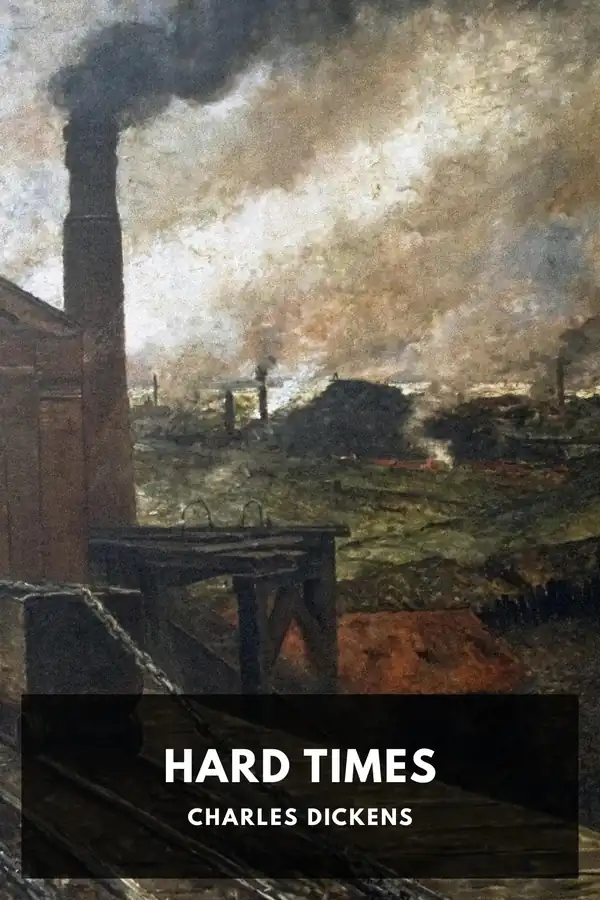
Coketown is the north of England with the serpents of smoke in it. The town has the same streets and the same hours as Manchester or Preston, and Dickens took the details from a visit to Preston in January 1854, in the middle of a weavers’ strike that had lasted since the summer before. He saw the hands standing idle and the masters standing firm, and came away with the raw material for a book about what a town looks like when it is built entirely for making money. The bricks, the river, the machinery and the bells are all facts of the 1840s and 1850s, and the novel takes them literally.
The school is the novel’s other factory. Utilitarian writers and administrators of the 1830s held that education should be useful, measurable and free of what they called fancy, and Gradgrind’s name announces the programme: he grinds facts into children. The half-yearly examination, the definition of a horse, the political economy that tells Sissy not to sympathise, the schoolmaster trained in a normal school and called M’Choakumchild — these are comic exaggerations of real practice. In the 1850s the question of whether the working classes should read anything but instructions was being argued in Parliament, in the reviews, and on the platforms of the Mechanics’ Institutes.
The legal and domestic arrangements matter to the story as much as the mills. A working man in England could not divorce a wife who drank and deserted him, because divorce required an Act of Parliament and the money to pay for it; that is why Stephen is bound, and why Bounderby’s talk of facts has no answer for him. Trade unions had been legal since 1825, but combination was still treated as conspiracy by masters and by much of the press, and the union meeting in the novel, with its orator and its oaths, was the sort of scene readers had been reading about for twenty years. Marriage, meanwhile, was a settlement, and a daughter could be disposed of with a proposal as calmly as a bill.
Key Characters & Literary Archetypes
- Thomas Gradgrind: A hardware merchant turned philanthropist and member for Coketown, with a square forefinger, a blue-brained clock among blue books, and a system that answers every question before it is asked. He is honest, tireless and genuinely kind in his own fashion, and that is what makes him frightening: he cannot see what his facts have not taught him. His late conversion, when it comes, costs him his public confidence and gives him his daughter back.
- Josiah Bounderby: Banker, mill owner and the loudest man in Coketown, a self-made man whose story of being born in a ditch is repeated to anybody who will hear it, though his mother is alive and quietly paid to stay away. He is Dickens’s portrait of the bully who calls himself humble, and of the employer whose generosity is a form of boasting. He marries Louisa, loses her, and dies in the street five years later, of a fit.
- Louisa Gradgrind: Gradgrind’s eldest daughter, starved of fiction and of any language for feeling, who marries Bounderby at her father’s suggestion and keeps her mind to herself. She loves her brother Tom with the only warmth she has, and she is watched by Mrs Sparsit, flattered by Mr Harthouse and finally brought to ask her father what his system has left her. What it has left her is enough honesty to accuse him, and the novel gives her no convenient second life.
- Tom Gradgrind: The eldest son, called the whelp, brought up on facts and thoroughly bored by them. He goes into the bank, spends more than he has, borrows from anybody and robs his employer’s safe, arranging matters so that a weaver will be blamed. His self-interest is his father’s doctrine in its plain form, and the novel punishes him with exile, disguise, and a death in hospital abroad, penitent and too late to be seen.
- Stephen Blackpool: A power-loom weaver of forty, honest, slow of speech and alone among the hands in refusing to join the union, on the grounds that he cannot swear to obey men he does not know. He has been married nineteen years to a woman who drinks, and he loves Rachael, the woman he cannot marry. Bounderby turns him off, Tom uses him, the town suspects him, and he dies after falling into the Old Hell Shaft on his way back to clear his name.
- Sissy Jupe: Cecilia Jupe, a circus child taken into the Gradgrind household after her father leaves her, who cannot master facts and does not try. She keeps her father’s bottle of nine oils, believes he will come back, and turns out to be the one person in the book whose education never went wrong. She nurses Louisa, faces Harthouse, and ends with a household of her own that Dickens sets against every other family in the novel.
Core Literary Themes
- Facts against fancy: The novel’s first subject is a theory of education. Gradgrind’s school weighs, measures and defines, and it treats every child as a vessel for statistics; Sissy, who has grown up among horses and acrobats, fails at the definitions and understands the animals. Dickens stacks the argument with comedy — the horse defined by Bitzer, the caps at fourteen-pence halfpenny — and then shows the bill for it: two children who cannot name their own feelings, a father who cannot hear them, and a town that applauds the system.
- The mill and the hands: Coketown exists to make money, and its people exist to work the machinery. Dickens calls them hands, as the mill owners did, and then gives one of those hands a name and a history, so that the word stops being a category. The union meeting, the orator Slackbridge, Bounderby’s refusal to see any grievance and the town’s readiness to blame a stranger are all part of the same subject; the novel is not a tract, but it knows exactly whose side it is on, and the machinery is never off stage.
- Marriage as a bargain: There is no love in the marriages of the novel, only settlement, forbearance and, in one case, calculation. Gradgrind proposes Bounderby to his daughter as a matter of arithmetic, Bounderby acquires a wife as he acquired his mill, and Mrs Gradgrind has spent her life agreeing with her husband about everything. Stephen, who cannot escape his own marriage, shows what the bargain costs those who cannot afford lawyers, and Sissy’s household at the end is the only one that is not a transaction, and it is also the smallest and the happiest.
- Respectability and the watcher: Mrs Sparsit watches everybody, from a window at the Bank and from behind her Coriolanian eyebrows, and her respectability is a form of appetite. Bitzer rises by calculation and delivers his own friend to the law; Bounderby’s reputation depends on a mother he has paid to disappear. Dickens’s subject here is the gap between the face a town presents and the arrangements that keep it, and the punishment of these people is the sort of exposure they fear most; Mrs Sparsit’s fall at the end is the novel’s one clear act of justice, and it is petty.
- The failure of the ledger: The novel is full of accounts: bank balances, insurance, dividends, the arithmetic of the schoolroom, the blue books full of figures. Dickens sets those ledgers against things that cannot be entered in them — Rachael’s nursing, Sissy’s patience, Tom’s debts of affection, Stephen’s dying look at the star — and lets the second column turn out to be the one that matters. The ending refuses to balance: the good are not rewarded with happiness and the wicked are not punished in any proportion, and the last line hands the account to the reader.
Why Download Our Custom E-Reader Edition of Hard Times?
Because the argument has not gone away. Every school that measures children, every town that treats its people as labour and every bargain that calls itself a marriage has a version of Mr Gradgrind in it, and the novel’s comedy is the comedy of recognition. It is short, quick and savage, and it contains scenes — the confrontation at Stone Lodge, the crowd at the shaft — that stay in the mind long after the plot has been forgotten.
The full text is here, unabridged, and it is the text the summaries on this page were checked against. The Project Gutenberg transcription supplies the reading copy; the chapter divisions follow the novel exactly, and nothing has been modernised, abridged or tidied. You can read the first chapter below, then take the whole book in whichever format suits your reader.
Read it with the notes beside you if you like, but read the scenes themselves: Harthouse’s arrival, the union meeting, Louisa’s staircase, the rescue at the pit, and the circus booth where a young man in comic livery says goodbye to his father. The page stops short of the last explanations, and the last chapter is short enough to be worth reaching on your own.
- Based on the Standard Ebooks Edition, via Standard Ebooks, whose editors prepared this text from the Project Gutenberg transcription and checked it against the printed book, keeping the chapter titles that Dickens gave to all thirty-seven chapters and the three-book division of the original.
- The complete thirty-seven chapters Three books and thirty-seven chapters, from The One Thing Needful to Final, with nothing cut and no editorial labels added to the text.
- EPUB, AZW3 and KEPUB One download for each format, so the novel opens on Kindle, Kobo, Apple Books and older e-ink readers without conversion, with a table of contents that works everywhere.
- Free and DRM-free Public domain in the United States, with no account, no sample chapter and no lock on the file; download it once and it stays yours, on every device you own.
- Bleak House — free EPUB, AZW3 & KEPUB
- Oliver Twist — free EPUB, AZW3 & KEPUB
- Great Expectations — free EPUB, AZW3 & KEPUB
Chapter summaries
Thirty-seven chapters in three books, from the schoolroom of facts to the last page of Bounderby’s will. These twelve summaries follow the novel in order and give away only what the story gives away.
- Book I, chapters 1–4 — The one thing needful; the Gradgrind schoolroom: A schoolroom in Coketown, where a gentleman with a square forefinger demands facts and nothing else. Thomas Gradgrind examines the class: Sissy Jupe, girl number twenty, cannot define a horse, and Bitzer can. Gradgrind walks home to Stone Lodge, satisfied with his model children, who have never wondered at anything. That evening Josiah Bounderby boasts of being born in a ditch, and Mrs Gradgrind agrees with everybody.
- Book I, chapters 5–8 — The keynote of Coketown; Sissy Jupe and Sleary’s circus: Coketown is laid out: red brick, serpents of smoke, a river dyed purple, chapels and a jail, and a schoolmaster called M’Choakumchild. Gradgrind and Bounderby trace Sissy to the Pegasus’s Arms, where Sleary’s circus is lodged and her father, a clown, has walked away, leaving the child behind. Sissy is taken into the Gradgrind house on trial. Mrs Sparsit, who keeps Bounderby’s house for a hundred a year, is introduced, and Louisa is caught saying that she wonders.
- Book I, chapters 9–13 — Sissy’s progress; Stephen Blackpool and Rachael: Sissy struggles with definitions and percentages, believes her father will come back, and cannot be persuaded to give him up. In the poorest quarter of Coketown lives Stephen Blackpool, a power-loom weaver of forty, married nineteen years to a woman who has gone to drink and ruin. The mill runs, the hands go in at the bell, and Stephen walks home past Bounderby’s house. He meets an old woman from the country who asks about Bounderby, and that night Rachael nurses his sick wife.
- Book II, chapters 1–3 — Midsummer at the Bank; Mr James Harthouse; the whelp: Midsummer: Louisa is married to Bounderby, not yet twenty, and Mrs Sparsit keeps her watch at the Bank. A new face arrives from London: James Harthouse, a bored young gentleman with a letter of introduction from Gradgrind in his pocket. Tom Gradgrind, now employed in the bank, takes to him at once, and the two smoke and talk in the stables while Tom’s sister keeps her husband’s house.
- Book II, chapters 4–6 — Men and brothers; the union; fading away: The hands meet in a crowded hall, where the orator Slackbridge denounces the masters and demands that the union stand together; Stephen alone refuses to join, saying that he cannot promise to obey men he does not know, and his fellows send him to Coventry. Bounderby sends for him and, before Louisa, Harthouse and Tom, demands to know what the union men have said to him, then tells him to finish the work in hand and go elsewhere. Stephen walks out into the night and finds Rachael, and the old woman again.
- Book II, chapters 7–9 — Gunpowder; explosion; hearing the last of it: Harthouse, going in for his party and finding the town dull, makes Louisa’s confidence his project, and Mrs Sparsit watches the garden and the alcove with more attention than anyone else in the house. The Bank is robbed: the safe forced, the money gone, and Stephen Blackpool, who left Coketown three days after his interview with Bounderby, is the obvious man to blame. The summer heat gathers over the town, and nobody in the Bank can say how the thing was done.
- Book II, chapters 10–12 — Mrs Sparsit’s staircase; lower and lower; down: Mrs Sparsit’s staircase: in her mind’s eye the figure of Louisa descends, flight after flight, towards a dark gulf, and she sits in the garden alcove while Harthouse whispers to Louisa in the dusk. Mrs Gradgrind dies without ever having got the fact, and her daughter’s reserve begins to frighten the people who trained it. A storm breaks over Coketown; Louisa walks out of her husband’s house and reaches Stone Lodge, where she tells her father what his system has made of her.
- Book III, chapters 1–2 — Another thing needful; very ridiculous: Louisa lies ill in her old room at Stone Lodge, and Sissy, with little Jane, nurses her. When her father comes, she can say only that Sissy has been good to her, and Gradgrind, looking at his daughter, begins to see what his facts have not answered. Harthouse waits a day and a night for a summons; what comes instead is Sissy, asking him quietly and without any pleading to leave Coketown for good, and he goes.
- Book III, chapters 3–4 — Very decided; lost: Mrs Sparsit, wrapped in shawls and spite, takes Bounderby to Stone Lodge at midnight with what she has overheard, and Bounderby hears Gradgrind read the letter that keeps Louisa at home. He goes back to Coketown without his wife. The robbery is still unsolved; a placard offers twenty pounds for Stephen Blackpool, and Gradgrind, who has begun to doubt his own arithmetic, takes up the search himself.
- Book III, chapters 5–6 — Found; the starlight of the Old Hell Shaft: Day and night again with no Stephen; Sissy sits with Rachael, and the two women keep faith that he will come back. Into the middle of the search comes Mrs Pegler, exposed by Mrs Sparsit as Bounderby’s mother, and the self-made man’s story collapses in a rage. Then a message from the country: a man has fallen down the Old Hell Shaft. They bring Stephen up at night, and he dies with Rachael holding his hand, looking at the star.
- Book III, chapters 7–8 — Whelp-hunting; philosophical: Tom has vanished, and Gradgrind, white and bowed, goes to Sleary, who hides the young man among the circus people, dressed as one of Sleary’s black servants. Then Bitzer arrives with the law on his side, and it takes a learned dog, a pony-gig and a dancing horse to get Tom away towards the Liverpool ship. Sleary also has a harder piece of news: the dog Merrylegs came home to die, and Sissy’s father never will.
- Book III, chapter 9 — Final; the will, the street and the last word: Five years in a paragraph: Bounderby dies of a fit in the Coketown street, Mrs Sparsit goes to live with her great aunt, Lady Scadgers, and Gradgrind grows white-haired and humble, making his facts serve faith, hope and charity. Louisa will not marry again and will have no children of her own; Tom dies in a hospital abroad, penitent; Rachael keeps working, and Sissy’s children love her. The book ends by handing its last sentence to the reader.
Hard Times: Frequently Asked Questions
What is Hard Times about?
Who is Thomas Gradgrind?
Why is the novel set in Coketown?
What happens to Stephen Blackpool?
Does the novel end happily?
Who is Sissy Jupe, and what does she represent?
Is Hard Times a political novel?
Where can I read the full text?
Part of: Classic Fiction · Victorian Literature