Persuasion by Jane Austen: Free EPUB, AZW3 & KEPUB Download
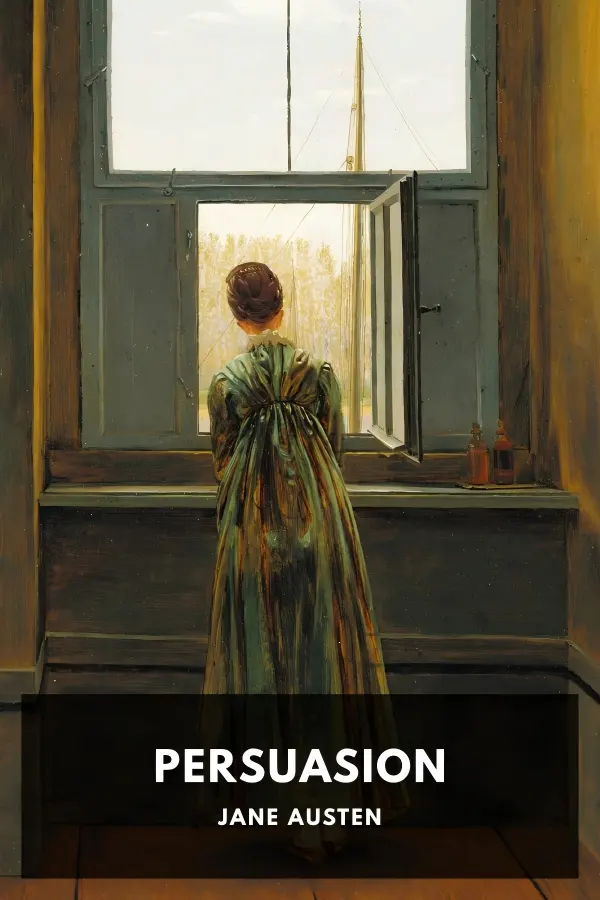
Persuasion
📖 Click to Read Chapter I Online Preview
I
Sir Walter Elliot, of Kellynch Hall, in Somersetshire, was a man who, for his own amusement, never took up any book but the Baronetage; there he found occupation for an idle hour, and consolation in a distressed one; there his faculties were roused into admiration and respect, by contemplating the limited remnant of the earliest patents; there any unwelcome sensations, arising from domestic affairs changed naturally into pity and contempt as he turned over the almost endless creations of the last century; and there, if every other leaf were powerless, he could read his own history with an interest which never failed. This was the page at which the favourite volume always opened:
“Elliot of Kellynch Hall.”
“Walter Elliot, born March 1, 1760, married, July 15, 1784, Elizabeth, daughter of James Stevenson, Esq. of South Park, in the county of Gloucester, by which lady (who died 1800) he has issue Elizabeth, born June 1, 1785; Anne, born August 9, 1787; a stillborn son, November 5, 1789; Mary, born November 20, 1791.”
Precisely such had the paragraph originally stood from the printer’s hands; but Sir Walter had improved it by adding, for the information of himself and his family, these words, after the date of Mary’s birth—“Married, December 16, 1810, Charles, son and heir of Charles Musgrove, Esq. of Uppercross, in the county of Somerset,” and by inserting most accurately the day of the month on which he had lost his wife.
Rediscover Anne Elliot and Captain Wentworth’s journey through lost youth, enduring fidelity, and second chances. Download the complete unabridged edition for your e-reader.
Download Full EPUBPersuasion is an 1817 novel by Jane Austen, her last completed work, a quiet Regency-era story of second chances, constancy, and the pain of love deferred.
It follows Anne Elliot, who at nineteen was persuaded to refuse Captain Frederick Wentworth, and who meets him again eight years later when he is rich and she has faded into quiet usefulness.
This Standard Ebooks edition is based on Project Gutenberg eBook #105 and is in the US public domain; readers outside the US should check local laws.
About Jane Austen’s Persuasion: Summary, Characters & Themes
Published in 1817, Persuasion is Jane Austen‘s final completed novel. This summary and analysis explores its autumnal grace, its themes of second chances and enduring devotion, and the quiet moral strength of its heroine.
Set during the Napoleonic era between 1814 and 1815, the narrative documents a profound historical transition in British society: the economic decline of the vain, landed aristocracy and the rising meritocracy of self-made naval officers who won wealth and honor at sea.
The story follows Anne Elliot, the quiet, overlooked twenty-seven-year-old middle daughter of the vain baronet Sir Walter Elliot. Eight years earlier, Anne had been persuaded by her godmother, Lady Russell, to break her engagement to the penniless naval officer Frederick Wentworth, an act of dutiful prudence she has quietly grieved ever since.
When Sir Walter’s reckless extravagance forces the family to let their ancestral estate, Kellynch Hall, and retreat to Bath, the new tenants happen to be Wentworth’s sister and brother-in-law. Now a wealthy, distinguished captain decorated in the war, Wentworth re-enters Anne’s social circle, his polite detachment masking lingering hurt and wounded pride.
As the party travels to the seaside town of Lyme, a catastrophic fall by the headstrong Louisa Musgrove highlights Anne’s calm inner resourcefulness, finally reawakening Wentworth’s appreciation of her steadfast character over superficial vivacity.
In Bath, despite the flattering courtship of her hypocritical cousin William Elliot, Anne’s heart remains constant. Overhearing Anne speak passionately about woman’s silent, unrewarded constancy of affection, Wentworth secretly pens a letter that has become one of the novel’s most quoted passages, reconciling past regrets into enduring partnership.
Key Characters & Literary Archetypes
- Anne Elliot (The Patient Observer & Steadfast Soul): Thoughtful, elegant, and persistently undervalued by her narcissistic family. Anne embodies quiet moral autonomy and emotional endurance, proving that genuine strength lies in reflective loyalty, gentle resilience, and self-knowledge rather than stubborn defiance.
- Captain Frederick Wentworth (The Self-Made Hero & Reconciled Lover): An intrepid naval officer who earned rank and fortune through gallantry and professional skill. Initially guarded by injured pride, his emotional evolution requires casting aside resentment to honor Anne’s unwavering constancy.
- Sir Walter Elliot (The Vain Aristocrat & Narcissistic Decay): A spendthrift baronet obsessed entirely with personal beauty and the Baronetage. Incapable of valuing substance over heraldic pedigree, he symbolizes the moral emptiness and social decay of the landed gentry.
- Lady Russell (The Well-Meaning Guardian & Cautious Traditionalist): Anne’s godmother whose advice originally sundered the engagement. Guided by class prejudice disguised as maternal prudence, she illustrates how worldly caution and social correctness can blind well-intentioned mentors to authentic virtue.
- William Elliot (The Calculating Opportunist & Polished Schemer): Sir Walter’s estranged heir presumptive who flatters his way back into favor. Beneath his smooth, charming manners lies cold, transactional self-interest, serving as the deceptive double to Wentworth’s transparent honesty.
- Admiral & Mrs. Croft (The Egalitarian Partners & Modern Vanguard): Practical, hearty, and deeply affectionate, they share domestic decisions and travels together. They represent a new social order built on mutual respect and shared experience, in stark contrast to the sterile snobbery of Kellynch Hall.
Core Literary Themes & Historical Significance
- Constancy and the Agony of Waiting: Austen contrasts the outward distractions available to men with the domestic confinement of women, exploring the tender, unexpressed endurance of female affection through years of silent regret.
- Persuasion vs. Individual Agency: The novel critically investigates the delicate line between yielding gracefully to wise counsel and allowing societal, familial pressures to extinguish authentic personal happiness.
- The Eclipse of Landed Privilege by Professional Merit: By contrasting the narcissistic ruin of Sir Walter with the energetic competence of the naval community, Austen prophetically heralds a new nineteenth-century social order founded on personal merit, bravery, and honest labor.
Why Download Our Free EPUB, AZW3 & KEPUB Edition of Persuasion?
Persuasion is Jane Austen’s final completed novel, published in 1817. It follows Anne Elliot and Captain Frederick Wentworth, whose engagement was broken eight years before the story opens, and who meet again when he is rich and she has faded into quiet usefulness.
This free edition is based on a Project Gutenberg transcription and produced by Standard Ebooks. It is DRM-free, unabridged, and formatted for EPUB, AZW3, and KEPUB readers.
- Standard Ebooks Transcription from Project Gutenberg eBook #105: Preserves the full, unabridged text of Austen’s 1817 novel, including the letter in Chapter XXIII (“You pierce my soul. I am half agony, half hope”).
- Formatted for Letters & Social Dialogue: Private correspondence, Bath drawing-room banter, and the seaside accident on the Cobb at Lyme are rendered with clean indentation and readable line spacing.
- EPUB, AZW3 & KEPUB for Every E-Reader: AZW3 is built for Kindle Paperwhite and Oasis; KEPUB is built for Kobo; and valid EPUB scales across iPad, Boox, and Android readers.
- Verified Public Domain Sources: Based on Project Gutenberg eBook #105 and produced by Standard Ebooks. Public domain in the US; check local laws outside the US.