The House of the Arrow by A. E. W. Mason: Free EPUB, AZW3 & KEPUB Download
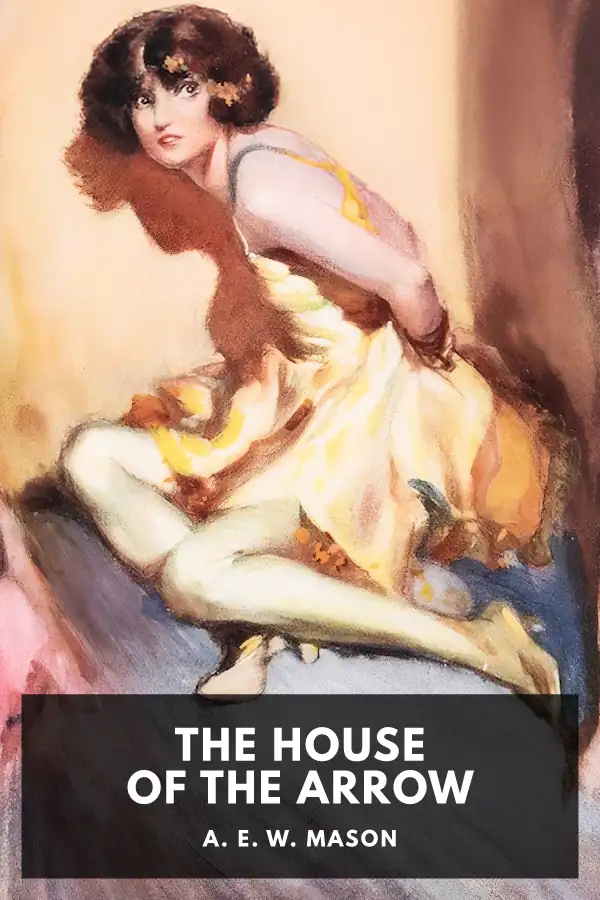
The House of the Arrow
📖 Click to Read Chapter One Online Preview
Chapter I · Letters of Mark
Messrs. Frobisher & Haslitt, the solicitors on the east side of Russell Square, counted amongst their clients a great many who had undertakings established in France; and the firm was very proud of this branch of its business.
“It gives us a place in history,” Mr. Jeremy Haslitt used to say. “For it dates from the year 1806, when Mr. James Frobisher, then our very energetic senior partner, organised the escape of hundreds of British subjects who were detained in France by the edict of the first Napoleon. The firm received the thanks of His Majesty’s Government and has been fortunate enough to retain the connection thus made. I look after that side of our affairs myself.”
Mr. Haslitt’s daily batch of letters, therefore, contained as a rule a fair number bearing the dark-blue stamp of France upon their envelopes. On this morning of early April, however, there was only one. It was addressed in a spidery, uncontrolled hand with which Mr. Haslitt was unfamiliar. But it bore the postmark of Dijon, and Mr. Haslitt tore it open rather quickly. He had a client in Dijon, a widow, Mrs. Harlowe, of whose health he had had bad reports. The letter was certainly written from her house, La Maison Grenelle, but not by her. He turned to the signature.
A widow dies of heart failure in Dijon, a fortune passes to her niece, and within the week the niece is accused of murder. Download the complete unabridged novel for your e-reader.
Download Full EPUB1924
~97,000 words (estimated)
Approx. 5.4 hours
EPUB · AZW3 · KEPUB
1.27 MB (EPUB) · 0.39 MB (AZW3) · 1.31 MB (KEPUB)
Public domain in the United States
Project Gutenberg #67514 · Standard Ebooks
The House of the Arrow is A. E. W. Mason’s 1924 detective novel and the second full-length case for Inspector Hanaud of the Paris Sûreté. A wealthy widow dies at her house in Dijon of what her doctors call heart failure; a week later her disreputable brother accuses her niece of poisoning her, and the family’s London solicitor, Jim Frobisher, travels out to defend a young woman he is certain cannot be guilty.
Hanaud has come to Dijon on a different errand altogether and stays for the poison. What follows is a patient, fair-play investigation of a closed house, a secret passage and a clock that does not say what it appears to say. This Standard Ebooks edition is based on Project Gutenberg #67514 and is in the public domain in the United States. The text is available via Standard Ebooks.
The House of the Arrow by A. E. W. Mason: Summary, Characters & Themes
The House of the Arrow is A. E. W. Mason’s 1924 detective novel, the second full-length case for Inspector Hanaud of the Paris Sûreté after At the Villa Rose (1910). This summary and analysis follows the case from a solicitor’s letter in London to Hanaud’s explanation on a terrace in Dijon: a murder that has already happened, a family that has already divided the money, and a young Englishman who arrives to defend the wrong woman.
Mrs. Harlowe, the rich widow of a famous collector, dies at her house in Dijon of what the doctors call heart failure. Her companion, Ann Upcott, was asleep in her chair across the passage; her niece Betty Harlowe was at a ball. Then Boris Waberski, Mrs. Harlowe’s brother and a man with debts and grievances, accuses Betty of poisoning her aunt, and the family’s London solicitors send out their young partner, Jim Frobisher, to hold the line. Frobisher is certain of Betty’s innocence, which is precisely the problem: his certainty is the thing the book sets out to test.
The physical evidence is a house. The Maison Grenelle holds Simon Harlowe’s collection, a treasure-room sealed by the police, a sedan chair set into the wall, and a clock on a marquetry cabinet that gives the time of the murder. That clock, and the mirror behind it, are the novel’s central illusion: the kind of clue that a fair-play detective story plants in plain sight and then dares you to read correctly.
Hanaud works by patience and by theatrical provocation, but the novel’s real subject is Frobisher’s education. He begins as a solicitor with a client and a chivalric idea of her, and ends as a witness who has to accept that the person he came to save may be the one who did it. Mason keeps the book moving with interviews, experiments and small humiliations of his young detective, and the solution, when it arrives, accounts for every object in the house.
This Standard Ebooks edition follows the text of the 1924 first edition, based on Project Gutenberg #67514 and on digital scans consulted by the Standard Ebooks transcribers. It is in the public domain in the United States; the text comes from Standard Ebooks.
Historical Context
Mason published the novel in 1924, in the middle of the decade that gave the detective story its rules and its golden age. Christie, Sayers, Chesterton and Freeman had made the fair-play puzzle a national habit in Britain; in France, where the novel is set, the Sûreté and the investigating magistrate gave the form a different, more procedural texture, which Mason uses for all it is worth.
Hanaud himself is a deliberate contrast to Sherlock Holmes: French, theatrical, garrulous, given to talking about luck and about being a servant of chance, and much more interested in what people do with their hands than in the shape of a footprint. Mason had introduced him in 1910 and would bring him back across four decades of fiction, which makes this book a middle-period case rather than an origin story.
The other period detail is the poison. Strophanthus, the arrow poison, was a real substance known to Victorian and Edwardian medicine, and the idea that a colonial collector might own a poisoned arrow was entirely plausible to Mason’s first readers. The novel turns that ethnographic curiosity into a murder weapon that leaves no trace, which is exactly the kind of threat the detective fiction of the 1920s was learning to take seriously.
Key Characters & Literary Archetypes
- Inspector Hanaud (the theatrical method): The Sûreté detective from Paris — vain, funny, observant, and kinder than he lets on. He solves the case by provoking people into revealing what they already know.
- Jim Frobisher (the chivalric outsider): A young London solicitor sent to defend Betty Harlowe, and the novel’s second detective. His certainty about his client is the book’s real subject.
- Betty Harlowe (the heiress): Mrs. Harlowe’s niece and principal heir. Charming, decisive, modern in her friendships, and the centre of every suspicion in Dijon.
- Ann Upcott (the companion): Mrs. Harlowe’s English companion, poor, watchful, and the only person in the house who was awake on the night of the death. She becomes the case’s second suspect.
- Boris Waberski (the accuser): Mrs. Harlowe’s brother, a gambler and a nuisance, who makes the accusation that starts everything and then departs in a hurry.
- Nicolas Moreau (the local police): The Dijon officer who works with Hanaud — solid, patient and, by the end, thoroughly tired of being outthought.
- Simon Harlowe (the absent collector): Mrs. Harlowe’s late husband, whose collection of arms, jewels and poisoned arrows fills the treasure-room and supplies the murder method.
- Girardot and Bex (the procedure): The examining magistrate and the juge d’instruction, whose seals, depositions and courtesies measure how far Hanaud is willing to go outside the rules.
Core Literary Themes
- Money and inheritance: Everyone in the book has a financial reason to want Mrs. Harlowe dead, and the will is the first thing anybody discusses. Mason makes greed ordinary and then makes it lethal.
- Performance: Betty is an actress to her fingertips, and Hanaud recognises the type early. The novel keeps asking how a person behaves when they know they are being watched.
- The illusion of the obvious: The clock on the cabinet, the sealed room, the necklace in the drawer — every major clue is something the reader has already looked at and misread.
- Chivalry as a mistake: Frobisher’s desire to protect is generous and completely unreliable. Mason lets his young man learn in public what it costs to defend someone on faith.
- The house as evidence: The Maison Grenelle, with its sealed doors and its hidden passage to the Hôtel de Brebizart, is the crime scene, the alibi and the witness at once.
- Foreign eyes: Hanaud is a Parisian in a provincial city, and much of the comedy and all of the detection come from his refusal to accept Dijon’s version of itself.
Why Download Our Custom E-Reader Edition of The House of the Arrow?
The House of the Arrow is one of the best constructed detective novels of the 1920s and one of the least read. Mason gives you a fair-play puzzle, a French setting that is not Paris, and a detective who is funny without being a buffoon — and then ties the whole solution to a piece of furniture you have been looking at since chapter ten.
It is also a long book by the standards of the genre, close to a hundred thousand words, with twenty-six chapters that each end somewhere useful. That is exactly the kind of novel an e-reader is for: a bookmark you cannot lose, a table of contents that works, and type you can read for five hours without noticing.
Many digital editions of Mason’s novels are scanned from later reprints or abridged for magazines. This edition follows the 1924 text, keeps all twenty-six chapters, and resets the prose from a verified transcription rather than an OCR pass.
- Based on the Standard Ebooks Edition, via Project Gutenberg #67514: The 1924 text, checked against scans consulted by the transcribers. Mason’s chapter divisions and his dialogue punctuation are preserved rather than modernised.
- Granular Architectural NCX/Nav Structural Navigation: All twenty-six chapters are individually addressable, so you can go straight back to the clock, the treasure-room or the terrace from your e-reader’s menu.
- Calibrated Typographical Layout for Long Detective Novels: Body text is set in a readable serif face at a comfortable size, with line spacing tuned for long sittings. Long cross-examinations and short exchanges of dialogue are both easy on the eye.
- Verified Public Domain Sources: The text is in the public domain in the United States and was sourced from Project Gutenberg #67514 and Standard Ebooks. Both sources are freely available and can be checked by anyone who wants to compare editions.
- The Monk by M. G. Lewis — free EPUB, AZW3 & KEPUB
- The Mysteries of Udolpho by Ann Radcliffe — free EPUB, AZW3 & KEPUB
- The Turn of the Screw by Henry James — free EPUB, AZW3 & KEPUB
Chapter summaries
Twenty-six chapters, merged here into eleven movements that follow the case from a solicitor’s letter in London to Hanaud’s explanation on the terrace.
- Chapters I–II: Frobisher & Haslitt, solicitors of Russell Square, receive a letter from Dijon: Boris Waberski has accused his niece of murdering her aunt, and the firm sends young Jim Frobisher to see what can be done. He arrives at the Maison Grenelle to find a household divided between grief, politeness and calculation.
- Chapters III–IV: At the Prefecture Frobisher meets Inspector Hanaud of the Paris Sûreté, who has come down about anonymous letters and is much more interested in the death than anyone has admitted. Hanaud walks the house, looks at the windows, and asks Betty Harlowe the first of his apparently idle questions.
- Chapters V–VI: Betty answers: she was at Monsieur de Pouillac’s ball on the night of the 27th and came home late; Ann Upcott was asleep in her chair and saw nothing. Frobisher moves his luggage into the house, the better to defend it, and begins to notice how many people in Dijon have reasons to dislike the Harlowes.
- Chapters VII–VIII: Waberski repeats his accusation and is shown out. Then Ann Upcott tells her story: a stranger in the passage, a hand at the door, a voice she did not know — testimony that turns a family quarrel into something the police must take seriously.
- Chapters IX–XI: Hanaud finds a treatise on strophanthus in Ann’s sitting-room and says nothing. A new suspect emerges, the town begins to talk, and the sealed treasure-room becomes the object of everybody’s attention, including the servants’.
- Chapters XII–XIV: The seals come off. Inside the treasure-room are Simon Harlowe’s collection, the sedan chair in its recess, and the clock on the marquetry cabinet. An experiment is staged and a discovery follows, and the missing arrow begins to look like the murder weapon.
- Chapters XV–XVI: The arrow is found — or rather, its absence is. Hanaud laughs, which is worse than an accusation, and the investigation turns from the household to the town: a chemist, a café, a set of small dealings that do not add up.
- Chapters XVII–XVIII: At Jean Cladel’s shop the trail produces a white tablet of cyanide, and the case acquires a second poison. Hanaud begins to reconstruct a plan that was made before the murder and has not finished yet.
- Chapters XIX–XXI: A plan is frustrated. A map and a pearl necklace are accounted for, and Hanaud locates the secret house behind the wall — the Hôtel de Brebizart, and the passage that connects it to the treasure-room.
- Chapters XXII–XXIV: The Corona machine is examined, and then Hanaud stages his demonstration with the clock, the mirror and the light switch, reproducing what Ann saw on the night of the 27th. Ann tells her story properly, and the alibi that held the case together comes apart.
- Chapters XXV–XXVI: What happened on the night of the 27th is set out in order, and on the terrace below Mont Blanc Hanaud explains the whole of it — the motive, the method, the letters, the necklace and the mistake he made himself. He leaves Frobisher at the façade of Notre Dame to read its frieze.
The House of the Arrow: Frequently Asked Questions
What genre is The House of the Arrow?
What is The House of the Arrow about?
Who are the main characters?
Is it part of a series?
Where is The House of the Arrow set?
How does the clock trick work?
Was The House of the Arrow adapted for film?
Where can I download The House of the Arrow as a free EPUB, AZW3, or KEPUB?
Part of: Detective and mystery classics · Classic books by word count