Meditations by Marcus Aurelius: Free EPUB, AZW3 & KEPUB Download
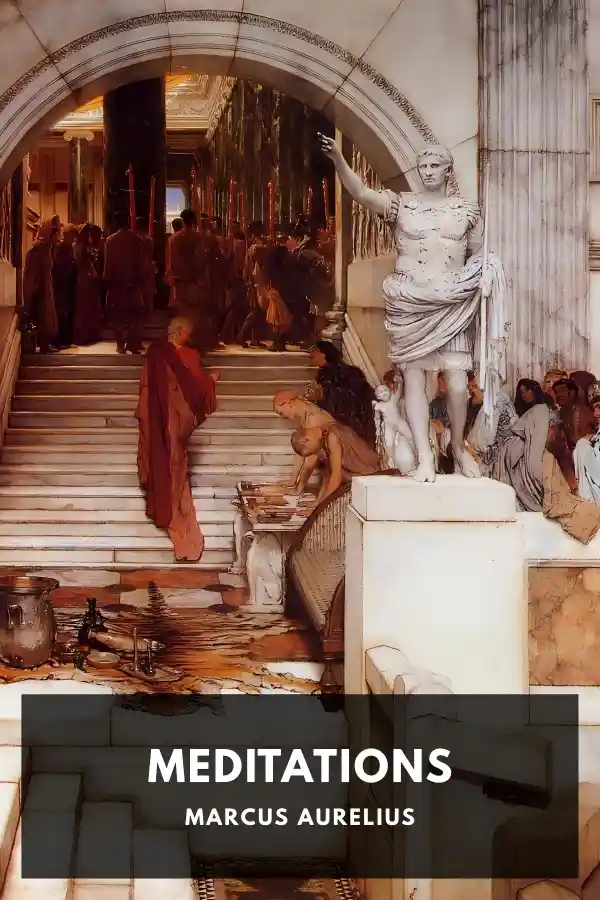
Meditations
📖 Click to Read Book I Online Preview
Book I
From my grandfather Verus I learned good morals and the government of my temper.
From the reputation and remembrance of my father, modesty and a manly character.
From my mother, piety and beneficence, and abstinence, not only from evil deeds, but even from evil thoughts; and further, simplicity in my way of living, far removed from the habits of the rich.
This is only the opening of Book I. Download the complete unabridged edition to read all twelve books of Marcus Aurelius’s private notebooks.
Download Full EPUBTL;DR
Meditations is a collection of twelve books of Stoic reflections written by the Roman emperor Marcus Aurelius between 170 and 180 CE. Composed as private notes to himself rather than for publication, it returns again and again to the same practical questions: how to separate what is within our control from what is not, how to meet anger and ingratitude without losing composure, and how to keep death in view without being ruled by fear of it. This Standard Ebooks edition uses George Long’s 1862 translation, based on a transcription from the Internet Classics Archive and on Google Books scans, and is in the public domain in the United States. The text was prepared by Standard Ebooks.
Meditations by Marcus Aurelius: Summary, Characters & Themes
Meditations is the private notebook of Marcus Aurelius, Roman emperor from 161 to 180 CE, written in Greek during his campaigns on the Danube frontier. This summary and analysis follows the twelve books as they move from gratitude and self-examination to a settled Stoic discipline. The text was never meant for readers; it is a working manual for keeping one’s own conduct in order.
Book I is a long thank-you list. Marcus names his grandfather, parents, tutors, and adoptive father one by one, and states what each taught him: modesty, endurance, simplicity, freedom from superstition, the habit of reading carefully. The entries are plain and specific, and they set the tone for everything that follows.
Books II to XII turn inward. Marcus reminds himself that most of what disturbs him is opinion rather than event, that anger at another person is a kind of self-harm, and that the present moment is the only thing he actually possesses. Death appears on nearly every page, not as a threat but as a fact that makes ordinary anxieties look small.
The later books are less structured. Short commands, repetitions, and abrupt shifts of subject suggest a man writing under pressure, often at night and often tired. What holds the whole together is the recurring demand to live according to nature and reason, and to treat every other person as a fellow member of the same community.
This Standard Ebooks edition uses the 1862 translation by George Long. It is based on a transcription from the Internet Classics Archive and on digital scans from Google Books, and the text was prepared by Standard Ebooks. The work is in the public domain in the United States.
Historical Context
Marcus Aurelius ruled during a period of near-constant war, plague, and fiscal strain. The Danube campaigns against the Quadi and Marcomanni kept him away from Rome for long stretches, and several of the books are marked with place names such as Carnuntum and the Granua river. Stoicism was not a private hobby for him; it was the working philosophy of a man who had to make decisions daily and live with their consequences.
Key Characters & Literary Archetypes
- Marcus Aurelius(The Emperor-Philosopher): The writer and sole subject of the book, addressing himself in the second person as a man in need of correction.
- Antoninus Pius(The Adoptive Father): Remembered in Book I for mildness, patience, and a quiet contempt for display; his example shapes Marcus’s ideal of rule.
- Rusticus(The Teacher): The Stoic who lent Marcus his copies of Epictetus and taught him to write plainly and to accept correction.
- Maximus(The Model of Self-Command): Praised for cheerfulness under illness and for a character that never seemed to perform its own virtue.
- The Unnamed Other(The Neighbor): A recurring figure in the later books, imagined as ignorant rather than wicked, and therefore to be taught or borne with rather than hated.
Core Literary Themes
- Reason and Nature: The universe is ordered, and the rational mind is the part of a person that can align with that order.
- The Dichotomy of Control: Judgement, desire, and action are ours; reputation, health, and length of life are not.
- Mortality: Death is a natural process, not a punishment, and remembering it strips ordinary anxieties of their weight.
- Duty and Social Fellowship: Human beings are made for cooperation, and injury to another is finally an injury to oneself.
- Self-Discipline: Freedom comes from ruling one’s own impulses, not from ruling others.
Why Download Our Custom E-Reader Edition of Meditations?
Marcus Aurelius wrote Meditations between 170 and 180 CE, near the end of his reign and in the middle of the Danube wars. It is not a treatise. It is a working notebook, kept in Greek by a Roman emperor for his own use.
The twelve books move from gratitude to self-command. Book I names the people who shaped him and what each one taught. The rest returns to a small set of problems: what is actually under our control, why anger at other people harms the person who feels it, and how the thought of death can make ordinary life clearer rather than darker.
Older plain-text editions of George Long’s 1862 translation often flatten the book’s structure. Books run together, the numbered divisions lose their hierarchy, and on a phone or e-reader the result is a wall of unbroken prose. This edition rebuilds the twelve-book structure with working navigation and a typographic layout suited to a philosophical text read in short sittings.
- Based on the Standard Ebooks Edition, via a transcription from the Internet Classics Archive and Google Books scans: The text follows the Standard Ebooks edition of George Long’s translation, which itself rests on a transcription from the Internet Classics Archive and on digital scans from Google Books.
- Granular Architectural NCX/Nav Structural Navigation: Each of the twelve books is a separate navigation point, so you can move between books, return to a passage, or read out of order without losing your place.
- Calibrated Typographical Layout for Philosophy: Long paragraphs are set with generous line spacing and a readable serif face, which matters when the content is dense and meant to be reread.
- Verified Public Domain Sources: The edition is based on Standard Ebooks, a volunteer project that produces public domain texts with modern typography. The text was prepared by Standard Ebooks, and the work is in the public domain in the United States.