Beyond Good and Evil by Friedrich Nietzsche: Free EPUB, AZW3 & KEPUB
Beyond Good and Evil
📖 Click to Read Chapter I: Prejudices of Philosophers — Section 1 Online Preview
Chapter I: Prejudices of Philosophers — Section 1
The Will to Truth, which is to tempt us to many a hazardous enterprise, the famous Truthfulness of which all philosophers have hitherto spoken with respect, what questions has this Will to Truth not laid before us! What strange, perplexing, questionable questions! It is already a long story; yet it seems as if it were hardly commenced. Is it any wonder if we at last grow distrustful, lose patience, and turn impatiently away?
That this Sphinx teaches us at last to ask questions ourselves? Who is it really that puts questions to us here? What really is this “Will to Truth” in us? In fact we made a long halt at the question as to the origin of this Will — until at last we came to an absolute standstill before a yet more fundamental question. We inquired about the value of this Will. Granted that we want the truth: why not rather untruth? And uncertainty? Even ignorance?
The problem of the value of truth presented itself before us — or was it we who presented ourselves before the problem? Which of us is the Oedipus here? Which the Sphinx? It would seem to be a rendezvous of questions and notes of interrogation. And could it be believed that it at last seems to us as if the problem had never been propounded before, as if we were the first to discern it, get a sight of it, and risk raising it? For there is risk in raising it, perhaps there is no greater risk.
This is the opening of Nietzsche’s critique of the will to truth. Download the full EPUB to continue reading all nine chapters, the epigrams, and the closing poem.
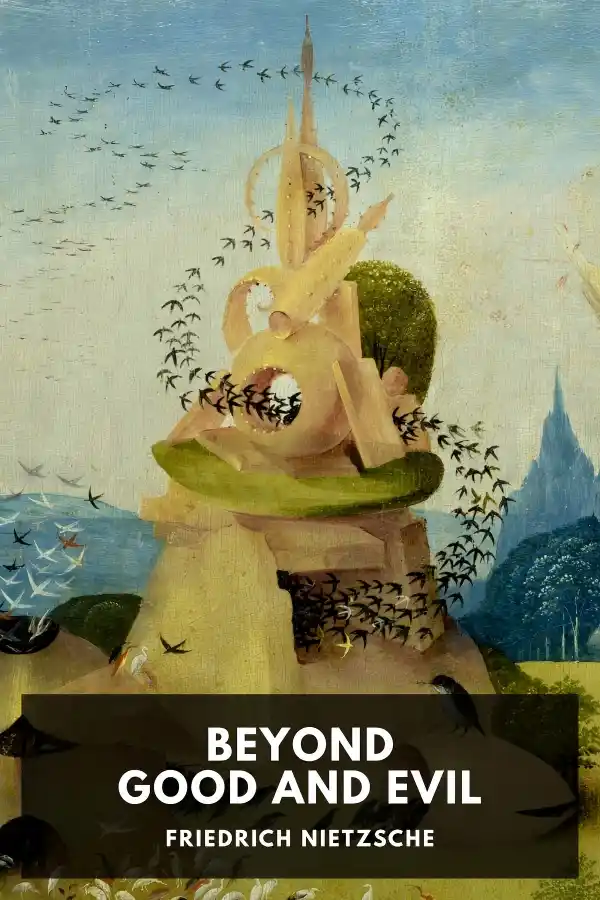
Download Full EPUBBeyond Good and Evil is an 1886 philosophical work by Friedrich Nietzsche, a radical critique of traditional European morality that examines the unexamined prejudices of past philosophers, explores themes of the will to power, master-slave morality, perspectivism, and the revaluation of all values, and champions the figure of the free spirit. This Standard Ebooks edition, based on Project Gutenberg #4363 and Internet Archive scans, is in the public domain in the United States; readers outside the US should check their local laws. The text is available via Standard Ebooks.
The book opens by interrogating the will to truth itself. Why, Nietzsche asks, do philosophers value truth over untruth, certainty over uncertainty? He argues that the great dogmatic systems — Plato’s, Kant’s, Christianity’s — rest not on disinterested reason but on unexamined moral preferences. Their belief in opposing values, in good against evil, truth against appearance, is itself a prejudice that philosophy has never dared to question.
From this opening, Nietzsche turns to the psychology of philosophers. He suggests that conscious thought is largely instinctive, that moral systems are disguised autobiographies, and that the will is far more complicated than the simple faculty philosophers have assumed. Chapter IV, “Apophthegms and Interludes,” condenses these observations into 185 short maxims, and Chapter V offers a natural history of morals, distinguishing master morality from slave morality and tracing how the latter came to dominate Europe.
Later chapters examine religion, scholarship, and virtue, before the final chapter asks what nobility could mean now that the old hierarchies have collapsed. Nietzsche does not answer with a system. He answers with a figure — the philosopher of the future, the “free spirit” who can live without the consolations of metaphysics or faith, who has learned to see morality as one perspective among many.
Nietzsche first formulated these ideas in poetic form in Thus Spake Zarathustra (1883–1885). He then elaborated their historical consequences in On the Genealogy of Morality (1887). Together, the three works form the core of his mature critique of European morality.
Why Download Our Custom E-Reader Edition of Beyond Good and Evil?
Published in 1886, Friedrich Nietzsche’s Beyond Good and Evil stands as one of the most provocative masterpieces in modern Western philosophy. This custom digital edition pairs Helen Zimmern’s landmark 1906 English translation with typography engineered for focused reading on modern screens. It is offered as a free EPUB, with AZW3 and KEPUB versions available for Kindle and Kobo devices.
The text comprises nine thematic chapters, 296 numbered aphorisms, and a closing poem. Its aphoristic structure demands sustained attention as Nietzsche deconstructs past metaphysics and articulates the will to power. Navigating such dense argumentation requires a distraction-free layout with clean section dividers and crisp contrast.
While raw public domain conversions often suffer from merged aphorism numbering, misplaced German and Latin epigraphs, and broken table of contents links, we resolved these flaws directly. The result is an intuitive, reliable reading experience across e-ink readers and mobile apps.
- Based on the Standard Ebooks Edition, via Project Gutenberg #4363: Sourced directly from verified public domain texts and historical scans, preserving Zimmern’s complete, unabridged, DRM-free translation without censorship.
- Granular Architectural NCX/Nav Structural Navigation: Features a comprehensive multi-tier table of contents providing instant jumps to each of the nine chapters, the epigrams section, and the closing poem “From the Heights.”
- Calibrated Typographical Layout for Philosophy & Aphorisms: Built with dedicated CSS stylesheets, optimized line spacing, and distinct formatting for philosophical aphorisms and italicized conceptual terms on e-ink displays.
- Verified Public Domain Sources: Built from open-access transcriptions hosted at Project Gutenberg and digital typesetting standards from Standard Ebooks.