Thus Spake Zarathustra by Friedrich Nietzsche: Free EPUB, AZW3 & KEPUB Download
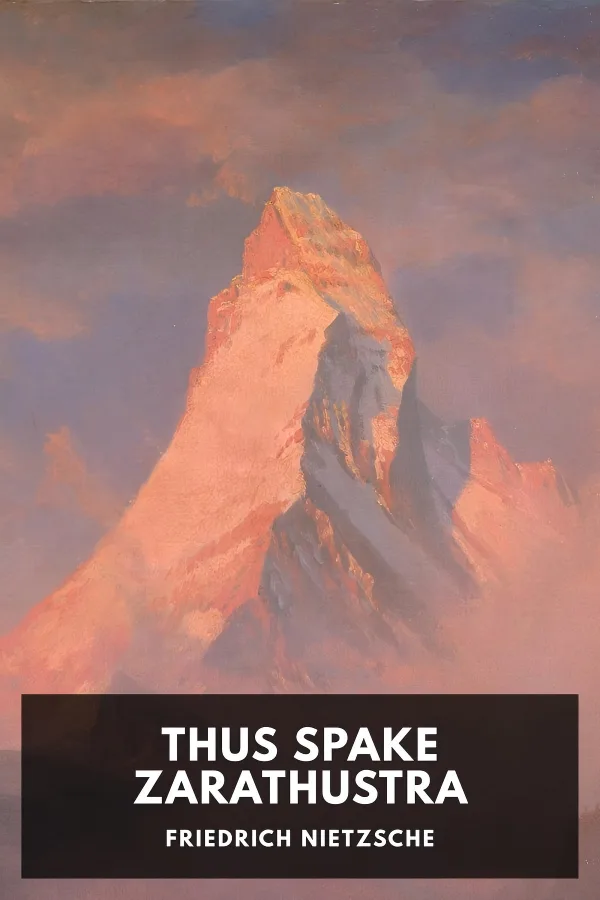
Thus Spake Zarathustra
📖 Click to Read Zarathustra’s Prologue — Section I Online Preview
Zarathustra’s Prologue — Section I
When Zarathustra was thirty years old, he left his home and the lake of his home, and went into the mountains. There he enjoyed his spirit and solitude, and for ten years did not weary of it. But at last his heart changed — and rising one morning with the rosy dawn, he went before the sun, and spake thus unto it:
Thou great star! What would be thy happiness if thou hadst not those for whom thou shinest!
For ten years hast thou climbed hither unto my cave: thou wouldst have wearied of thy light and of the journey, had it not been for me, mine eagle, and my serpent. But we awaited thee every morning, took from thee thine overflow and blessed thee for it. Lo! I am weary of my wisdom, like the bee that hath gathered too much honey; I need hands outstretched to take it. I would fain bestow and distribute, until the wise have once more become joyous in their folly, and the poor happy in their riches.
This is the opening of Zarathustra’s descent from the mountain. Download the full EPUB to continue reading all four parts, the 80 discourses, and the closing “Sign.”
Download Full EPUBThus Spake Zarathustra is an 1883–1885 philosophical novel and prose poem by Friedrich Nietzsche, a landmark work of modern philosophy set across mountainous solitudes and ancient towns that follows the prophet Zarathustra descending to teach humanity, exploring themes of the Übermensch, the death of God, the will to power, and the eternal recurrence of the same. This Standard Ebooks edition, based on Project Gutenberg #1998 and Google Books scans, is in the public domain in the United States; readers outside the US should check their local laws. The text is available via Standard Ebooks.
Thus Spake Zarathustra by Friedrich Nietzsche: Summary, Characters & Themes
Friedrich Nietzsche composed Thus Spake Zarathustra (Also sprach Zarathustra) between 1883 and 1885. The book is a philosophical novel and prose poem written in biblical cadence. This critical summary and analysis examines the doctrines Nietzsche first staged here: the death of God, the Übermensch, the will to power, and the eternal recurrence.
The narrative begins after Zarathustra has spent a decade in mountain solitude with his symbolic companions, the eagle and the serpent. Sensing an abundance of wisdom, he descends to the marketplace of the Town of the Motley Cow to teach humanity how to transcend itself. His announcement of the Übermensch meets uncomprehending derision from the crowd, who prefer the complacent comfort of the “Last Man.”
Realizing that the herd cannot receive his teachings, Zarathustra seeks individual disciples and withdraws into solitude. Across four parts and eighty discourses, he wrestles with the psychological burden of his own vision. In the dramatic fourth part, he encounters various “higher men” in his mountain cave. He helps them confront spiritual vacuum while warning against shallow nihilism.
The work stands as the poetic wellspring of Nietzsche’s mature output. Where Zarathustra speaks through mythic parable, Nietzsche later turned to analytical critique in Beyond Good and Evil (1886) and On the Genealogy of Morality (1887). Together, the three books form the core of his revaluation of European values.
This digital edition presents the complete, unabridged English translation by Thomas Common, first published in 1909. The transcription is sourced from Project Gutenberg #1998 and Google Books scans. Readers can also consult the digital edition maintained by Standard Ebooks.
Historical Context
Nietzsche wrote the book during travels between Genoa, Sils Maria, and Nice. It reflects the creative burst that followed his emotional break with Lou Andreas-Salomé. Confronting the secularization of late 19th-century Europe, he sought a prophetic literary form. He wanted a form that could parody scripture while offering a life-affirming mythos to replace decaying Christian dogma.
Key Characters & Literary Archetypes
- Zarathustra (The Solitary Prophet): The Persian prophet reimagined as the herald of self-overcoming, descending from mountain heights to dismantle asceticism and teach earthly devotion.
- The Übermensch (The Overman): The ideal goal for humanity, representing creative autonomy, vitality, and the capacity to generate values without divine sanction.
- The Last Man (Der letzte Mensch): The antithesis of the Overman — a stagnant, risk-averse creature seeking only comfort, entertainment, and docile equality.
- The Higher Men: The failed seekers of the fourth part, gathered in Zarathustra’s cave, who embody the spiritual exhaustion of modern Europe.
- The Eagle and the Serpent: Zarathustra’s animal companions, symbolizing pride and wisdom respectively.
Core Literary Themes
- The Death of God and the Challenge of Nihilism: The collapse of transcendent foundations forces humanity to choose between trivial mediocrity and heroic self-creation.
- Fidelity to the Earth: Zarathustra demands a rejection of other-worldly hopes in favor of embodied, sensual, and earthly existence.
- The Will to Power as Self-Overcoming: Creative struggle is defined not as physical domination over others, but as relentless mastery over one’s own limitations.
- The Eternal Recurrence and Amor Fati: The ultimate existential test — every moment will repeat infinitely, demanding absolute affirmation of one’s earthly existence.
- Solitude Versus the Crowd: Authentic intellectual breakthroughs require radical isolation away from the conformist noise of the public square.
Why Download Our Custom E-Reader Edition of Thus Spake Zarathustra?
Published between 1883 and 1885, Friedrich Nietzsche’s Thus Spake Zarathustra is one of the most stylistically daring philosophical texts in modern history. This custom digital edition pairs Thomas Common’s 1909 English translation with typography calibrated for sustained immersion on modern screens. It is offered as a free EPUB, with AZW3 and KEPUB versions available for Kindle and Kobo devices.
The work unfolds across four parts and eighty allegorical discourses. It moves between dramatic parables, poetic chants, and philosophical dialogues on the Übermensch and eternal recurrence. Reading such lyrical prose requires a clean, rhythmic layout with clear section dividers and balanced whitespace.
While unvetted public domain transcriptions often suffer from merged speech segments, missing part dividers, and broken table of contents links, we resolved these defects directly. The result is an intuitive, fluid reading journey across all major e-ink devices.
- Based on the Standard Ebooks Edition, via Project Gutenberg #1998: Formatted from verified public domain source files and Google Books scans, preserving Common’s complete, unabridged, DRM-free text and its rhythmic cadences.
- Granular Architectural NCX/Nav Structural Navigation: Features an exhaustive multi-level table of contents allowing direct jumps to all four parts, the prologue, and every individual discourse.
- Calibrated Typographical Layout for Poetic Philosophy: Engineered with tailored CSS rules, balanced line heights, and distinct margins optimized to prevent visual fatigue on e-ink displays.
- Verified Public Domain Sources: Built from open-access transcriptions hosted at Project Gutenberg and typesetting standards maintained by Standard Ebooks.