The Green Mummy by Fergus Hume: Free EPUB, AZW3 & KEPUB Download
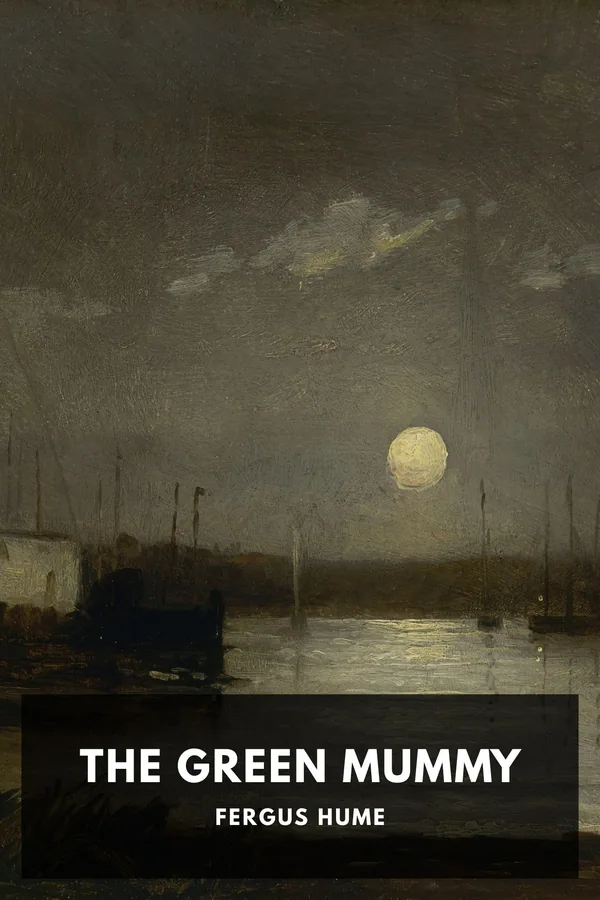
The Green Mummy
📖 Click to Read the Opening Pages Online Preview
The opening of Chapter I, headed The Lovers: Lucy Kendal and Archie Hope walk the lane above the marshes, quarrelling over the thousand pounds he has paid her stepfather for his consent to their marriage.
“I am very angry,” pouted the maid.
“In heaven’s name, why?” questioned the bachelor.
“You have, so to speak, bought me.”
“Impossible: your price is prohibitive.”
“Indeed, when a thousand pounds—”
“You are worth fifty and a hundred times as much. Pooh!”
“That interjection doesn’t answer my question.”
“I don’t think it is one which needs answering,” said the young man lightly; “there are more important things to talk about than pounds, shillings, and sordid pence.”
“Oh, indeed! Such as—”
“Love, on a day such as this is. Look at the sky, blue as your eyes; at the sunshine, golden as your hair.”
“Warm as your affection, you should say.”
“Affection! So cold a word, when I love you.”
The excerpt below prints the first twelve short paragraphs of Chapter I, from Lucy’s complaint that she has been bought to Archie’s reply that affection is too cold a word for what he feels. It stops inside that first exchange, before the two of them walk on towards the Pyramids and the village, and before the question of the mummy is raised at all.
Download Full EPUB1908
Novel
88,400 words
4.9 h
Standalone
Gartley, a village of cottages and one wheat field on the marshes beside the Thames, with Professor Braddock’s house the Pyramids, the artillery fort on the road above the river, the old jetty among the bents, Mrs. Jasher’s wooden cottage, and Pierside, Brefort and the railway station at Jessum within reach.
Twenty-seven chapters in twelve parts
EPUB · AZW3 · KEPUB
0.67 MB (EPUB) · 0.75 MB (AZW3) · 0.70 MB (KEPUB)
Public domain in the United States
Project Gutenberg #2868 · Standard Ebooks
Professor Braddock, an Egyptologist living in an old house called the Pyramids, sends his assistant Sidney Bolton to Malta to buy a Peruvian mummy wrapped in green bandages. Bolton comes back dead, strangled, and the mummy has vanished; the packing case that reaches Gartley holds his body instead. Lucy Kendal, the Professor’s stepdaughter, is engaged to the painter Archie Hope, who paid a thousand pounds for the old man’s consent, and Sir Frank Random, the soldier she refused, takes up the search. A Peruvian, a Yankee skipper and a Latin manuscript follow, and the answer lies closer to home than anyone has looked.
The novel runs on talk: interviews, quarrels, confessions and long explanations in the museum, with the police rarely more than an interruption. Its evidence is circumstantial and its amateurs keep accusing one another by inference, which is the joke as well as the method. The Wikipedia list of Fergus Hume’s novels shows how many books he had behind him by this date, and the text reproduced here is the Standard Ebooks edition. — The text is available via Project Gutenberg #2868 and Standard Ebooks.
The Green Mummy by Fergus Hume: Summary, Characters & Themes
This page gives a summary and analysis of The Green Mummy, with its twenty-seven chapters set out in reading order, the household at the Pyramids and the visitors who come to it described, and the inquiry into Sidney Bolton’s death followed in the order the book gives its evidence. Fergus Hume published the novel in 1908, by which time he had been writing mysteries for more than twenty years. The edition reproduced here numbers its chapters I to XXVII and heads the first of them The Lovers; the twelve groups in the chapter list are ours, added for navigation, and each one stops where its last chapter stops. Names, sums of money and chapter numbers are the novel’s own, so a passage found here can be carried back to the page it comes from, and the pages that solve the case are left to say so in their own time.
The household is a museum with a family attached. Professor Braddock keeps his Egyptian collection on the ground floor of the Pyramids, dines at five thirty, forgets meals, and leaves the housekeeping to Lucy Kendal, his stepdaughter by a marriage of convenience that brought him five hundred a year. Lucy is engaged to Archie Hope, a painter with three hundred a year, and Hope has sold investments to give Braddock the thousand pounds that bought the mummy and the old man’s consent. Sir Frank Random, an artillery captain at the fort and a baronet, wanted Lucy himself and was refused. The text used here is the Standard Ebooks edition, and the same text is at Project Gutenberg #2868. Below stairs there is a cook with a husband who gardens and a parlourmaid, and on the ground floor a museum that nobody but its owner is allowed to dust.
Round this small circle the book sets a larger story. The mummy is the body of Inca Caxas, and Don Pedro de Gayangos, who comes to Gartley from Lima with his daughter, says it was stolen from his father thirty years before by a sailor called Vasa. A Latin manuscript, shown over a dinner table and quoted at intervals afterwards, names two emeralds enclosed in the dead hands. Hume keeps the pieces moving: a tramp steamer and her skipper, a public house at Pierside, a garden in the marshes, a copy of the manuscript hidden among the books of an officer’s quarters. Every arrival is a new witness, and the reader weighs them as the people in the book do, on circumstantial evidence and manner. The interviews are the plot: each witness adds a piece, and each piece is argued over in a museum, an inn or a garden.
The comedy deserves notice because it carries most of the first half. Braddock is a fighting cherub of fifty-odd, rude to guests, tender to scarabs, and convinced that the world exists to fund an expedition to a queen’s tomb in Ethiopia. Mrs. Jasher, a Scotch widow of forty-five who lets it be thought that she is younger, sets out to marry him for the title he may inherit and the position she wants in London. The village talks, the newspapers exaggerate, and Inspector Date of Pierside arrives with constables and no clue. Hume’s narrator enjoys himself: Gartley, he says, awoke one morning to find itself famous, like a geographical Lord Byron. The minor people are drawn with the same relish: a young doctor who wants to be noticed, a constable who was at school with the dead man, and a laundress who has turned prophecy into a trade.
The last chapters cost more than the first ones promise. A written confession supplies the whole design in a single sitting, and the novel’s comedy of manners turns into a story about a man who let an obsession set the price of other people’s lives. Lucy is left with the disgrace of a name she does not share, and Hume marries her off quickly and kindly, to a household in San Remo with nearly a thousand a year and no mummies in it. Readers who want the same decade in a colder key can take The Hound of the Baskervilles, published six years earlier, or The Innocence of Father Brown, three years later; the rest of the Detective and Mystery Classics shelf is free as well. What stays is the portrait of a collector who could not tell the value of a dead man from the value of a living girl, and of a village that talked about the case for a season and then found something else to talk about.
Historical Context
Detective fiction was a trade by 1908, and Hume had been in it since the 1880s, when a murder story set in Melbourne made his name. He wrote for a large and quick market: long novels for the circulating libraries and the colonial trade, serial rights, cheap reprints, and readers who expected a mystery to be solved before the last page. The conventions are all visible here. There is a country house with a locked room in it, a professional police force that arrives late and achieves nothing, a class of amateurs with time on their hands, an inquest reported in the newspapers, and a final explanation delivered at length by the people who worked it out. Hume’s own recipe, in this book as elsewhere, is a small closed society, a visitor who asks questions, and a secret kept for years by people who cannot afford to tell it.
Egyptology supplied the book with its vocabulary and half its jokes. Braddock reads hieroglyphics, dates a scarab to the twentieth dynasty, quotes a recipe from a papyrus, and quarrels with anyone who suggests that Peruvian embalming came from Egypt rather than the other way about; his ground floor is crowded with mummy cases, sepulchral ornaments and hawk-headed gods. The novel assumes a reader who knows what a mummy case is and why a museum would want one, and it trades on the period’s appetite for the contents of tombs, fed by excavation reports, lectures and newspaper stories, and by the Egyptian department of the British Museum, where Braddock goes to work. The green bandages themselves are a newspaper detail, the sort of thing a collector would remember and a reporter would print, and Don Pedro’s Peru is the other half of the same appetite.
The rest of the machinery is military and domestic. Gartley Fort is a recognisable place for the decade: garrison artillery, quarters and a mess, a sentry box at the gate, and guns that watch the traffic on the Thames and answer the smaller guns across the water. Random’s income is a captain’s pay plus a private fortune dented at Monte Carlo, and the difference matters to everyone considering a marriage. The book’s sums are small and exact, because its people live on them: three hundred a year for a painter, five hundred for a widow’s income, a thousand pounds for a mummy, a hundred for a reward, three thousand for an emerald. An Edwardian reader would have known what each of those meant. The book also knows what a legacy does to a household, since a life interest and a reversion stand quietly behind every proposal in it.
Key Characters & Literary Archetypes
- Lucy Kendal: Braddock’s stepdaughter, who keeps his house, pays his bills and manages his temper. She is quick, decided and fond of teasing, denies that her stepfather has any authority over her, and says she will marry Hope whether the old man consents or not. Her mother’s five hundred a year comes to her after Braddock’s life interest, and her last wish is to leave Gartley and the museum behind her.
- Professor Braddock: A small, plump, rosy Egyptologist of fifty-odd, rude to visitors, tender to his collection, and methodical to the minute. He married Lucy’s mother for an income and would marry Mrs. Jasher for a legacy; he is heir to a baronetcy through an unmarried brother, and he needs five thousand pounds for a tomb in Ethiopia. His rages are famous, his meanness is exact, and his selfishness is treated as a branch of scholarship.
- Archie Hope: A painter of twenty-five with three hundred a year, who sells investments to buy his engagement and then finds himself umpire between Braddock and Don Pedro. He argues where Random agrees, defends his friend when the skipper accuses him, and ends the book as the amateur who reads the confession aloud. He marries Lucy within a fortnight of the last death and takes her away from Gartley.
- Sir Frank Random: An artillery captain at the fort and a baronet, good-looking, good-tempered and unremarkable, refused by Lucy before the story opens. He is in love with Donna Inez, follows the mummy across Europe for her father, and proves to be the book’s best detective: he traces a blackmailing letter by the perfume on the paper and by a night train from Jessum, and he keeps his promise to help the woman who wrote it.
- Mrs. Jasher: A Scotch widow of forty-five, small, plump and lively, who has come to a wooden cottage on the marshes to find a husband. She invents a brother in Peking and a legacy to explain money she does not have, sets her cap at Braddock for his possible title, and does the book’s most damage with a pen. Her death is the one the novel laments, and the only mourner at it is her servant.
- Cockatoo: Braddock’s Kanaka body servant, brought from the Solomon Islands by way of Queensland: dwarfish, deep-chested, tattooed, with a mop of hair dyed a vivid yellow. He guards the museum, waits at table when permitted, and worships his master. The novel notes his childish rages and the fear he causes in the household, gives him very little to say, and lets his devotion explain everything he does.
Core Literary Themes
- The mummy and its price: Almost every scene has a figure attached to it. The mummy costs nine hundred pounds in Malta and a thousand to buy back; the expedition to Ethiopia needs five thousand; Mrs. Jasher’s imaginary legacy is said to be some thousands; the anonymous letter asks for five thousand; the reward for the sailor is a hundred; one emerald fetches three thousand in Amsterdam and Don Pedro hopes for five. Hume’s joke is that the corpse is worth nothing as a body and everything as a container: Braddock wants the bandages, Don Pedro wants the hands, and the thief wants the stones. The novel keeps its accounts honestly to the last page, and the sums are how its people measure one another.
- A museum in a house: The Pyramids is a Georgian house that Braddock has filled with mummy cases, scarabs, papyri and a silver mirror from Memphis, and it is run like an institution: locked while he is away, guarded by Cockatoo, closed to visitors, and never spring-cleaned. The British Museum is where the finds are meant to end up, and a Cairo museum is where the records were read. Hume makes the collection a character. It explains the meanness, the rages and the neglect of Lucy, and it is why a locked door and a servant with a key matter so much. When the furniture is sold and the lease given up at the end, an institution closes.
- Detection without a detective: There is no Sherlock in Gartley. Inspector Date of Pierside is tall, severe and baffled, and Constable Painter is willing but slow; the work is done by a painter, a baronet and a Peruvian with a memory for faces, all of them guessing. The theories arrive in turn and are all wrong: Random is accused by a skipper, Mrs. Jasher by the village and by Braddock, Widow Anne by Lucy, and the woman in the shawl turns out to be a man in a borrowed dress. The method is the interview, and the evidence is circumstantial until a confession arrives. The reader is asked to suspect everyone, which is what the people in the book do, and to be wrong for as long as they are.
- Marriage, money and the title: Marriage is a transaction here and everyone says so. Braddock married Lucy’s mother for an income and proposes to Mrs. Jasher for her supposed legacy; Mrs. Jasher wants a baronetcy and a salon; Random’s fortune has been reduced at Monte Carlo; Lucy rejects a soldier-baronet for a painter with three hundred a year, and makes a running joke of having been bought. The thousand pounds changes hands like a bride price and is given back like a loan. The two weddings at the end settle the sums: the check for the mummy is made payable to Lucy, who passes it to the man who lent the money in the first place.
- The servant and the household: Cockatoo is the book’s most uncomfortable figure and its most useful one. A Kanaka from the Solomon Islands, brought to England by a master who found him on a plantation, he guards the museum, waits at table, rows the boat and takes orders. The novel calls him a savage in one sentence and shows his devotion in the next, and that devotion is the engine of the plot: a servant with no standing in English law is exactly what a hard-pressed master needs, and the violence, when it comes, is the other side of that dependence. Round him are Jane, loyal to a mistress nobody else mourns, and Widow Anne, whose washing keeps her alive after her son is killed.
Why Download Our Custom E-Reader Edition of The Green Mummy?
The download is the whole novel: twenty-seven chapters, from Lucy’s complaint in the lane to the last sentence at Monte Carlo, with nothing cut and no scene summarised in place of the original. The text is the Standard Ebooks edition, set from the Project Gutenberg transcription and from digital scans at the HathiTrust Digital Library, so the spelling, the punctuation and the chapter breaks are the edition’s throughout.
Around the text the page supplies what a book of this kind needs: twelve grouped summaries that stop where their chapters stop, six character notes, five themes, and a short account of the detective fiction, the Egyptology and the money of 1908. The groups are ours; the chapters and their numbering are not. Each summary names the chapters it covers, so a passage found here can be looked up in any edition that prints the numbers, and the whole case is covered in order without giving away what the next chapter discovers.
The files come in three formats with the same text and the same chapter breaks. The EPUB opens in Apple Books, Calibre and most Android readers, the AZW3 is the file for a Kindle by cable or through Send to Kindle, and the KEPUB is the one Kobo devices read best. No account is needed for any of them, and nothing in the downloads is locked, watermarked or time limited, so the files keep working long after the app you first opened them in is gone.
- Based on the Standard Ebooks Edition, via Standard Ebooks, whose text of The Green Mummy is set from a Project Gutenberg transcription and from digital scans at the HathiTrust Digital Library, with the chapter numbers kept as the edition prints them.
- Complete text in twenty-seven chapters Every chapter from the Pyramids to the jetty, numbered I to XXVII as the edition numbers them, with no chapter abridged and no dialogue rewritten.
- Twelve grouped chapter summaries Twelve summaries in reading order, each keyed to the chapters it covers and stopping at their end, so that the page can be read beside the novel without running ahead of it.
- EPUB, AZW3 and KEPUB files The same text in three formats, for Apple Books, Kindle and Kobo, with the chapter numbers and the chapter breaks intact and no reader software to install beyond the one you already use.
- Arthur Conan Doyle’s novel of 1902, six years earlier: an English house under a family curse, a hound on the moor, and a detective called in from London. — free EPUB, AZW3 & KEPUB
- G. K. Chesterton’s twelve stories of 1911, three years later, in which a small priest solves the cases that the police cannot. — free EPUB, AZW3 & KEPUB
- The shelf where this edition sits, with the rest of our free detective and mystery classics. — free EPUB, AZW3 & KEPUB
Chapter summaries
The novel has twenty-seven chapters, numbered I to XXVII, and the first of them is headed The Lovers. The twelve group names used here are ours, added so that the evidence can be followed in the order the book gives it. Each group begins where its first chapter begins and stops where its last chapter stops, and none of them names a criminal before the chapter that names him. Chapters are cited by number throughout, and the numbering is the same in all three downloads.
- Chapters I–II — The thousand pounds and the Pyramids: Lucy Kendal teases Archie Hope about the thousand pounds he paid her stepfather, and the two walk back through Gartley. At the Pyramids, Braddock forgets his dinner, shows Mrs. Jasher his collection, and lets her see how much he wants an expedition he cannot pay for.
- Chapters III–IV — The Kanaka, and a case that comes by cart: Cockatoo waits at table while the Professor describes the queen’s tomb and the five thousand pounds an expedition would cost. Hope learns that his money has not bought him peace of mind. Then the packing case arrives by lorry without Bolton, and the opened case holds a dead man.
- Chapters V–VI — The cord round the throat, and the inquest: Dr Robinson finds a red window cord from the blind knotted round Bolton’s neck, and Cockatoo is sent for the police at Pierside. The village becomes famous and the newspapers invent theories; at the inquest the chambermaid Eliza Flight describes a woman in a dark shawl talking to Bolton through his window. The verdict is wilful murder by a person unknown.
- Chapters VII–VIII — Hervey’s five hundred pounds, and Random’s story: Captain Hervey of the Diver calls at the Pyramids, says the window was snibbed from outside with a string, and offers to hunt the thief for five hundred pounds. Random, back from his yacht, tells Braddock that a Peruvian called Don Pedro de Gayangos is following the mummy to England, and refuses to lend the money.
- Chapters IX–X — Mrs. Jasher’s legacy, and the Peruvians arrive: Mrs. Jasher confides that a brother in Peking has died and left her money, which she means to spend on marrying the Professor and becoming Lady Braddock. Braddock goes off to London, and Don Pedro and Donna Inez arrive at the Warrior Inn, he in black with a red tie, saying that the mummy was stolen from their family.
- Chapters XI–XII — The manuscript at dinner, and the arbor: At Mrs. Jasher’s table Don Pedro tells how the sailor Vasa stole Inca Caxas from Lima, and shows a Latin manuscript naming two emeralds buried in the mummy’s hands. Braddock comes home, proposes to Mrs. Jasher, and that night Lucy and Archie find the green case standing in the widow’s arbor.
- Chapters XIII–XIV — An accusation, and an empty pair of hands: Braddock accuses Mrs. Jasher of the theft, she faints, and the engagement collapses. Next morning the village decides that she is the murderer, Don Pedro claims his ancestor, and Hope is made umpire: the mummy is to be sold back for a thousand pounds. When the case is opened, the swathings are cut and the emeralds are gone.
- Chapters XV–XVI — The skipper names a murderer: The missing jewels give Don Pedro his theory, and a hundred pounds is offered for the sailor Vasa. Hervey forces his way into the museum and declares that Sir Frank Random killed Bolton, hid the mummy in the garden and took the emeralds. Hope answers him; that evening a copy of the Latin manuscript falls out of Random’s bookcase.
- Chapters XVII–XIX — The defence, and a face from Lima: Random explains his visit to the Diver and to the Sailor’s Rest and denies all knowledge of the manuscript, and Hope believes him. At the Pyramids, Don Pedro drops a cigarette case to make Hervey stretch for it, greets him as Gustav Vasa, and Braddock admits paying Vasa for a mummy in Peru thirty years before. Hervey’s revolver goes off through the ceiling.
- Chapters XX–XXI — A letter, and a scent: Random buys the mummy for a thousand pounds, Donna Inez rounds on Hervey, and Lucy’s tale of borrowed clothes points at Widow Anne. Next day Random receives a letter demanding five thousand pounds for proofs against him, and traces it to Mrs. Jasher by her Chinese perfume and a night train from Jessum. She admits the letter and the invented brother, and he lets her stay.
- Chapters XXII–XXIV — A wedding present, and a knife: Random tells Braddock, who rages and refuses to part with the mummy. That evening an emerald is left in the sentry box with a note calling it a wedding gift. Random and Hope go to the cottage, hear a scream, and find Mrs. Jasher stabbed; before she dies she says she sent the emerald, points to a written confession on her desk, and names Cockatoo.
- Chapters XXV–XXVII — The confession, the flight, and the river: The confession sets out the whole business: Braddock’s knowledge of the emeralds, the borrowed disguise, the murder at Pierside, the mummy under the jetty and then in the arbor, the emerald sold in Amsterdam. The Professor and Cockatoo have fled with the case. At the jetty Hervey’s boat is caught, the case goes overboard, and Braddock is found shot inside it.
The Green Mummy: Frequently Asked Questions
What is The Green Mummy about?
Who killed Sidney Bolton?
Who is Professor Braddock?
Who is Mrs. Jasher?
What are the emeralds, and where do they end up?
What happens to the green mummy?
How is the novel put together?
How do I read the free downloads?
Part of: Detective and Mystery Classics · 1900s