The Picture of Dorian Gray by Oscar Wilde – Free Download (EPUB, AZW3, KEPUB)
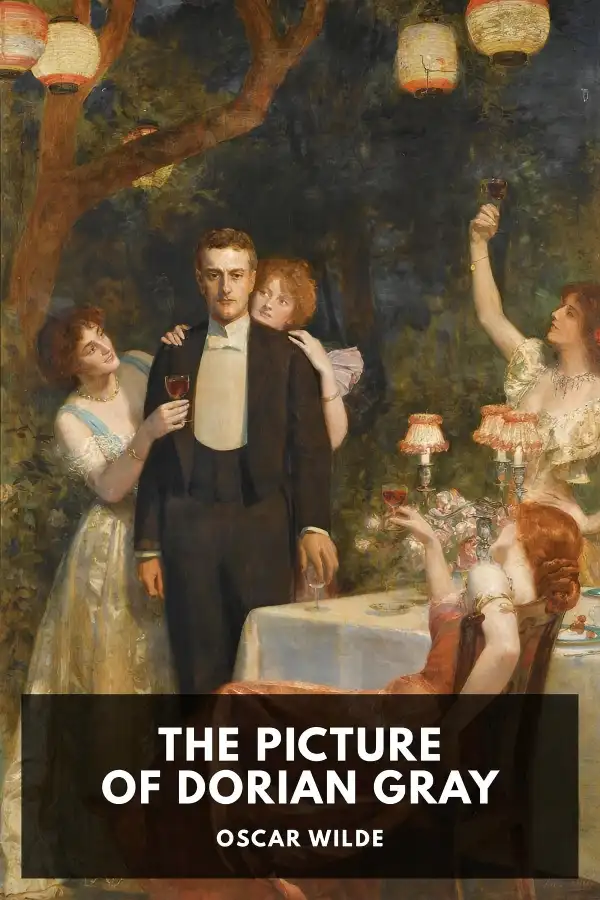
The Picture of Dorian Gray
📖 Click to Read Chapter 1 Online Preview
Chapter I
The studio was filled with the rich odour of roses, and when the light summer wind stirred amidst the trees of the garden, there came through the open door the heavy scent of the lilac, or the more delicate perfume of the pink-flowering thorn.
From the corner of the divan of Persian saddle-bags on which he was lying, smoking, as was his custom, innumerable cigarettes, Lord Henry Wotton could just catch the gleam of the honey-sweet and honey-coloured blossoms of a laburnum, whose tremulous branches seemed hardly able to bear the burden of a beauty so flame-like as their own; and now and then the fantastic shadows of birds in flight flitted across the long tussore-silk curtains that were stretched in front of the huge window, producing a kind of momentary Japanese effect, and making him think of those pallid jade-faced painters of Tokio who, through the medium of an art that is necessarily immobile, seek to convey the sense of swiftness and motion.
In the centre of the room, clamped to an upright easel, stood the full-length portrait of a young man of extraordinary personal beauty, and in front of it, some little distance away, was sitting the artist himself, Basil Hallward, whose sudden disappearance some years ago caused, at the time, such public excitement and gave rise to so many strange conjectures.
Immerse yourself in Oscar Wilde’s seductive exploration of art, vanity, and corruption. Download the complete unabridged novel for your e-reader.
Download Full EPUBExplorations of Duality & Gothic Terror
About Oscar Wilde’s The Picture of Dorian Gray
First published in Lippincott’s Monthly Magazine in July 1890 and significantly expanded for book publication by Ward, Lock and Company in April 1891, The Picture of Dorian Gray is the only novel written by the peerless Irish playwright, poet, and wit Oscar Wilde. The work ignited an immediate firestorm of moral outrage across Victorian England, condemned by mainstream periodicals as scandalous, poisonous, and decadent. Today, it is revered as an extraordinary aesthetic tour de force and an enduring metaphysical interrogation of hedonism, art, and the fracture of the modern psyche. This editions.ink edition is based on the Standard Ebooks version, derived from Project Gutenberg #174 and Internet Archive scans, and the novel is in the public domain in the United States.
The premise revolves around Dorian Gray, a radiant young aristocrat who captures the artistic imagination of painter Basil Hallward. Fascinated by his own likeness, and seduced by the radical, amoral philosophy of Lord Henry Wotton, Dorian makes an impassioned Faustian wish: that he might remain perpetually youthful while Basil’s oil portrait ages in his stead. His wish is mysteriously granted. For the ensuing eighteen years, Dorian pursues a life of unrestrained sensual indulgence, libertinism, and cruelty across London’s elite salons and squalid opium dens. While his physical countenance remains flawless and innocent, the hidden canvas in his attic festers with the horrific physical marks of his sins, becoming an inescapable spiritual mirror. The novel has 20 chapters and is set in late Victorian London.
Wilde famously defended the novel by declaring in his newly drafted Preface: “There is no such thing as a moral or an immoral book. Books are well written, or badly written. That is all.” This aphoristic opening manifesto established the theoretical foundation of the British Aesthetic movement, insisting on the primacy of artistic sensation over didactic Victorian moralizing.
Central Themes & Philosophical Context of The Picture of Dorian Gray
Aestheticism and the “New Hedonism”
The philosophical engine of the narrative is Lord Henry Wotton’s seductive doctrine of the “New Hedonism,” which implores youth to indulge every impulse, experience all passions, and cast aside religious self-abnegation. Drawing from Walter Pater’s The Renaissance, Lord Henry argues that life itself should be treated as a pure work of art. However, Wilde constructs a cautionary dimension to this doctrine: while Lord Henry merely philosophizes safely from his armchair, Dorian puts these hedonistic precepts into absolute practice, ultimately discovering that sensory indulgence severed from ethical responsibility leads inexorably to psychological ruin and self-destruction.
The Double Life and Victorian Hypocrisy
Like Stevenson’s Dr Jekyll and Mr Hyde, Wilde’s novel examines the duality of late-Victorian society. London is represented through stark social bifurcations: the glittering, perfumed drawing rooms of Mayfair contrasted against the squalid, nocturnal underworld of the East End docks. Dorian’s ageless beauty grants him an unassailable social armor; the Victorian elite repeatedly dismiss persistent rumors of his depravities simply because he looks so pure and aristocratic. The portrait functions as the ultimate indictment of bourgeois superficiality, proving that outward appearances frequently mask profound institutional rot.
Art as the Transcendent Double
The portrait serves as a dynamic, living entity—a supernatural conscience that refuses to be suppressed. Basil asserts that he put too much of himself into the canvas, transforming the painting into a repository of Basil’s adoration, Henry’s philosophy, and Dorian’s corruption. When Dorian ultimately attempts to destroy the canvas to free himself from his conscience, he inadvertently kills himself, illustrating Wilde’s supreme paradox: art outlives mortality, and attempting to eradicate the soul only obliterates the flesh. The novel ends with Dorian stabbing the portrait and dying himself, while the portrait returns to its original beauty.
Key Characters in The Picture of Dorian Gray
- Dorian Gray: The titular protagonist. Initially naive, beautiful, and impressionable, he degenerates into a ruthless, narcissistic sensualist who uses his unblemished physical charm to evade the consequences of his actions.
- Lord Henry Wotton: An aristocratic cynic and master of epigrammatic brilliance. Serving as a Mephistophelean mentor, he orchestrates Dorian’s moral awakening and degeneration purely for his own intellectual entertainment. Unlike Dorian, he never acts on his own theories—he only plays with them.
- Basil Hallward: The conscientious, deeply moral artist who paints the fateful portrait. His pure aesthetic reverence for Dorian represents true artistic devotion, making his tragic demise at Dorian’s hands the novel’s moral nadir. His confession that he has “put too much of myself into it” is the painting’s origin.
- Sibyl Vane: A talented, impoverished young Shakespearean actress whose romance with Dorian ends in suicide after he cruelly discards her when her newly awakened real-world love impairs her theatrical performance. She is Dorian’s first direct victim and marks the turning point from aesthetic experiment to moral crime.
- James Vane: Sibyl’s protective, working-class brother who embarks on a relentless quest across years and oceans to avenge his sister’s death. He is the only person who nearly kills Dorian—his death in a shooting accident at Selby Royal removes the last threat to Dorian’s secret.
- Alan Campbell: A young chemist and former intimate friend of Dorian’s. Summoned in secret, he is blackmailed into destroying Basil Hallward’s corpse with chemicals. His suicide later in the novel is one of the hidden costs of Dorian’s crimes.
Digital Edition & Typography Notes for The Picture of Dorian Gray
Because early serialized prints differed substantially from later editions, this release on editions.ink offers readers a carefully prepared text:
- Textual Standard: Based on the Standard Ebooks edition, derived from a Project Gutenberg transcription (#174, 2008) and Internet Archive scans, including Oscar Wilde’s famous aphoristic Preface.
- Typographic Refinements: Fully typeset with reflowable typography tailored for E-Ink paper displays. Features verified chapter headers, balanced dialogue indents, custom drop caps, and pristine typographic quotation punctuation.
- Universal DRM-Free Standards: Provided cleanly in EPUB, AZW3, and KEPUB without tracking mechanisms, vendor restrictions, or licensing limitations.