The Jungle Book by Rudyard Kipling: Free EPUB, AZW3 & KEPUB Download
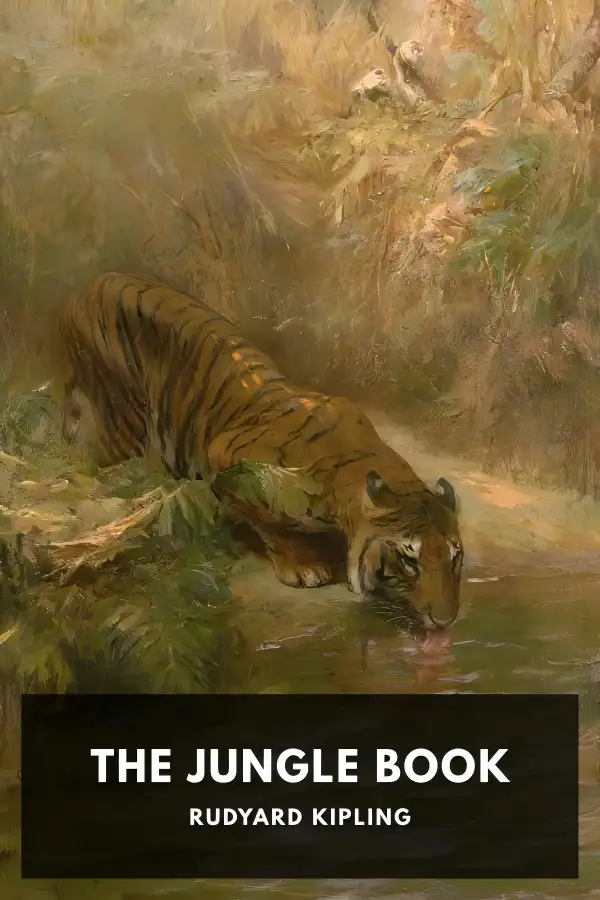
The Jungle Book
📖 Click to Read Mowgli’s Brothers Online Preview
Mowgli’s Brothers
It was seven o’clock of a very warm evening in the Seeonee hills when Father Wolf woke up from his day’s rest, scratched himself, yawned, and spread out his paws one after the other to get rid of the sleepy feeling in the tips. Mother Wolf lay with her big gray nose dropped across her four tumbling, squealing cubs, and the moon shone into the mouth of the cave where they all lived. “Augrh!” said Father Wolf, “it is time to hunt again”; and he was going to spring downhill when a little shadow with a bushy tail crossed the threshold and whined: “Good luck go with you, O Chief of the Wolves; and good luck and strong white teeth go with the noble children, that they may never forget the hungry in this world.”
It was the jackal—Tabaqui, the Dish-licker—and the wolves of India despise Tabaqui because he runs about making mischief, and telling tales, and eating rags and pieces of leather from the village rubbish-heaps. They are afraid of him too, because Tabaqui, more than anyone else in the jungle, is apt to go mad, and then he forgets that he was ever afraid of anyone, and runs through the forest biting everything in his way. Even the tiger hides when little Tabaqui goes mad, for madness is the most disgraceful thing that can overtake a wild creature. We call it hydrophobia, but they call it *dewanee*—the madness—and run.
Follow Mowgli, Baloo, Bagheera, and Rikki-Tikki-Tavi through the timeless law of the wilderness. Download the complete unabridged edition for your e-reader.
Download Full EPUBThe Jungle Book is an 1894 collection of stories by Rudyard Kipling, set in the Indian jungle and built around the Law of the Jungle, the fables of Mowgli, and the bonds between animals and men.
Its best-known stories follow Mowgli, a man-cub raised by wolves and taught by Baloo the bear and Bagheera the panther, as he grows up among the Seeonee wolf-pack and confronts Shere Khan the tiger; other stories include “Rikki-Tikki-Tavi” and “The White Seal.”
This Standard Ebooks edition is based on Project Gutenberg eBook #35997 and is in the US public domain; readers outside the US should check local laws.
About Rudyard Kipling’s The Jungle Book: Summary, Characters & Themes
Published in 1894, The Jungle Book is Rudyard Kipling‘s best-known collection of stories. This summary and analysis explores its Mowgli tales, its cast of characters, and its themes of law, identity, and the bond between animals and men.
Far beyond a simple children’s beast fable, Kipling constructs an intricate moral and social ecosystem centered on the “Law of the Jungle.” This code represents an ancient system of self-restraint, mutual respect, and civic duty that binds diverse species together against primal anarchy.
The core narrative follows Mowgli, an orphaned human infant who escapes the jaws of the lame tiger Shere Khan and is adopted by Father Wolf and Mother Wolf (Raksha) in the Seeonee hills. His acceptance into the wolf pack is sealed by the testimony of Baloo the bear and the sacrifice of a freshly killed bull by Bagheera the black panther.
Under Baloo’s demanding instruction, Mowgli learns the Master Words and survival disciplines necessary to navigate the forest safely. When kidnapped by the anarchic Bandar-log monkeys to a ruined jungle city, Mowgli is rescued through the coordinated ferocity of Bagheera, Baloo, and the ancient python Kaa.
As the noble pack leader Akela ages and faces mutiny, Mowgli uses the dreaded “Red Flower” (fire) to defeat Shere Khan’s predatory ambitions. Cast out from both the beast society and human villages due to his hybrid nature, Mowgli navigates the tragic alienation of belonging fully to neither world.
Alongside Mowgli’s adventures, Kipling weaves famous freestanding tales of animal heroism—such as the courageous mongoose Rikki-Tikki-Tavi and the white seal Kotick—celebrating courage, individual discipline, and unyielding stewardship of the living earth.
Key Characters & Literary Archetypes
- Mowgli (The Feral Child & The Liminal Mediator): Raised in the wild yet possessing human mastery of tools and fire. Trapped between wild animal instincts and complex human society, he personifies the existential alien who must forge his own moral code outside cultural dogmas.
- Bagheera (The Redeemed Captive & Fierce Mentor): Born in the king’s cages at Oodeypore, he carries the mark of an iron collar beneath his sleek fur. Combining lethal agility with intimate knowledge of human cruelty, he protects Mowgli with pragmatic, fierce devotion.
- Baloo (The Venerable Lawgiver & Stoic Teacher): The wise, drowsy brown bear whose sole task is teaching young cubs the ancient Law of the Jungle. Demanding, affectionate, and uncompromising, he embodies moral tradition, discipline, and generational wisdom.
- Shere Khan (The Lawless Tyrant & Predatory Usurper): A haughty, lame Bengal tiger who disdains communal law and preys cowardly on defenseless livestock and men. He serves as the archetypal bully who rules through intimidation and division rather than legitimate authority.
- Akela (The Solitary Leader & Fallen Patriarch): The honorable “Lone Wolf” who directs the Free Pack through wisdom and physical prowess. His inevitable physical decline and defense against youthful mutineers illustrate the bittersweet tragedy of principled leadership.
- Kaa (The Ancient Power & Primordial Wisdom): A giant rock python centuries old. Cold, detached, and possessing mesmerizing hunting dances, Kaa represents primal earth power operating beyond human morality, yet allied with wisdom and natural balance.
- The Bandar-log (The Lawless Mob & Demagogic Anarchy): The chatter-loving monkeys who have no speech of their own, no memory, and no law. They serve as Kipling’s biting satire of chaotic, self-indulgent crowds incapable of collective sustained achievement.
Core Literary Themes & Historical Significance
- The Law of the Jungle as Civilization: Kipling inverts the modern misconception of the phrase; here, “the law” does not mean savage lawlessness, but a balanced social contract emphasizing self-preservation, respect for food sources, and protection of the weak.
- The Burden of Dual Identity: Mowgli’s emotional tragedy is his inescapable estrangement; viewed as a demon by superstitious villagers and as a man by his beloved beasts, he must shoulder the loneliness of belonging to neither.
- Discipline, Obedience, and Brotherhood: Across both the Indian jungles and the Bering Sea, the stories affirm that survival, freedom, and moral dignity are achieved not through undisciplined freedom, but through voluntary submission to shared values and disciplined self-restraint.
Why Download Our Free EPUB, AZW3 & KEPUB Edition of The Jungle Book?
The Jungle Book is Rudyard Kipling’s best-known collection of stories, published in 1894. It includes the Mowgli tales, in which a man-cub is raised by the Seeonee wolf pack under the tutelage of Baloo and Bagheera, as well as freestanding stories such as “Rikki-Tikki-Tavi” and “The White Seal.”
This free edition is based on a Project Gutenberg transcription and produced by Standard Ebooks. It is DRM-free, unabridged, and formatted for EPUB, AZW3, and KEPUB readers.
- Standard Ebooks Transcription from Project Gutenberg eBook #35997: Preserves the full, unabridged text of Kipling’s 1894 collection, including the Hindustani animal names (such as Shere Khan, Akela, and Kaa) and the original poetry that opens each story.
- Formatted for Fable Prose & Verse: Clear separation for the poetic interludes and dramatic dialogue, whether reading the jungle hunts or the Arctic seal migrations.
- EPUB, AZW3 & KEPUB for Every E-Reader: AZW3 is built for Kindle Paperwhite and Scribe; KEPUB is built for Kobo; and valid EPUB scales across iPad, Boox, and Android readers.
- Verified Public Domain Sources: Based on Project Gutenberg eBook #35997 and produced by Standard Ebooks. Public domain in the US; check local laws outside the US.