The Origin of Species by Charles Darwin: Free EPUB, AZW3 & KEPUB Download
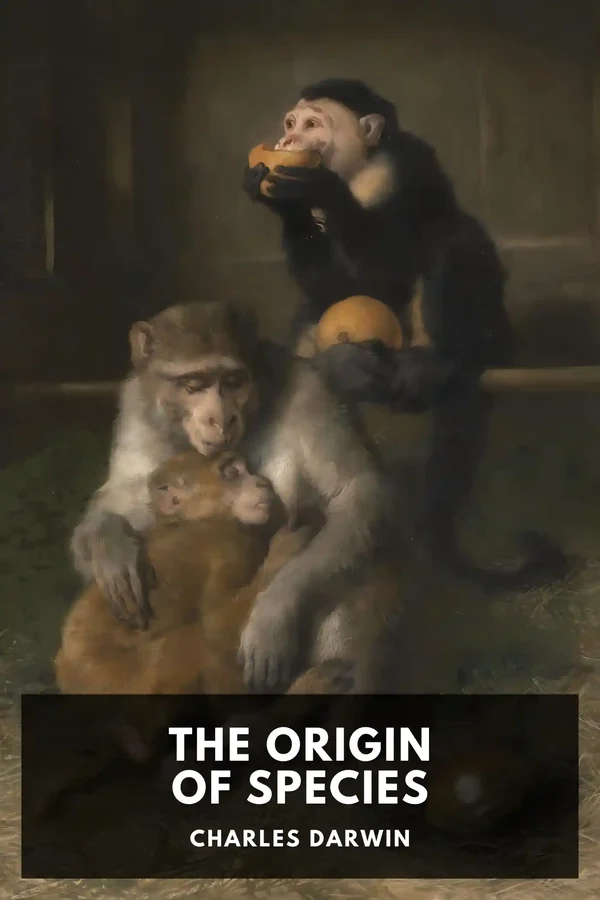
The Origin of Species
1859
~201,000 words
Approx. 11.2 hours
EPUB · AZW3 · KEPUB
973 KB · 1.2 MB · 949 KB
Public domain in the US
Project Gutenberg #2009 · Standard Ebooks
The Origin of Species is an 1859 scientific treatise by Charles Darwin that argues species are not fixed creations but change over time, and that the mechanism is natural selection acting on inherited variation. Working from the distribution of plants and animals he had observed aboard HMS Beagle, Darwin builds the case chapter by chapter — variation under domestication, the struggle for existence, the imperfection of the fossil record, the geographical spread of species — and answers the objections he expects from naturalists and theologians. This Standard Ebooks edition is based on Project Gutenberg #2009 and HathiTrust scans, and is in the public domain in the United States; the text is available via Standard Ebooks.
The Origin of Species by Charles Darwin: Summary, Characters & Themes
The Origin of Species is Charles Darwin’s 1859 argument for evolution by natural selection, and one of the few books that changed what the word “science” meant. It is not a textbook. Darwin called it “one long argument”, and he wrote it for the general reader: the evidence arrives as barnacles and pigeons, fossil beds and island finches, and the conclusion is reached by accumulation rather than by a single decisive experiment. This summary and analysis follows the structure Darwin actually used, chapter by chapter.
The book opens with variation under domestication. Pigeon breeders, Darwin shows, can produce fantastical forms from a single ancestor in a few generations, because they select the variations they find useful. If human selection can do that, he argues, then the far slower and far more thorough selection exerted by the environment can do more. The second chapter turns to variation in nature, the third to the “struggle for existence” — the quiet arithmetic by which more individuals are born than can survive.
From there the argument becomes a machine. Natural selection explains adaptation; the imperfection of the fossil record explains why the evidence looks patchy; the geographical distribution of species explains why islands hold species found nowhere else. Darwin then takes on the hardest cases he can find: the eye, the instinct of the hive bee, the sterility of hybrids, and the sudden appearance of whole groups of fossils. His method is to concede the difficulty and then show that the same difficulty is worse for the alternative.
The book ends by refusing the consolation of a designed universe. “There is grandeur in this view of life,” Darwin writes in the closing pages, with its “several powers, having been originally breathed into a few forms or into one”. It is a famously restrained ending, and it is the reason the book could be read as a work of natural theology by some Victorians and as a demolition of natural theology by others.
Darwin wrote several other books that carry this argument into different territory: The Voyage of the Beagle (1839), the travel narrative that supplied his evidence; The Descent of Man (1871), which applied natural selection to human beings; and The Expression of the Emotions in Man and Animals (1872), an early work of comparative psychology. None of them is on this site yet, but each can be read as a sequel to the argument begun here.
This edition is based on Project Gutenberg #2009 and digital scans from the HathiTrust Digital Library, and is available via Standard Ebooks. The text follows a later revised edition rather than the 1859 first printing: it includes Darwin’s 1861 “Historical Sketch” and his adoption of Herbert Spencer’s phrase “survival of the fittest”, which entered the book in the fifth edition of 1869.
Historical Context
Darwin had the theory by 1838 and sat on it for twenty years. The delay was partly temperament — he was a cautious, illness-plagued man who preferred barnacles to controversy — and partly the fear that his conclusion would be read as an attack on religion. What forced his hand was Alfred Russel Wallace, who in 1858 sent him an essay from the Malay Archipelago that arrived at the same idea independently. Lyell and Hooker arranged a joint reading at the Linnean Society, and Darwin began the “abstract” that became this book.
Key Characters & Literary Archetypes
- Charles Darwin (author): The narrator is not a neutral reporter. He is a patient, hedging, endlessly qualifying advocate who concedes objections before answering them, and the book’s persuasive power comes from that posture.
- Alfred Russel Wallace (co-discoverer): The younger naturalist whose 1858 essay forced Darwin to publish. His independent arrival at natural selection is the book’s unspoken second author.
- Charles Lyell (geologist): Darwin’s mentor, whose Principles of Geology supplied the deep time the theory requires, and who arranged the Linnean Society reading.
- Thomas Henry Huxley (“Darwin’s bulldog”): The public defender, whose 1860 debate with Bishop Wilberforce at Oxford made the controversy a cultural event.
- Thomas Malthus (economist): His Essay on the Principle of Population gave Darwin the arithmetic of scarcity that turns variation into selection.
- The eye (test case): Darwin’s chosen hardest problem — an organ he admits seems absurd to explain by gradual steps, and then explains anyway.
Core Literary Themes
- Descent with modification: Species are related by genealogy, not created separately; the tree of life replaces the ladder of being.
- The struggle for existence: Scarcity, competition and predation as the engine of change, not a moral lesson about nature’s cruelty.
- Deep time: The argument only works if the earth is old enough, which is why geology is inseparable from biology here.
- Adaptation without design: Complex fit between organism and environment, produced without a designer — the book’s most disturbing claim.
- The rhetoric of concession: Darwin’s method of granting every objection and then showing the balance of evidence still favours descent.
- Humility about evidence: The repeated admission that the record is incomplete, which makes the argument stronger rather than weaker.
Chapter summaries
The book has fifteen chapters plus the Introduction: the first four build the argument, the middle chapters answer objections, and the last five apply it to the fossil record and to geography.
- Introduction: Darwin explains how the voyage of the Beagle raised the question, why he waited twenty years, and how Wallace’s 1858 essay forced him to publish this “abstract”.
- Chapter I — Variation under Domestication: Pigeon breeds, dogs and cultivated plants show how far inherited variation can be pushed by human selection — the analogy on which the whole argument rests.
- Chapter II — Variation under Nature: Individual differences are everywhere, species boundaries are often arbitrary, and the commonest, most widespread species vary most.
- Chapter III — Struggle for Existence: Malthus’s arithmetic: more offspring are produced than can survive, and the checks are competition, predation, climate and disease.
- Chapter IV — Natural Selection: The core of the book: favourable variations are preserved, unfavourable ones destroyed; divergence of character and extinction follow from the same principle.
- Chapter V — Laws of Variation: Use and disuse, correlation of growth, acclimatisation and reversion — the machinery that supplies variation, not its purpose.
- Chapter VI — Difficulties on Theory: Darwin states the hardest objections himself: missing transitional forms, the eye, instinct, and why nature does not make jumps.
- Chapter VII — Miscellaneous Objections: A chapter added in later editions, answering critics on sterility, hybridism, the age of the earth and the argument from design.
- Chapter VIII — Instinct: The hive bee’s cells, the cuckoo’s parasitism and the slave-making ant are explained as products of selection, not of foresight.
- Chapter IX — Hybridism: Why crosses between species are often sterile, and why that sterility is a by-product rather than a special endowment.
- Chapter X — On the Imperfection of the Geological Record: The fossil record is a poor archive: gaps, missing intermediates and sudden appearances are what the theory predicts, not evidence against it.
- Chapter XI — On the Geological Succession of Organic Beings: Extinction, the order of appearance in the rocks, and why the same types recur in the same regions.
- Chapter XII — Geographical Distribution: Species have single centres of origin and spread from them; barriers, dispersal and climate explain the map.
- Chapter XIII — Geographical Distribution (continued): Islands, freshwater life and the absence of land mammals on oceanic islands as a test of separate creation.
- Chapter XIV — Mutual Affinities of Organic Beings: Morphology, embryology and rudimentary organs all point to common descent rather than to independent design.
- Chapter XV — Recapitulation and Conclusion: Darwin restates the argument and ends with the “grandeur in this view of life” paragraph.
Why Download Our Custom E-Reader Edition of The Origin of Species?
Darwin published The Origin of Species in 1859, and the book has been in print ever since. That continuity is the problem for a digital reader: most free copies online are transcriptions of a single edition, with footnotes stripped out, running heads lost, and chapter numbering flattened into one endless document. The argument depends on structure — chapter, section, cross-reference — so a bad transcription damages the argument itself.
The book is also long. At roughly 201,000 words it runs to about eleven hours of reading, and Darwin’s prose assumes you will move back and forth between his chapter on the fossil record and his chapter on geographical distribution. A navigable table of contents and clean paragraphing are not luxuries at that length; they are the difference between finishing the book and abandoning it at chapter six.
This edition starts from the Standard Ebooks text, which is re-proofread against scans rather than pasted from a single source, and adds AZW3 and KEPUB builds for Kindle and Kobo. The result is the same argument Darwin made, in a file your e-reader can actually navigate.
- Based on the Standard Ebooks Edition, via Project Gutenberg #2009: re-proofread text, with the 1861 Historical Sketch and the later revisions included.
- Granular Architectural NCX/Nav Structural Navigation: all twenty-five sections, from the Introduction through the concluding “Recapitulation and Conclusion”, reachable from the e-reader’s table of contents.
- Calibrated Typographical Layout for Scientific Prose: Darwin’s italics, Latin names and cross-references kept distinct, so the argument’s emphasis survives conversion.
- Verified Public Domain Sources: text from Project Gutenberg #2009, edition from Standard Ebooks, both public domain in the United States.
- On Liberty by John Stuart Mill — free EPUB, AZW3 & KEPUB
- Meditations by Marcus Aurelius — free EPUB, AZW3 & KEPUB
- Beyond Good and Evil by Friedrich Nietzsche — free EPUB, AZW3 & KEPUB
Introduction
When on board H.M.S. Beagle, as naturalist, I was much struck with certain facts in the distribution of the organic beings inhabiting South America, and in the geological relations of the present to the past inhabitants of that continent. These facts, as will be seen in the latter chapters of this volume, seemed to throw some light on the origin of species—that mystery of mysteries, as it has been called by one of our greatest philosophers. On my return home, it occurred to me, in 1837, that something might perhaps be made out on this question by patiently accumulating and reflecting on all sorts of facts which could possibly have any bearing on it. After five years’ work I allowed myself to speculate on the subject, and drew up some short notes; these I enlarged in 1844 into a sketch of the conclusions, which then seemed to me probable: from that period to the present day I have steadily pursued the same object. I hope that I may be excused for entering on these personal details, as I give them to show that I have not been hasty in coming to a decision.
My work is now ( 1859 ) nearly finished; but as it will take me many more years to complete it, and as my health is far from strong, I have been urged to publish this abstract. I have more especially been induced to do this, as Mr. Wallace, who is now studying the natural history of the Malay Archipelago, has arrived at almost exactly the same general conclusions that I have on the origin of species. In 1858 he sent me a memoir on this subject, with a request that I would forward it to Sir Charles Lyell, who sent it to the Linnean Society, and it is published in the third volume of the journal of that society. Sir C. Lyell and Dr. Hooker, who both knew of my work—the latter having read my sketch of 1844 —honoured me by thinking it advisable to publish, with Mr. Wallace’s excellent memoir, some brief extracts from my manuscripts.
This abstract, which I now publish, must necessarily be imperfect. I cannot here give references and authorities for my several statements; and I must trust to the reader reposing some confidence in my accuracy. No doubt errors may have crept in, though I hope I have always been cautious in trusting to good authorities alone. I can here give only the general conclusions at which I have arrived, with a few facts in illustration, but which, I hope, in most cases will suffice. No one can feel more sensible than I do of the necessity of hereafter publishing in detail all the facts, with references, on which my conclusions have been grounded; and I hope in a future work to do this. For I am well aware that scarcely a single point is discussed in this volume on which facts cannot be adduced, often apparently leading to conclusions directly opposite to those at which I have arrived. A fair result can be obtained only by fully stating and balancing the facts and arguments on both sides of each question; and this is here impossible.
The preview stops here. The full text continues in the download.
Download Full EPUBBefore you download The Origin of Species: format, length and copyright
Which format you need. Take EPUB for Apple Books, Kobo, Google Play Books and most reading apps; AZW3 for Kindle e-readers and the Kindle app; KEPUB for Kobo, where it adds page counts and reading stats. The text is identical in all three files.
How long it takes. It runs to ~201,000 words, or roughly 11.2 hours at 300 words per minute.
Whether you can share it. Published in 1859 and in the public domain in the United States, so the file can be copied, emailed or put on a class reading list without permission.