The Art of War by Sun Tzu: Free EPUB, AZW3 & KEPUB Download
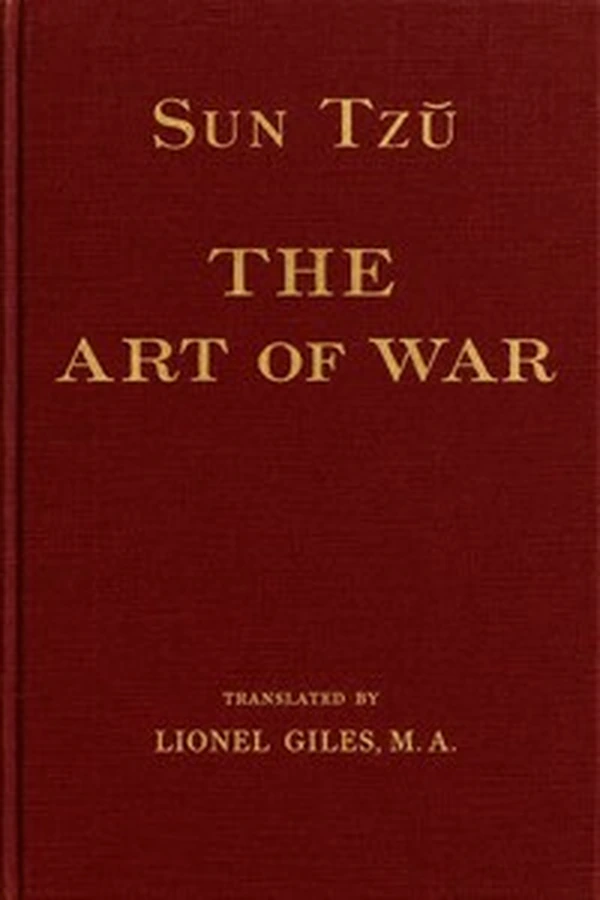
The Art of War
📖 Click to Read the Opening Pages Online Preview
The Art of War opens: Chapter I, Laying Plans
1. Sun Tzŭ said: The art of war is of vital importance to the State.
2. It is a matter of life and death, a road either to safety or to ruin. Hence it is a subject of inquiry which can on no account be neglected.
3. The art of war, then, is governed by five constant factors, to be taken into account in one’s deliberations, when seeking to determine the conditions obtaining in the field.
Three paragraphs, under a hundred words: the five constant factors and the seven questions by which two armies are compared before a shot is fired. The download adds Giles’s introduction, all thirteen chapters and the notes he set against them.
Download Full EPUBc. 5th century BC
~55,000 words (estimated)
Approx. 3.0 hours
Standalone
The warring states of ancient China
13 chapters
EPUB · AZW3 · KEPUB
0.40 MB (EPUB) · 0.49 MB (AZW3) · 0.42 MB (KEPUB)
Public domain in the United States
Project Gutenberg #132
The Art of War is the oldest surviving manual of military strategy, and the least sentimental: war is a matter of life and death for the state, so it is calculated in advance, fought as briefly as possible, and won if possible without fighting at all. Its thirteen chapters run from planning and supply through stratagem, dispositions and the interplay of strength and weakness to manoeuvre, terrain, the nine situations, fire attack and spies. Generations of readers have quoted two lines from it — all warfare is based on deception, and the supreme excellence is breaking the enemy’s resistance without fighting.
This download is Lionel Giles’s annotated English translation of 1910, made in London for Luzac & Co. by a keeper of Chinese books at the British Museum, and written to replace Captain Calthrop’s careless version of 1905. Western officers had begun to read Chinese strategy after the Russo-Japanese war, and Giles’s rendering stayed the standard one for a century — quoted in staff colleges, and later in business schools. Its notes were written for soldiers, not for armchairs, and they have outlasted most of the armies they were meant for. See Wikipedia’s article on The Art of War for its publication history. The text is available via Project Gutenberg #132.
The Art of War by Sun Tzu: Summary, Characters & Themes
This page is a summary and analysis of The Art of War by Sun Tzu, with the historical context, the principal figures, the themes, thirteen chapter summaries in Giles’s order, and the free download links. The book itself is short: thirteen chapters of maxims, roughly 6,000 words, with no narrative, no characters in the fictional sense, and almost no worked examples. It sits closer to a staff manual than to a treatise, and it treats war as a problem of calculation — ground, weather, supply, morale, intelligence and deception — rather than a contest of courage. Every chapter returns to the same demand: win the battle in the planning, before the armies meet.
The author is Sun Tzu, and the text of The Art of War itself has a long critical history. Sun Wu, called Sun Tzu, commanded the armies of the state of Wu in the sixth century BC, and almost all that is known of his life comes from a single chapter of Ssu-ma Ch’ien’s Records of the Grand Historian. Giles spends much of his introduction on that biography, then on the state of the text and on the long line of Chinese commentators — Ts’ao Ts’ao, Tu Mu, Li Ch’uan, Chia Lin, Mei Yao-ch’en, Chang Yü, Wang Hsi, Ho Shih — whose notes he translates alongside the original. Modern scholarship treats the book as a compilation of the fourth and third centuries BC rather than the work of one hand, but the thirteen-chapter form is old: the Han bibliography already lists the text in thirteen sections.
The 54,841 words counted in this EPUB are not Sun Tzu’s words. This is Lionel Giles’s edition of 1910, published in London by Luzac & Co., and in that volume the thirteen chapters occupy a small fraction of the pages. Giles supplies a preface, a long introduction on the text, its history, its commentators and its bibliography, a full apparatus of numbered notes, appendices and an index; the chapters are interleaved with those notes, so a reader going straight through is reading Sun Tzu and his commentators together. The word count on this page describes the file, not the treatise. The Chinese text behind it is about a tenth as long, and the thirteen chapters can be read in an hour.
Giles numbers the paragraphs as the Chinese editions do, so a maxim can be cited as III.2 or XI.43, and he keeps the romanised names of the commentators at the points where they first speak. He also preserves the difficulties rather than smoothing them: his note on the Nine Grounds concedes that the definitions overlap and that the received text is disordered, which is why the summaries below follow his order and not a tidier one. The text used here is the Project Gutenberg transcription (#132), which reproduces the 1910 printing. Two shelves worth reading next: The Prince, on a ruler who must keep what he has taken, and The Republic, on the question of who should be allowed to command.
A note on the order of the thirteen chapters. Giles keeps the received sequence, and it is not a syllabus but a campaign: planning, cost, the attack that avoids battle, dispositions, energy, weakness and strength, manoeuvre, variation, the march, ground, the nine situations, fire, and intelligence last. That order is deliberate — everything before it depends on knowing the enemy’s condition — and the fire chapter closes the argument about destroying an enemy without closing with him. The headings are Giles’s own renderings: what the Chinese calls ping-fa, the art of war, he divides as Laying Plans, Waging War, Attack by Stratagem and so on. The oldest surviving commentary is Ts’ao Ts’ao’s, written in the third century AD, and Giles quotes him on nearly every page, along with Tu Mu, Li Ch’uan, Chia Lin, Mei Yao-ch’en, Chang Yü, Wang Hsi and Ho Shih. Because those notes run beside the text, the book can be read as a record of how Chinese commanders argued with it, not only as a manual.
Historical Context
Sun Wu is placed by tradition at the court of Ho Lu, king of Wu, in the last years of the sixth century BC, when the old chariot aristocracies of the Yellow River states were being pressed by larger infantry armies and by the fortified cities that infantry could hold. The book reflects that world without describing it: chariots are counted by the hundred, siege engines take three months to build, a hundred thousand men eat a thousand ounces of silver a day. It assumes a single commander with wide discretion, a sovereign who may interfere and should not, and a countryside that can be foraged as an army passes through it.
The famous anecdote is Ssu-ma Ch’ien’s. Ho Lu, wanting to test whether the theories could be applied to anyone, gave Sun Wu a company of 180 women from the palace. He divided them into two, put the king’s two favourite concubines at their heads, and drilled them. They laughed. He explained the orders again; they laughed again. He then had the two officers executed, over the king’s protest, on the ground that a commander who has accepted a commission must carry it through. The remaining women drilled, the king appointed him, and Wu became a power in the south.
The reception is almost as long as the text. Ts’ao Ts’ao, the third-century warlord, wrote the earliest surviving commentary and is quoted on nearly every page of Giles’s notes; the book was later one of the Seven Military Classics studied for the imperial examinations. Giles translated it after the first English attempt, Captain E. F. Calthrop’s Sonshi of 1905, which he thought bad enough to justify a fresh version from the Chinese, and he used the French of the Jesuit Père Amiot, a century and a half earlier, mainly as an example of what happens when a translator guesses. For six centuries it was one of the texts a Chinese officer was expected to know, and Ts’ao Ts’ao’s commentary became the standard gloss — practical, terse, and interested in supply and ground rather than in virtue.
Key Characters & Literary Archetypes
- The General (Chiang): The central figure of every chapter: the commander who calculates in the temple, keeps his plans dark, treats his soldiers as his own children, and is called the bulwark of the state.
- The Ruler (Chün): The sovereign who hands an army to a general and is then expected to leave it alone; interference from the throne is one of the three ways, in Chapter III, that a ruler ruins his own army.
- The Soldier: The rank and file, whose spirit is keenest in the morning and gone by evening; handled with humanity first and iron punishment after, and dangerous when there is no road home.
- The Spy: Five working classes of informant — local, inward, converted, doomed and surviving — on whom all foreknowledge depends, and of whom the converted spy is the hinge of the system.
- The Enemy Commander: A temperament to be worked on rather than a person: the choleric general is irritated, the arrogant one fed with apparent weakness, the hasty one provoked into moving first.
Core Literary Themes
- Deception: War is deception: seem weak when strong, near when far, inactive when active. Bait, feint and concealment are not tricks added to strategy but the medium in which strategy operates at all.
- Victory without battle: The highest skill takes the enemy’s state, army and cities intact. Sieges are the last resort, and the general who has to fight and conquer in every battle has not reached the top of the craft.
- Foreknowledge: Plans, weather, ground and the enemy’s condition must be known before the army moves. Spirits, experience and calculation cannot supply this, so it comes from men — hence the five kinds of spy.
- Terrain and circumstance: Ground dictates tactics: nine situations, from dispersive to desperate, each with a rule of its own. Like water, an army takes the shape of what it meets instead of repeating the form that won last time.
- Discipline and reward: Method, ranks, roads and pay hold an army together; rewards must be prompt and punishments real. Humanity without authority produces spoilt children rather than soldiers.
Why Download Our Custom E-Reader Edition of The Art of War?
The text is Giles’s, entire. Nothing has been modernised, condensed or rewritten for a modern reader: his paragraph numbers stay on the maxims, his romanised names keep their diacritics, and his notes are printed where they belong rather than stripped out to make a cleaner-looking file. That matters more here than with a novel, because half of what Giles offers is the argument with his Chinese commentators — Ts’ao Ts’ao reading a line one way, Tu Mu another — and the book is easier to understand with them than without.
The file is built for reading on a device, and its table of contents follows the book rather than the page around it. Thirteen chapters, each a linked section of its own, so the book opens where you left off; the introduction can be skipped on a first pass and returned to later, when the names of the commentators stop being noise. The three formats cover the usual readers — EPUB for phones, tablets and most e-readers, AZW3 for Kindle, KEPUB for Kobo — and none of them carries DRM, an account requirement or a link back to this page.
The page around the download is written for a second reading as much as a first. The thirteen summaries follow Giles’s chapter order and quote the phrases each chapter is remembered for, the notes cover the Warring States background, the Ho Lu anecdote and the long commentary tradition, and the questions at the end answer what readers ask most often: whether the book is really by one man, why the word count is so much larger than the text, and whether any of it survives contact with a modern office. It is also short enough to reread: a reader who finishes the thirteen chapters in an hour can go back to the notes on the nine grounds or the five kinds of spy without losing the thread of the whole.
- Project Gutenberg transcription, via Project Gutenberg #132 — the complete text, unabridged, with the chapter headings the author set.
- Unabridged Giles text The complete 1910 translation, paragraph by paragraph, with his preface, introduction and numbered notes kept where he set them rather than cut for length.
- Real chapter marks Thirteen chapters in Giles’s order, from Laying Plans to The Use of Spies, each a separate entry in the table of contents so the book opens where you stopped.
- Three formats, no DRM EPUB for most readers, AZW3 for Kindle and KEPUB for Kobo, all from this page, all free, with nothing to register and no software to install.
- The Prince — free EPUB, AZW3 & KEPUB
- The Republic — free EPUB, AZW3 & KEPUB
- Philosophy classics — free EPUB, AZW3 & KEPUB
Chapter summaries
The Art of War is arranged in thirteen chapters, and the titles below are Giles’s own renderings of the Chinese headings. Each summary runs to about eighty words and stays with what the chapter actually says, in his order of paragraphs.
- Chapter I: Laying Plans: War is the state’s life-or-death business, settled in the temple before armies meet. Sun Tzu names five constant factors — the moral law, heaven, earth, the commander, method and discipline — and seven questions that compare two sides. Then the sentence the book is remembered for: all warfare is based on deception. Feign weakness, hold out baits, strike where the enemy is unprepared. He who has weighed the five against the seven has already decided the campaign, before a single chariot rolls.
- Chapter II: Waging War: A hundred thousand men in the field cost a thousand ounces of silver a day, and a long campaign empties the treasury. No country has profited from protracted war. The skilled commander raises one levy, forages on the enemy, and turns captured chariots and men to his own use. Victory, not duration, is the object; a general who drags a war out is the arbiter of his people’s ruin. The cost falls on the fields as well — carts, horses, armour, untilled land — and so the same families are not levied twice or the grain shipped thrice.
- Chapter III: Attack by Stratagem: Better to take a state whole than to wreck it. Supreme excellence is breaking the enemy’s resistance without fighting; the worst policy is besieging walled cities, which costs three months of preparation and a third of the army. Baulk the enemy’s plans, then split his alliances, then fight him in the field. Five essentials of victory follow; a ruler who orders advances his army cannot make, or meddles in the command, ruins it three times over. Attack is ranked above battle: the enemy’s plans, then his alliances, then his army, and battle comes last of all.
- Chapter IV: Tactical Dispositions: The good fighter first makes himself hard to beat, then waits for the enemy to become beatable. Defence lies in our own hands; the chance to win is given by the adversary. Victories the whole empire applauds are not the highest art: the skilled commander makes no mistakes and fights only after victory is assured. A victorious army wins its battles before they are fought; the good commander stands on ground that cannot be lost.
- Chapter V: Energy: Control a large army as you control a few men, by dividing and by signals. Join battle with the direct and win with the indirect: five notes, five colours, five tastes, two methods of attack, and combinations past counting. Energy is the bent crossbow, decision the trigger. Simulated disorder demands real discipline; the direct and the indirect are two ends of one circle. A commander who combines energy with timing moves his whole army as if it were one man.
- Chapter VI: Weak Points and Strong: Whoever reaches the field first is fresh; the latecomer arrives tired. Impose your will and never suffer the enemy’s. Strike the undefended, hold the unattackable; if the place of battle is unknown, the enemy must guard everywhere and be weak everywhere. Draw him out and give him a shape while keeping none yourself, so that you can be many where he is few. Then change tactics with circumstance, as water changes shape with the ground.
- Chapter VII: Manoeuvring: After the army is raised and camped comes manoeuvring, the hardest part: turning the circuitous into the direct. Forced marches cost divisions — fifty li and half the army arrives, thirty li and two thirds. Be swift as wind, compact as forest, raiding as fire, still as mountain, dark as night, falling as a thunderbolt. Gongs, drums, banners and flags make one body of the host; avoid the enemy while his spirit is keen, and strike when it flags.
- Chapter VIII: Variation of Tactics: Five circumstances in which orders must be varied: roads not to be followed, armies not to be attacked, towns not to be besieged, positions not to be contested, and commands of the sovereign not to be obeyed. Weigh advantage against disadvantage before you move. Then five faults that ruin generals — recklessness, cowardice, a hasty temper, thin-skinned honour, and over-solicitude for the men. No general should stake an army on the hope that the enemy will not come; readiness, not prediction, is what keeps it.
- Chapter IX: The Army on the March: How to camp, and how to read the enemy from signs. Cross mountains quickly and keep to valleys; let half an invading army cross a river before striking; leave salt marshes at once; camp on hard, high, sunny ground. Humble words mean the enemy is preparing, bluster means he will withdraw, light chariots on the flanks mean he is deploying. Reward and punish with method, and never despise an opponent. Dust rising in high columns means chariots coming, low and wide means infantry, and birds starting up means an ambush is set.
- Chapter X: Terrain: Six grounds — accessible, entangling, temporising, narrow passes, precipitous heights, distant — and what to do on each. Then six calamities that come not from nature but from the general: flight, insubordination, collapse, ruin, disorganisation, rout. A commander who reads ground that favours him and still loses it has tripped over one of the six. The one who judges when to fight even against his ruler’s order, and treats his soldiers as his children, is the kingdom’s jewel. Know the enemy and know yourself, and the outcome of a hundred battles needs no oracle.
- Chapter XI: The Nine Situations: Nine grounds, from dispersive to desperate, each demanding its own response. Drive deep, put the army where retreat is impossible, and it stands and fights: thrown into peril it survives, sunk into death it lives. The shuai-jan snake strikes with head and tail, and men of Wu and Yüeh in one boat help each other like a left hand and a right. On desperate ground there is nothing to do but fight, and men who cannot run find an order they never had.
- Chapter XII: The Attack by Fire: Five ways to use fire: burn the camp and its men, burn stores, burn baggage-trains, burn arsenals. Fire needs dry weather and rising wind; if it starts inside the enemy’s camp, be ready to answer from outside. Water can cut an enemy off but cannot take his goods. No anger should start a war, for a destroyed kingdom does not come back. Anger can pass into gladness again, but a destroyed kingdom cannot be restored and its dead cannot be brought back.
- Chapter XIII: The Use of Spies: A hundred thousand men in arms, a stalemate of years, decided in a single day: the ruler who grudges a hundred ounces for intelligence is no leader. Foreknowledge cannot come from spirits, experience or calculation, only from men. Five classes of spy — local, inward, converted, doomed, surviving — of which the converted spy is essential. Reward them generously and keep the secret absolute, for nothing in war is closer held. Spies must be treated with the utmost liberality, for they carry the safety of the state in their hands.
The Art of War: Frequently Asked Questions
What is The Art of War about?
Is this the Lionel Giles translation?
Why does this edition run to 54,841 words if the book is short?
Who was Sun Tzu, and did he write the book?
Do I need to know Chinese history to follow it?
How long does it take to read?
Which file should I download?
Where can I read the full text?
Part of: Philosophy classics · Classic fiction