The Mystery of the Blue Train by Agatha Christie: Free EPUB, AZW3 & KEPUB Download
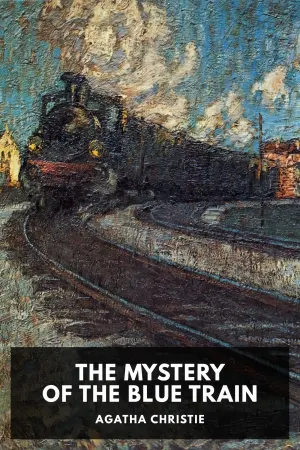
The Mystery of the Blue Train
📖 Click to Read the Opening Pages Online Preview
Read the opening of The Mystery of the Blue Train
“Then you were really in the thick of it all!” said Lady Tamplin enviously. “My dear, how thrilling!” She opened her china blue eyes very wide and gave a little sigh.
“A real murder,” said Mr. Evans gloatingly.
“Of course Chubby had no idea of anything of the kind,” went on Lady Tamplin; “he simply could not imagine why the police wanted you. My dear, what an opportunity! I think, you know—yes, I certainly think something might be made out of this.”
The first chapter has only begun. The full novel runs to thirty-six chapters, from the jeweller’s back room in Paris to a garden in Kent.
Download Full EPUB1928
~70,000 words (estimated)
Approx. 3.9 hours
Hercule Poirot
Paris, the Blue Train, and the Riviera
36 chapters
EPUB · AZW3 · KEPUB
0.28 MB (EPUB) · 0.42 MB (AZW3) · 0.33 MB (KEPUB)
Public domain in the United States
Project Gutenberg #72824
The Mystery of the Blue Train is Agatha Christie’s sixth Poirot novel, published in 1928, and the thinnest-disguised of her books: the plot is her own 1923 story “The Plymouth Express” stretched to novel length. Rufus Van Aldin, an American millionaire, buys the Heart of Fire, a ruby of scandalous size, in a shabby Paris flat and gives it to his daughter Ruth, who is married to a man he cannot stand. Ruth boards the Blue Train, the luxury express from Calais to the Riviera. Somewhere between Paris and Nice she is strangled in her sleeper, and the ruby is gone.
Christie fills the Pullman car with people who each have a reason to want the stone: a husband in debt, a French count with a past, a dancer with a temper, a maid who insists she slept through everything, and a white-haired man in an opera cloak whom nobody can quite place. Poirot, on holiday and vain about his patent-leather shoes, is pulled off the beach to separate the alibis from the lies. See Wikipedia’s article on The Mystery of the Blue Train for its publication history. The text is available via Project Gutenberg #72824.
The Mystery of the Blue Train by Agatha Christie: Summary, Characters & Themes
This summary and analysis of The Mystery of the Blue Train takes the novel from the jeweller’s back room in Paris to the terrace of a house in Kent, and it keeps the solution off the page, so it can be read before the book without spoiling the last two chapters. Agatha Christie published it in 1928, two years after The Murder of Roger Ackroyd had made her famous and a year after The Big Four, and it carries marks of both phases: the tight closed-circle puzzle of the early Poirot books, and the restlessness, the travelling, the hotel life and the divorce courts, that belonged to her own life at the end of the 1920s.
The book is built on three journeys. The first is Van Aldin’s: a secret purchase of four stones in a Paris flat, a night walk along the Seine, two apaches in a doorway, and a millionaire who keeps the necklace in his pocket and his temper under control. The second is the Blue Train itself, which Christie uses the way other novelists use a country house: a corridor, a dining car, a maid, a conductor who has worked the line for twenty years, and a murderer who has to get on and off without being seen. The third is Poirot’s reconstruction, late in the book, when he takes the same train south again and makes the journey minute by minute, looking for the one passenger nobody has accounted for.
Poirot here is on holiday, which in Christie’s hands never means rest. He has come south for the air and the food, is particular about his tisane and his shoes, and is flattered, in the way he always is, by being asked what he thinks. His method is the usual one: he listens to the same story three times from three people, notices that a coat is too big for the man wearing it, that a woman knows a fact she could not have known, that a servant’s account of a Tuesday is too polished. He is also, unusually for him, sentimental in this book; he spends a good part of it arranging other people’s romances while pretending to be busy with a murder.
Christie tells it in thirty-six short chapters, each with a title and a plain number, and the titles do a lot of quiet work: “An Offer Refused”, “A Useful Gentleman”, “Defiance”, “Explanations”. The prose is brisk and largely spoken; whole chapters are interviews, and the reader is meant to sit in the room and watch a witness get comfortable. The Riviera material, the casino at Monte Carlo, the tennis at Cannes, the villa at Nice, the corridor of the express, is drawn with the ease of somebody who had spent a great deal of time in those hotels. The text here follows the Project Gutenberg #72824 transcription, which was checked against the printed American edition.
Its reputation is a little lower than its neighbours’, and the reason is fair: the solution depends on a performance rather than on a trick, and readers who prefer a locked room to a disguise sometimes find it thin. But the book has one of the best-matched casts in the canon, a genuinely moving last chapter, and the sharpest thing in it, the idea that a professional thief can buy the same clothes and the same manners as the people he robs, is more interesting than a locked door. If you want the same author in a lighter, more country-house key, try The Secret of Chimneys or The Seven Dials Mystery, both of which share this book’s taste for impostors and house parties.
Historical Context
The Blue Train was real. The Calais-Méditerranée Express left Calais in the evening after the boat train, ran round the ceinture of Paris so that the through carriages never had to be shunted into a terminus, and reached Nice and Monte Carlo the following morning. It carried sleeping cars, a dining car, a bar, and the kind of passengers who did not care what a ticket cost; the French called it le train bleu, the English called it the millionaire’s train, and the whole Riviera season depended on it. Christie’s timetable is accurate enough to be checked: the train is at the Gare de Lyon in the small hours, stops at Dijon, and the murder is discovered in the approach to Nice.
The novel also belongs to a specific moment in its author’s life. In 1926 Christie disappeared for eleven days after her husband asked for a divorce, and the newspapers had a very good time with it. By 1928 she had remarried, was travelling constantly, and was writing about a rich woman trapped in a bad marriage, a husband who is charming and useless, and a divorce that everybody is discussing behind the wife’s back. The book is not autobiography, but the divorce court, the settlement, the question of who gets the necklace, are all handled with a knowledge that is not entirely literary. For the same author in a younger, more adventurous mood, The Man in the Brown Suit sends its heroine across the world on very little more than nerve.
Key Characters & Literary Archetypes
- Hercule Poirot: The retired Belgian detective, on holiday on the Riviera with a wardrobe of patent-leather shoes; vain, tidy, sentimental about young couples, and quietly delighted by a case that lets him interview everybody twice.
- Katherine Grey: Thirty-three, ten years a paid companion to an old woman in a Kent village, and suddenly rich; the one honest witness in the story, and the character through whom the reader is allowed to be shocked.
- Ruth Kettering: Van Aldin’s daughter, married to a man she no longer troubles to hide her contempt for; handsome, reckless, generous with other people’s money and bored by her own.
- Derek Kettering: Her husband, a gambler with a peer’s title waiting for him and nothing to meet it with; charming in exactly the way that costs other people, and in debt to everyone who matters.
- Armand, Comte de la Roche: A French aristocrat with beautiful manners, expensive habits and a history the Paris police know by heart; Ruth’s lover, and the most convenient suspect in Europe.
- Mirelle: The dancer Derek loves, famous, temperamental and entirely unsentimental; a woman who has fought her way up and has no intention of sliding back down for anyone’s marriage.
Core Literary Themes
- Money and marriage: Every marriage in the book is a contract about money. Van Aldin bought his daughter a ruby and tried to buy her a divorce; Derek married for an allowance and gambled it; the Comte offers love with a price list attached. Christie never moralises, she simply lets the arithmetic show.
- The professional: This is one of the first Christie novels in which the criminal is a professional rather than a passionate amateur: patient, well-dressed, informed, and able to perform the manners of a class he was not born into. Theft here is a trade, and the trade has standards.
- Disguise and performance: A wig, a cloak, a uniform, a change of clothes, a man’s cap on a woman’s head: the plot turns on the fact that people see what they expect to see. Christie uses the theatre, the dancer, the maid’s uniform and the train itself as stages.
- The train as a small society: Thirty passengers, one corridor, an enforced intimacy, and no way out between stations. The Blue Train gives Christie a closed world with a timetable, which is all a detective story needs: a fixed set of people, and a clock.
- Women with no good options: Katherine’s ten years of service, Ruth’s gilded cage, the maid’s dependence, the dancer’s hard-won independence: the book is unusually clear-eyed about what a woman could do in 1928 with no money of her own, and what she had to do to get some.
Why Download Our Custom E-Reader Edition of The Mystery of the Blue Train?
Because the book is a good long evening and this is a clean copy of it. The text is the Project Gutenberg transcription of the 1928 novel, checked against itself, with all thirty-six chapters and all their titles intact. Nothing has been abridged, modernised or tidied up, and the punctuation follows the printed book rather than a word processor.
The reconstruction in the thirty-fourth chapter is worth the download on its own. Poirot takes the same train south, sits in the same compartments and makes the same journey at the same hour, and Christie lets the reader watch a detective think for twenty pages without a single gunshot. It is the closest she came to showing her working, and it plays much better in a clean text than in a scanned one.
Read it on a train if you can. The book is fair: every clue Poirot uses is on the page, and the answer, when it comes, depends on something a careful reader has been told twice and has probably discounted. Our editions are DRM-free, work on Kindle, Kobo, Apple Books and most phones, and the three files below are the same book in three wrappers.
- Project Gutenberg transcription, via Project Gutenberg #72824, produced by Greg Weeks, Mary Meehan and the Online Distributed Proofreading Team, so the text can be checked line by line against the source.
- Chapter titles preserved All thirty-six titles are kept as they were printed, from “The Man with the White Hair” to “By the Sea”, so the chapter list below matches the file you download.
- Paragraphing kept, not reset Dialogue, letters and the long interview chapters are laid out as the printed book lays them out; nothing has been reflowed into solid blocks.
- Three formats, one text EPUB for Kobo, Apple Books and most tablets, AZW3 for Kindle, and KEPUB for Kobo’s own reader; all three come from the same source file, so page numbers and chapter breaks agree.
- The Man in the Brown Suit — free EPUB, AZW3 & KEPUB
- The Seven Dials Mystery — free EPUB, AZW3 & KEPUB
- The Secret of Chimneys — free EPUB, AZW3 & KEPUB
Chapter summaries
The novel runs to thirty-six chapters, numbered in plain arabic numerals and each with a title of its own. The twelve summaries below group them in threes, in the order the story goes, from a jeweller’s flat in Paris to a garden in Kent. They are written to be read before the book: they follow the investigation as it happens and stop short of the solution, which Christie keeps for the last three chapters.
- 1-3: The Man with the White Hair: Paris, in autumn. Rufus Van Aldin, an American millionaire with a face like a sphinx, sits in a shabby flat opposite the Russian Embassy and buys four stones from an ex-official of the Bolshevik government, who wants the money to leave Europe and buy an aeroplane. Van Aldin walks back along the river with the necklace in his pocket and is followed by two apaches; he knocks one down and frightens the other off. The man who set them on him, a figure in an opera hat with white hair and a cloak, had dropped a glove in the street as a signal. In the second chapter this same M. le Marquis visits a Greek dealer named Papopolous in his flat and arranges where the proceeds of a robbery will be delivered. In the third, Van Aldin is in London at the Savoy with his secretary and his daughter Ruth, and the great ruby, the Heart of Fire, is lying on the table between them.
- 4-6: In Curzon Street: Van Aldin calls on his son-in-law in Curzon Street and finds him at breakfast with an ash-tray full of cigarettes and no intention of explaining himself. Derek Kettering is thirty-four, heir to a title, owed money to half London, and quite candid about it: he wants ten thousand pounds and he is not going to pretend it is for his wife. Van Aldin, who has already hired a private enquiry agent named Mr. Goby to find out how his daughter’s husband spends his evenings, refuses. Goby’s report is a small comic masterpiece of information gathering, and it names the dancer Mirelle. Van Aldin sends Derek a message through Goby and offers him a bargain: a divorce, quietly, and a settlement. Derek goes to Mirelle’s flat and tells her about it; she tells him, in the middle of a row, that Ruth has gone to Paris to meet the Comte de la Roche, and that everybody in London except Derek seems to know it.
- 7-9: Letters: In Kent, in a village called St Mary Mead, Katherine Grey is reading her post. She is thirty-three, has spent ten years as companion to an old woman in a small house, and has just discovered that she has been left a great deal of money by a connection of the family she served; the first letter is from a relative who wants to settle the matter quietly and cheaply, the second, in a blue envelope, is from the solicitors and makes the sum real. Katherine takes the news to her old schoolmistress, Miss Viner, who runs a tea shop and has no illusions about human nature: money, she observes, will not change Katherine, but it will change what everyone else expects of her. Lady Tamplin, a cousin of Ruth’s who lives chiefly on her connections, writes to invite Katherine to the Riviera as a guest who will pay her way as a secretary and travelling companion, and after some hesitation Katherine accepts, buys a new hat, and starts, for the first time in her life, to spend money.
- 10-12: On the Blue Train: Victoria Station at five o’clock: the boat train, the crossing, and then, at Calais, the Blue Train itself, with its blue sleeping cars and its dining car and its passengers who are mostly American and mostly rich. Katherine travels with Lady Tamplin, her husband, and her daughter Lenox, a plain-spoken girl who is the best value in the party. At dinner Katherine sees Ruth Kettering, whom she knows by sight, and Ruth’s maid, a thin woman in black called Ada Mason, and later, in the corridor, a man standing outside Ruth’s compartment door with his hand on the handle. In the morning, before Nice, the conductor finds Ruth Kettering dead in her bunk, strangled with a length of black cord, the ruby gone, and her face battered beyond recognition. The police take statements in a villa above the town, and Katherine, who is the only passenger who saw anything at all, gives hers twice.
- 13-15: Van Aldin Gets a Telegram: Van Aldin is at the Ritz in Paris when the wire arrives. He reaches Nice that night, identifies what is left of his daughter’s face, and sets about the world the way he always does, with money and with force. The police have a suspect almost at once: the Comte de la Roche, whose letter was in Ruth’s handbag, and who was in Paris when he should have been somewhere else. The Comte is interviewed and is charming, exact, and entirely willing to admit the affair; he produces an alibi, given by his valet and his concierge, that he was at home on the night in question. Van Aldin, who does not believe in alibis, sends for the one man in Europe he trusts to disbelieve them too. Hercule Poirot arrives at the Negresco with a suitcase and a cold, and is persuaded to take the case by being told that no one else can.
- 16-18: Poirot Discusses the Case: Poirot begins the way he always begins, by asking questions that seem beside the point. He wants to know who knew the ruby was in the train, who knew which compartment Ruth had, and how a man could walk the length of a corridor at three in the morning without being seen by a conductor who was awake. Van Aldin gives him the background: the purchase in Paris, the white-haired man, the apaches, the quarrel with Derek, the Comte’s old affair with Ruth twelve years earlier. Poirot interviews the Comte, who is elegant, insolent and rather likeable, and who insists that he was in Paris and that Ruth was carrying the rubies for him. Then Derek Kettering arrives in Nice to be questioned, lunches with Poirot, and denies everything with an air of injured virtue that convinces nobody, least of all Poirot.
- 19-21: An Unexpected Visitor: A parcel reaches Poirot from Paris containing four rubies, mailed by the Comte, who explains that Ruth had agreed to bring them to him and that he is returning what is not his. Poirot has them valued and is told they are not the Heart of Fire. Mirelle arrives at the Negresco, furious, dressed in orange and black, and tells anyone who will listen that Derek is being persecuted; Poirot lets her talk and learns more from what she avoids than from what she says. At the tennis at Cannes, Poirot and Van Aldin see Papopolous in the crowd, and Poirot begins to understand that the stones have a history longer than the murder. Katherine, meanwhile, has made a friend of Lenox Tamplin, and it is Lenox, watching the police, who notices that the train stopped twice in the night.
- 22-24: M. Papopolous Breakfasts: Poirot calls on Papopolous at breakfast and is received with the elaborate courtesy of a man who has been in the trade for forty years. The Greek admits nothing and hints at everything: he has heard of the Heart of Fire, he has heard of the Marquis, he would not touch a stolen stone, and he will not say where he was on the night of the murder. His daughter Zia, who is sharper than her father, watches Poirot through the whole interview and says almost nothing. Poirot, who has been showing people a set of rubies, reveals that they are first-class imitations of his own manufacture, and that the real stones are still out there somewhere, waiting to be sold. He then gives Van Aldin a piece of advice that is really a warning: the man who killed Ruth is not a man who loses his head, and the next person to get in his way will not be strangled in a sleeping car.
- 25-27: Defiance: The Comte tries to sell Derek Kettering the one thing he has that Derek needs: proof that Ruth was unfaithful, for a hundred thousand francs. Derek, who has no money and less pride, refuses, and the two men part enemies. Mirelle, cornered, tells Derek that she saw him come out of his wife’s compartment just before Lyons, and that she knows Ruth was already dead; Derek realises that he has been seen doing something he cannot explain and that the person who can hang him is the woman he loves. Poirot has a conversation with Katherine in which he says the thing the whole book is about: one can love a thief, but not a murderer. He also, in the same week, watches Richard Knighton, Van Aldin’s secretary, fall in love with Katherine, and does not discourage it.
- 28-30: Poirot Plays the Squirrel: Poirot goes back to the timetable. If a man could not walk the corridor unseen, could he get on at a station where the train stopped for ten minutes, and could he get off again? Lenox Tamplin’s remark about the two stops gives him the shape of the answer. He lunches with Papopolous and Zia again, and Zia, who has been waiting for an excuse, tells him what she saw: a woman came to the flat in Paris and handed over the rubies, and later, through a keyhole, she saw the Marquis himself, masked, white-haired, and walking like a young man. In Kent, a letter from Miss Viner reaches Katherine with a piece of village gossip in it, and Poirot, following the gossip to Paris, breaks the Comte’s alibi by frightening his valet and his concierge into admitting that their master arrived on Wednesday, not Tuesday.
- 31-33: Mr. Aarons Lunches: Poirot lunches with a theatrical agent named Mr. Aarons and asks about a music-hall act he has been told about: a male impersonator called Kitty Kidd, who left the stage three years ago and went to the South of France with a nobleman. Aarons remembers her, and remembers that the nobleman called himself a marquis. In Paris, at a jeweller’s, Poirot sees Mirelle wearing a single great ruby on a platinum chain and understands that the stones have begun to move. Katherine, back at St Mary Mead, receives a visit from Knighton and is not sure what to make of him; Miss Viner, who is never wrong about people, tells her to trust her own eyes. Poirot and Katherine compare notes and Poirot, for the first time, begins to see the outline of a theory that does not fit the Comte at all.
- 34-36: The Blue Train Again: Poirot asks Van Aldin for the use of the Blue Train and takes the whole party south again, stopping at the same stations at the same hours, so that everyone can see what the murderer saw. He walks them through the night minute by minute: the corridor, the conductor, the two stops, the maid, the compartment next to Ruth’s, the face that was battered so that it could not be identified, and the reason a man would want the woman in the next bunk not to be recognised. Then he names the two people who have been in plain sight since Calais. The last chapter is not about the murderer at all: it is about Derek Kettering, released and ashamed, going down to Kent to see whether the woman he has been half in love with since Nice will have him, and Poirot, who has spent the book arranging other people’s lives, pronouncing on the subject of trains.
The Mystery of the Blue Train: Frequently Asked Questions
What is The Mystery of the Blue Train about?
Is this a Hercule Poirot novel?
Do I need to read the earlier Poirot books first?
How long is the novel, and how long will it take to read?
Is it the same story as “The Plymouth Express”?
Where is the novel set?
Is the mystery fair-play, and can I solve it?
Where can I download the full text of The Mystery of the Blue Train?
Part of: Detective & Mystery Classics · The Seven Dials Mystery