The Thirty-Nine Steps by John Buchan: Free EPUB, AZW3 & KEPUB Download
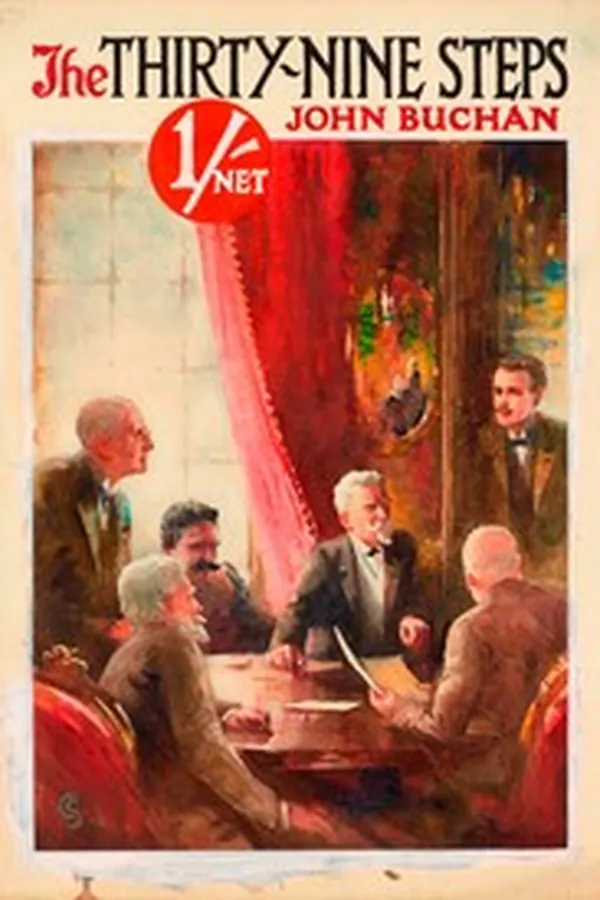
The Thirty-Nine Steps
📖 Click to Read the Opening Pages Online Preview
Chapter I: The Man Who Died
I returned from the City about three o’clock on that May afternoon pretty well disgusted with life. I had been three months in the Old Country, and was fed up with it. If anyone had told me a year ago that I would have been feeling like that I should have laughed at him; but there was the fact. The weather made me liverish, the talk of the ordinary Englishman made me sick. I couldn’t get enough exercise, and the amusements of London seemed as flat as soda-water that has been standing in the sun. “Richard Hannay,” I kept telling myself, “you have got into the wrong ditch, my friend, and you had better climb out.”
It made me bite my lips to think of the plans I had been building up those last years in Buluwayo. I had got my pile—not one of the big ones, but good enough for me; and I had figured out all kinds of ways of enjoying myself. My father had brought me out from Scotland at the age of six, and I had never been home since; so England was a sort of Arabian Nights to me, and I counted on stopping there for the rest of my days.
But from the first I was disappointed with it. In about a week I was tired of seeing sights, and in less than a month I had had enough of restaurants and theatres and race-meetings. I had no real pal to go about with, which probably explains things. Plenty of people invited me to their houses, but they didn’t seem much interested in me. They would fling me a question or two about South Africa, and then get on to their own affairs. A lot of Imperialist ladies asked me to tea to meet schoolmasters from New Zealand and editors from Vancouver, and that was the dismalest business of all. Here was I, thirty-seven years old, sound in wind and limb, with enough money to have a good time, yawning my head off all day. I had just about settled to clear out and get back to the veld, for I was the best bored man in the United Kingdom.
Four days later the stranger is dead on the floor, and the police are hunting a murderer who has every reason to want the story buried. Download the complete novel to read on.
Download Full EPUB1915
~44,000 words (estimated)
Approx. 2.4 hours
Standalone
London and the Scottish Borders, May-June 1914
10 chapters
EPUB · AZW3 · KEPUB
0.32 MB (EPUB) · 0.39 MB (AZW3) · 0.33 MB (KEPUB)
Public domain in the United States
Project Gutenberg #558
Richard Hannay, thirty-seven, three months back in London from a Buluwayo mining camp and “the best bored man in the United Kingdom”, takes in a frightened American neighbour for four days and comes home to find him dead on the floor with a knife through his heart. The Thirty-Nine Steps is what happens next: Hannay runs from both the police and the spy ring Scudder called the Black Stone, changing clothes, name and county while staying ahead of men with aeroplanes, cars and polite suburban houses. Buchan tells it in the first person, in short practical sentences, with an ex-miner’s eye for weather, boots and breakfast. The engine is not detection but motion, and it never idles.
Its real subject is camouflage. Buchan hides everything inside something ordinary: a murder inside a faked suicide, a German agent inside a stockbroker who plays tennis and chaffs about his handicap, a secret aerodrome inside a ring of firs, a staircase inside a chalk cliff. The book’s anxiety is that a normal surface is exactly what cannot be trusted, and Hannay’s only defence is a doctrine he learned from an old Rhodesian scout: play the part until you believe it, and it stops being a part. The disguise works because nobody looks twice at a roadman, a drover or a dry-fly fisherman. See Wikipedia’s article on The Thirty-Nine Steps for its publication history. The text is available via Project Gutenberg #558.

The Thirty-Nine Steps by John Buchan: Summary, Characters & Themes
This summary and analysis of The Thirty-Nine Steps follows all ten chapters, from the May evening when Franklin Scudder dies on Richard Hannay’s floor to the June night when a German agent gets down a staircase cut into the chalk and a British minister is left holding a pair of handcuffs. It is a short book — forty-four thousand words, ten chapters, most of them under five thousand — and almost all of it is movement: a borrowed milkman’s cap, a stolen 40 h.p. car, a bicycle left in a bog, a day spent under a bush. What lifts it above the chase is the voice. Hannay is dry, unimpressed, faintly amused by his own cleverness, and honest about the moments when he is guessing. He tells you what he does not know, and Buchan lets him be wrong in public.
The author is John Buchan, and the text of The Thirty-Nine Steps itself has a long critical history. Buchan wrote it in the winter of 1914 during an illness, and says so in the dedication, which is also a defence of the form: the story of the “shocker”, where “the incidents defy the probabilities, and march just inside the borders of the possible”. He had been a barrister, an administrator in South Africa under Lord Milner and a war correspondent, and none of that shows up as self-importance; the book’s authority is procedural. Hannay decodes a cipher because a name surfaces from memory and counts a staircase because a dying man told him to count it. The plainness is a technique, not an absence of technique. He was writing about the state of the country at a moment when the state was about to be tested, and the details he chose — the hayfield aerodrome, the staff talks with France, the dispositions of the fleet — were things a well-informed man in 1914 knew to be live questions rather than inventions.
Structurally the book is a series of doors. Each chapter opens in a new place with a new set of people who are more or less what they seem, and Buchan never finishes one without giving you a reason to open the next. The trick is that the plot is not solved but outrun: between Galloway and Kent Hannay learns almost nothing except a name, the Black Stone, and a phrase, thirty-nine steps, and those two scraps are enough to finish the business. The prose works the same way. Short declaratives, almost no metaphor that costs anything, and a refusal of rhetoric at precisely the moments when rhetoric would be easiest — the murder, the aerodrome, the last minute on the cliff.
What dates the book, and also explains it, is its confidence about class and nation. Every herd, innkeeper, roadman and butler Hannay meets can be read at a glance and is almost always generous; every gentleman is either a colleague or a traitor; and the middle-class suburb, with its tennis, its golf handicap and its barometer, is where the enemy hides because nobody there is ever looked at twice. That is the joke Buchan plays on his own readers, and it still works. The chase machinery — one man alone on open ground with the whole apparatus of the state against him — is older than Buchan, and readers who enjoy it should go next to The Hound of the Baskervilles for the moor and to Christie’s The Secret Adversary for amateurs who stumble into a conspiracy. What all three share is a suspicion of surfaces: a moor, a country house, a London flat and a suburban villa are each places where the ordinary thing in front of you turns out to be the lie.
The book’s afterlife belongs mostly to the cinema. Hitchcock’s 1935 film keeps the title and almost nothing else, and the version most people half-remember — a music-hall couple handcuffed together, a chase across the Forth Bridge — is his invention, not Buchan’s. The novel is lonelier and more political, and it is also a period document about how a particular kind of Englishman imagined invasion in 1914; its casual cruelties, including the antisemitic shorthand Buchan puts into Scudder’s mouth in the first chapter, belong to the record rather than to the plot. Chesterton’s The Man Who Was Thursday runs the same joke about amateurs and conspiracy from the opposite direction, with anarchy as a game of masks. The text used here is the Project Gutenberg transcription (#558), which is in the public domain in the United States.
Historical Context
Buchan wrote the book during an illness in the winter of 1914, and the dedication to Thomas Arthur Nelson explains exactly what he thought he was doing: he had exhausted his store of “that elemental type of tale which Americans call the ‘dime novel’ and which we know as the ‘shocker’”, and was driven to write one for himself. The formula he names is precise — incidents that “defy the probabilities, and march just inside the borders of the possible” — and the novel keeps to it, depending on coincidence but never on magic. Buchan was thirty-nine, a barrister, a former colonial administrator in South Africa and a working journalist, and the flatness of the prose reads like a deliberate refusal of the literary manner he could easily have used instead. The shocker is a machine for keeping a reader awake, and his innovation was to run it on facts that were themselves entirely ordinary.
William Blackwood and Sons published it in 1915, in the first year of a war that made its premise less fantastic every month, and it did well enough to give Buchan a second career. He wrote four more Hannay novels and a great deal else, ending as Governor General of Canada and Lord Tweedsmuir, but this is the book that fixed the formula: a private man, no training, no authority, and a state that becomes competent only after it has been warned. Its nearest relatives are the invasion stories of the previous generation, from The Battle of Dorking to Erskine Childers’s The Riddle of the Sands, and it inherits their assumption that the danger is administrative — papers, plans, a leak — rather than military. The Blackwood edition of 1915 has never been out of print, which for a book written during a convalescence is a durable result.
The novel’s politics are those of 1914, and its blind spots are worth naming. There are no women in the story with parts to speak of beyond a cottager’s wife and a parlour-maid, the enemy is identified by accent, boots and the cut of a collar, and Scudder’s opening account of the conspiracy uses the antisemitic shorthand of the period without a flicker of correction from the narrator. What the book does see clearly is the shape of the coming war: staff talks with France, a fleet whose dispositions decide everything, and a Britain that will be saved, if at all, by amateurs who happen to be standing in the right place. The fantasy is not that the country is strong. It is that it is warnable.
Key Characters & Literary Archetypes
- Richard Hannay: is the narrator, and the book is built out of his limitations: a mining engineer with a good memory and no official standing, three months home from Buluwayo and “the best bored man in the United Kingdom” when the story starts. He is capable rather than brilliant, reading a cipher because a name surfaces, counting staircases because a dead man told him to, and he admits his mistakes as he makes them. “I could not have sworn to one of them,” he says of the three men at Trafalgar Lodge, and that honesty is the character.
- Franklin P. Scudder: is the American journalist whose death starts everything, and whose notebook proves more useful than his conversation. He arrives in Hannay’s flat with a story about a murdered Greek premier and a conspiracy he calls the Black Stone, drinks a whisky-and-soda in three gulps, cracks the glass as he sets it down, and says “I happen at this moment to be dead.” He is not wrong for long. His method — authorities given “a numerical value and then striking a balance” — is the book’s model for thinking about a rumour.
- Sir Walter Bullivant: is the Foreign Office man who turns a hunted fugitive into an asset. He begins as a name in a letter and a voice on a telephone, then appears at his own dinner table, calm and established, and is the only person in the book with the standing to make Hannay’s information count. “You may dismiss the police from your mind,” he tells him, and that sentence is the hinge of the plot, because it converts a murder case into a question of national survival. He also keeps a dry-fly fisherman on his staff, which is a joke Buchan enjoys.
- Alexander Turnbull: is the roadman whose job, coat, spectacles and lunch of scones and cheese become Hannay’s disguise. He is drunk, quarrelsome and known as a bad character, which is exactly why nobody looks twice at the man doing his work, and his cottage at Blackhopefoot holds Hannay’s clothes and Scudder’s notebook when Hannay has to leave them behind. Later he nurses a stranger through a fever for ten days without ever learning his name, and that is the book’s one image of decency that expects nothing back.
- The bald archaeologist: is the enemy’s most convincing performance: a genial old man on a bare moor who offers cold pie and beer to a starving tramp, knows the county’s history and its families, and has already been told the tramp’s real name. He has the hooded eyes of a bird of prey, a locked storeroom full of lentonite and a mill full of men, and his last line, “Der Schwarze Stein ist in der Siegeskrone”, is delivered with a patriot’s heat. “He was more than a spy,” Hannay says; “in his foul way he had been a patriot.”
- Marmaduke Jopley: is the book’s comic irritant and its most useful accident: a wealthy, self-important young man who recognises Hannay on a moor and is out of his car within a page. Hannay calls him “an offence to creation”, takes his driving-coat to cover a roadman’s shirt, and leaves him to explain the loss. He exists to show how easily the English upper class can be separated from its possessions, which is the same joke the Black Stone plays on the nation, and he is also the reason the police have a witness who saw the wrong man.
Core Literary Themes
- Camouflage and the ordinary surface: The governing idea is that the dangerous thing looks like the dull thing. Scudder’s death is staged as a suicide using a corpse bought for the purpose; the secret aerodrome sits inside a ring of firs; the enemy commander keeps a villa, a tennis lawn and a golf handicap, and Hannay cannot swear to any of the three faces he has already seen twice. The rule is stated first in Rhodesia, where a duiker escapes the hunt by standing still against grey rock: “It didn’t need to run away; all it had to do was to stand still and melt into the background.” The young innkeeper in Galloway puts the same thought better: “The only thing to distrust is the normal.”
- Competence as a moral style: Hannay is not clever in the detective’s way; he is capable, and the novel treats capability as a form of decency. He knows lentonite because he was a mining engineer, wears a dead man’s spectacles because eyes are what witnesses remember, buys the tide tables instead of guessing, and writes down eleven facts and three guesses before he acts. Buchan hands the reader the same evidence in the same order, so the solutions feel earned: the thirty-nine steps are found by counting staircases, not by intuition. In a book about a man with no official standing, the only authority available is knowing your job. The reader is held to the same rule, and none of it needs a specialist — only attention.
- The map and the clock: This is a novel of timetables, and its suspense is administrative. The murder is dated — “the 23rd day of last month” — the deadline is the fifteenth of June, and the final clue is a tide time that has to be matched against an Admiralty table: 10.17 at the staircase, 10.27 at Bradgate. Trains, cars, steamers and aeroplanes all run to schedule, and the plot turns on who has read the schedule. Buchan’s confidence that the world is legible is what makes the book feel modern, and its fear is not of chaos but of a timetable that somebody else has already worked out. A missed train is as fatal here as a bullet, and a man’s watch counts as a weapon.
- Gentlemen, servants and traitors: Class is the book’s sorting machine. Herds, innkeepers, roadmen and butlers are read at a glance by Hannay and are almost always honest, and their kindness carries him from Galloway to Kent. Gentlemen are harder: Sir Harry is decent, Sir Walter is competent, and the three men at Trafalgar Lodge are indistinguishable from any club four until the last page, because the enemy is not a foreigner but a member. Hannay’s own discomfort sharpens the point — he can talk to herds and to Cabinet ministers, but the comfortable villa world leaves him “as shy of them as of a black mamba”.
- The war that has not started: Buchan sets the book weeks before the war and ends it with the war arriving on schedule: “Seven weeks later, as all the world knows, we went to war.” Everything Hannay does is therefore both futile and necessary — the fleet’s plans are saved, and the war happens anyway. That double ending is the real argument: intelligence can prevent a disaster without preventing the disaster of the age, and the man who saves the plans takes a captain’s commission and does his best service before he puts on khaki. It also dates the book exactly. The fantasy is not that Britain wins; it is that Britain is warned in time.
Related on editions.ink: The Hound of the Baskervilles — Conan Doyle’s moor, a family legend and a rational explanation; The Secret Adversary — Christie’s amateurs chasing a lost treaty through London; The Monk — Lewis’s pursuit through vaults, dungeons and a monastery.
Why Download Our Custom E-Reader Edition of The Thirty-Nine Steps?
This edition gives you the complete 1915 novel, all ten chapters, from the murder in the Portland Place flat to the chalk staircase above the Kentish beach, with Buchan’s own chapter headings kept exactly as he set them and the dedication to Thomas Arthur Nelson included at the front. Nothing is abridged, modernised or annotated inside the text, so the book reads the way it was printed: short chapters, hard breaks, and a narrator who assumes you are keeping up.
The files are DRM-free and come in three formats from one page: EPUB for most readers, AZW3 for older Kindles and KEPUB for Kobo devices. Each has real chapter marks and a linked table of contents, which matters in a book built out of ten separate episodes — you can close it at the end of a chapter and find your place again without scrolling through a wall of text.
It is a short book, and that is part of the point: the whole chase runs to fewer than forty-five thousand words, so it fits a train journey or two quiet evenings rather than a month. Reading it beside the Hitchcock film is a good exercise in seeing what a screen does to a plot, and reading it as a document of 1914 is a good exercise in seeing what a country wanted to believe about itself that summer.
- Project Gutenberg transcription, via Project Gutenberg #558 — the complete text, unabridged, with the chapter headings the author set.
- Formats included EPUB, AZW3 and KEPUB, DRM-free, each opening on the first page of Chapter I rather than on a title screen, and each reading cleanly on the device it was made for.
- Chapter marks all ten chapter headings as Buchan set them, with the dedication and the front matter kept separate so that the story starts where it should and the Contents links actually go somewhere.
- Reading time short enough for a single evening, and paced so that one chapter a night works just as well; the reading-time box near the top of this page gives the estimate.
- The Hound of the Baskervilles — free EPUB, AZW3 & KEPUB
- The Secret Adversary — free EPUB, AZW3 & KEPUB
- The Man Who Was Thursday — free EPUB, AZW3 & KEPUB
Chapter summaries
Buchan’s ten chapters are ten doors: a flat behind Langham Place, a Galloway inn, a bare moor, a mill, a cottage by a stream, a villa in Kent. The summaries below follow Hannay through them in order and stop short of the last deduction.
- Chapter I — The Man Who Died: Hannay, thirty-seven and “the best bored man in the United Kingdom”, gives the Old Country one more day. That evening Franklin Scudder, from the flat above, tells him a story about a murdered Greek premier and a conspiracy called the Black Stone, fakes his own death with a corpse, and hides in Hannay’s spare room for four days of chess and cipher notes. Hannay comes home to find him pinned to the floor with a long knife and no police he can safely go to.
- Chapter II — The Milkman Sets Out on his Travels: Hannay works out that the police will hang him for a killing he did not commit, that the murderers will kill him to be safe, and that the only exit is the street. He finds Scudder’s pocket-book in the tobacco jar, buys a milkman’s cap and overalls for a sovereign at eight in the morning, walks past two watchers, and gets on the 7.10 express from St Pancras with no ticket and a good Scots accent.
- Chapter III — The Adventure of the Literary Innkeeper: In Galloway a herd gives him tea and a bed under a turf roof, and next morning a monoplane sweeps the hills looking for him. The innkeeper is a young man with literary ambitions who quotes Milton at length and remembers every stranger; his two overnight guests — one dark and thin, the other plump and lisping — ask a few too many questions about the murder in the papers. Hannay cracks the cipher with the key “Julia Czechenyi” and takes a 40 h.p. car while the police are closing in.
- Chapter IV — The Adventure of the Radical Candidate: The notebook gives up its secret: the war has been arranged “ever since February 1912”, Karolides is only the fuse, and the Black Stone will strike at the fleet’s dispositions when a French staff officer brings them to London on the fifteenth of June. “The little man had told me a pack of lies,” Hannay writes. He wrecks the stolen car, is taken for a heckler at a Free Trade meeting, and talks Sir Harry into a letter of introduction to his godfather, Sir Walter Bullivant.
- Chapter V — The Adventure of the Spectacled Roadman: On a bare moor with no cover at all, Hannay takes the place of Alexander Turnbull, a roadman with a bad head and a worse reputation, and becomes spectacles, dust and a broken pipe. The County Surveyor passes him, a carload of visitors asks directions, and a policeman looks straight at him. His nerve holds until Turnbull’s own behaviour gives him away, Jopley’s car comes up the road, and he has to decide whether to run as a roadman or as himself.
- Chapter VI — The Adventure of the Bald Archaeologist: Half-starved and out of cover, Hannay walks into a moorland house whose owner greets him by name. The old man is hospitable, knowledgeable about the county and patient; the hooded eyes are not. Locked in, Hannay recognises the sacks in the mill as lentonite, blows the floor apart with a quarter of a brick, escapes through a dovecot, and sees from its window what the ring of firs has been hiding: a secret aerodrome, and the wire traps around it.
- Chapter VII — The Dry-Fly Fisherman: Fever and a cold spring leave Hannay in a herd’s cottage, where Turnbull, never told his name, nurses him for ten days. He walks south as a drover called Hislop, is turned away from a cottage door in the rain, and on the last evening hears a man on the water whistling “Annie Laurie”. The fisherman’s scolding about begging is a performance for a passer-by; five minutes later Hannay has a bath, borrowed dress clothes, dinner with Sir Walter, and the news that Karolides was shot at seven.
- Chapter VIII — The Coming of the Black Stone: Royer is coming a day early, so Hannay drives to London as the Foreign Office chauffeur, is told at Scotland Yard that the police are now the least of his problems, and lunches at the Savoy in a fog of restlessness. In Jermyn Street he runs into Jopley and knocks him down in public. At Bullivant’s house the butler hides him in an alcove and lies for him, and the man at the head of the table is not Lord Alloa — Alloa, telephoned at home, is in bed.
- Chapter IX — The Thirty-Nine Steps: The impostor repeats the naval plans back page by page without a note, and Whittaker doubts that a single word of them can be changed. Then Scudder’s last message surfaces: “Thirty-nine steps — I counted them — high tide, 10.17 p.m.” Hannay buys the tide tables, finds a place where full tide is at 10.27, and guesses the coast of Kent. Scaife counts the staircases; one of them has thirty-nine steps, and the villa at the top belongs to a retired stockbroker called Appleton.
- Chapter X — Various Parties Converging on the Sea: At Bradgate the suspects play tennis, chaff about their handicaps, and look like “three ordinary, game-playing, suburban Englishmen”. Hannay, remembering Peter Pienaar’s duiker that melted into the kopje, stays for a game of bridge, watches the old man’s fingers tapping on his knee, and tells them the game is up. The lights go out, Franz runs for the cliff stair, and a lever brings down a cloud of chalk dust on the only way to the sea.
The Thirty-Nine Steps: Frequently Asked Questions
What is The Thirty-Nine Steps about?
Is The Thirty-Nine Steps hard to read?
How long is it?
Do I need to read the other Hannay books first?
Is it suitable for children?
Is the book the same as the Hitchcock film?
What do the thirty-nine steps turn out to be?
Where can I get the full text and the downloads?
Part of: Adventure and Sea Stories · Classic Fiction