Grimms’ Fairy Tales by Jacob and Wilhelm Grimm: Free EPUB, AZW3 & KEPUB Download
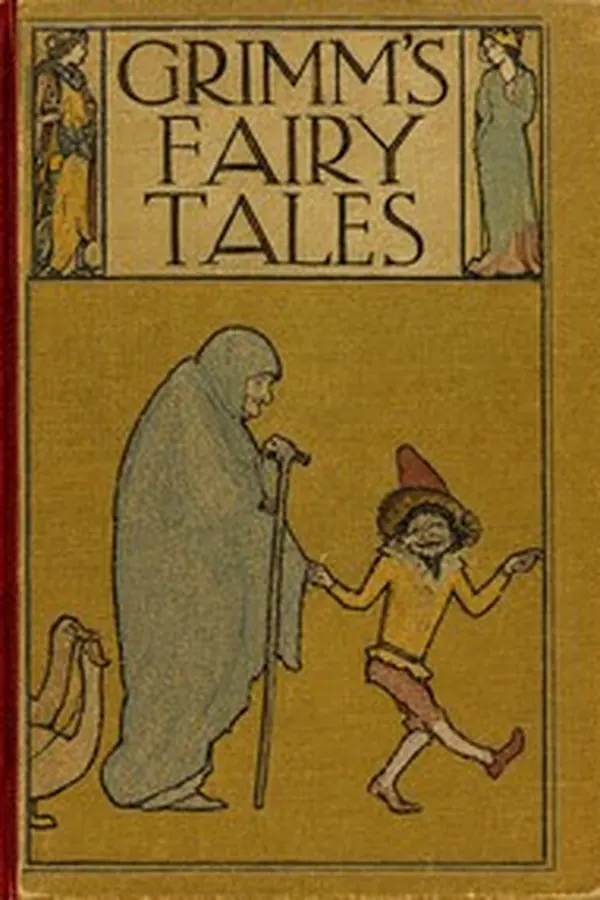
Grimms’ Fairy Tales
📖 Click to Read the Opening Pages Online Preview
Grimms’ Fairy Tales, opening pages: The Golden Bird
Then the gardener’s eldest son set out and thought to find the golden bird very easily; and when he had gone but a little way, he came to a wood, and by the side of the wood he saw a fox sitting; so he took his bow and made ready to shoot at it. Then the fox said, ‘Do not shoot me, for I will give you good counsel; I know what your business is, and that you want to find the golden bird. You will reach a village in the evening; and when you get there, you will see two inns opposite to each other, one of which is very pleasant and beautiful to look at: go not in there, but rest for the night in the other, though it may appear to you to be very poor and mean.’ But the son thought to himself, ‘What can such a beast as this know about the matter?’ So he shot his arrow at the fox; but he missed it, and it set up its tail above its back and ran into the wood. Then he went his way, and in the evening came to the village where the two inns were; and in one of these were people singing, and dancing, and feasting; but the other looked very dirty, and poor. ‘I should be very silly,’ said he, ‘if I went to that shabby house, and left this charming place’; so he went into the smart house, and ate and drank at his ease, and forgot the bird, and his country too.
‘One feather is of no use to me, I must have the whole bird.’
Download Full EPUB1812
~100,000 words (estimated)
Approx. 5.6 hours
EPUB · AZW3 · KEPUB
0.51 MB (EPUB) · 0.63 MB (AZW3) · 0.54 MB (KEPUB)
Public domain in the United States
Project Gutenberg #2591
Grimms’ Fairy Tales is the English selection of the Kinder- und Hausmärchen that Jacob and Wilhelm Grimm collected in Germany and published between 1812 and 1857: sixty-two stories in which a youngest son, a miller’s daughter or a child lost in the wood meets a talking fox, a witch, or a bargain that must be paid. The text here follows the Project Gutenberg edition that descends from Edgar Taylor’s 1823 selection, the version that carried the tales into English and gave them their first wide readership outside Germany.
The collection runs from the famous to the strange: Hansel and Gretel and Little Red-Cap beside Ashputtel, Rapunzel and Snowdrop, and then the animal tales, the clever servants, the fools and the devil’s bargains that English readers rarely meet. Read in sequence, the tales show a whole pre-industrial world of hunger, stepmothers, forests and promises, told in a plain prose that is far harsher than the nursery versions remembered today. See Wikipedia’s article on the collection for its seven editions between 1812 and 1857. The text is available via Project Gutenberg #2591.
Grimms’ Fairy Tales by Jacob and Wilhelm Grimm: Summary, Characters & Themes
This is a summary and analysis of Grimms’ Fairy Tales, the collection Jacob and Wilhelm Grimm began publishing in 1812 and revised until 1857, read here in the English text that descends from Edgar Taylor’s 1823 selection. The edition contains sixty-two tales, from the ten-page quests to single-page anecdotes, and it is arranged in the order the Grimms gave them rather than by theme, so a child’s story follows a tale of murder and a joke about a foolish peasant follows a hymn to the forest.
The tales come out of a world of small farms and walled towns, and they are practical about hunger, inheritance and marriage. A youngest son sets out because there is nothing for him at home; a miller’s daughter is promised to a king because her father boasted; a girl is sent into the wood with a basket and a warning. The Grimms did not invent these plots. They collected them from storytellers, neighbours and friends, and then edited what they collected, and the plain sentences of this English text keep both the oral rhythm and the nineteenth-century tidying.
What holds the collection together is not a character but a shape. Someone leaves home, meets a creature or a stranger who offers help or a bargain, breaks the rule or keeps it, and is rewarded or punished in a way that is exact and often physical. The fox who gives good counsel, the old woman at the well and the little man at the spinning wheel are all the same figure in different clothes: the test that arrives disguised as help. Jacob and Wilhelm Grimm were philologists first, and the collection began as a scholarly project before it became a book for families.
The prose is deliberately flat. There are few adjectives, almost no description of faces, and a great deal of direct speech, which is what makes the tales so easy to retell and so hard to illustrate definitively. Violence is reported without comment: a step-sister cuts off her great toe to make the slipper fit, a robber hacks a finger off a murdered girl, and the story moves on to the wedding. Modern readers notice the cruelty and the fairness at the same time, and both are in the text.
The version used for this page is the Project Gutenberg #2591 transcription of the English text, which preserves the tale order, the headings and the punctuation of the printed selection. Our Household Tales edition is the companion volume, in Margaret Hunt’s fuller translation.
Historical Context
Jacob and Wilhelm Grimm published the first volume of Kinder- und Hausmärchen in 1812 and the second in 1815, in the middle of the Napoleonic wars and in the middle of a German argument about what a nation was. The brothers were librarians and philologists at Kassel, working on a German dictionary and on the history of the language, and the tales began as evidence: what people told each other, in what words, with what turns of phrase. The book was not written for children at first, though children read it immediately.
Wilhelm Grimm kept revising. Between 1812 and 1857 the collection went through seven editions, and he added tales, smoothed sentences, removed some of the bawdry and supplied the notes that made the book useful to scholars. The final edition of 1857 is the one most translations follow, including the English line that begins with Edgar Taylor’s German Popular Stories of 1823, illustrated by George Cruikshank.
Taylor translated a selection, not the whole collection, and later translators filled in the rest; the Project Gutenberg text used here gathers that English line and keeps the older spellings and the older punctuation. The tales had already travelled a long way before the Grimms wrote them down, from India and Italy and France, and they kept travelling afterwards, into picture books, opera and film.
Key Characters & Literary Archetypes
- The youngest son: called Dummling when he is called anything, he is the third brother who is mocked, shares his bread with a stranger and wins the princess while his clever brothers are still arguing. He carries The Golden Goose, The Queen Bee and The Water of Life, and he is the collection’s idea of luck as a moral quality.
- The maiden under a spell: Rapunzel in her tower, Briar Rose behind the hedge of thorns, Jorinda turned into a nightingale and Snowdrop in the glass coffin. She is usually the object of the quest and almost never the one who solves it, and her silence is what the story is built around.
- The helpful animal: the fox who gives counsel in The Golden Bird, the fish and the ants repaid in The White Snake, the cat who kills the wolf in Old Sultan. Kindness to a creature is the collection’s most reliable test of character, and the creature always remembers.
- The wicked stepmother: the figure who stands between a child and its inheritance, in Hansel and Gretel, The Juniper-Tree, Snowdrop and Ashputtel. She is the collection’s most consistent villain, and her punishment is always the harshest in the book.
- The clever rogue: the discharged soldier of The Blue Light, the tailor of Seven at One Blow, and the peasant who sells a wooden calf. He has no magic and no manners, and he wins because he can see the trick that the honest man cannot.
Core Literary Themes
- The bargain and its price: almost every tale turns on a promise made under pressure, from Rumpelstiltskin’s straw to the fisherman’s wife and her flounder. The stories are not interested in whether the promise was fair, only in whether it is kept, and the failure to keep it is what turns a wish into a punishment.
- Kindness to the least creature: the hero is usually the person who spares the fox, feeds the ants or gives away the last of the bread. The tales treat this as practical wisdom rather than sentiment, since the creature returns at the moment when nothing else can help.
- Hunger and the edible house: the forest is a place without food, and the gingerbread house in Hansel and Gretel is the fantasy that answers it. Bread, milk, apples and sausages recur constantly, and a meal is often the whole plot of a story.
- Leaving home and coming back: the tales begin with a departure and end with a return, usually with a kingdom attached, and the road between them is where the rules are learned. What the hero brings back is rarely the treasure he set out for, which is the quiet joke at the centre of the collection.
Why Download Our Custom E-Reader Edition of Grimms’ Fairy Tales?
This edition is built from the Project Gutenberg transcription of the English text that descends from Edgar Taylor’s 1823 selection, with the tales in the order the book prints them. Nothing is abridged, no tale is summarized, and the collection is not cut down to the dozen stories that usually survive in children’s anthologies.
The formatting is made for a reading device. Each tale has its title as a heading and begins on a fresh page, the table of contents links to every one of the sixty-two, the verse lines keep their breaks, and the long paragraphs are left long. The result opens like a book of stories rather than a web page chopped into sections.
It takes about five and a half hours to read from end to end, and much less if you dip. That is the right way to use a collection: one tale at a time, in the order printed, and you will meet the animal tales, the fools and the devil’s bargains that the picture-book versions leave out. The EPUB opens anywhere, the AZW3 goes straight onto a Kindle, and the KEPUB is for a Kobo with proper chapter marks.
- Project Gutenberg transcription, via Project Gutenberg #2591 — the complete collection of sixty-two tales, not a selection, in the English text of Taylor and the translators who followed him.
- The old English text, unmodernised — the 1823 phrasing, the spellings and the punctuation stay as printed, so the tales keep the period voice that later retellings smooth away.
- Real story and paragraph structure — every tale carries its title, starts on its own page and keeps its internal breaks, so the collection is navigable instead of being one long file.
- Three formats, one upload — EPUB for most readers, AZW3 for Kindle, KEPUB for Kobo, all DRM-free, free to keep, and free to move to another device later.
- The Wonderful Wizard of Oz — free EPUB, AZW3 & KEPUB
- Peter and Wendy — free EPUB, AZW3 & KEPUB
- The Secret Garden — free EPUB, AZW3 & KEPUB
Chapter summaries
Grimms’ Fairy Tales is a collection, not a single narrative: sixty-two tales with no chapters and no plot that runs through them. This guide groups them into thirteen strands by motif, from the quest of the youngest son to the bargain that has to be paid, so that every tale in the book has a place.
- The Golden Bird: the youngest son sets out: A king’s golden apples are stolen at night, and the gardener’s three sons go after the bird. The two eldest meet a fox who offers good counsel, ignore it, and forget the bird entirely; the youngest takes the counsel, wins the golden horse and the princess, and comes home with all three. The Water of Life and The Queen Bee repeat the shape: an old king’s illness or a hidden treasure, two brothers who mock, and a third who is kind to the least creature he meets.
- The simpleton who wins: In The Golden Goose the boy called Dummling shares his bread with a grey man and then cannot shake the women who stick to his goose, until the princess who has never laughed sees him and the kingdom follows. The Three Languages gives a boy who learns what dogs, frogs and birds say and is laughed at for it, and The Turnip hands the reward for a giant vegetable to the brother who does not scheme.
- The Bremen town musicians (The Travelling Musicians): Four worn-out animals on the road to Bremen, an ass, a dog, a cat and a cock, decide to earn their living as musicians and end by frightening a band of robbers out of a house with nothing but noise. Old Sultan, The Dog and the Sparrow, The Willow-Wren and the Bear, The Fox and the Cat and The Fox and the Horse belong to the same family: animals who talk, hold a grudge, keep a bargain or avenge a friend.
- When animals keep house: Cat and Mouse in Partnership stores a pot of fat in a church and eats it layer by layer while the mouse is told it is a christening. The Mouse, the Bird and the Sausage divide the housework between them and destroy it by wanting each other’s share, and The Straw, the Coal and the Bean escape a fire only to be sewn up by a tailor. The Adventures of Chanticleer and Partlet and The Wolf and the Seven Little Kids close the group with two very different stories of a household undone.
- The tower, the spindle and the hundred years: Rapunzel is sold for a handful of rampion, shut in a tower and visited by a prince who climbs her hair, and the story does not spare either of them. Briar Rose is the sleeping princess, the thirteenth fairy, the spindle and the hedge of thorns that grows for a hundred years. Jorinda and Jorindel and The Raven add the enchanted maiden and the lover who must break the spell before the wedding can happen.
- The false bride and the true one: The Goose-Girl loses her place to a maid on the road, and her horse Falada speaks the truth after its head is nailed to the gate. Sweetheart Roland, Fundevogel and The Twelve Huntsmen all turn on a disguise that has to be seen through: a flower and a lake, a rosebush and a church, eleven maidens in huntsmen’s clothes.
- The children in the wood: Hansel and Gretel leave a trail of breadcrumbs, find the house of cake and sugar, and end with the oven. Little Red-Cap carries a basket to her grandmother and meets the wolf on the way, and The Juniper-Tree gives the collection its most cold-blooded stepmother. The Robber Bridegroom and Tom Thumb complete the group with a finger kept as proof and a boy no bigger than a thumb.
- Cinders and the slipper: Ashputtel plants a hazel twig on her mother’s grave, is dressed by the doves for three balls, and leaves a slipper that the step-sisters mutilate their feet to fit. Snowdrop is the queen’s stepdaughter, the huntsman’s mercy and the seven dwarfs, and Cat-Skin is a princess in a cloak of fur and soot who hides in a kitchen. Mother Holle sends two girls down a well and brings one back in gold and the other in pitch.
- Seven at one blow: The Valiant Little Tailor kills seven flies with one stroke, embroiders the number on his belt and talks his way past giants, a unicorn and a boar, which is the collection’s best joke about a man who wins by boasting. The Four Clever Brothers learn to steal, to read the stars, to shoot and to sew, and each is needed in turn. The Story of the Youth Who Went Forth to Learn What Fear Was spends three nights in a haunted castle and never learns, King Grisly-Beard humbles a proud princess, and Iron Hans is the wild man let out of the cage.
- The beast bridegroom: The Frog-Prince comes to dinner for a golden ball, The Wedding of Mrs Fox is a comedy of suitors and nine tails, and Lily and the Lion begins with a rose and ends in a nut tree. Snow-White and Rose-Red keep house with a bear who is not a bear, and The Pink is the tale of a child who can wish for anything and the cook who steals him.
- The devil’s bargain: The Blue Light gives a discharged soldier a light that summons dwarfs, and The King of the Golden Mountain sells a merchant’s son to a black dwarf for twelve years of luck. The Salad arms a huntsman with a wishing-cloak and a bird’s heart, and The White Snake lets a servant taste the king’s covered dish and understand every animal he has helped. In each of them the price is agreed in advance and paid at the end.
- Fools, knaves and clever servants: Clever Gretel eats the roast and blames the guest, Clever Elsie sits in the cellar and asks whether it is she or not she, and Clever Hans answers every question with the phrase he learned last. Doctor Knowall finds the stolen money by accident, The Little Peasant sells a wooden calf and drowns a village, and Frederick and Catherine are two fools who deserve each other. The Old Man and His Grandson gives the collection its shortest and coldest lesson, and The Miser in the Bush buries a fortune under a bush.
- Promises, wishes and their price: Rumpelstiltskin spins straw into gold for a promise, The Fisherman and His Wife asks for a cottage, a castle and a throne and ends in the pigsty, and The Seven Ravens sends a sister to the sun, the moon and the stars for her brothers. The Twelve Dancing Princesses wear out their shoes every night in a castle underground, Hans in Luck trades a lump of gold down to nothing and is glad of it, and The Elves and the Shoemaker finish the work by night until the shoemaker leaves them clothes.
Grimms’ Fairy Tales: Frequently Asked Questions
What is Grimms’ Fairy Tales about?
When was it published, and who wrote it?
Is this the 1812 first edition?
Who translated this English text?
How long does it take to read?
How close are these to the versions I know?
Are the tales suitable for young children?
Where can I read the complete text?
Part of: Children’s Classics · Classic Books by Word Count and Reading Time