Our Mutual Friend by Charles Dickens: Free EPUB, AZW3 & KEPUB Download
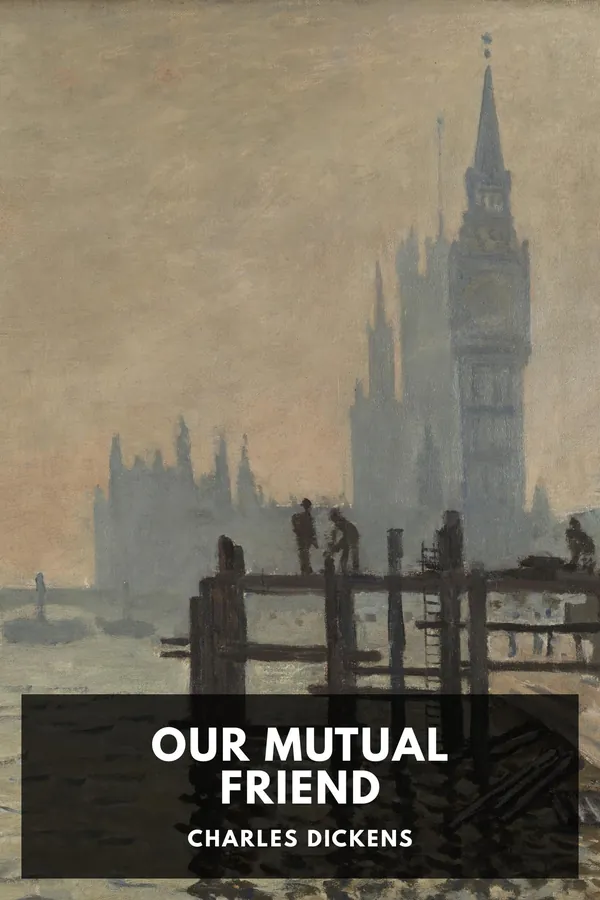
Our Mutual Friend
📖 Click to Read the Opening Pages Online Preview
On the Look Out: the opening of Book I
In these times of ours, though concerning the exact year there is no need to be precise, a boat of dirty and disreputable appearance, with two figures in it, floated on the Thames, between Southwark bridge which is of iron, and London Bridge which is of stone, as an autumn evening was closing in.
The figures in this boat were those of a strong man with ragged grizzled hair and a sun-browned face, and a dark girl of nineteen or twenty, sufficiently like him to be recognizable as his daughter. The girl rowed, pulling a pair of sculls very easily; the man, with the rudder-lines slack in his hands, and his hands loose in his waistband, kept an eager look out. He had no net, hook, or line, and he could not be a fisherman; his boat had no cushion for a sitter, no paint, no inscription, no appliance beyond a rusty boat-hook and a coil of rope, and he could not be a waterman; his boat was too crazy and too small to take in cargo for delivery, and he could not be a lighterman or river-carrier; there was no clue to what he looked for, but he looked for something, with a most intent and searching gaze. The tide, which had turned an hour before, was running down, and his eyes watched every little race and eddy in its broad sweep, as the boat made slight headway against it, or drove stern foremost before it, according as he directed his daughter by a movement of his head. She watched his face as earnestly as he watched the river. But, in the intensity of her look there was a touch of dread or horror.
Allied to the bottom of the river rather than the surface, by reason of the slime and ooze with which it was covered, and its sodden state, this boat and the two figures in it obviously were doing something that they often did, and were seeking what they often sought. Half savage as the man showed, with no covering on his matted head, with his brown arms bare to between the elbow and the shoulder, with the loose knot of a looser kerchief lying low on his bare breast in a wilderness of beard and whisker, with such dress as he wore seeming to be made out of the mud that begrimed his boat, still there was a businesslike usage in his steady gaze. So with every lithe action of the girl, with every turn of her wrist, perhaps most of all with her look of dread or horror; they were things of usage.
The preview stops after the opening paragraphs of Book I, chapter 1, where a boat works the Thames at nightfall, and the whole novel is in the download.
Download Full EPUB1865
~324,000 words (estimated)
Approx. 18.0 hours
Standalone
London and the Thames in the 1860s
67 chapters in four books
EPUB · AZW3 · KEPUB
1.26 MB (EPUB) · 1.72 MB (AZW3) · 1.40 MB (KEPUB)
Public domain in the United States
Project Gutenberg #883 · Standard Ebooks
Our Mutual Friend was the last novel Charles Dickens finished, and it opens with a corpse in the Thames. Gaffer Hexam, who earns his living by what the river gives up, hauls a drowned man aboard one autumn evening, and the body is taken for John Harmon, heir to a fortune made of London dust. The money passes to a servant, Nicodemus Boffin, and the dead man’s intended bride, Bella Wilfer, is left to marry whatever the will allows. Around that inheritance Dickens arranges usurers, false suitors, a schoolmaster and a dolls’ dressmaker, all of them watching the dust heap for what it will do next.
Critics often call it Dickens’s darkest finished novel, and also his most experimental: the hero spends most of the book under another man’s name. Its subject is money — who inherits it, who marries it, what it does to the people waiting for it. The book appeared in monthly numbers between May 1864 and November 1865, and the serial rhythm still shows. Readers who want the publishing history can begin with the Wikipedia entry on Our Mutual Friend. The full text runs to roughly 324,000 words. The text is available via Project Gutenberg and Standard Ebooks.
Our Mutual Friend by Charles Dickens: Summary, Characters & Themes
Charles Dickens began Our Mutual Friend in 1863, after a silence of several years, and it is the last novel he completed. His earlier books had sent orphans and clerks into fortunes they could not quite believe in; this one asks what a fortune is actually made of, and answers with London dust. The Charles Dickens of 1864 was a famous man, rich, restless and increasingly interested in money as a system rather than a reward, and the book carries that interest into every chapter. What follows is a summary and analysis of the novel’s design — its inheritance plot, its river, its usurers and its marriage market — with some notes on the serial form that shaped it and on the bleaker comedy that distinguishes it from the novels of the 1850s.
The novel was written for sale in twenty monthly parts, the first issued in May 1864 and the last in November 1865, with the two-volume edition following from Chapman and Hall at the end of that year. Dickens was fifty-two and in poor health, still editing All the Year Round and still travelling to give readings; he had also survived the Staplehurst railway crash in June 1865, while the later numbers were going to press. The part-issue format is visible in the finished book. Each number ends on a small turn of the screw, minor figures are reintroduced for the sake of a monthly reminder, and the subplots are braided with unusual patience for a writer who usually preferred to keep his stories moving.
The plot turns on a substitution. John Harmon, recalled from abroad by a father he hated, is supposed to marry Bella Wilfer in order to inherit the Harmon dust-heaps, and instead disappears at Limehouse on the night he lands. A body is recovered, identified and buried under his name, and the estate passes to Nicodemus Boffin, the foreman who once worked the mounds and is now nicknamed the Golden Dustman. Boffin hires a secretary, John Rokesmith, who is Harmon under another name and who is watching Bella to see what money has made of her. Dickens lets the reader suspect this long before he says it, so that the pleasure lies less in the solution than in the behaviour of everyone circling the fortune.
Around that spine Dickens hangs a second novel’s worth of machinery: the Hexam family, whose father dredges the river for corpses and whose daughter Lizzie refuses to be respectable on her brother’s terms; Bradley Headstone, the schoolmaster who wants her and destroys himself; Silas Wegg, the ballad seller with a wooden leg, who finds a will and tries to blackmail a patron; the Lammles, who married each other for money neither of them had; and the usurer Fledgeby, hiding behind the courteous old Jew Riah. The result reads like a darker cousin of Great Expectations and Bleak House, and readers who enjoy the slow comedy of the law in the latter will find the moneylenders here equally well observed.
What holds the book together is the dust. Dickens had grown up hearing that the great heaps near Battle Bridge were worth a fortune, and he builds the novel on that fact: refuse is capital, and almost everyone in the story is either shovelling it or waiting to inherit it. The satire is harsher than in the earlier novels, the good characters are fewer, and the ending, though happy, is deliberately muted. The text for this edition comes from Project Gutenberg and Standard Ebooks. If you would like a gentler Dickens to begin with, try David Copperfield, also on this site, before coming back to the dust. The novel is set from the first volume text, with its chapter divisions kept, and it costs nothing to download in any of the three formats.
Historical Context
London in the 1860s produced refuse on an industrial scale, and refuse was a business. Dust contractors collected household ashes and sorted them into brick dust, fine cinders and the soil that went to the brickfields; the yards around Battle Bridge and King’s Cross were reckoned to be worth tens of thousands of pounds, and disputes over them reached the courts. Dickens had known about this trade since childhood, and he gives Boffin the nickname the Golden Dustman because the joke was already current in London. The Harmon fortune is therefore not a fairy-tale treasure but a working business, with carts, horses, contracts and men who knew exactly what a heap weighed.
The river in this period was both highway and sewer. Until Bazalgette’s intercepting sewers were finished in the 1870s, most of London’s waste went into the Thames, and the Great Stink of 1858 had already forced Parliament to act; the Embankment, begun in 1862, was steadily reclaiming the foreshore where Hexam works. Watermen, dredgers and mudlarks made a living from what the tide left, and the river police knew the reach by its stairs and causeways. Drownings were common enough to be routine, and the opening of the novel — a boat, a body, an autumn evening — assumes a reader who has seen such reports in the newspapers.
Inheritance in 1860s England was governed by wills and probate, and a will could be contested, suppressed or simply mislaid, which is the engine of Dickens’s plot. Money was also lent at compound interest by firms that employed a respectable front man, since a gentleman usurer needed a name to lend under. Education was expanding unevenly: ragged schools, pupil-teachers and the Revised Code of 1862, which paid schools by examination results, produced both Charley Hexam’s anxious self-improvement and Bradley Headstone’s cramped respectability. Around all of it ran the daily business of the City, where a merchant’s credit could fail in an afternoon. A fortune in such a city was always provisional, and the novel’s men of business know it.
Key Characters & Literary Archetypes
- John Harmon (John Rokesmith): The heir who is presumed drowned in the first chapter and spends most of the novel as John Rokesmith, a secretary with no past. He comes home mistrustful of a wife chosen for him by a will, and tests Bella by keeping his name back. Dickens makes him watchful rather than charming: he reads ledgers, hires himself out, and keeps his temper until the last book, when he shakes Wegg by the cravat and takes his inheritance in hand.
- Bella Wilfer: The heroine, introduced as a girl who has been told all her life that she is too good for poverty. She is engaged to a dead man’s name, then installed in the Boffins’ house to be improved, and her snobbery and her honesty are set against each other until the apparent miserliness of her benefactor cures her. She marries Rokesmith secretly a chapter after refusing him, which is either the boldest thing in the book or the silliest.
- Nicodemus Boffin: The Golden Dustman, a former foreman who inherits the Harmon mounds and then performs greed so convincingly that readers have always argued about when the performance begins. He reads the decline and fall of the Roman Empire, keeps a one-legged ballad seller on a stipend, and fusses over his wife. His avarice is a test of Bella, and his relief when the pretence ends is the warmest moment in a cold book.
- Lizzie Hexam: Daughter of the waterman who finds the body, and the novel’s moral centre. She knows her father’s trade and hates it, teaches herself letters, and refuses both her brother’s plan for her respectability and the schoolmaster’s passion. When Wrayburn is left for dead she gets him out of the river and marries him once he recovers, which society finds unforgivable and Twemlow defends in the last chapter.
- Eugene Wrayburn: A barrister with no practice and no ambition, who amuses himself by following Lizzie Hexam and discovers too late that he is in earnest. He is beaten near a paper mill by Headstone, survives with a scarred face, and marries the woman who saved him. Dickens gives him the book’s sharpest social observation and its least earned conversion, both of which suit a man who has always been able to talk his way clear of trouble.
- Bradley Headstone: A pupil-teacher made good, schoolmaster at a respectable establishment, with a watch-chain and a suppressed rage. He loves Lizzie Hexam, hates Wrayburn’s careless ease, and arranges a murder before attempting one himself; the novel ends with him drowning in a weir lock beside the only man who could expose him. Dickens treats him as the product of an education system that rewards cramming and punishes feeling.
Core Literary Themes
- Dust and the price of everything: The dust-heaps are the novel’s central image because they are at once worthless and enormously valuable: rubbish that pays for dinners, marriages and seats in Parliament. Dickens uses them to ask what an inheritance actually transfers — money, obligation, or a habit of watching other people’s fortunes. Almost every character is waiting for something to be handed over: Bella for a rich husband, Wegg for a legacy, the Lammles for a fortune, Riderhood for a reward. The book’s moral test is whether anyone can accept a gift without first calculating what it will cost.
- Masks and withheld names: Harmon’s disguise as Rokesmith is the obvious one, but the novel is full of people presenting a front: Fledgeby lends money through Riah’s respectable name, the Veneerings give dinners on borrowed credit, and Headstone wears a schoolmaster’s surface over a temper. Dickens is interested in how long a performed character can be kept up before the performance becomes the person. Boffin’s pretended avarice is the riskiest version of the joke, because it nearly convinces his own household, and the resolution requires every mask to be dropped in public.
- The Thames as workshop and grave: The river opens the novel and closes it. It is a place of work for Hexam, a place of disposal for murderers, and a place of rescue for Lizzie, and Dickens keeps all three uses in view at once. The water carries the dead man who is not Harmon, gives up the corpse that starts the plot, and finally swallows Headstone and Riderhood together. Against the drawing rooms of the West End, the Thames stands for labour that cannot be hidden away, and the novel’s most respectable characters are the ones who never go near it.
- Respectability and the voice of society: Podsnap, the Veneerings and Lady Tippins exist to show how opinion is manufactured: a dinner party, a rumour, a verdict. Podsnap’s technique is to sweep anything unpleasant aside as un-English, while the Veneerings’ brilliance is entirely on credit. Dickens gives the last word not to them but to Twemlow, the poor relation who has been used as furniture for years, when he says that a wife who has saved her husband’s life is a wife to be proud of. The chorus is loud throughout the book, and wrong at the end.
- Marriage as a market: The will that attaches Bella to a dead man is only the crudest form of the marriage market. The Lammles marry each other for fortunes neither possesses and spend the rest of the book trying to sell a second bride; Fledgeby negotiates for a wife through an intermediary; and Headstone offers Lizzie respectability as though it were a wage. Against these Dickens sets Bella’s refusal of a rich marriage and her secret wedding to a man with no prospects. The argument is not that money is irrelevant to marriage, but that it cannot be the only thing contracted for.
Why Download Our Custom E-Reader Edition of Our Mutual Friend?
Most free Dickens files online are large, plain and inherited from a single transcription made decades ago. This edition is assembled for reading on a current e-reader: the text is proofread, the paragraphs are not broken by scanner artefacts, and the quotation marks and dashes are typographically correct. You get the whole novel in one download rather than a chapter at a time, and you can move it between devices without an account or an app standing in the way.
The base text is the Project Gutenberg transcription, which has been the standard plain-text Dickens for a generation, checked against the chapter divisions of the first volume edition. Nothing is abridged, modernised or annotated in the body; the sixty-seven chapters appear in Dickens’s order, under his own book titles. Where the serial and volume texts differ in accidentals we have preferred the volume reading, and the few obvious transcription errors have been corrected against the sense of the surrounding paragraph.
Our custom conversion keeps the file small enough for an old Kobo and clean enough for a new Kindle. The EPUB validates, the AZW3 is generated from that EPUB rather than reflowed from raw text, and the KEPUB keeps the chapter breaks in the right places. If you only want the opening, the preview above gives you the first three paragraphs exactly as they appear in the book, so you can judge the type and the tone before you commit to several hundred pages.
- Based on the Standard Ebooks Edition, via Standard Ebooks, whose volunteer editors proofread and typeset the text we start from. Their edition is the cleanest public-domain Dickens available, and we keep their chapter divisions and their handling of the serial’s punctuation.
- Three formats in a single download EPUB for most readers, AZW3 for Kindle, KEPUB for Kobo. Every file in the download is complete, so pick the one your device prefers and ignore the others; there is nothing extra to buy later.
- Proofread text, not a scan The file has been checked for broken paragraphs, stray page numbers and OCR leftovers, so a chapter reads the same on a phone as it does on a tablet or a desktop monitor.
- No DRM, no account There is no sign-up, no reader app to install and no copy protection. Copy the file wherever you like, including onto the devices of the people you share books with.
- Great Expectations — free EPUB, AZW3 & KEPUB
- Bleak House — free EPUB, AZW3 & KEPUB
- David Copperfield — free EPUB, AZW3 & KEPUB
Chapter summaries
Our Mutual Friend was published in twenty monthly parts, and the four books below follow the volume edition. The twelve groups summarise the action in order, from the boat on the Thames to the last chorus of society, with chapter ranges given so you can find your place in the download.
- Book I, chapters 1–4 — the man from somewhere; the river: An autumn evening on the Thames: Gaffer Hexam and his daughter Lizzie pull a drowned man from the water, and the body is taken for John Harmon, heir to the Harmon dust fortune. At the Veneerings’ dinner the news is passed round with the wine, and Mortimer Lightwood explains the will that obliges Harmon to marry Bella Wilfer. We then meet the Wilfer household in Holloway, where Bella is being congratulated on a fiancé who is already dead.
- Book I, chapters 5–8 — Boffin’s Bower; the reader of the dust: Nicodemus Boffin, the Golden Dustman, inherits the mounds and moves from his bower to a mansion, taking on Silas Wegg to read him the decline and fall of the Roman Empire by the hour. Wegg, who has a wooden leg and an eye for the main chance, begins to look around the property. Boffin consults Lightwood about the estate and about the secretary he needs, and the phrase our mutual friend is coined over the tea table by a man who does not know how much it will mean.
- Book I, chapters 9–13 — a marriage contract; Podsnappery; the bird of prey: The Boffins decide to take Bella into their house. Alfred Lammle marries Sophronia Akershem, each believing the other has money, and the mistake is settled on their wedding day. Mr Podsnap demonstrates the art of sweeping unpleasantness aside, and Riderhood, a waterman with a grudge, offers the Reward Office information about the Harmon murder. Lightwood and Wrayburn follow the trail down to Limehouse, where the bird of prey is known to lie.
- Book I, chapters 14–17 — the bird brought down; two new servants; a dismal swamp: Gaffer Hexam is found drowned, and the inquest leaves Lizzie alone with her brother Charley, who is ashamed of the river. Boffin hires John Rokesmith as secretary, and Bella comes to live in the new house as a companion for Mrs Boffin. The house stands in a district the narrator calls the Dismal Swamp, where fresh stucco and unmade roads pass for fashion, and Bella begins to understand what being poor inside a rich house feels like.
- Book II, chapters 1–4 — an educational character; cupid prompted: Charley Hexam is placed at a school and falls under the influence of Bradley Headstone, the headmaster, who sees in the boy a way to reach Lizzie. Lizzie herself lives with the dolls’ dressmaker Jenny Wren and refuses to be rescued on her brother’s terms. The Lammles, discovering that their marriage has left them poor, turn their attention to Georgiana Podsnap and her father’s money, and begin to arrange a match that will cost the girl everything.
- Book II, chapters 5–8 — mercury prompting; the friendly move; an innocent elopement: Fledgeby is revealed as the real principal of Pubsey and Co., with the gentle old Jew Riah lending his name and his manners to the business. Wrayburn keeps finding excuses to visit Lizzie, and Charley warns him off. Wegg and Mr Venus, the articulator of bones, form a partnership over a document found in the dust, and Bella spends a day on the river with her father, imagining a rich marriage she knows she ought to want.
- Book II, chapters 9–12 — the orphan’s will; a successor; more birds of prey: Life in the Dismal Swamp settles into a routine of ledgers and callers, and Bella’s contempt for Rokesmith sharpens as Boffin begins to talk about money in a new tone. Riderhood takes over Hexam’s river business and falls in with a stranger who knows more about the drowned man than he admits. Headstone’s pursuit of Lizzie becomes an obsession, and Miss Peecher watches him from her schoolroom window. The book ends with Riderhood drinking in Limehouse Hole, quarrelling with his daughter Pleasant and waiting for his visitor to come back.
- Book II, chapters 13–16 — a solo and a duet; an anniversary occasion: A visitor comes looking for Riderhood in Limehouse Hole, and the night ends with the two of them drinking and talking. Rokesmith walks the streets all night, heaping earth in his mind over the name of John Harmon. Headstone proposes to Lizzie in a churchyard and is refused, which makes him dangerous. At the Boffins’ wedding anniversary the Lammles and the Podsnaps are on show, Bella is at her most brilliant, and Rokesmith asks her to marry him and is told that she will never marry a poor man.
- Book III, chapters 1–5 — lodgers in Queer Street; the golden dustman in bad company: London disappears into fog, and the Wilfers, now poorer, take a lodger who turns out to be Rokesmith. Boffin, under Wegg’s influence, begins to behave like a miser, and the household feels the change; Bella leaves in disgust. Riah continues to be used by Fledgeby, who is lending money to half the characters in the book. The Boffins’ anniversary returns, and Rokesmith’s position in the house becomes impossible to defend.
- Book III, chapters 6–10 — worse company; the end of a long journey; scouts out: Wegg and Venus raise the price of their silence, and Boffin appears to sink further into avarice. The carts keep coming to the dust mound, and Betty Higden, fleeing the workhouse to the last, dies on the road with Lizzie beside her and is buried in a churchyard by the paper mill. Wrayburn follows Lizzie to that mill town, Headstone follows Wrayburn, and Riderhood begins to put together the story of the drowned man.
- Book III, chapters 11–17 — in the dark; the golden dustman at his worst; a social chorus: Headstone wanders the streets at night while Wrayburn sleeps. The Lammles’ credit collapses and their furniture is sold; Fledgeby’s schemes tighten around Riah. Wegg prepares his grindstone, and Boffin, at his worst, drives Bella out of the house for good. Bella goes home to her father, and the small tea party she gives for Rokesmith in the City is the happiest scene in the novel. Society, meanwhile, is deciding what it thinks of everyone.
- Book IV, chapters 1–17 — setting traps; checkmate; the voice of society: Riderhood and Headstone meet at Plashwater Weir Mill Lock, and traps are set on both sides. Bella and Rokesmith marry secretly, and Mrs Wilfer’s fury is worth the chapter. Wrayburn is attacked and left for dead, and Lizzie saves him; Headstone drowns in the lock with the only witness to his guilt. Boffin scatters his dust, the friendly move is checkmated, and Twemlow answers society in the last chapter.
Our Mutual Friend: Frequently Asked Questions
Is Our Mutual Friend a difficult Dickens novel to start with?
How is the novel divided?
Is this edition complete and unabridged?
Which format should I download?
Do I need to read the other Dickens novels first?
What is the novel’s most famous scene?
Does the preview show the whole book?
Where does the text come from, and is it legal to download?
Part of: Classic fiction · Victorian era