Paradise Lost by John Milton: Free EPUB, AZW3 & KEPUB Download
Paradise Lost
📖 Click to Read the Opening Pages Online Preview
“Of Man’s first disobedience”: the invocation that opens the poem
Of Man’s first disobedience, and the fruit Of that forbidden Tree, whose mortal taste Brought death into the world, and all our woe, With loss of Eden, till one greater Man Restore us, and regain the blissful seat, Sing Heavenly Muse, that on the secret top Of Oreb, or of Sinai, didst inspire That shepherd, who first taught the chosen seed, In the beginning how the Heavens and Earth Rose out of Chaos: Or if Zion hill Delight thee more, and Siloa’s brook that flowed Fast by the oracle of God, I thence Invoke thy aid to my adventurous song, That with no middle flight intends to soar Above the Aonian mount, while it pursues Things unattempted yet in prose or rhyme. And chiefly thou, O Spirit, that dost prefer Before all temples the upright heart and pure, Instruct me, for thou know’st; thou from the first Wast present, and with mighty wings outspread, Dove-like sat’st brooding on the vast Abyss, And mad’st it pregnant: what in me is dark Illumine, what is low raise and support; That to the highth of this great argument I may assert the Eternal Providence, And justify the ways of God to men.
Say first (for Heaven hides nothing from thy view, Nor the deep tract of Hell) say first what cause Moved our grand parents in that happy state, Favoured of Heaven so highly, to fall off From their Creator, and transgress his will For one restraint, lords of the world besides. Who first seduced them to that foul revolt? The infernal Serpent; he it was, whose guile, Stirred up with envy and revenge, deceived The Mother of Mankind, what time his pride Had cast him out from Heaven, with all his host Of rebel Angels, by whose aid, aspiring To set himself in glory above his peers, He trusted to have equalled the Most High, If he opposed; and with ambitious aim Against the throne and monarchy of God Raised impious war in Heaven and battle proud, With vain attempt. Him the Almighty Power Hurled headlong flaming from the ethereal sky, With hideous ruin and combustion, down To bottomless perdition; there to dwell In adamantine chains and penal fire, Who durst defy the Omnipotent to arms.
Nine times the space that measures day and night To mortal men, he with his horrid crew Lay vanquished, rolling in the fiery gulf, Confounded though immortal. But his doom Reserved him to more wrath; for now the thought Both of lost happiness and lasting pain Torments him; round he throws his baleful eyes, That witnessed huge affliction and dismay, Mixed with obdurate pride and steadfast hate. At once, as far as angels ken, he views The dismal situation waste and wild: A dungeon horrible, on all sides round, As one great furnace flamed; yet from those flames No light, but rather darkness visible Served only to discover sights of woe, Regions of sorrow, doleful shades, where peace And rest can never dwell, hope never comes That comes to all; but torture without end Still urges, and a fiery deluge, fed With ever-burning sulphur unconsumed. Such place Eternal Justice had prepared For those rebellious, here their prison ordained In utter darkness, and their portion set, As far removed from God and light of Heaven As from the centre thrice to the utmost pole. O how unlike the place from whence they fell! There the companions of his fall, o’erwhelmed With floods and whirlwinds of tempestuous fire, He soon discerns; and weltering by his side, One next himself in power, and next in crime, Long after known in Palestine, and named Beelzebub. To whom the Arch-Enemy, And thence in Heaven called Satan, with bold words Breaking the horrid silence thus began:
The preview stops after the third verse paragraph of Book 1. The complete poem, all twelve books, is in the free download below.
Download Full EPUB1667
~82,000 words (estimated)
Approx. 4.6 hours
Standalone
Heaven, Hell, Chaos and Eden, outside ordinary time
Twelve books, one summary each
EPUB · AZW3 · KEPUB
0.76 MB (EPUB) · 1.02 MB (AZW3) · 0.90 MB (KEPUB)
Public domain in the United States
Project Gutenberg #26 · Standard Ebooks
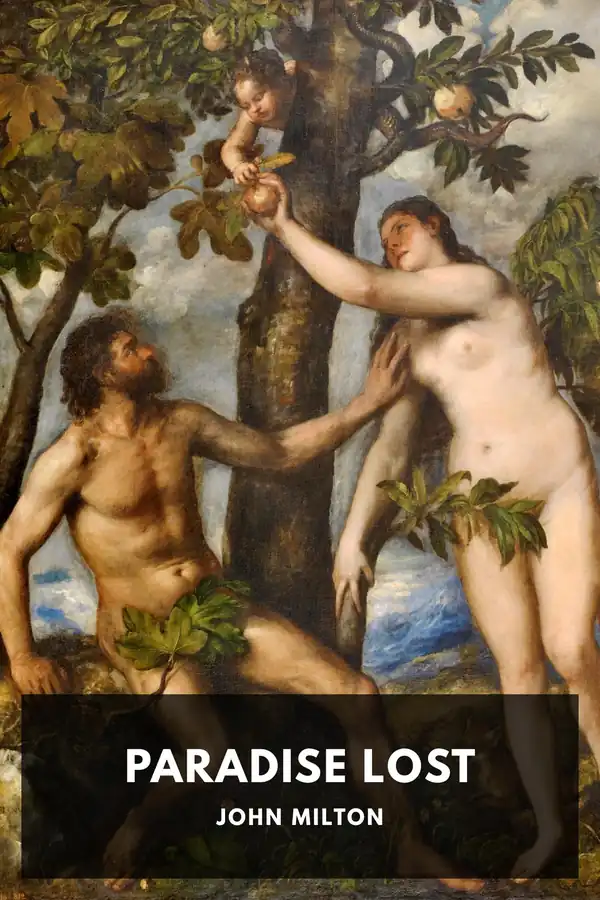
Paradise Lost is John Milton’s epic of the fall of man, published in 1667 in ten books and reissued in 1674 in twelve. It opens with the rebel angels stretched on a lake of fire, their leader counting his ruined legions and calling a council in a palace built out of the dark. From that council comes the offer to cross Chaos alone and find the new world God has made. The poem then follows the journey: a disguised Satan in Eden, a warning angel sent from Heaven, a war told at a dinner table, a serpent in the garden, a sentence of exile, and a vision of everything that follows it.
The poem is an argument as much as a story. Milton gives the rebel his eloquence, lets him feel the loss of Heaven as a wound, and then shows what that eloquence costs the two people who have to live in its wake. The blank-verse line is dense, built for debate and for the sight of Eden, and it rewards slow reading far more than a sprint. Satan’s speeches, the council in Pandemonium, Eve’s dream, the war in Heaven and the vision of the future in the last two books belong to one design, and Wikipedia’s article on Paradise Lost sets out the whole of it. The text is available via Project Gutenberg #26 and Standard Ebooks.
Paradise Lost by John Milton: Summary, Characters & Themes
This is a summary and analysis of John Milton’s Paradise Lost, the epic of the fall of man that he published in 1667 in ten books and reissued in 1674 in twelve. The poem begins after the war is lost. Satan and his angels lie on a burning lake, stunned and immortal, and their first act is not despair but organisation: a council, a debate about another battle, and a proposal to find the new world that prophecy says God has made. The rest of the epic moves between three places, Hell, Heaven and Eden, and between two questions, whether the first pair could have stood, and why they did not. Adam and Eve are given a single prohibition, a garden full of everything else, and an enemy who arrives by night.
Milton divides the poem with invocations, and each one marks a change of ground. Books 1 and 2 belong to the fallen, ending with Satan’s flight through Chaos; Book 3 moves to Heaven, where the Father sees him coming and the Son offers himself as ransom. Books 4 to 8 place the reader in Eden: Satan’s first sight of the garden and of Adam and Eve, Eve’s dream, the arrival of Raphael, and the archangel’s long account of the war in Heaven and the six days of creation. Book 9 is the fall itself. Book 10 gives the judgement and the quarrel. Books 11 and 12 show Adam the future, from Cain to the Flood to the coming of Christ, before the two are led out of the garden.
Milton had been writing the poem for years before it appeared. He had served the Commonwealth as Latin secretary, had defended the execution of Charles I in print, and had lost his sight in 1652; by the Restoration he was a known apologist for the defeated cause, briefly arrested, and living quietly in London. The poem was composed by dictation, in fragments, to whoever was available, and then fitted into ten books. John Milton was in his late fifties when the first edition appeared, and blind, and he sold the manuscript to Samuel Simmons for five pounds. The voice of the invocations, which asks for light while insisting that it cannot see, comes out of that situation rather than out of convention.
The theology is not a set of pieties. Milton’s God argues his own case in Book 3, and the case is about freedom: creatures who could not fall would not be obedient but mechanical, and so the first pair are made able to stand and left free to fail. That argument is what the poem means by justifying the ways of God to men, and it is pressed hardest in the last books, where the fall is folded into a long history that ends with a redemption. The epic also knows its predecessors. The Divine Comedy gave it a map of the afterlife and a guide, and The Iliad gave it a war in which the gods take sides; Milton sets his argument above both, and asks for a heroism of patience rather than of arms.
The text here follows the twelve-book edition of 1674, which is the version almost everyone reads and the one Standard Ebooks prints, prepared from digital scans from the HathiTrust Digital Library. Spelling and punctuation are lightly modernised, as in that edition; the verse paragraphs, the arguments that summarise each book, and the blank-verse line are kept as they stand. Project Gutenberg #26 has the same text for anyone who wants to check a passage against a second transcription. Read beside Beowulf, the poem shows what a Christian epic looks like when it inherits a pagan past, and how much of that past it keeps.
Historical Context
The poem arrived in 1667, seven years after the monarchy came back. Milton had spent the 1650s as a servant of the Commonwealth, writing in defence of regicide and of a free press, and the Restoration made that record dangerous. He was arrested in 1660, briefly, and the intervention of friends and a general amnesty kept him alive; some of his books were burned, and he was never again safe in print. Paradise Lost is therefore a poem written by a defeated man in a city that had changed sides. Its politics are not allegory, but the language of lost war, of counsel and of tyranny runs through it, and the fallen angels organise themselves like a parliament.
Milton had been blind since 1652, and the poem was dictated. The usual account, that he composed in the night and gave the lines to an amanuensis in the morning, comes from his nephew Edward Phillips, and the verse is consistent with it: long-breathed, easy to hold in the ear, and built for a voice. The blind poet is present in the poem itself. The invocation to Book 3 asks for light and admits that the eyes it once had find no dawn, and the invocation to Book 7 describes a fall on evil days, in darkness, with dangers round and solitude. Those passages are not decoration. They set the price of the song.
The first edition of 1667 was a modest quarto in ten books, priced four shillings, and it sold slowly. The second edition of 1674 divided the poem into twelve books, added a note on the verse, and made the smaller divisions that readers still use; the twelve-book shape follows Virgil and turns the fall into six books of loss and six of consequence. Milton’s theology was his own. He argued for free will against strict predestination, doubted the Trinity in the treatise found after his death, and refused to make Satan a simple villain. That independence is why the poem has been read as orthodox, as heretical, and as a dramatic argument in which no single voice is quite the author’s.
Key Characters & Literary Archetypes
- Satan: He is the poem’s first voice and its most dangerous pleasure: a leader who can turn defeat into a programme, and whose rhetoric of courage, merit and free refusal is thrilling for two books. Milton then lets the same rhetoric curdle. In Eden he is a spy and a peeping creature, in Book 10 a hissing serpent among his own applauding peers, and his monologue admits that he brings Hell with him wherever he goes. He is not a hero and not a simple villain, but a will that cannot stop asserting itself.
- Beelzebub: Satan’s second in command, fallen beside him and named in the first book with the note that he was long after known in Palestine. He is the practical mind of the council: when the debate between open war and patient waiting has run out, it is Beelzebub who puts Satan’s own proposal back on the table and makes the search for the new world sound like strategy rather than desperation. His speeches carry the assembly. He is the poem’s model of a deputy who knows what his leader wants to hear.
- The Son: He appears in Book 3, seated at the Father’s right hand, and he does the one thing nobody else in Heaven does: he offers to pay. The offer is voluntary, and it turns the argument about justice into a story about mercy. In Book 6 he drives the rebel angels out of Heaven, and in Book 10 he comes down to judge Adam and Eve, gives the sentence, and clothes them before he ascends. He is the poem’s answer to Satan’s claim that service is servility, and he speaks least of anyone.
- Abdiel: A seraph of the rebel host who argues with Satan to his face in Book 5 and then walks out of the assembly, alone, through a Heaven that has just been divided. He is the only one who answers the rhetoric of freedom with the plain claim that God made him and that service is not slavery. The angels who stay call him a slave; the poem calls him faithful, and in Book 6 he fights the rebels he once stood beside. His single dissenting stand is the poem’s counter-image to the council in Pandemonium.
- Adam: The first man, made for contemplation and for work, who names the animals, asks for company, and receives Eve as a gift he did not think to ask for twice. He is generous, curious and a little too fond of his own reasoning; the long conversation with Raphael in Books 7 and 8 shows a mind that wants to know everything, including things not meant for it. His fall is not seduction but choice: he eats because he will not be parted from Eve, and then spends Book 10 learning what that decision cost.
- Eve: She is made from Adam’s side, wakes in a garden she does not know, and is given the poem’s loveliest account of first self-recognition at the water’s edge. She is also the poem’s most argued-about figure: Milton gives her the wish to work apart, the dream that foreshadows the temptation, and the argument with the serpent that actually persuades, so that her fall is a matter of reason rather than weakness. She repents first, and her last speeches are quiet, obedient and dignified.
Core Literary Themes
- Free will and the justification of God: The poem sets itself a problem most epics avoid: it has to show a catastrophe that is nobody’s fault but the fault of the people who cause it. Milton’s solution is freedom. The Father’s speech in Book 3 insists that the first pair were made sufficient to stand and free to fall, that foreknowledge does not compel, and that obedience which could not be refused would be worth nothing. Everything else in the poem is arranged to test that claim. Satan’s revolt, Abdiel’s stand, Eve’s argument with the serpent and Adam’s choice are all versions of the same question.
- Satan’s eloquence and the cost of grandeur: Milton gives the devil the best speeches, and the poem has been argued over for three centuries because of it. The grandeur is real, and it is also the disease: Satan talks himself into courage, calls his envy a love of liberty, and organises a kingdom whose first act is to build a palace and a debating chamber. The reader who admires him is being shown how seduction works, from the inside. The cure is structural rather than rhetorical. By Book 10 the same voice is hissing in the dust, and the epic has shown that the style of heroism it borrowed from older poems cannot survive its own consequences.
- Eden, marriage and the difference of the sexes: Eden is not a paradise of idleness. Adam and Eve work, talk, eat, pray and go to their rest, and the poem gives their marriage more attention than any epic gives a marriage. Milton is explicit about hierarchy and equally explicit about companionship: Eve is made for society, Adam is told he needs her, and the dialogue in Book 9 shows two people reasoning with each other, badly, in a way that recognisably belongs to married life. The fall enters through a domestic argument about garden work. That is the poem’s most radical move, and it is why the last books feel like a household breaking up as much as a world ending.
- Light, blindness and the poet’s calling: Three invocations divide the poem, and each one is a struggle for authority. The first asks the Heavenly Muse to justify God’s ways; the second asks for light while confessing that the poet’s eyes find no dawn; the third asks Urania to govern a song sung in darkness, on evil days, with dangers round. Milton turns his blindness into an argument about inward light, and the result is a poem that keeps asking who is entitled to speak. The epic voice is not a neutral narrator. It is a man, half-hidden in his own poem, asking to be trusted and giving reasons why he might not be.
- Providence, history and the shape of the future: The last two books abandon narrative for vision, and the change is deliberate. Adam is shown the whole of human history, from Cain’s murder to the Flood, from Babel to Israel, from the law to the incarnation, and the sequence is not cheerful: it is a long record of violence that the fall has let in. The comfort offered is not that history is pleasant but that it is governed, and that the promise made in Book 10 will be kept. The poem ends with the two exiles walking down into a world of work and death, and the ending is quiet because the argument has been made.
Why Download Our Custom E-Reader Edition of Paradise Lost?
Because the poem is built to be heard as much as read. The verse paragraphs are long, but they are paragraphs, each with an argument and a turn, and the twelve books can be taken one at a time without losing the whole. This edition keeps the arguments that Milton printed before each book, so a reader can see the shape of an episode before entering the verse, and the line is set without numbering in the middle of the page.
The files are made for reading rather than for archiving. Each book starts on a new page, the table of contents lists all twelve, and the type is set for a phone or an e-ink screen rather than a photographed page. There are no illustrations standing in for the text, no footnotes interrupting the verse and no modernised paraphrase. If you want to compare a passage with another transcription, Project Gutenberg #26 is the obvious place to look, and the two texts agree book for book.
Read it as a poem rather than a monument. Begin at the invocation, take Books 1 and 2 together as a single debate, then let Book 3 change the light, and treat Book 9 as the hinge it is. The summaries above are meant to be useful before and after the poem, not instead of it, and they stop short of the last speeches, which are better met in the verse. Three formats are offered, one download each, and all three carry the same complete text.
- Based on the Standard Ebooks Edition, via Standard Ebooks, whose editors prepared this text from digital scans from the HathiTrust Digital Library and checked it against the early editions; the twelve-book division, the arguments before each book and the spelling used on this page follow their edition, so what you read here matches what you download.
- Complete twelve-book text All twelve books, from the invocation of Book 1 to the hand-in-hand departure at the end of Book 12, with the arguments, the invocations and the verse paragraphs kept in order and nothing cut for length or for the classroom.
- EPUB, AZW3 and KEPUB One download per format, so the poem opens on Kindle, Kobo, Apple Books and other readers without conversion, with a table of contents that works and chapter breaks that survive a change of font size or an old device.
- Free and DRM-free Public domain in the United States, with no account, no sample book and no lock on the file; download it once and it stays on your device, ready to be read one book at a time and to be returned to for the speeches you skipped.
- The Divine Comedy — free EPUB, AZW3 & KEPUB
- The Iliad — free EPUB, AZW3 & KEPUB
- Beowulf — free EPUB, AZW3 & KEPUB
Chapter summaries
Twelve books, one summary each, following the poem from the burning lake to the gate of Eden.
- Book 1 — The fallen angels in Hell; the council: The poem opens in the middle of the action, with the rebel angels lying on a lake of fire and Satan recovering first. He wakes Beelzebub, and the two of them take stock: Heaven is lost, the battle is over, and the punishment is a place with no light in it. Satan refuses despair on principle, and the book ends with him calling his legions up out of the burning marl, numbering them, naming their leaders, and promising another attempt. Pandemonium rises out of the ground, and the council is summoned.
- Book 2 — The council of Hell; Satan crosses Chaos: The debate in Pandemonium is the poem’s first great set piece. Moloch wants another war, Belial counsels patience, Mammon prefers to make Hell comfortable, and Beelzebub returns to Satan’s own proposal, which is to look for the new world and its new creature. The question of who will go is settled when Satan volunteers, and the assembly applauds. He travels to the gates, where Sin and Death keep watch, and then crosses the gulf of Chaos with the help of its ruler, until the new world hangs in view.
- Book 3 — God sees Satan come; the Son offers himself: The scene changes completely. In Heaven, the Father watches Satan flying towards the world he has just made, tells the Son what will happen, and answers the objection before it is raised: the first pair were made free, and free creatures can fall. The Son offers himself as ransom, and Heaven sings. Satan, meanwhile, lands on the outside of the world, passes the gate of Heaven, and takes the shape of a lesser angel to question Uriel, the regent of the sun, about where the new creature lives.
- Book 4 — Satan enters Eden; the first sight of Adam and Eve: Satan reaches Eden and the poem gives the garden in full: the flowers, the rivers, the birds, and then the two figures at its centre. He watches Adam and Eve with something close to envy, overhears them talk about the forbidden tree, and settles on the plan that will use them rather than force them. Uriel, suspicious, warns Gabriel, and the night watch comes looking. They find Satan at Eve’s ear, whispering a dream, and bring him to Gabriel; he answers with scorn, is about to fight, and then vanishes at a sign from Heaven.
- Book 5 — Eve’s dream; Raphael sent; Abdiel’s warning: Eve tells Adam her dream: a voice, a walk in the night, and a figure at the tree who tasted the fruit and promised she would be like a god. Adam is troubled and comforts her. God sends Raphael to warn them, and the angel arrives to a meal of fruit and a long conversation. Most of the book is Raphael’s account of the rebellion, and of Abdiel, the one seraph who stood up in Satan’s assembly, argued with him, and left.
- Book 6 — The war in Heaven; the Son’s victory: Raphael continues with the war. Michael and Gabriel lead the loyal angels out, and the first day is a draw; Satan’s side retires, invents cannon, and disorders Heaven’s army on the second day, until the loyalists pull up mountains and bury the machines. On the third day the Son comes out in his chariot, and the rebels are driven to the wall of Heaven and over it into the gulf, falling for nine days. The war is told at a table in Eden, which is what makes it strange.
- Book 7 — The creation of the world, told by Raphael: Adam asks how the world was made, and Raphael takes him through the six days: light, the firmament, the dry land, the plants, the sun and moon, the fish and birds, the animals, and finally man. The book opens with the invocation to Urania in which Milton speaks of his blindness and his dangerous times. The sequence is careful and orderly, and its point is not cosmology but dependence: everything is made, nothing is self-made, and the creature who forgets that is the one who falls.
- Book 8 — Adam’s creation and Eve’s, told by Adam: Adam asks about the stars, and Raphael answers with a warning about curiosity: the question is not forbidden, but it is not the most useful thing to know, and the angel tells him to think about what concerns him. Adam then describes his own creation, his first waking, his conversation with God about solitude, and the making of Eve, including the dreamlike scene in which he first sees her. Raphael warns him once more about passion, and leaves.
- Book 9 — The serpent, the temptation and the Fall: The fall begins with a domestic argument. Eve proposes that they divide the garden work; Adam objects that the enemy is near, and she hears the objection as a doubt about her strength. She works alone, and the serpent finds her. His flattery, his account of how the fruit gave him speech, and his argument that knowledge cannot be forbidden to the creature made to seek it, do the work. She eats, then brings the fruit to Adam, and he eats because he will not be separated from her. The book ends with shame, fig leaves and accusation.
- Book 10 — The judgement; Sin and Death; quarrel and repentance: The Son comes down to judge them, gives each a sentence, and clothes them before he leaves. Sin and Death, waiting at the gates of Hell, feel the change and build a bridge from Hell to the new world. Satan returns to Pandemonium expecting applause and gets a hiss: he and his audience turn into serpents, and the fruit they reach for turns to ash. Adam and Eve quarrel bitterly, each blaming the other, and then, in the last movement of the book, begin to repent.
- Book 11 — Michael shows the future, from Cain to the Flood: The Son presents their prayers, and the Father accepts them, but the garden is no longer theirs. Michael comes down with a band of angels to lead them out, and first shows Adam a vision of what is to come: a field of labour, Cain striking Abel, disease and violence, the wickedness that fills the earth, and the Flood covering it. Adam is left grieving over what his choice has opened, and Michael tells him that the vision has a second half.
- Book 12 — Israel and the coming of Christ; the expulsion: Michael continues the history: Babel and the scattering of the languages, Israel in Egypt, the law, the kings, the captivity, and then the one figure the whole poem has been waiting for, the seed of the woman, announced in Book 10 and now shown in his birth, death, resurrection and reign. Adam is comforted and says that he has learned to submit. Eve, asleep through the vision, wakes with a gentler dream, and the two are led out of Eden hand in hand, the gate closing behind them.
Paradise Lost: Frequently Asked Questions
What is Paradise Lost about?
Why does Milton want to justify the ways of God to men?
Why is Satan so compelling, and is he the hero?
Is the poem hard to read, and is it really blank verse?
Is this the ten-book edition of 1667 or the twelve-book edition of 1674?
Who are Adam and Eve in the poem?
Is it a religious poem or a political one?
Where can I download the free EPUB, AZW3 and KEPUB?
Part of: Poetry & epics · Classic fiction