Oedipus Rex by Sophocles: Free EPUB, AZW3 & KEPUB Download
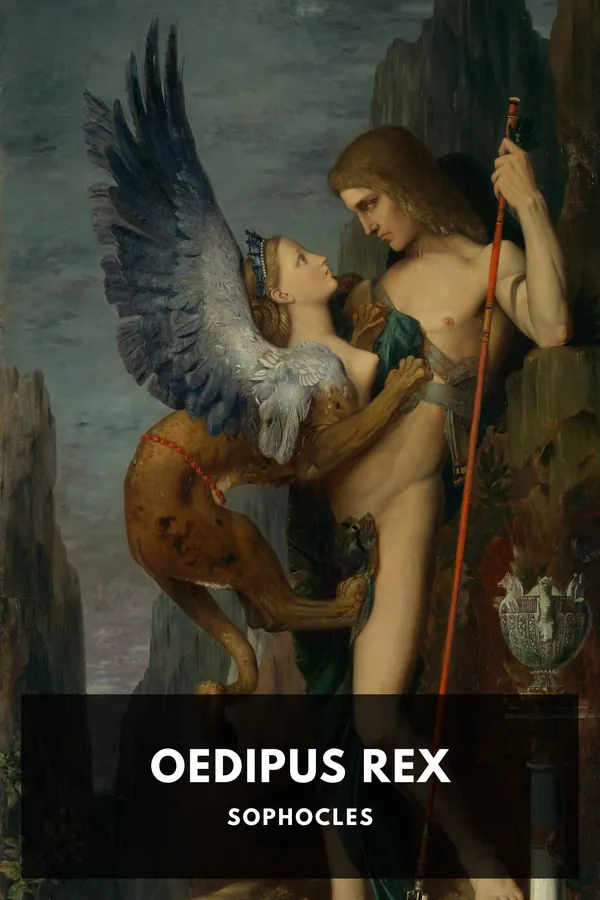
Oedipus Rex
📖 Click to Read the Opening Pages Online Preview
The opening of the Prologue — suppliants at the altar of Thebes
Suppliants of all ages are seated round the altar at the palace doors, at their head a Priest of Zeus. To them enter Oedipus.
My children, latest born to Cadmus old, Why sit ye here as suppliants, in your hands Branches of olive filleted with wool? What means this reek of incense everywhere, And everywhere laments and litanies? Children, it were not meet that I should learn From others, and am hither come, myself, I Oedipus, your world-renownèd king. Ho! aged sire, whose venerable locks Proclaim thee spokesman of this company, Explain your mood and purport. Is it dread Of ill that moves you or a boon ye crave? My zeal in your behalf ye cannot doubt; Ruthless indeed were I and obdurate If such petitioners as you I spurned.
Yea, Oedipus, my sovereign lord and king, Thou seest how both extremes of age besiege Thy palace altars—fledglings hardly winged, And greybeards bowed with years; priests, as am I Of Zeus, and these the flower of our youth. Meanwhile, the common folk, with wreathèd boughs Crowd our two market-places, or before Both shrines of Pallas congregate, or where Ismenus gives his oracles by fire. For, as thou seest thyself, our ship of State, Sore buffeted, can no more lift her head, Foundered beneath a weltering surge of blood. A blight is on our harvest in the ear, A blight upon the grazing flocks and herds, A blight on wives in travail; and withal Armed with his blazing torch the God of Plague Hath swooped upon our city emptying The house of Cadmus, and the murky realm Of Pluto is full fed with groans and tears.
The preview stops after the third speech, at the end of the Priest’s account of the plague. The complete play is in the free download below.
Download Full EPUBc. 429 BC
~12,000 words (estimated)
Approx. 40 minutes
Standalone
Thebes, before the royal palace, in the age of Greek myth
11 sections in one continuous text
EPUB · AZW3 · KEPUB
0.44 MB (EPUB) · 0.43 MB (AZW3) · 0.46 MB (KEPUB)
Public domain in the United States
Project Gutenberg #27673 · Standard Ebooks
Oedipus Rex is Sophocles’ tragedy of a king who sets out to save his city and finds himself. Thebes is dying of plague; Creon comes back from Delphi with the god’s answer, that the killer of the old king Laius is still in the land and must be driven out. Oedipus takes up the search with the energy he once turned on the Sphinx, and every witness he questions brings the crime closer to his own hearth. A seer who will not speak, a queen who remembers a prophecy, a messenger with good news from Corinth and a shepherd who wants to be left alone: the play is one long day of discovery, and it ends in the palace.
Sophocles wrote the play for the Athenian festival of Dionysus, probably around 429 BC, and Aristotle used it in the Poetics as the model of a plot built on recognition and reversal. Nothing in it is decoration: the plague, the oracle, the quarrel with Teiresias, the report from Corinth and the arrival of the Theban shepherd are one chain of questions, and the answer is the man asking them. Oedipus Rex is among the oldest surviving tragedies and still the cleanest example of dramatic irony. The text is available via Project Gutenberg #27673 and Standard Ebooks.

Oedipus Rex by Sophocles: Summary, Characters & Themes
This page is a summary and analysis of Sophocles’ Oedipus Rex, the tragedy first performed at Athens around 429 BC and known in English as Oedipus the King or Oedipus Tyrannus. The translation is Francis Storr’s, published in 1912. Thebes is dying of plague, and Creon returns from Delphi with an oracle: the murderer of Laius is in the city, and the pollution will not lift until he is found. Oedipus, who came to Thebes as a stranger, solved the Sphinx’s riddle and married the widowed queen, takes the case as his own; he follows it from the first proclamation to the last broken sentence, in one place and in one day. There is no subplot and no change of scene. The altar, the palace doors and the citizens who come to them are the whole set, and the action is a sequence of interviews with a priest, a brother-in-law, a seer, a queen, a messenger and a shepherd.
Sophocles was in his late sixties when the play was performed, a wealthy Athenian, a general at least once, and the most successful tragedian of his generation; he wrote more than a hundred plays and seven survive. He had already written Antigone, and Oedipus at Colonus was still to come, so the Theban family occupied him at both ends of a long career. The play is usually dated to the early years of the Peloponnesian War, when Athens was crowded with refugees and had recently suffered a plague of its own. That timing is not an explanation, but it makes the opening scene less like a convention and more like a memory.
Aristotle treated the play as the finest example of tragic construction, and the terms he used for it — recognition, reversal, the change from ignorance to knowledge — have shaped criticism ever since. The plot has been read as a study of fate, of character, of the limits of reason, and of the family as a place where violence repeats itself; the twentieth century added psychoanalysis, which took the story as a pattern and renamed it. Its descendants are everywhere in the library: the revenge tragedy of Hamlet, the epic of a city under siege in The Iliad, the guided tour of the afterlife in The Divine Comedy. Each of them borrows something the Theban play had already done.
This edition follows the Project Gutenberg #27673 transcription of Storr’s translation and the Standard Ebooks text prepared from it. Storr keeps the choral odes in verse and the dialogue in a plain, sturdy English that has aged well; the speakers’ names and the Greek place names are left as the 1912 printing gives them. Nothing is cut and nothing is modernised. The play is a single continuous text, so the summaries below follow its eleven structural sections — Prologue, Parodos, four episodes with their stasima, and Exodos — rather than inventing chapter divisions the theatre does not have. Word count, reading time and file sizes are measured from the files on this page.
One warning is fair to give. The play is a detective story in which the detective is the criminal, and it works only once as a surprise; if you have never read it, read it before the plot summaries below, or at least before the last two of them. The text itself is short enough for a single evening, and the sections are marked so that you can stop at the end of a stasimon and pick the thread up again. Everything is here: the proclamation, the quarrel, the three roads, the messenger, the shepherd, the brooches, and the last chorus on the day that ends all days.
Historical Context
Athenian tragedy was performed at the City Dionysia, a spring festival in honour of Dionysus that combined procession, sacrifice, choral competition and three days of plays. A tragedian entered three tragedies and a satyr play, paid for by a wealthy citizen as a public service, and competed for a prize decided by the audience. The theatre of Dionysus held perhaps fifteen thousand people and was open to the sky. Oedipus Rex is usually dated to the early years of the war, around 429 BC, though the evidence is a note in an ancient commentary rather than a production record. What the audience brought to it was not suspense — they knew the story — but the pleasure of watching a familiar disaster arrive exactly on time.
The material is older than tragedy. Oedipus belongs to the Theban cycle, the sagas of Cadmus, Laius, Oedipus and his children, which Greek audiences knew from epic, from local cult and from the visual arts; Homer’s Odyssey already mentions Oedipus ruling at Thebes and his mother’s terrible marriage, without the details Sophocles supplies. The play is therefore an interpretation rather than an invention. Sophocles selects, sharpens and adds: the plague, the detail of the three roads, the shepherd, the brooches. He also leaves out what later writers dwell on — the Sphinx is a memory here, not a scene. The result is a version of the myth that has largely replaced the others.
Aristotle’s Poetics, written a century later, treats Oedipus Rex as the model tragedy. He praises its plot as a single action with a beginning, middle and end, its recognition as the finest kind, and its reversal as the moment when the messenger’s good news becomes the worst. The terms are descriptive rather than prescriptive, but they fixed the play’s reputation in Europe: Renaissance critics read it through Aristotle, French classicists turned its unities into rules, and nineteenth-century readers made it a study of fate. Modern productions have thrown out the rules and kept the play, which suggests that Aristotle identified something durable — the pleasure of a story in which every answer is a step toward the trap.
Key Characters & Literary Archetypes
- Oedipus: A king who is also a detective: quick, generous, impatient and used to solving things. He came to Thebes as an unknown traveller, answered the Sphinx, married the queen and has ruled well enough to be loved. His temper is the engine of the plot — he bullies Teiresias, suspects Creon, threatens the shepherd — and his courage is real: he will not stop asking even when the answers begin to point at him. When the truth arrives he punishes himself with the same thoroughness he brought to the search.
- Jocasta: Laius’ widow and Oedipus’ wife, a woman who has already survived one prophecy and thinks she has disproved another. She remembers the oracle that her first husband would die by his son’s hand, remembers exposing the child, and remembers that Laius was killed by robbers where three roads meet — and she draws the wrong conclusion from all three. She calms Oedipus when he suspects Creon, then realises what the Corinthian news means before he does. Her exit is abrupt and silent, and the second messenger’s account of her death is the cruellest speech in the play.
- Creon: Jocasta’s brother, sent to Delphi before the play begins and accused of treason within an hour of returning. He is patient, rational and a little cold: his defence is an argument about power, that a man who shares the throne without its anxieties has no reason to plot, and it is convincing enough for Jocasta to intervene. The chorus trusts him. At the end he is the one who takes charge, refuses to exile Oedipus without the god’s word, and gives him his daughters to hold. He is not a villain, which is what makes the family’s politics feel real.
- Teiresias: The blind seer who knows the answer before the question is finished. He comes when summoned, refuses to speak, and is goaded into naming Oedipus as the murderer and the man living in shame with his nearest kin. His blindness is the play’s central image, and Sophocles gives him the plainest, most terrible lines: the man who sees is the man who does not see. He leaves before the end and is not reconciled; his function is not to explain but to make the first crack in Oedipus’ confidence.
- The Messenger from Corinth: A polite old man with the worst possible good news. He comes to tell Oedipus that Polybus is dead and that Corinth wants him as king, and instead of ending the investigation he reopens it: he mentions that Oedipus was adopted, that he was given to Polybus by a shepherd, and that the shepherd can still be found. He means only to reassure. His cheerful certainty that the oracles have failed is the moment the play turns, and he spends the rest of the scene being questioned by a king who no longer wants the answer.
- The Shepherd of Laius: The one witness who could have stayed silent for ever. He was the slave who took the infant with pinned ankles up the mountain, gave him to the Corinthian, and later came home to find Oedipus on the throne; he asked to be sent to the far pastures and has been there ever since. Brought back, he lies, then bargains, then tells the truth in fragments: the child was Jocasta’s, the order came from Laius, and he disobeyed it out of pity. He is the play’s most unwilling witness and its most human.
Core Literary Themes
- Fate and the limits of foresight: The play is not a story about a man who cannot escape a prophecy; it is a story about what happens when everyone tries. Laius and Jocasta expose the child to defeat the oracle, Oedipus leaves Corinth to defeat it, and each attempt supplies the next link in the chain. Sophocles keeps the gods offstage and the oracles accurate, so the characters are free and the outcome is fixed at the same time. The effect is not fatalism but irony: the audience watches reasonable people make reasonable choices that happen to complete the pattern. The question the play leaves open is whether knowledge would have helped.
- Sight, blindness and the cost of knowing: Teiresias is blind and sees; Oedipus has eyes and cannot. The image runs through the language of the play — the seer is mocked for his blindness, the king is told he is blind to his own house, and the messenger who brings light brings the darkness with it. When Oedipus blinds himself with Jocasta’s brooches he is not simply punishing a body that saw too much; he is taking up the condition the seer described, and refusing to look at the people he has wronged. The final scenes are acted in darkness, and the audience is left to do the seeing.
- Plague, pollution and the body of the king: The play opens with a city that is sick and a king who promises to cure it, and the cure turns out to be the king himself. Sophocles uses the language of medicine and of ritual purity: the murderer is a stain, a sickness, a thing that must be expelled. In a Greek city the health of the community and the conduct of its ruler were not separate questions, and the play makes the connection literal. The plague is not simply a metaphor for Oedipus’ guilt, but the two are diagnosed by the same investigation, and the remedy — exile or blood — falls on the same man.
- The drive to know and the refusal to stop: Oedipus is offered exit after exit. Teiresias tells him to let the matter go; Jocasta begs him to drop the question; the shepherd tries to send him away; the chorus adds its voice. He refuses every time, and not because he is brave in the ordinary sense. He is a man whose competence depends on knowing, and he cannot leave a riddle unsolved; the same temperament that saved Thebes now destroys him. Sophocles makes this admirable before he makes it fatal. The play’s most disturbing suggestion is that the truth was worth having only to the god, and that the human cost of it is borne by people who did nothing.
- Riddle, language and the double answer: The play is built out of riddles. The Sphinx’s question is answered by a man who does not know his own name; Teiresias speaks in riddles that are plain statements; the oracle is a sentence that means one thing to the city and another to the king. Sophocles uses the gap between what a line says and what it means as a structural device, so the audience hears the doom in compliments and congratulations. Even the messenger’s good news is a riddle with an answer he does not intend. When the answer finally comes it is not a revelation but a recollection, and the play has been quoting it all along.
Why Download Our Custom E-Reader Edition of Oedipus Rex?
Because this is a play meant to be heard in one sitting, and the text here is arranged for that. One continuous text, eleven sections marked at the points where the chorus changes the subject, and no invented chapter titles. Storr’s verse keeps the odes singable and the stichomythia quick. You can read the whole thing in an evening and then go back to the scene you suspected, which is the way this play has always been read: once for the shock, once for the machinery.
The text is not an abridgement. It follows the Standard Ebooks edition of Francis Storr’s 1912 translation, prepared from the Project Gutenberg #27673 transcription, with the speakers’ names, the choral stanzas and the stage directions kept where the printing puts them. Greek names are transliterated as Storr transliterated them — Teiresias, Cithaeron, Jocasta — and the line arrangement is his. If you want to check a passage against the source, the Gutenberg file is the obvious place to start.
The files are made for readers rather than for archiving. EPUB, AZW3 and KEPUB, one download each, with a working table of contents, no page images and no scan errors, so the play opens on a phone, a Kindle, a Kobo or an old e-ink device. There is no account, no sample chapter and no lock on the file. Read it beside this page if you want the scene-by-scene summary, or read it cold if you would rather meet the messenger without warning.
- Based on the Standard Ebooks Edition, via Standard Ebooks, whose edition of Francis Storr’s 1912 translation was prepared from the Project Gutenberg transcription and checked against scans of the printed text; their section divisions, spelling and punctuation are the ones used here, and the play is complete rather than abridged.
- Complete text in Storr’s 1912 verse No cuts, no modernised spelling and no prose paraphrase: the Prologue, the choral odes and the Exodos as Storr set them, with the speakers’ names and the stage directions left in place, and nothing added to explain the plot to a first-time reader.
- EPUB, AZW3 and KEPUB One file per format, so the play opens on Kindle, Kobo, Apple Books and most other readers without conversion, with a table of contents that works on old devices and section breaks placed where the drama changes gear.
- Free and DRM-free Public domain in the United States, with no account, no subscription and no lock on the file; download it once and it is yours to keep, to move between devices and to reread, with nothing to renew and nothing that expires.
- Hamlet — free EPUB, AZW3 & KEPUB
- The Iliad — free EPUB, AZW3 & KEPUB
- The Divine Comedy — free EPUB, AZW3 & KEPUB
Chapter summaries
The play runs without a break, so these eleven summaries follow its structural sections — Prologue, Parodos, four episodes and their stasima, Exodos — from the suppliants at the altar to the blind king in Creon’s charge.
- Prologue — Thebes asks for help: The play opens before the palace, where children, priests and old men sit as suppliants with olive branches. Oedipus comes out and asks what they want; the Priest of Zeus tells him the city is dying — crops, herds and births blighted, the god of plague walking the streets. Oedipus says he has already sent Creon to Delphi. Creon arrives with the answer: the murderer of Laius must be found and driven out. Oedipus promises to hunt him down, and the scene ends with the suppliants dismissed and the investigation begun.
- Parodos — the chorus prays for the city: The elders of Thebes enter and sing the parodos, a prayer in strophic pairs. They call on Athena, Artemis and Apollo to drive the plague out as they drove it out before, and they describe what they see: empty streets, corpses everywhere, women dying in childbirth, no one to bury the dead. The music is urgent and the theology is simple — the city is suffering and the gods can stop it. What the chorus does not know is that the illness and the murderer are the same problem.
- First Episode — Teiresias names the king: Oedipus addresses the city, offering immunity to any informer and a curse on the killer, himself included if the man is in his house. The chorus suggests Teiresias. The seer comes, refuses to speak, and is provoked into saying that Oedipus is the murderer and lives in shame with his nearest kin. Oedipus accuses him of plotting with Creon, mocks his blindness, and boasts that he solved the Sphinx without augury. Teiresias answers with a prophecy of blindness, exile and a cry on Cithaeron, and leaves.
- First Stasimon — the gods and the riddle: The chorus is shaken. It cannot accept the seer’s charge against a king who has been good to the city, and it cannot dismiss the seer either, so it does what a chorus does in a deadlock: it waits for proof and sings about the gods. The ode insists that Zeus and Apollo see everything, that no mortal escapes them, and that the old oracles cannot simply be wrong. The last strophe is the first hint that the play is less about a criminal than about a limit on human knowledge.
- Second Episode — Creon’s oath and Jocasta’s story: Creon comes in furious and defends himself: he has no reason to want the throne, he shares its power without its fears, and the city’s goodwill is worth more to him than a crown. Jocasta separates them, and then, to calm Oedipus, tells him not to trust prophets: an oracle once said Laius would die by his son’s hand, and Laius was killed by robbers where three roads meet, while the child had been exposed three days after birth. The detail about the three roads stops Oedipus cold.
- Second Stasimon — the tyrant and the law: The chorus sings about insolence and law. It has watched the quarrel and does not like what it implies: a king who trusts his own wit more than the gods, a household with something hidden in it, a city that cannot tell whether its ruler is its saviour or its sickness. The ode ends with a famous difficulty — if oracles can be wrong, why sing and dance at all? It is not a statement of doubt but a warning, and the play is about to answer it.
- Third Episode — the news from Corinth: Jocasta prays at the altar of Apollo for a clean end to the quarrel, and a messenger arrives from Corinth with news: Polybus is dead and the Corinthians want Oedipus for their king. Jocasta is triumphant, because the prophecy said Oedipus would kill his father, and Polybus died of old age. Oedipus is relieved and then uneasy, because the other half of the prophecy — marriage to his mother — is still open. The messenger, meaning to reassure him, explains that Polybus was not his father.
- Third Stasimon — the mountain and the birth: The chorus turns to the mystery of Oedipus’ birth. It imagines the mountain where he was found, Cithaeron, as his nurse and his true country, and sings of a birth that might belong to a god or a nymph. The tone is strange — a lament that is also a myth-making — and the elders end by saying they will not believe the seer’s charge until they see it proved. The ode is the last moment before the evidence arrives, and it is full of unintended irony.
- Fourth Episode — the shepherd tells the truth: The messenger identifies the old servant who was with Laius as the same shepherd who gave him the infant, and the Theban is sent for. Jocasta understands and begs Oedipus to stop; he refuses, and she goes inside. The shepherd arrives, resists, and is frightened into answering: the child was Jocasta’s, given to him with its ankles pinned, and he took pity and passed it to the Corinthian. Oedipus now knows the whole of it, and the chorus sings the short, appalled ode that ends the scene.
- Fourth Stasimon — the chorus laments: The last stasimon is brief and bleak: generations of men are nothing, the law that stands highest is unwritten, and the one man who guessed the riddle has been undone by the answer. The chorus calls Oedipus by the name of his own victory and then names the marriage. There is no argument left to make. The ode clears the stage for the exodos, and it is the only chorus in the play that sounds as if it has stopped hoping.
- Exodos — the brooches and the children: A second messenger reports what happened inside: Jocasta hanged herself, and Oedipus, finding her, tore the gold brooches from her dress and struck his eyes until he was blind. He comes out, bleeding, and speaks to the chorus and to Creon: he asks for death or exile, then for his daughters. Creon sends for Antigone and Ismene, and Oedipus holds them, weeping for the marriages they will never make. Creon takes him inside. The play ends without a verdict, only the warning to call no man happy until his last day.
Oedipus Rex: Frequently Asked Questions
What is Oedipus Rex about?
Who are the main characters?
How long is the play, and how long does it take to read?
When was it first performed?
What is the riddle of the Sphinx?
Is Oedipus Rex a tragedy of fate or of character?
Why does Jocasta kill herself?
Where can I download the free EPUB, AZW3 and KEPUB?
Part of: Drama classics · Classic fiction