Mrs. Dalloway by Virginia Woolf: Free EPUB, AZW3 & KEPUB Download
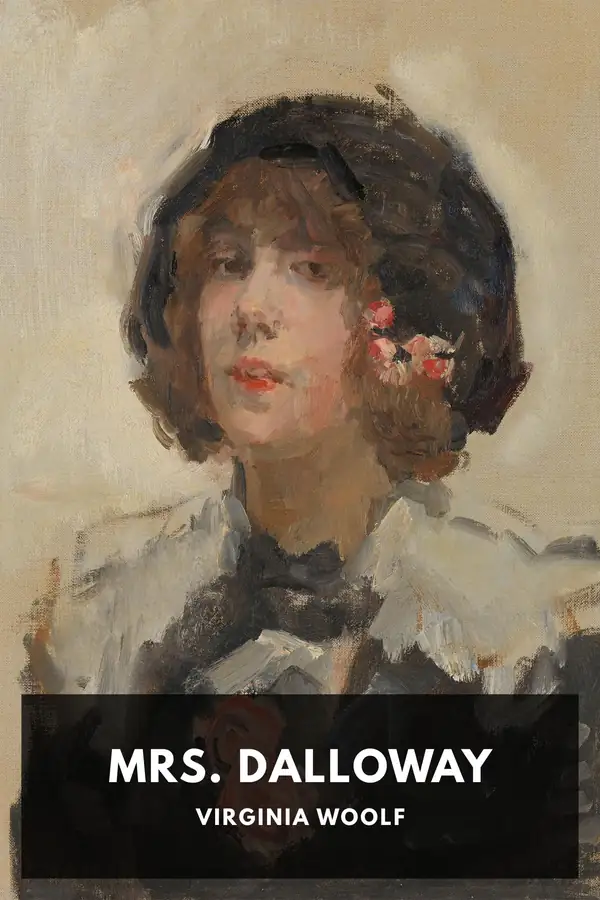
Mrs. Dalloway
📖 Click to Read the Opening Pages Online Preview
The opening of the novel
Mrs. Dalloway said she would buy the flowers herself.
For Lucy had her work cut out for her. The doors would be taken off their hinges; Rumpelmayer’s men were coming. And then, thought Clarissa Dalloway, what a morning—fresh as if issued to children on a beach.
What a lark! What a plunge! For so it had always seemed to her, when, with a little squeak of the hinges, which she could hear now, she had burst open the French windows and plunged at Bourton into the open air. How fresh, how calm, stiller than this of course, the air was in the early morning; like the flap of a wave; the kiss of a wave; chill and sharp and yet (for a girl of eighteen as she then was) solemn, feeling as she did, standing there at the open window, that something awful was about to happen; looking at the flowers, at the trees with the smoke winding off them and the rooks rising, falling; standing and looking until Peter Walsh said, “Musing among the vegetables?”—was that it?—“I prefer men to cauliflowers”—was that it? He must have said it at breakfast one morning when she had gone out on to the terrace—Peter Walsh. He would be back from India one of these days, June or July, she forgot which, for his letters were awfully dull; it was his sayings one remembered; his eyes, his pocketknife, his smile, his grumpiness and, when millions of things had utterly vanished—how strange it was!—a few sayings like this about cabbages.
It begins with the first three paragraphs, as Clarissa Dalloway sets out to buy the flowers herself:
Download Full EPUB1925
~64,000 words (estimated)
Approx. 3.6 hours
Standalone
Westminster and the London streets, one June day in 1923
No chapters, one June day; the guide divides it into ten movements
EPUB · AZW3 · KEPUB
0.72 MB (EPUB) · 0.76 MB (AZW3) · 0.74 MB (KEPUB)
Public domain in the United States
Project Gutenberg #71865 · Standard Ebooks
Mrs Dalloway is Virginia Woolf’s novel of a single June day in London in 1923. Clarissa Dalloway, in her early fifties and married to a Conservative member of Parliament, spends the morning buying flowers and the evening giving a party; in between she is visited by Peter Walsh, the man she refused thirty years earlier, and she remembers Bourton, the house where she was eighteen and in love. In a park, in a Harley Street consulting room and in a lodging house off the Tottenham Court Road, a former soldier named Septimus Warren Smith is being treated for a war he cannot leave behind. Two lives that never meet share one city, one clock and one day, and the novel closes at the party with the news of a death.
It is also a book about time, memory and the effort of holding a self together. Big Ben strikes through the pages, an aeroplane writes letters in the sky above Westminster, and the streets fill with people whose names we never learn. Mrs Dalloway appeared in May 1925 from the Hogarth Press, the press Virginia and Leonard Woolf ran from their own home. This edition follows the Standard Ebooks text, which is based on a transcription from Project Gutenberg Australia and checked against scans from the Internet Archive; the separate United States transcription is Project Gutenberg #71865. The text is available via Project Gutenberg #71865 and Standard Ebooks.
Mrs. Dalloway by Virginia Woolf: Summary, Characters & Themes
This is a summary and analysis of Virginia Woolf’s Mrs Dalloway, the novel she published in 1925 and the book that made the single day a modernist form. Clarissa Dalloway is in her early fifties, the wife of a Conservative member of Parliament, and the novel follows her from a June morning, when she walks to Bond Street to buy flowers for a party, to the small hours of the next day, when the last guests go home. Very little happens and everything does: a visit from an old suitor, a lunch, a hat, a suicide, a party. Around her, in the same city and on the same clock, moves Septimus Warren Smith, a veteran of the Great War whose mind has not come back from France.
The day is built of small errands and long thoughts. Clarissa’s husband Richard is asked to lunch at Lady Bruton’s without her, and comes home with roses but cannot say the words he means; her daughter Elizabeth, seventeen, is in the grip of Doris Kilman, a tutor whose Christianity Clarissa finds intolerable; Peter Walsh, back from India and in love with a married woman, calls in the morning, cries, opens and shuts his knife, and goes to sit in Regent’s Park. He has come to London to see his solicitors about a divorce that is not his own, and the woman he wants is married already. The party that evening gathers the Prime Minister, an aunt of eighty, Sally Seton, whom Clarissa loved at eighteen, and the doctors who are treating Septimus; it is at the party that Clarissa hears he has thrown himself from a window.
Virginia Woolf was born in London in 1882, the daughter of a Victorian man of letters, and educated at home among her father’s books. Her mother died when she was thirteen, and the first of the breakdowns that would return through her life followed; she died in 1941, walking into the River Ouse near her home at Rodmell. Before Mrs Dalloway she had published The Voyage Out (1915), Night and Day (1919) and Jacob’s Room (1922), the last a portrait of a young man killed in the war and the book in which she began to break the novel’s old furniture. In 1917 she and Leonard Woolf bought a hand press and founded the Hogarth Press, which would publish her own work and, in 1923, the first English book edition of The Waste Land.
What separates Mrs Dalloway from the novels around it is its method: the narration moves from head to head without warning, and the world is made of what each person notices. A single word — the party, Evans, Bourton — opens a door into another mind. The result is a book with almost no plot in the ordinary sense and a very strict structure underneath: twelve hours, one city, a clock that keeps striking. Readers who like the method can follow it in Dubliners, where Joyce gives a city’s interior voices in fifteen stories, or in The Awakening, an earlier novel of a woman’s inner life set against a social order. The Great Gatsby, published the same year on the other side of the Atlantic, is the decade’s other short novel of a single season and a single obsession.
The text here is complete and unabridged, with the punctuation of the 1925 printing, the long sentences and the semicolons intact. It follows the Standard Ebooks edition, prepared from a transcription from Project Gutenberg Australia and checked against scans from the Internet Archive. A separate American transcription, numbered 71865, is held at Project Gutenberg. This particular ebook is based on a transcription from Project Gutenberg Australia and on digital scans from the Internet Archive.
Historical Context
London in 1923 was a city counting its dead. The war had ended five years before, the Cenotaph stood in Whitehall, the Unknown Warrior lay in the Abbey, and the streets were full of men who had come back changed. Shell shock was the phrase of the period, coined in 1915 and used loosely afterwards; by the end of the war about eighty thousand British soldiers had been treated for it, and the pensions and tribunals of the 1920s were still arguing over what it was. By 1922 a government committee had reported on the condition, and the word itself was becoming a way of not saying what had happened. Medicine had little to offer beyond rest and a sense of proportion, which is exactly what Sir William Bradshaw prescribes. Woolf gives Septimus the symptoms the doctors of her day described — the flatness, the voices, the conviction of a crime — and gives him no cure.
Woolf began the book in 1922 as a short story, Mrs Dalloway in Bond Street, and then, through 1923, wrote a longer version she called The Hours, after the chimes that divide the day. She worked on it in London and at Rodmell, in the middle of the Hogarth Press’s growing list, and finished the manuscript in the autumn of 1924. Hogarth published it on 14 May 1925, with an American edition from Harcourt, Brace in the same year. It was her fourth novel and the first in which the method she had been feeling towards in Jacob’s Room — the mind on the page, in its own order — runs from the first sentence to the last.
Mrs Dalloway belongs to the years in which the novel was rebuilt in public: Joyce’s Ulysses and Eliot’s The Waste Land both appeared in 1922, and Proust’s long book was still coming out in English. In the lecture she published as Mr. Bennett and Mrs. Brown (1924) Woolf said that in or about December 1910 human character had changed, and that the Edwardian novelists described houses while she wanted the mind. Modern Fiction asked for the luminous halo of consciousness rather than the plot. The working title, The Hours, survives in the clocks and in the book’s argument that a life is not a story but a set of hours; she would use a version of the method again in To the Lighthouse (1927) and The Waves (1931).
Key Characters & Literary Archetypes
- Clarissa Dalloway: In her early fifties, still handsome, still told she has a touch of the bird about her, and lately ill enough to have gone white. She has spent her life arranging rooms and evenings: flowers, the green dress, the guest list, the party that is her art and her offering. She is not clever in the way her husband’s friends are clever, and she knows it; what she has is an appetite for the ordinary — the morning, the roses, the people she passes — and a fear of death that she keeps at the end of a corridor.
- Septimus Warren Smith: A clerk who volunteered in 1914, was promoted for bravery, and watched his officer Evans die in Italy. He came home with the war inside him: he cannot feel, he hears the dead, he believes the trees are alive and that human nature has condemned him to death for a crime he cannot name. He is the novel’s second mind and its test case, the man the doctors fail. His last act is a refusal, and his death is the thing Clarissa never sees and cannot stop thinking about.
- Peter Walsh: Clarissa’s suitor of thirty years before, back from India at fifty-two, in love with a married woman called Daisy and no nearer to settling. In his pocket is the knife he opens and shuts; in his head is Bourton, the fountain and the afternoon he lost her. He is quick, warm, sharp-tongued and unreliable about himself, and the novel uses him as its outside eye: he sees the party and the people clearly, except the one thing in front of him.
- Richard Dalloway: Clarissa’s husband, a Conservative member of Parliament, honest, practical and shy of the one sentence he wants to say. He lunches with Lady Bruton, helps draft a letter about emigration, carries red and white roses across the park and comes home to hold his wife’s hand. He is not in the Cabinet and knows his limits; his decency is real and a little flat, and the novel treats him with the affection that is harder to give than contempt.
- Rezia Warren Smith: Lucrezia Warren Smith, an Italian hatmaker from Milan, married in a hurry and now alone in a London lodging house with a husband who talks to a dead man. She is far from home, childless and desperate to be looked after herself: she feeds Septimus, takes him to Harley Street, sews hats for the landlady’s daughter and cries for the first time since her wedding. The novel is careful with her loneliness, and that care is what makes the death unbearable.
- Sally Seton: Clarissa’s friend at Bourton, the girl in the red cloak who ran through corridors, smoked cigars and kissed Clarissa on the terrace one evening, the most exquisite moment of Clarissa’s life. She married a rich self-made man and became Lady Rosseter, with five sons and ten thousand a year, and arrives at the party without an invitation. The old recklessness is still in her, and so is the warmth; she is proof that the past can walk into a room and that it does not come back the same.
Core Literary Themes
- Time and memory: The novel is governed by clocks. Big Ben strikes the hours and the leaden circles dissolve in the air; other clocks come in two minutes late with their lap full of errands; the aeroplane writes in the sky and time becomes visible. Inside the heads, time runs backwards: Bourton returns whole, a July afternoon, a fountain, a girl in white. Woolf’s point is double, that the day is short and the past is never over, and the structure makes the reader feel both at once.
- The shell-shocked veteran: Septimus is not a subplot. His inability to feel is the war’s delayed detonation, and the novel treats it as a public failure as much as a private one: Dr Holmes says there is nothing the matter, Sir William prescribes proportion and a rest home, and neither asks what he saw. Woolf wrote the portrait in the 1920s, when shell shock was still a contested word, and she gives him the symptoms the case notes of the period record, not the language of the doctors who wrote them.
- Parties as art and social ritual: Clarissa’s party is not a diversion from the serious plot; it is her form of creation. She cannot write or paint or play, she says, so she makes an evening, brings people who do not know each other into one room and offers it, to whom she cannot say. The party is a small victory over chaos and also a machine for exclusion: Ellie Henderson is nearly not asked, Lady Bruton terrifies her, the Bradshaws bring death in with their coats.
- The double life of the city: London is the other protagonist. Its geography is exact — Westminster, Bond Street, Regent’s Park, Harley Street, Fleet Street, St Paul’s — and its surface is a stream of traffic, skywriting, shop windows and strangers. Under the surface the novel shows a city of separate rooms: Clarissa’s drawing room, Septimus’s lodging, a hotel bedroom, the little room where the Prime Minister goes. Here was one room, Clarissa thinks, there another, and no creed or love crosses the gap.
- Death and the will to live: Death is in the novel from the first pages — the war memorial, the motor car with the blinds down, Clarissa’s own illness and her sense of having been a nun since it — and it arrives at the party as news. She does not pity the young man; she feels like him, and she is glad he threw it away while the others went on living. The last movement is not a funeral but a defence of ordinary life: the old woman going to bed, the sky, the clock, the people in the drawing room.
Why Download Our Custom E-Reader Edition of Mrs. Dalloway?
Because it is one of the few novels that can be read in a day and thought about for years. The plot is a party and a suicide; the subject is consciousness, and Woolf keeps it moving with a rhythm that carries you from Bond Street to Harley Street to the little room where Clarissa looks out at the sky. The text here is complete and unabridged, from the flowers on the first page to the final sentence, and the Project Gutenberg #71865 transcription is listed alongside it for comparison, while every format on this page follows the Standard Ebooks text.
The files are built for reading rather than for archiving: clean text, working navigation, no page images and no scanning errors. Mrs Dalloway has no chapters, so nothing has been invented to break the day into units; the paragraphs run as Woolf set them, and the clocks do the work of structure. The same file opens on a phone, a Kindle, a Kobo or an old e-ink reader, the type can be enlarged, and there is no account, no sample chapter, no email address and no conversion step between you and the first sentence.
Read it beside this page rather than instead of it. The movements, the character notes and the context are here for before and after, not as a substitute for the prose; the summaries stop short of the last pages. If you know the book, the second reading is the better one, because the pattern of the day is easier to see when you are watching for it, and the small repetitions — the knife, the roses, the old woman at the window — come back. If you do not know it, avoid the plot summaries and let the day unfold.
- Based on the Standard Ebooks Edition, via Standard Ebooks, whose text is based on a transcription from Project Gutenberg Australia and checked against scans from the Internet Archive.
- Complete text, one continuous day No abridgement, no modernised spelling and no silent rewriting: the novel as the 1925 printing gives it, from the flowers in Bond Street to the final sentence, with the semicolons, the italics and the interior monologue intact.
- EPUB, AZW3 and KEPUB One download per format, so the book opens on Kindle, Kobo, Apple Books and other readers without conversion, with navigation that works on older devices as well as new ones.
- Free and DRM-free Public domain in the United States, with no account, no sample chapter and no lock on the file; download it once and it is yours to keep, to move between devices and to read again.
- Dubliners — free EPUB, AZW3 & KEPUB
- The Awakening — free EPUB, AZW3 & KEPUB
- The Picture of Dorian Gray — free EPUB, AZW3 & KEPUB
Chapter summaries
Mrs Dalloway has no chapters. The novel runs from a June morning to the small hours of the next day, and the only divisions are the hours struck by Big Ben. The ten movements below follow the order of the text and are the editor’s convenience, not Woolf’s; they are meant to help you find your place, not to break the day into a plot. Read them in order, or use them as a map of the hours.
- Morning, Westminster to Bond Street: Clarissa Dalloway leaves her house in Westminster to buy flowers for the party, and the morning opens into the whole city: the shop windows, Hugh Whitbread, a great motor car with the blinds down, an aeroplane writing letters in the sky over Buckingham Palace. She thinks of Bourton, of Peter Walsh, of being eighteen, and comes home to the green dress she is mending and the news that Peter is back.
- The house in Westminster: At home Clarissa sews and lets the morning run backwards: Bourton, Sally Seton’s kiss on the terrace, the summer she was eighteen, her own illness and the narrow bed she has slept in since. The house fills with the small machinery of an evening, and with the problem of her daughter, seventeen and serious, closeted upstairs with Doris Kilman, the tutor Clarissa cannot bear.
- Peter Walsh’s return: Peter calls at eleven, back from India, fifty-two, in love with a married woman, and within minutes he is weeping and Clarissa is laughing at him. They talk about Bourton, about the man he might have been, about the woman he might have married. He walks to Regent’s Park, follows a girl, dreams of the solitary traveller, wakes with the death of the soul, and remembers the afternoon by the fountain when Clarissa ended it.
- Septimus and Rezia in the park: In the same park, on a green chair, Septimus Warren Smith talks to his dead officer while Rezia, his Italian wife, tries to keep him calm. He has been in the war, he was brave, and now he feels nothing; Dr Holmes says nothing is the matter, and at noon they are to see Sir William Bradshaw. They sit, they argue about the time, and Peter passes and takes them for lovers.
- Harley Street and the doctors: Sir William receives them in Harley Street, diagnoses a complete breakdown, and speaks to Rezia about proportion, rest and a home in the country where Septimus will be taught to rest and she will not be allowed to go with him. Septimus, who has been told he has a brilliant career, cannot remember the crime he is accused of, and Rezia leaves in despair at the man she has just asked for help.
- Lunch with Lady Bruton: At Lady Bruton’s in Brook Street, Richard Dalloway and Hugh Whitbread help draft a letter to The Times about emigration, eat a long lunch and hear that Peter Walsh is in town. Richard, who has never told his wife he loves her, leaves determined to say it, buys red and white roses, crosses the Green Park and comes home with the flowers and the sentence unsaid.
- The afternoon hours: The afternoon belongs to the women. Elizabeth and Miss Kilman go to the Army and Navy Stores, where Miss Kilman eats, suffers and cannot let the girl go; Elizabeth escapes on top of an omnibus and rides up the Strand, thinking of being a farmer or a doctor. At home Clarissa lies down, thinks about parties and death and the old woman opposite, and decides that her evenings are an offering.
- Rezia and the hat: In the Tottenham Court Road lodging house Rezia trims a hat for the landlady’s daughter while Septimus lies on the sofa and watches the light on the wall. He is calm, then excited, then certain that Holmes is coming; the papers are tied up, the bedroom packed, and Holmes pushes past Rezia at the door. Septimus jumps from the window onto the area railings, and the ambulance carries him away.
- The party begins: By nine the drawing room is full. The Prime Minister is installed in the little room with Lady Bruton, is installed in a chair, Ellie Henderson stands by the curtain, and Peter Walsh arrives certain that Clarissa will not speak to him. Sally Seton appears without an invitation, five sons and ten thousand a year later, and for a moment the party at Bourton is in the room again.
- The last hours: The Bradshaws arrive late because Sir William has been called up about a suicide, and Lady Bradshaw tells Clarissa about it among the guests. Clarissa goes into the little room, looks across at the old woman going to bed, thinks of the young man and does not pity him, and finds that she feels like him. Then she comes back to Sally and Peter, and the novel’s last sentence finds her.
Mrs. Dalloway: Frequently Asked Questions
What is Mrs Dalloway about?
Who is Septimus Warren Smith?
Why does the novel take place in a single day?
What happens at the party?
Is Mrs Dalloway a modernist novel?
What does the line about fearing the heat of the sun mean?
Why is the novel set in 1923?
Where can I read the full text for free?
Part of: Modern Classics · 1920s