The Pilgrim’s Progress by John Bunyan: Free EPUB, AZW3 & KEPUB Download
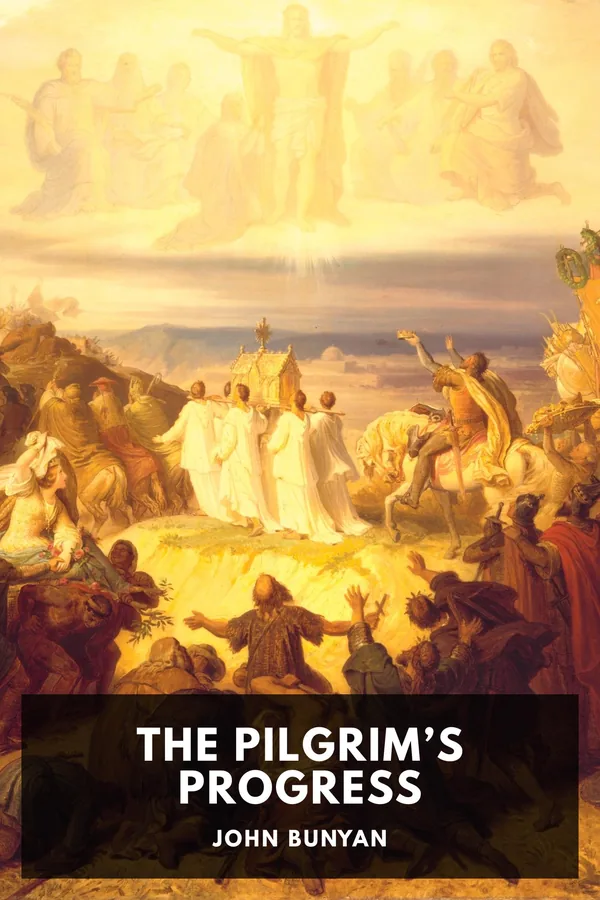
The Pilgrim’s Progress
📖 Click to Read the Opening Pages Online Preview
The opening of the book
As I walked through the wilderness of this world, I lighted on a certain place, where was a den;1 and I laid me down in that place to sleep: and as I slept, I dreamed a dream. I dreamed, and, behold, “I saw a man clothed with rags, standing in a certain place, with his face from his own house, a book in his hand, and a great burden upon his back.”2 I looked, and saw him open the book,3 and read therein; and as he read, he wept and trembled; and not being able longer to contain, he brake out with a lamentable cry, saying, “What shall I do?”4
In this plight, therefore, he went home, and refrained himself as long as he could, that his wife and children should not perceive his distress; but he could not be silent long, because that his trouble increased. Wherefore at length he brake his mind to his wife and children; and thus he began to talk to them: “O my dear wife,” said he, “and you, the children of my bowels, I, your dear friend, am in myself undone, by reason of a burden that lieth hard upon me; moreover, I am for certain informed that this our city will be burned with fire from Heaven; in which fearful overthrow, both myself, with thee, my wife, and you, my sweet babes, shall miserably come to ruin, except (the which yet I see not) some way of escape can be found, whereby we may be delivered.” At this, his relations were sore amazed; not for that they believed that what he had said to them was true, but because they thought that some frenzy distemper had got into his head;5 therefore, it drawing towards night, and they hoping that sleep might settle his brains, with all haste they got him to bed. But the night was as troublesome to him as the day; wherefore, instead of sleeping, he spent it in sighs and tears. So when the morning was come, they would know how he did; he told them, worse and worse; he also set to talking to them again, but they began to be hardened. They also thought to drive away his distemper by harsh and surly carriages to him. Sometimes they would deride, sometimes they would chide, and sometimes they would quite neglect him. Wherefore he began to retire himself to his chamber to pray for, and pity them, and also to condole his own misery. He would also walk solitarily in the fields, sometimes reading, and sometimes praying; and thus for some days he spent his time.6
Now I saw upon a time, when he was walking in the fields, that he was, as he was wont, reading in his book, and greatly distressed in his mind; and as he read, he burst out, as he had done before, crying, “What shall I do to be saved?”7
It begins with the first three paragraphs, as the narrator lies down in a den and dreams of the man in rags:
Download Full EPUB1678
~109,000 words (estimated)
Approx. 6.0 hours
Standalone
The road from the City of Destruction to the Celestial City
Two parts in one volume; the road is divided here into eight stages
EPUB · AZW3 · KEPUB
0.78 MB (EPUB) · 1.14 MB (AZW3) · 0.87 MB (KEPUB)
Public domain in the United States
Standard Ebooks · Project Gutenberg #131
The Pilgrim’s Progress is a dream of a man running out of a doomed city with a burden on his back. Christian, whose name was Graceless until he came to the cross, is pointed by a preacher named Evangelist at a wicket gate and a shining light, and walks from the City of Destruction towards the Celestial City. The road takes him through the Slough of Despond, up Hill Difficulty, into the palace called Beautiful, down into the Valley of Humiliation to fight Apollyon, through Vanity Fair, where Faithful is burned, and into Doubting Castle, where Giant Despair keeps him for four days. He crosses the Enchanted Ground and comes at last to a river with no bridge. The second part sends his wife Christiana and her four sons along the same road.
Bunyan was a Bedfordshire tinker turned preacher, and the book came out of the twelve years he spent in prison for preaching after the monarchy came back in 1660. The first part appeared in 1678, the second in 1684, and this Standard Ebooks edition prints both. The Pilgrim’s Progress was read aloud in kitchens and chapels within a generation, and its places — the Slough, the Hill, Vanity Fair, Doubting Castle — passed into ordinary English as names for states of the soul. The text is available via Project Gutenberg 与 Standard Ebooks.

The Pilgrim’s Progress by John Bunyan: Summary, Characters & Themes
This is a summary and analysis of John Bunyan’s The Pilgrim’s Progress, the most influential allegory written in English and one of the very few books of the seventeenth century that people still read for pleasure rather than duty. Its frame is a dream. A narrator walks through the wilderness of this world, finds a den, lies down and sees a man in rags with a book in his hand and a great burden on his back, crying out, What shall I do? Everything that follows is what the dreamer sees: the man’s flight, his instructions, his failures, his fights, and the river at the end of the road. Bunyan keeps the frame almost invisible, so the book reads like a journey with a map rather than a vision, and its place-names have outlived the theology that made them.
Bunyan gives the road a real geography — a slough, a hill, a palace, a valley, a town with a year-long fair, a castle with a dungeon, a range of mountains with a view — and then fills it with talkers. Christian’s progress is mostly conversation: with Obstinate and Pliable at the start, with Worldly-wiseman and his neighbours Legality and Civility, with the porter Goodwill, with the virgins of Palace Beautiful, with Faithful, with Talkative, with By-ends of Fair-speech, with Ignorance out of the country of Conceit. The set pieces are the hinges — the burden falling into the sepulchre at the cross, the half-day fight with Apollyon, the trial before Lord Hate-good, the key called Promise — but the substance of the book is argument, and Bunyan was a preacher who knew how an argument sounds between two people walking.
John Bunyan was born at Elstow, just outside Bedford, in 1628, the son of a tinker, and he followed the same trade, mending pots and kettles across the county. He served in the parliamentary army in the 1640s, married a poor woman whose two books were the first library he had, and after a conversion he later described as a long terror joined the gathered church at Bedford under John Gifford in 1655; within a few years he was preaching in villages and barns. The restoration of Charles II in 1660 made that a crime. He was arrested in Bedfordshire that November and spent some twelve years in the county jail, where he wrote Grace Abounding to the Chiefest of Sinners (1666) and, after a second and shorter imprisonment in 1675, began the dream that became this book. He died in London in 1688, having caught a chill on the road.
The second part is a companion rather than a sequel. Christiana, the wife who once thought her husband mad, is pricked awake by his absence, dreams a dream of her own, and sets out with her four sons and her neighbour Mercy, under the guidance of Mr Great-heart. She is received at the same house, warned by the same shepherds and brought through the same dangers, and the book closes with a series of deaths at the river that are among the finest pages Bunyan wrote. Readers who finish here and want more of the same road can go back three centuries to The Divine Comedy, forward to the gothic terrors of The Monk, or sideways into the chivalric world of Le Morte d’Arthur, all of them journeys with a soul at the centre.
The text in this edition is the complete work, both parts in one volume, with Bunyan’s verse apology for his book at the front and his closing word to the reader at the back. It runs to 108,673 words. The transcription is Standard Ebooks, and a plainer one of the same two parts is at Project Gutenberg. The second part opens with its own address to the courteous companions, and the two are printed in the order Bunyan published them. Bunyan wrote one continuous dream without chapters or numbers, and the stages on this page are an editor’s convenience.
Historical Context
The England Bunyan was born into was a country of compulsory religion. Everyone attended the parish church by law, and the penalties for staying away, or for meeting elsewhere, were fines and prison. The Civil War of the 1640s broke that settlement open: censorship collapsed, preachers of every kind — Baptists, Independents, Quakers, Seekers — travelled the roads, and a tinker with a gift for speech could find a congregation. The restoration of Charles II in 1660 closed the door again. The Act of Uniformity of 1662 ejected some two thousand clergymen from their livings, and the Conventicle Act of 1664 made a religious meeting of five or more people outside the parish church a criminal offence. Bunyan, who had been preaching since the 1650s, was exactly the man those statutes were written for.
His arrest came in November 1660, at a meeting in Bedfordshire, and the magistrates offered him freedom on one condition: that he would not preach. He refused, and stayed in the county jail at Bedford for twelve years, supporting his family by making laces, preaching to the prisoners and writing. Grace Abounding came out of that cell in 1666, a spiritual autobiography of unusual candour about terror, doubt and the fear of damnation. Released in 1672 under the Declaration of Indulgence, he was licensed as a preacher and became pastor of the Bedford congregation. A second, shorter spell in the town jail on Bedford bridge followed in 1675, and tradition, though not certainty, places the beginning of The Pilgrim’s Progress there.
The book appeared in London in 1678, published by Nathaniel Ponder, and it sold at once: cheap editions, pirated editions and chapbook abridgements carried it into cottages where a folio would never have gone. Part Two followed in 1684, partly because readers would not let the story end. Its afterlife is unusual for a seventeenth-century religious book, because the names outlived the doctrine: a person can say Doubting Castle or Vanity Fair today without knowing who wrote them or what they once argued. Bunyan died in London in 1688, ten years after the first part, and the book has never been out of print since.
Key Characters & Literary Archetypes
- Christian: Christian is the dream’s pilgrim, and his name is a destination rather than a description: at Palace Beautiful he admits that he was called Graceless until he came to the cross. He leaves a wife and four children in the City of Destruction, and the book is honest about what that costs them, since the second part is the story of their following him. His progress is not steady. He takes Worldly-wiseman’s advice, sleeps in the arbour and loses his roll, and follows By-ends into By-Path Meadow, and every failure is repaired by something he remembers or something he is given.
- Faithful: Faithful is the companion Christian overtakes on the road, a man who came through the same country by another route and was tempted by Madam Wanton, Adam the First, Discontent and Shame. His answers are short and hard, and Bunyan uses him as the correction to Talkative: Faithful wants to know what a person has felt, not what a person can say. He is the one of the two who is taken at Vanity Fair, scourged, stoned and burned at the stake, and his death is the book’s first great loss and the conversion of Hopeful, who stands in the crowd and watches a man die well.
- Hopeful: Hopeful joins Christian at Vanity Fair after watching Faithful burn, and he is the second half of the book’s friendship. His long account of his own conversion, told on the Enchanted Ground to keep them both awake, is the most sustained piece of spiritual autobiography in the story, and his companionable stubbornness carries the last chapters: it is Hopeful who argues in Doubting Castle against the giant’s advice to die, and Hopeful who, in the river, feels the bottom with his feet and calls to Christian to be of good cheer.
- Christiana: Christiana is Christian’s wife, and the second part belongs to her. Where her husband fled alone and in terror, she leaves with a household: four sons, Matthew, Samuel, James and Joseph, her neighbour Mercy, and a guide, Mr Great-heart, given to her because a woman with children cannot fight every giant on the way. Her journey repeats his and corrects it. She is received where he was received and warned where he was warned, and the book’s interest shifts from a single soul to a family that grows as it travels, picking up the frightened and the lame.
- Mr Great-heart: Mr Great-heart is the guide of the second part, and he is what Christian never had: a soldier. His trade is killing giants, and he does it without ceremony, cutting off Giant Despair’s head, setting it on a pole and spending seven days pulling Doubting Castle down to its foundations; he also brings Mr Despondency and his daughter Much-afraid out of that dungeon. But Bunyan makes him a teacher as well, explaining each place to the women and children as they pass it, so that the second part turns into a guided tour of the first part’s terrors.
- Giant Despair: Giant Despair owns the castle at the edge of By-Path Meadow and is the most fully realised villain in the book, because he is not a monster but a landlord. His wife Diffidence advises him, his crab-tree cudgel does the work, and his method is not violence so much as argument: he shows his prisoners the bones of those who died there and recommends that they kill themselves. He has fits in sunny weather, which is Bunyan’s joke at despair’s expense, and his castle stands within sight of the right road. He is killed in the second part, and the castle is demolished.
Core Literary Themes
- The burden and the cross: The book’s first image is a weight and its first release is a place. Christian carries a burden he cannot put down until he stands at the cross and looks at it, and then it looses of its own accord and falls into the mouth of the sepulchre. Bunyan is careful about the order: the burden does not fall at the wicket gate, or after the fight, or on the mountains, but at the sight of a man hanging bleeding, and the three Shining Ones who strip him, mark him and give him a sealed roll are the book’s picture of what happens next.
- Names that argue: Bunyan’s characters are walking definitions. Mr Worldly-wiseman lives in the town of Morality with Legality and Civility; By-ends of Fair-speech marries Lady Feigning’s daughter; Talkative is the son of Say-well of Prating Row; Ignorance comes out of the country of Conceit by a crooked lane. The names are not decoration but the argument itself, and one of the book’s quiet pleasures is watching a name turn out to be a prophecy, as when Giant Despair’s wife is called Diffidence and his castle stands on the wrong path.
- Doubting Castle and the key of Promise: Four days in a dungeon, without bread, water or light, is the longest single scene in the book, and it is almost all argument. The giant does not torture Christian and Hopeful so much as reason with them, and Bunyan, who had known despair at first hand, gives it a wife, a cudgel and a yard full of bones. The escape is not a fight but a memory: Christian recalls a key in his bosom called Promise, and the dungeon door, the yard door and the iron gate all open. The lesson is exact and unconsoling: the key was there the whole time.
- Vanity Fair and the religion of getting on: Vanity Fair is the book’s vision of the world as a market, kept all the year round, set up by Beelzebub, Apollyon and Legion, where everything is for sale and the pilgrims have nothing to sell but the truth, which nobody wants to buy. The trial of Faithful is a satire on English justice with a judge called Lord Hate-good and a jury of Mr Malice, Mr Live-loose and Mr Implacable, and the scene ends with the one thing the fair cannot buy, a man who will not recant.
- Fellowship on the road: Christian begins alone, and the book’s correction of that loneliness is the second half, where nobody travels alone. Faithful walks with him to the fair, Hopeful walks with him to the river, and Christiana’s party is a household with children, a guide and a growing train of the weak and the frightened. Bunyan keeps the individual soul at the centre of every scene, but he refuses the solitary hero: the road is walked in company, and the last chapters are a series of people helped over the water by someone standing beside them in it.
Why Download Our Custom E-Reader Edition of The Pilgrim’s Progress?
The book is older than the novel and does not behave like one: no chapters, no chapter numbers, a narrator who is asleep, and a plot that is really an argument. Bunyan’s sentences are short, his images physical, his dialogue quick. If you have only met the book as a set of allusions, the surprise is how funny and how cruel it is, and how often the pilgrims fail. A free text is at Project Gutenberg if you want to check a passage before you commit to the whole road.
This edition is built for a reader rather than a scholar: both parts in one file, with the second part’s own company and its own ending, since an edition of part one alone stops at the wrong place and leaves Christiana on the road. The text is the Standard Ebooks transcription, cleaned of scanning errors, with the verse apology at the front and the conclusion at the back, and it is set for e-readers: real italics and a table of contents that finds the stages.
The page above divides the road into eight stages so that a long book can be read in sittings, and each stage stops short of the surprises ahead. If you have read the book before, the stage on Doubting Castle and the stage on Vanity Fair are the two that repay rereading; if you have not, start at the wicket gate, keep the names in mind, and let them do their work as you go.
- Based on the Standard Ebooks Edition, via Standard Ebooks, whose text of both parts has been proofread against the early editions and checked by hand for the errors that creep into scanned reprints.
- Both parts in one file Part One of 1678 and Part Two of 1684 together, with Christiana’s journey, Great-heart’s giants and the deaths at the river, so the book does not stop halfway.
- EPUB, AZW3 and KEPUB One download for every reader: EPUB for Kobo, Nook and Apple Books, AZW3 for Kindle, and KEPUB for Kobo’s own renderer, all with working tables of contents.
- Free, and nothing to sign up for No account, no newsletter, no sample chapter: the whole text, both parts, in a file that is yours to keep and to pass on.
- The Divine Comedy — free EPUB, AZW3 & KEPUB
- The Monk — free EPUB, AZW3 & KEPUB
- Le Morte d’Arthur — free EPUB, AZW3 & KEPUB
Chapter summaries
Bunyan wrote one continuous dream in two parts and printed it without chapters or numbers, so the eight stages below are our division, made for reading in sittings and for finding a place again. They follow the road in order, and each one says what happens and what it is for.
- Flight and the Wicket Gate: The book opens in a den, in a dream. A man in rags stands in a field with a book in his hand and a great burden on his back, crying out, What shall I do? His wife and children think him mad; Evangelist gives him a parchment roll and points him at a wicket gate with a light above it. Obstinate turns back, Pliable goes with him and gives up in the Slough of Despond, and Help hauls him out. Mr Worldly-wiseman sends him towards Legality and Civility, under the hanging mountain of Sinai, and Evangelist comes back to turn him round. Goodwill lets him in while Beelzebub’s castle shoots at the door.
- The Cross and the Burden: A little further on, on a place somewhat ascending, stands a cross with a sepulchre a little below it. Christian looks at it, and the burden looses from his shoulders and tumbles into the mouth of the sepulchre, and he never sees it again. Three Shining Ones meet him: one tells him his sins are forgiven, one strips off his rags and dresses him in a change of raiment, and one sets a mark in his forehead and gives him a sealed roll to hand in at the Celestial Gate. He goes on singing, past Simple, Sloth and Presumption asleep in irons, and past Formalist and Hypocrisy, who climbed over the wall.
- Hill Difficulty and Palace Beautiful: The hill is steep, with a spring at the foot and two side paths called Danger and Destruction, and Christian goes up on his hands and knees. In the arbour halfway he sleeps, loses his roll and has to go back for it, weeping, before he can face the lions, which are chained though he cannot see the chains. Watchful, the porter, calls him on, and the palace called Beautiful receives him: Discretion, Prudence, Piety and Charity, the chamber called Peace, the study of records, and the armoury with its sword and shield and the engines of Moses, Jael, Gideon, Shamgar, Samson and David. He is harnessed head to foot before he leaves.
- Apollyon and the Valley: In the Valley of Humiliation Christian meets Apollyon, scaled like a fish, winged like a dragon, with a lion’s mouth and fire in his belly, who claims him as a runaway vassal. They fight for above half a day; the dragon wounds his head, his hand and his foot, and his sword flies out of his hand, and he recovers it with a text, Rejoice not against me, O mine enemy. The two-edged sword ends it, Apollyon goes off on his wings, and the leaves of the tree of life close the wounds. Then the Valley of the Shadow of Death, worse than the fight: a pit on one side, a cave on the other, and the giants Pope and Pagan sitting at the mouth of it.
- Vanity Fair: Christian overtakes Faithful, who has been troubled by Madam Wanton, Adam the First, Discontent and Shame, and they cross the wilderness together, warned by Evangelist that one of them will suffer at Vanity Fair. The fair has been kept all the year since Beelzebub, Apollyon and Legion set it up; its traders ask, What will ye buy, and the pilgrims answer, We buy the truth. They are beaten, smeared with dirt and caged, tried before Lord Hate-good, and convicted on the evidence of Envy, Superstition and Pickthank. Faithful is scourged, stoned and burned to ashes; a chariot carries him up, and Hopeful, who watched him die, takes his place beside Christian.
- Doubting Castle and Giant Despair: Christian and Hopeful pick up By-ends of Fair-speech, who will not own a religion that goes in rags, and leave him to Demas and the silver mine on Hill Lucre; a pillar of salt stands by the road to remind them of Lot’s wife. Then comes the easy stile into By-Path Meadow, Vain-confidence falling into a pit in the dark, and a night in the grounds of Doubting Castle, where Giant Despair and his wife Diffidence beat the pilgrims, starve them, show them the bones of dead men and urge them to kill themselves. They pray until almost daybreak, and Christian remembers the key called Promise in his bosom, which opens the dungeon, the yard and the iron gate.
- The Delectable Mountains and the Enchanted Ground: The shepherds Knowledge, Experience, Watchful and Sincere take them in and show them the wonders: Hill Error, where men who denied the resurrection lie dashed to pieces; Mount Caution, where pilgrims who went over the stile wander blind among the tombs; the door in the side of the hill, a byway to hell; and Mount Clear, where a perspective glass shows them the gate of the city. Below the mountains they meet Ignorance out of the country of Conceit, are caught in the Flatterer’s net, and are told by Atheist that there is no such place. The Enchanted Ground makes them drowsy, and they keep awake by talking.
- The River and the Celestial City: Beulah comes last, where the air is sweet and the city is in sight, and both men fall sick with longing. The river has no bridge: Christian begins to sink, and Hopeful, feeling the bottom with his feet, holds his head above the water until Christian remembers a promise and finds ground to stand on. Two Shining Ones wait on the far bank, and the pilgrims go up the hill with ease, their mortal garments left in the river. Ignorance comes after, ferried over by one Vain-hope, and is carried to the door in the side of the hill. In the second part Christiana’s company comes to the same water, and Stand-fast stops halfway across to speak.
The Pilgrim’s Progress: Frequently Asked Questions
What is The Pilgrim’s Progress about?
Who was John Bunyan, and did he write it in prison?
What is the difference between the two parts?
What happens at Vanity Fair?
What is Doubting Castle?
Is it hard to read today?
Why is the whole book a dream?
Where can I read the full text for free?
Part of: Classic Fiction · John Bunyan