A Little Princess by Frances Hodgson Burnett: Free EPUB, AZW3 & KEPUB Download
A Little Princess
📖 Click to Read the Opening Pages Online Preview
The opening of Chapter 1
She was such a little girl that one did not expect to see such a look on her small face. It would have been an old look for a child of twelve, and Sara Crewe was only seven. The fact was, however, that she was always dreaming and thinking odd things and could not herself remember any time when she had not been thinking things about grown-up people and the world they belonged to. She felt as if she had lived a long, long time.
At this moment she was remembering the voyage she had just made from Bombay with her father, Captain Crewe. She was thinking of the big ship, of the Lascars passing silently to and fro on it, of the children playing about on the hot deck, and of some young officers’ wives who used to try to make her talk to them and laugh at the things she said.
Principally, she was thinking of what a queer thing it was that at one time one was in India in the blazing sun, and then in the middle of the ocean, and then driving in a strange vehicle through strange streets where the day was as dark as the night. She found this so puzzling that she moved closer to her father.
The excerpt below quotes the opening three paragraphs of Chapter 1, in which Sara Crewe, seven years old and newly arrived from Bombay, sits in a London cab with her father in the yellow fog, watching the streets and thinking her old-fashioned thoughts.
Download Full EPUB1905
~67,000 words (estimated)
Approx. 3.7 hours
Standalone
London, in the years around 1900, at Miss Minchin’s Select Seminary for Young Ladies.
Nineteen chapters grouped into ten movements
EPUB · AZW3 · KEPUB
0.54 MB (EPUB) · 0.58 MB (AZW3) · 0.57 MB (KEPUB)
Public domain in the United States
Project Gutenberg #146 · Standard Ebooks
A Little Princess is Frances Hodgson Burnett’s novel of Sara Crewe, a rich child left at a London boarding school who loses her father, her money and her place there in a single afternoon. Miss Minchin sends her to the attic to work as a drudge, and Sara keeps herself going by pretending to be a princess in rags. The book follows the attic years, her friendship with Becky the scullery maid and Ermengarde the dunce, a rat named Melchisedec, and the comfort that begins to arrive, unexplained, from the house next door.
A Little Princess appeared in 1905, expanded from Burnett’s earlier story Sara Crewe and from the play she made of it; Wikipedia’s entry on the novel sets out its publication and its long life on stage and screen. The plot turns on a fortune in Indian diamond-mines, a school that values it above the child, and a girl who keeps her manners when both are gone — The text is available via Project Gutenberg #146 and Standard Ebooks.
A Little Princess by Frances Hodgson Burnett: Summary, Characters & Themes
A Little Princess is Frances Hodgson Burnett’s novel of 1905, and the book in which Sara Crewe finally gets the whole of her story. This page gives a summary and analysis of the novel, with the chapters grouped into movements, the historical setting, the characters and the ideas the book turns on. Sara is seven when her father leaves her at Miss Minchin’s Select Seminary for Young Ladies in London and goes back to India; she is eleven when a man from the lawyers arrives to say that the diamond-mines have failed and that Captain Crewe is dead. In between, the novel turns a clever, spoiled, much-loved child into a servant in the same house, and asks what is left of a person when the money, the clothes and the name have gone. Burnett’s life had taken her from Manchester to Tennessee and back to England, and by 1905 she was famous; the book is not autobiography, but it knows the difference between being loved for yourself and being valued for your money.
The novel did not begin as a novel. Burnett had already written the story of Sara Crewe, and had then made a play of it called A Little Princess; the preface printed in this edition says that after the play was produced in New York, and children there liked Becky and Lottie and Melchisedec, her publishers asked her to write Sara’s story over again and put in all the things and people who had been left out before. That preface is the best short introduction to the book: it is Burnett’s own account of the difference between the short story and the long one, and it names the people she found she had left in the story’s shadow. The Project Gutenberg transcription of the 1905 text carries the same preface and the same nineteen chapters.
Once the money is gone, Miss Minchin’s school shows what it was always for. Sara is sent to the attic beside Becky’s, kept from the other girls, made to run errands in all weathers and to teach the little ones, and fed whatever the kitchen does not want. The middle of the book is a long, patient account of cold, hunger and humiliation, and of the three friendships that hold: Ermengarde, who is slow and kind and brings her father’s books; Lottie, four years old and motherless, who adopts Sara as a mother; and Becky, the scullery maid, who is hungrier than Sara and shares the wall between their attics with a code of knocks. Burnett’s later The Secret Garden would take up the same materials, a neglected child and a room that answers care with growth, but with a boy at the centre and a whole household to repair.
The last third is the part children remember: the attic is furnished while Sara sleeps. A fire is lit, a supper laid, a satin quilt put on the bed, and a note left on a flyleaf. The reader learns before Sara does that the magician is the invalid next door, Mr Carrisford, working with his servant Ram Dass, who crosses the roofs at night and has been watching over her for months. The device lets Burnett have both things at once: the fairy-tale wish granted almost exactly as Sara describes it, and a plausible chain of adult kindness, money and guilt behind the wish. Anne of Green Gables, published three years later, would give its orphan a home from the start; Burnett’s Sara has to be given one twice, and the second giving is the one that costs somebody something.
The prose is plain and quick, with a habit of direct address that lets the narrator stand beside the reader. The chapters are scenes rather than a plotted whole, and the famous moments are small: five buns given away, a note on a flyleaf, a monkey at a skylight, a girl saying that she tried not to be anything else. This page follows the Standard Ebooks text, which keeps Burnett’s preface, the chapter titles and the 1905 byline. Readers who like the mixture of hard luck and enchantment can go from here to The Wonderful Wizard of Oz, where the magic turns out to be machinery and the child is the one who was brave all along.
Historical Context
Miss Minchin’s is a private school run for profit, and the novel is exact about what that means. Sara is a parlour boarder, a pupil who pays more and is treated better; her father’s money buys a French maid, a pony, furs and the headmistress’s flattery. When the money stops, the school keeps her because a girl who can teach French and manage the little ones is worth more as a servant than as a pupil, and because turning her out would be talked about. The attic, the kitchen and the schoolroom are three economies in one house, and the book watches how quickly a child can be moved from one to another.
Sara was born in Bombay and has lived in India until she is seven, and the novel takes that seriously. She speaks enough Hindustani to greet Ram Dass, recognizes his dress at a glance, and remembers being served and salaamed to. India in the book is where fortunes are made and lost and where fathers die of fever; the diamond-mines are never seen, only reported in letters, and the wealth they promise is always at a distance. The Indian gentleman of the square is an Englishman who has come back, not an Indian, and the novel is careful about the difference even when its characters are not.
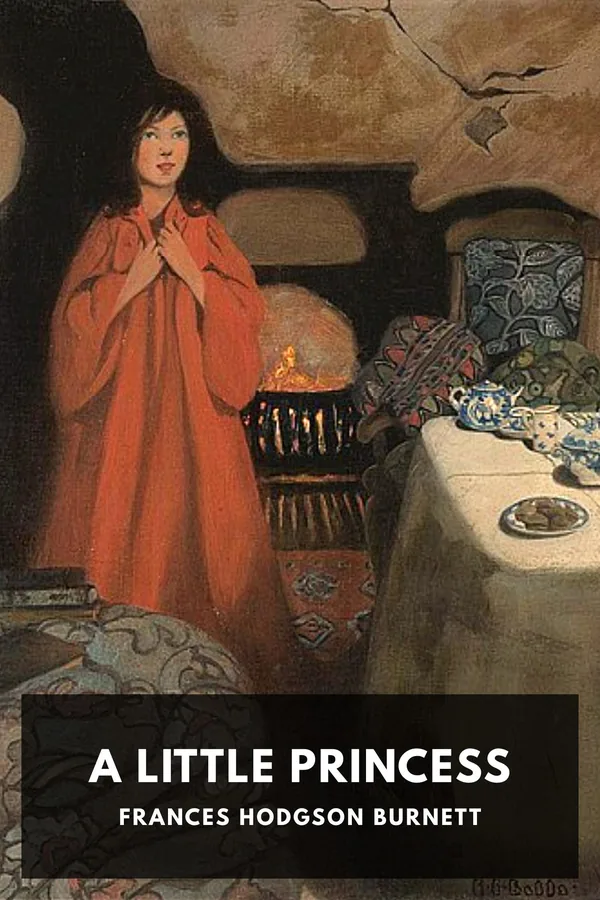
A Little Princess appeared in 1905, after the stage version had been running in New York, and the preface printed here describes that order of events. It was published as a children’s book, in a decade when such books were sold as gifts and illustrated; the Standard Ebooks cover adapts a drawing made for the first edition by Ethel Franklin Betts in 1905. The world it describes, of boarding schools, servants, errand girls and fortunes carried home from India, is the world Burnett had been living in on both sides of the Atlantic, and the book does not explain it, because its first readers did not need the explanation.
Key Characters & Literary Archetypes
- Sara Crewe: The heroine, seven when she arrives from Bombay and eleven when the news of her father’s death comes. She speaks French and Hindustani, invents stories for the little girls, and holds to a private rule that she is a princess whatever she is wearing. Her charm is real and so is her temper: she calls lies vulgar, refuses to beg Miss Minchin’s pardon for thinking, and tells her that she could wave her hand and order an execution. The book asks what her good manners are worth when nobody is watching.
- Captain Crewe: Sara’s father, a young, generous, cheerful man who adores her, calls her his Little Missus, and puts every penny he owns into his school friend’s diamond-mines. He dies in India of fever and loss, and the novel never lets him speak again; he survives in letters, in a photograph, and in the habits Sara keeps. He is the book’s measure of what money is for, and of how quickly a fortune made abroad can vanish there.
- Miss Minchin: The proprietress of the Select Seminary, a woman of business who calculates the value of every pupil. She flatters Sara while the money is there and makes her a drudge when it is gone; she is not a monster but a hard, worldly woman, as her sister says at last, and her great fear is what patrons will think. Her final interview, when the fortune returns, is the coolest scene in the book: she offers to take Sara back and is refused in front of the lawyers.
- Becky: The scullery maid, worked from morning to night, beaten for a meat-pie the cook gave away, and always hungry. She becomes Sara’s friend when Sara buys pies and sandwiches and eats them with her in the attic, and she believes in the Bastille and the secret passage Sara invents. Her dialect is transcribed throughout, and she is the first person Sara thinks of when the magic begins; her reward is to be Sara’s attendant, with a pink, round face.
- Ermengarde St. John: The dunce of the school, fat, slow, kind and miserable about her lessons. She is the first girl to befriend Sara, brings her father’s Carlyle to the attic, and supplies the hamper on the night of the feast. Sara is gentle with her slowness and tells her that to be kind is worth more than to be quick, and it is Ermengarde who reads Sara’s letter aloud to the assembled school while Miss Amelia cries in bed.
- Mr Carrisford: The Indian gentleman of the square: an Englishman who made and lost a fortune in India and nearly died of brain-fever. He believes he ruined his friend Ralph Crewe and has searched two years for Crewe’s daughter without knowing she is next door. He is the book’s second father and its guilt-ridden magician, planning the furnishing of the attic with Ram Dass, and Sara is told to call him Uncle Tom.
Core Literary Themes
- The princess in rags: Sara’s rule is that a princess is what you are when no one can see it. In the rich years the title is easy and slightly absurd; in the attic it becomes a discipline, courtesy to servants who are rude, patience with Miss Minchin, and a refusal to answer meanness with meanness. Burnett does not pretend the rule is comfortable: Sara bites her tongue, is ashamed of her shoes, and admits that pretending gets harder as the winter grows colder. Nobility here is a practice rather than a possession, and it can survive the loss of everything that usually guarantees it.
- Pretending and the Magic: Sara’s imagination is first a luxury and then a technique. She tells stories to the little girls, invents the Bastille for Becky, and lays out a pretended feast with handkerchiefs and a red shawl; the novel then answers the pretence literally, furnishing the attic while she sleeps. The Magic is the name she gives to a pattern she has noticed, that something always happens just before the worst, and the book keeps two meanings in the word at once: a child’s faith, and Ram Dass on the roof with a dark lantern and a box of tacks.
- Money, manners and the servant child: The school is a machine for measuring girls by what they cost, and Miss Minchin’s flattery and her cruelty come from the same calculation. Against it Burnett sets the servants: Becky, beaten for a pie; Anne, the beggar child of the bun shop; the bun woman, who gives away bread. The novel’s sympathy is real and its horizon is not: it ends with Sara rich and Becky her attendant, and a modern reader can see both the generosity and the limit at once. Burnett is more interested in how a child treats a servant than in changing what a servant is.
- Hunger and the share: Hunger is the book’s most physical fact, and it is never a metaphor. Sara gives five of six buns to a starving child and keeps one; she is hungrier for having done it. The scene returns at the end, when she asks to pay the bun woman to feed hungry children and asks that the girl she fed should hand out the bread. Burnett’s ethics are simple here and hard to argue with: hunger is a fact about the body, and the test of a princess is what she does with a bun when she has fourpence and no dinner.
- The story that grows: The novel is about telling stories and is itself a story told again. Sara’s gift holds the schoolroom; her supposings furnish the attic before Ram Dass does; and Burnett’s preface explains that the 1905 book exists because the people who saw the play wanted the characters left out of the first version. The book’s own history repeats its theme: a story told once is revised by the people who were not in it, and the second telling is the one that lasts. It is a children’s book about the making of a children’s book.
Why Download Our Custom E-Reader Edition of A Little Princess?
A Little Princess has been reprinted since 1905 in editions that reset the text from whatever copy was nearest to hand, and the chapter titles are often dropped on the way. This edition follows the Standard Ebooks text, prepared from the Project Gutenberg transcription and checked against scans of the 1905 printing, and it keeps the preface, the chapter titles and the byline. That matters here because the book opens with the author’s own account of how it was made, and a reader who skips those pages misses the reason Lottie and Becky and Melchisedec are in the story at all. The Project Gutenberg text is the same text in plainer dress.
The ten chapter groups on this page are a reading map, not a substitute for the book. Each group names what happens across two or three chapters and points to the turn taken there: the birthday, the attic, the wall, the feast, the discovery. Read in order, they show how tightly Burnett builds. Almost every comfort that arrives in the attic has been wished for in an earlier chapter, and almost every adult who fails Sara has been described in the first fifty pages, so that the ending feels earned rather than granted.
For readers coming from The Secret Garden this is the earlier, harsher book: the same belief that a child can be saved by stories and by being needed, with less garden and more hunger. For readers who know the story from a film, the novel’s ending is quieter than most versions of it: a girl in a warm coat at a carriage door, a bun shop, a scullery maid with a pink face, and a promise about bread. It is worth reading the last chapter twice, once for the plot and once for how little Burnett needs to say to make it land.
- Based on the Standard Ebooks Edition, via Standard Ebooks, whose text is prepared from the Project Gutenberg transcription and checked against scans of the 1905 printing; the preface, chapter titles and byline follow that edition.
- Nineteen chapter titles as printed Every chapter is named as this edition prints it, from Sara and A French Lesson to It Is the Child! and Anne, and the ten groups on this page keep those titles in view instead of inventing new ones.
- The 1905 preface, kept in place Burnett’s own account of how Sara Crewe became A Little Princess, and of the people she found she had left out, is printed before Chapter 1; it is the best short introduction to the book and the reason the order of this edition matters.
- EPUB, AZW3 and KEPUB from one text All three files are built from the same Standard Ebooks text, so chapter breaks, punctuation and the preface match whichever format you read; the AZW3 is the file to send to a Kindle, and the KEPUB is the one Kobo devices read best.
- The Secret Garden — Burnett’s later novel of a sour child, a locked garden and a house full of secrets, with the same faith in fresh air and in being needed. — free EPUB, AZW3 & KEPUB
- Anne of Green Gables — Montgomery’s 1908 orphan, who talks her way into a home in the same years that Sara was learning to keep quiet in one. — free EPUB, AZW3 & KEPUB
- The Wonderful Wizard of Oz — Baum’s American fairy tale, where the magic turns out to be machinery and the child is the one who was brave all along. — free EPUB, AZW3 & KEPUB
Chapter summaries
The novel runs to nineteen chapters, printed in this edition with their titles and with no parts or books. The ten groups below follow the book’s own turns: the school, the fortune, the attic, the house next door, the feast and the discovery.
- Chapters 1–2 — Sara and the French lesson: Sara Crewe, seven years old, arrives from Bombay with her father and is installed at Miss Minchin’s Select Seminary as a parlour boarder. Captain Crewe, rich from a friend’s diamond-mines, pays for a French maid and a pony and tells Miss Minchin to spare nothing. In the schoolroom Sara answers Monsieur Dufarge in fluent French, and Ermengarde St. John stares at her with awe.
- Chapters 3–5 — Ermengarde, Lottie and Becky: Sara makes three friends: Ermengarde, the school’s dunce; Lottie, four years old and motherless, who wants a mother; and Becky, the scullery maid who is sent up and down the stairs and blamed for what she has not done. Sara feeds Becky pies and sandwiches, tells the little girls stories, and learns that Lavinia and Jessie dislike her. Her father’s letters grow more excited about the mines.
- Chapters 6–7 — The diamond-mines and the birthday: Captain Crewe writes that his friend’s mines may make them both rich, and the school talks of nothing else. For Sara’s eleventh birthday Miss Minchin stages a party and the Last Doll arrives from Paris, with a trunk of dresses and an ermine cloak. Then a man from the lawyers comes with papers: the mines have failed, Captain Crewe is dead, and Sara is penniless. Miss Minchin keeps her as a servant, and Becky is found hiding under the table.
- Chapters 8–9 — In the attic with Melchisedec: The change comes all at once. Sara sleeps in the attic beside Becky, wears an old black frock, teaches the little ones, runs errands, and is fed whatever the kitchen will spare. On the first night she hears rats in the walls; she tames one she names Melchisedec and shares her crumbs with him. Ermengarde and Lottie visit when they dare, and Sara’s stories make the attic a place they want to come to.
- Chapters 10–11 — The Indian gentleman and Ram Dass: Across the square a house is made ready for an invalid who has lived in India; the servants say his fortune came back and his health did not. Sara watches him from the street and adopts him as a friend. At her own door a small boy of the Large Family gives her a sixpence for charity. Then a Lascar servant, Ram Dass, appears at an attic skylight after a runaway monkey, and Sara answers him in Hindustani.
- Chapters 12–13 — The wall, the buns and the populace: Mr Carmichael, the Large Family’s father, is Carrisford’s solicitor, and the search for Captain Crewe’s daughter has reached Moscow, though Carrisford still suspects that a girl adopted in Paris may be the one. Sara hears only fragments through the wall. Sent out wet and hungry in the worst weather, she finds a fourpenny piece in the mud, buys hot buns, and gives five of them to a beggar child outside the shop.
- Chapters 14–15 — The plan, the feast and the raid: While Sara is out, Ram Dass and Carrisford’s secretary enter the attic through the skylight to measure it and plan its furnishing, with Melchisedec as the only witness. That night Ermengarde brings a hamper and the three girls stage a feast on a red shawl, with handkerchiefs for napkins, until Miss Minchin, told by Lavinia, breaks in, boxes Becky’s ears and takes the food away. Sara is left in the dark to suppose a fire, a supper and a soft bed.
- Chapter 16 — The magic that stays: Sara wakes to a blazing fire, a boiling kettle, a rug, a laid table and a bed with a satin quilt; a note on a flyleaf says it is from a friend. She fetches Becky, and the two of them eat and sleep warm. She writes a thank-you note and leaves it on the table, and in the evening it has been taken away with the dishes. That night a monkey scratches at the skylight and she takes him in.
- Chapters 17–18 — It is the child: Carmichael comes back from Moscow with the wrong girl, and Carrisford sinks. Ram Dass brings Sara in to return the monkey; she says she was born in India, that her father was Ralph Crewe and that he died of his losses, and Carrisford recognizes her. Miss Minchin arrives to fetch her pupil and is told that Sara’s fortune has been restored and that she will live with Carrisford.
- Chapter 19 — Anne: Sara tells the story of the banquet to the Large Family and asks Carrisford for his half of it. She asks to visit the bun shop and pay the woman to feed hungry children; the beggar girl of the wet afternoon is now the shopkeeper’s Anne, and Sara asks that she be the one to hand out the bread. The book ends with a carriage, a warm coat and Becky as attendant, while Miss Minchin watches from her window.
A Little Princess: Frequently Asked Questions
Is A Little Princess the same book as Sara Crewe?
Is the novel suitable for children today?
Why does Sara call herself a princess?
What happened to Captain Crewe’s money?
Who is the Indian gentleman?
How does Sara survive the attic years?
How is the novel structured?
Where can I get the free EPUB, AZW3 and KEPUB files?
Part of: Children’s classics · Early 20th century