A Princess of Mars by Edgar Rice Burroughs: Free EPUB, AZW3 & KEPUB Download
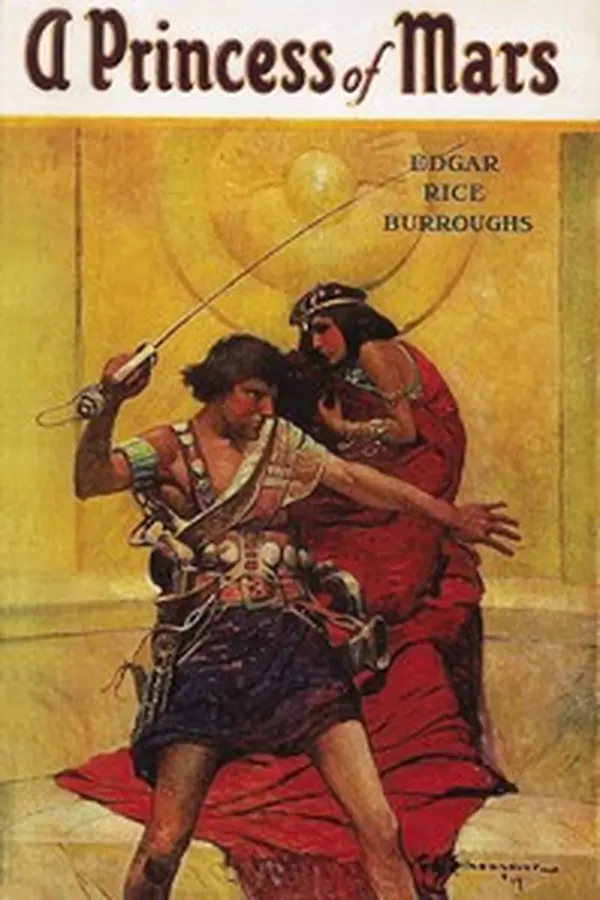
A Princess of Mars
📖 Click to Read the Opening Pages Online Preview
Foreword
In submitting Captain Carter’s strange manuscript to you in book form, I believe that a few words relative to this remarkable personality will be of interest.
My first recollection of Captain Carter is of the few months he spent at my father’s home in Virginia, just prior to the opening of the civil war. I was then a child of but five years, yet I well remember the tall, dark, smooth-faced, athletic man whom I called Uncle Jack.
He seemed always to be laughing; and he entered into the sports of the children with the same hearty good fellowship he displayed toward those pastimes in which the men and women of his own age indulged; or he would sit for an hour at a time entertaining my old grandmother with stories of his strange, wild life in all parts of the world. We all loved him, and our slaves fairly worshipped the ground he trod.
The opening of the Foreword is shown here; the complete novel, all twenty-eight chapters, follows below in the free edition.
Download Full EPUB1912
~67,000 words (estimated)
Approx. 3.7 hours
Barsoom
Arizona and Barsoom (Mars), 1866 and 1912
Ten parts, 28 chapters
EPUB · AZW3 · KEPUB
1.29 MB (EPUB) · 1.39 MB (AZW3) · 1.31 MB (KEPUB)
Public domain in the United States
Project Gutenberg #62
In 1866 a Confederate cavalry captain named John Carter is chased into an Arizona cave, paralysed by a gas, and wakes on Mars. The planet he finds is dying and crowded: fifteen-foot green warriors with four arms, ten-legged riding beasts, dead cities whose fountains ran dry a hundred thousand years ago, and a red race that keeps the air itself running from a single guarded building. Burroughs tells it in the first person and at speed, in the flat, practical voice of a soldier who has stopped being surprised. Nothing is explained; everything is reported, and the reporting is the pleasure.
The frame is the engine. Burroughs writes a foreword in his own name, presenting the manuscript of a man who died in 1886 and was buried in a tomb whose spring lock opens only from the inside. What the manuscript records is the ten years his body lay in that cave, and a love affair with a princess of Helium that has to be bought, again and again, with violence. Carter is a prisoner, then a chieftain, then a fugitive; Dejah Thoris is a captive, then a pledge, then a bride promised to the wrong man. See Wikipedia’s article on A Princess of Mars for its publication history. The text is available via Project Gutenberg #62.

A Princess of Mars by Edgar Rice Burroughs: Summary, Characters & Themes
This page is a summary and analysis of A Princess of Mars by Edgar Rice Burroughs, with the historical context, the characters and the themes, followed by chapter summaries and the free download links. The novel is John Carter’s own account of ten years on Mars, written, he says, because he has died twice and does not expect to do it again. It is less a plotted book than a sequence of situations, each solved by a leap, a duel or a lie, and each explained in the same unhurried voice. Carter is a poor narrator of his own feelings and an excellent narrator of terrain, weapons and customs, which is why the planet feels more solid than the man. It is also a book about procedure: how a horde feeds itself, how eggs are graded, how a duel is opened, how a city is taken. That attention is the difference: an administration, not scenery.
The author is Edgar Rice Burroughs, and the text of A Princess of Mars itself has a long critical history. Burroughs was thirty-six in 1912, a former cavalryman and failed shopkeeper who had been reading the pulp magazines and had decided he could do better. A Princess of Mars ran as a serial that year under the title “Under the Moons of Mars” and a pen name, Norman Bean; the book edition followed in 1917, after Tarzan had made its author famous. The novel is therefore a magazine story, written to hold a reader between advertisements, and its chapters end on a cliff or a sword-point almost every time. The frame is worth noticing too: Burroughs puts himself in the book as a boy of five who called the hero “Uncle Jack”, which lets him vouch for a story that no reader can check. The magazine audience wanted a new world every month, and he supplied one that could be extended indefinitely.
The Martian detail is where the book earns its reputation. A green female lays “about thirteen eggs each year”; the best are stored in cold vaults for five years, examined yearly by a council of twenty chieftains, then hatched in the sun for five more, and the hatchlings are “the common children of the community”, raised by whichever female claims them. Burroughs follows the logic to its end: “parental and filial love is as unknown to them as it is common among us”, and a child born deformed is “promptly shot”. Elsewhere the machinery is just as literal – the radium rifle, the thoats trained by kindness, the atmosphere plant whose door answers to nine sounds. The inventions are not decoration. They are the rules of the place, and the plot is what happens when a man from Virginia refuses to obey them. The result is a world that can be reasoned about, and the reasoning keeps the reader reading.
Carter’s education is the plot. He arrives believing in fair play, and the green Martians teach him that their law is custom and their virtue is success; he kills in single combat, inherits the names of the men he has killed, and becomes Dotar Sojat, a chieftain of the horde. Dejah Thoris supplies the counter-argument from inside her captivity: “Let us pity them, my chieftain… since we are greater than they and they know it.” Sola, the green woman who mothers them both, says the harder thing, that her people live in “one continual, awful period of bloodshed from the time we break the shell”. By the last third of the book Carter has stopped asking whether Martian customs are right and started asking what they cost. The novel’s real subject is therefore not combat but conversion: a man learning the grammar of a place and discovering, too late to be comfortable, that he has been changed by it and that the change is not reversible.
Barsoom became a franchise – ten sequels, a newspaper strip, films – but this first book is the strangest of them, because nothing has been settled yet and the planet is still being built in front of the reader. Its influence is easy to see in everything from Dune to Star Wars, though Burroughs’s version is odder, more bureaucratic and more interested in manners than his imitators usually are. Readers who like the dead sea bottoms and the canal-building red race can go on to The War of the Worlds, which takes a similar premise and uses it for invasion rather than escape, or to Twenty Thousand Leagues under the Sea, where the machine and the depth do the work instead of the sword, or to The Time Machine, which looks at a dying world from the other end of time. The text here is the Project Gutenberg transcription (#62), public domain in the United States.
Historical Context
Burroughs wrote the book in 1911, in his thirties, after a decade of jobs that had not worked out: cavalryman, shopkeeper, pencil-sharpener salesman, railroad policeman. It was serialised in 1912 as “Under the Moons of Mars”, over the name Norman Bean, and reached book form only in 1917, by which time Tarzan had made its author famous. That gap matters. The serial form explains the novel’s shape – short chapters, a crisis at every turn, a narrator who explains each new custom the moment it becomes useful – and it explains why the book never lingers in a room it is about to leave. It also explains the confidence: a writer being paid by the instalment learns quickly that a world can be invented as it is used.
The Foreword is the most modern thing in the book. Burroughs appears as himself, a boy of five who called the hero “Uncle Jack”, and reports Carter’s death in 1886: found in the snow with his arms stretched toward a bluff, no marks of violence, a verdict of heart failure. The instructions in the will are stranger – no embalming, an open coffin in a ventilated tomb, and a door with “a single, huge gold-plated spring lock which can be opened only from the inside”. The manuscript was to stay sealed for eleven years and its contents hidden for twenty-one. The frame does not explain the story. It only guarantees that someone is willing to be embarrassed by it, which is exactly what a fantastic story needs.
This edition prints the Project Gutenberg transcription, number 62, without preface, notes or translator. It carries the Foreword and twenty-eight numbered chapters, from “On the Arizona Hills” to “At the Arizona Cave”, and the chapter headings are the author’s own. The text runs to about 67,000 words. Burroughs’s Mars has no consistent map and no consistent biology, and the book does not mind; what it has is momentum, and a plain American prose that carries it. Every chapter ends on a decision, which is why the book reads quickly even in long sittings. The EPUB keeps each chapter as its own document, so the contents list behaves the way a reader expects, and the text is uncorrected: the spelling and the punctuation are Gutenberg’s.
Key Characters & Literary Archetypes
- John Carter: The narrator, a Virginia captain who has “died twice and am still alive”, and who treats Mars as a problem of terrain. He is modest about nothing except his own feelings: his competence, the leap and the sword and the lie told well, is the whole engine of the book. He is also, by his own account, “a very old man” who has not aged since the Civil War, and whose one weakness is that he cannot stop explaining a custom while standing in the middle of it.
- Dejah Thoris: The princess of Helium, granddaughter of Tardos Mors, and a prisoner for most of the novel. She is not passive: she tells Carter that his captors are children in cruelty, she strikes the mirror from Sarkoja’s hand in the middle of a duel, and she argues that her blood is older than the horde’s. Her line about being “greater than they” is the moral centre of the book, and her promise to marry Sab Than is the trap the last third of the plot is built around.
- Tars Tarkas: The green chieftain who first spares Carter and finally calls him friend: “there is no other mortal upon Barsoom who would have done what you have for me.” He is the book’s best portrait of a hard man made curious, a warrior who has spent centuries obeying customs he has begun to doubt. His late duel with Tal Hajus, fought over a death twenty years old, makes him Jeddak of Thark and settles the debt the novel has been carrying since the first chapter.
- Sola: The green woman who teaches Carter the language and shields Dejah Thoris from Sarkoja’s dagger. Her speech about a life of “one continual, awful period of bloodshed” is the book’s clearest indictment of Thark society, and she says it in front of the chieftains who enforce that society. Her own story, a mother who hid her in a tower for four years, supplies the novel with its one real family and explains why she is the only green Martian who can imagine a different arrangement.
- Sarkoja: The old green woman who hates Carter from his first day in the horde, reports his escape plans to Lorquas Ptomel, and blinds him with a mirror during his duel with Zad. She is not a villain with a plan, only a person with a grudge and a long memory, and she is most dangerous when she is being helpful. The book never gives her a scene of punishment, which is its own kind of accuracy: custom outlives the people who use it.
- Kantos Kan: A padwar of Helium’s navy, met in the arena at Warhoon, where the two prisoners save each other’s lives and then stage each other’s deaths. He is the book’s second pair of hands: he flies, he scouts, he is caught trying to reach Sab Than’s tower, and his piloting helps bring the fleet over Zodanga in time. Where Carter is a strategist by instinct, Kantos Kan is a professional, and the difference is the joke the last chapters run on.
Core Literary Themes
- Death without end: Carter dies in the first chapter and keeps narrating; he watches his own body from outside it, and the book ends with him waking in the same cave ten years later. Barsoom treats death as a change of address: the tomb door that opens only from inside, the river Iss from which “no Martian has ever returned”, the pilgrimage every Martian takes at about a thousand years. Immortality here is not a reward. It is a sentence to keep watching, and the novel is honest about how tiring that would be.
- Custom as law: On Barsoom nothing is forbidden and everything is regulated. A marriage promise is final before the ceremony, “We are ruled by custom upon Barsoom”, a warrior may not kill a woman, a name is won by killing a named man, and eggs are culled by a council of twenty. The book’s violence is not chaos but administration, which is what makes it feel alien rather than merely brutal. The horror is that every killing has a form, and the form is what makes it repeatable: a duel has rules, a name has an owner, and a stranger can be absorbed into the system by winning a single fight.
- Bloodshed as a system: Sola’s account of her people is the novel’s harshest passage: war at home and abroad, from hatching to the river Iss. Burroughs keeps the arithmetic, a life expectancy of about three hundred years cut short by “duels, hunting, aviation and war”, and a child “promptly shot” if it is born wrong. The green Martians are not savages in the book’s terms. They are a society that has decided what to spend its people on, and the coldness of that decision is what makes the reader side with the prisoner instead of the tribe.
- Love as a debt: Carter falls in love in the middle of a war and understands it late: “So this was love!” Dejah Thoris calls him “my chieftain” months before either of them knows what the phrase commits her to, and the promise she makes to Sab Than turns the romance into a contract. The lovers spend the last third of the book not courting but paying, for a rescue, a fleet, a city and an atmosphere. Even the marriage, when it comes, is a public ceremony with an army watching, and the book is careful to show the invoice.
- A world kept alive by a machine: The atmosphere factory is the book’s one piece of hard science fiction: walls a hundred and fifty feet thick, a door with a nine-sound lock, a reserve of the ninth ray that could keep Mars breathing “for a thousand years”. Its keeper has watched the pumps for eight hundred years, with one assistant and half a Martian year alone at a time. Burroughs understands that a dying planet is not a setting but an emergency, and the last chapter runs on that fear. The romance and the machinery meet at exactly this door.
Why Download Our Custom E-Reader Edition of A Princess of Mars?
This edition is built to be read straight through. The Foreword and each of the twenty-eight chapters is a separate document inside the EPUB, so the table of contents and the chapter jumps land where they say they will, not at the front of a seventy-thousand-word block. The text is Burroughs’s, complete as Project Gutenberg prints it, with nothing abridged, no modernised spelling and no editorial essay standing between you and the first line of the Foreword. The typography is plain, the paragraphs are set as prose, and the chapter heads sit where the manuscript puts them.
The three files are the same book in three skins. The EPUB is for tablets and phones, the AZW3 for Kindle, the KEPUB for Kobo, which wants its own page numbering and a contents list it can navigate. All three are DRM-free and open in Calibre; all three keep the chapter marks and the reading order. None of them needs an account, and nothing here is a sample or a teaser. If you later want a different format, converting from the EPUB is a two-minute job because nothing in the file is locked.
The preview on this page is the real Foreword, not a blurb, so you can hear Burroughs’s voice before you download: the cousin remembering “Uncle Jack”, the death in the snow, the lock that opens only from inside. If those three paragraphs work on you, the rest of the book will. The cards further up pair it with Verne’s voyage and Wells’s journey forward, the nearest things on this site to a Barsoom shelf, and the summaries below let you check where a particular scene falls before you commit to the whole novel.
- Project Gutenberg transcription, via Project Gutenberg #62 — the complete text, unabridged, with the chapter headings the author set.
- Made for reading Unabridged, twenty-eight chapters Every chapter heading is a separate document in the EPUB, so navigation matches the printed book.
- Made for reading Three formats, no DRM EPUB for tablets, AZW3 for Kindle and KEPUB for Kobo, all carrying the same text and chapter marks.
- Made for reading The actual opening The preview is the Foreword as Burroughs wrote it, not a rewritten sample.
- Twenty Thousand Leagues under the Sea — free EPUB, AZW3 & KEPUB
- The Time Machine — free EPUB, AZW3 & KEPUB
- The War of the Worlds — free EPUB, AZW3 & KEPUB
Chapter summaries
A Princess of Mars runs to twenty-eight short chapters, and the story moves in ten stages: the cave, the horde, the captive, the escape that fails, the long detour through Warhoon and Zodanga, and the return. The summaries follow Burroughs’s order, with the chapter titles as he set them, and each one covers the ground a reader needs before the next turn.
- Chapters I–II: On the Arizona Hills · The Escape of the Dead: 1866: Carter and a fellow Confederate officer, Powell, find gold in Arizona, are hunted by Apaches, and take shelter in a cave. A gas paralyses Carter where he stands. He watches his own body from outside it, and then feels something draw him across space toward a red star that is not a star. The chapter ends with him falling; the next begins on sand that is not Earth’s. Burroughs never explains the transition; the gas, the cave and the red star are simply left standing.
- Chapters III–IV: My Advent on Mars · A Prisoner: He lands naked on a moss plain, in a gravity he can barely manage, and is taken by fifteen-foot green warriors with four arms who speak a language he does not know. In the dead city of Korad he learns the word “sak”, clears a hundred and fifty feet in a single jump, and is kept alive because he is interesting. The horde has never seen a man who can do that, and they want to know how long it lasts.
- Chapters V–VI: I Elude My Watch Dog · A Fight That Won Friends: Carter slips away with Woola, the ten-legged calot set to guard him, and is cornered by white apes in a ruined building. He fights them off with a club while Tars Tarkas and his warriors look on; when it is over, the green chieftain has decided that this small creature is worth keeping. It is the first time in the book that Carter is valued for what he is rather than for what he can be made to do.
- Chapters VII–IX: Child-Raising on Mars · A Fair Captive from the Sky · I Learn the Language: The horde rides to its incubator and Carter sees how green Martians are made: eggs five years in cold vaults, five more in the sun, children raised by whichever female claims them, the deformed shot, the rest taught to fight before they can talk. Then a red flier is brought down in a battle and its pilot, Dejah Thoris, is taken prisoner. The horde now holds a bargaining chip worth more than its eggs.
- Chapters X–XII: Champion and Chief · With Dejah Thoris · A Prisoner with Power: Carter kills a guard who strikes Dejah Thoris and, by Martian custom, inherits the dead man’s name and rank; he becomes Dotar Sojat, a chieftain of the horde, with a retinue and a place at the council. He is given a room with her and a guard at the door, and the two begin talking. The talking is where the book turns: captivity becomes conversation, and conversation becomes the only kind of freedom either of them has.
- Chapters XIII–XV: Love-Making on Mars · A Duel to the Death · Sola Tells Me Her Story: Dejah Thoris calls him “my chieftain” and he does not know what he has been given. Sarkoja sets the warrior Zad on him, and in the duel the old woman blinds Carter with a mirror until Dejah Thoris strikes it from her hand. Carter wins, bleeding, and learns what the phrase meant. Then Sola tells him who her mother was, and which chieftain is her father. The revelation reframes the horde as a family with a secret, and Carter sees that the green Martians have a history.
- Chapters XVI–XVIII: We Plan Escape · A Costly Recapture · Chained in Warhoon: The escape is planned over a map scratched on a marble floor with a diamond, and it fails within sight of the waterway, in a last stand and a kiss. The Warhoons take them instead, and Carter is chained in a dungeon with a dead jailer, a broken sword and no way to reach the keys. The chapter ends with him waiting for the games, which is the harshest cliff in the book.
- Chapters XIX–XXI: Battling in the Arena · In the Atmosphere Factory · An Air Scout for Zodanga: In the Warhoon arena Carter meets Kantos Kan of Helium, and the two men stage each other’s deaths to get out alive. Carter crosses the desert on a dying thoat, reaches the atmosphere plant, learns the nine sounds that open its doors from a keeper who has watched them for eight hundred years, and is nearly killed when the man begins to suspect him. He walks out with the code and a scar.
- Chapters XXII–XXV: I Find Dejah · Lost in the Sky · Tars Tarkas Finds a Friend · The Looting of Zodanga: Carter reaches Zodanga as an air scout, finds Dejah Thoris on the eve of a political marriage, and hears her say the promise is already binding. He flies for help to Thark, where Tars Tarkas kills Tal Hajus before the assembled chieftains, and returns with a green army to break the wedding and loot the city. The last hundred pages are one continuous battle, seen from the air and then from the street, with Carter mostly watching it from a stolen flier.
- Chapters XXVI–XXVIII: Through Carnage to Joy · From Joy to Death · At the Arizona Cave: The Helium fleet wins the sky, the green horde wins the streets, and Carter marries his princess in the palace of Tardos Mors. Nine years later the atmosphere plant fails and he flies to it alone, with the nine sounds in his head and no way to test them. The book ends ten years after his death, in an Arizona cave, with a man who is not dead waking beside a mummy and a wall of skeletons. It is a strange, quiet ending to a loud book.
A Princess of Mars: Frequently Asked Questions
What is A Princess of Mars about?
Do I need to read the other Barsoom books first?
Is A Princess of Mars in the public domain?
How long does it take to read?
Is this the John Carter of the 2012 film?
Does it end with a cliffhanger?
Is it suitable for younger readers?
Does this edition include the Foreword and all twenty-eight chapters?
Part of: Science Fiction Classics · Adventure and Sea Stories