The Pickwick Papers by Charles Dickens: Free EPUB, AZW3 & KEPUB Download
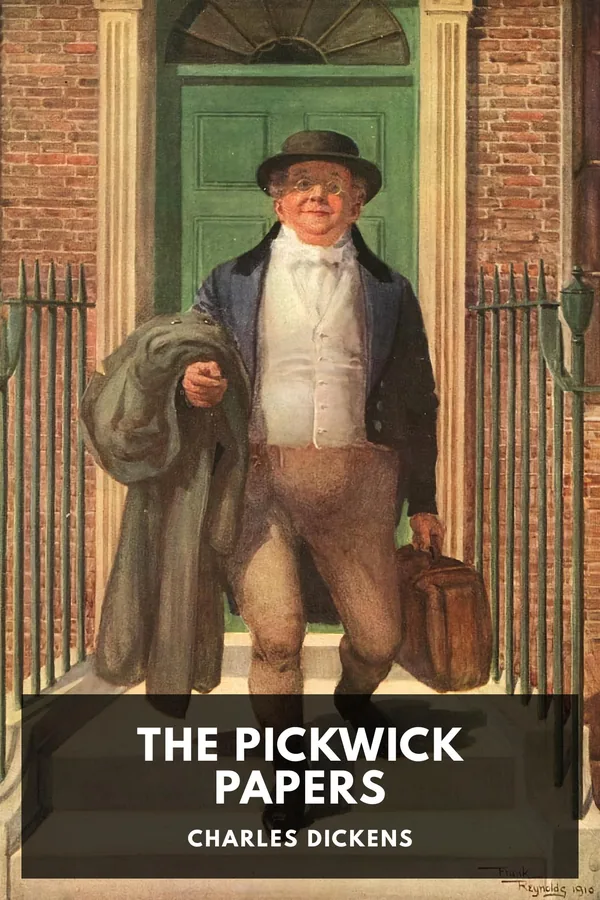
The Pickwick Papers
📖 Click to Read the Opening Pages Online Preview
The opening of Chapter 1
That punctual servant of all work, the sun, had just risen, and begun to strike a light on the morning of the thirteenth of May, one thousand eight hundred and twenty-seven, when Mr. Samuel Pickwick burst like another sun from his slumbers, threw open his chamber window, and looked out upon the world beneath. Goswell Street was at his feet, Goswell Street was on his right hand—as far as the eye could reach, Goswell Street extended on his left; and the opposite side of Goswell Street was over the way. “Such,” thought Mr. Pickwick, “are the narrow views of those philosophers who, content with examining the things that lie before them, look not to the truths which are hidden beyond. As well might I be content to gaze on Goswell Street forever, without one effort to penetrate to the hidden countries which on every side surround it.” And having given vent to this beautiful reflection, Mr. Pickwick proceeded to put himself into his clothes, and his clothes into his portmanteau. Great men are seldom over-scrupulous in the arrangement of their attire; the operation of shaving, dressing, and coffee-imbibing was soon performed; and, in another hour, Mr. Pickwick, with his portmanteau in his hand, his telescope in his greatcoat pocket, and his notebook in his waistcoat, ready for the reception of any discoveries worthy of being noted down, had arrived at the coach-stand in St. Martin’s-le-Grand.
“Cab!” said Mr. Pickwick.
“Here you are, sir,” shouted a strange specimen of the human race, in a sackcloth coat, and apron of the same, who, with a brass label and number round his neck, looked as if he were catalogued in some collection of rarities. This was the waterman. “Here you are, sir. Now, then, fust cab!” And the first cab having been fetched from the public-house, where he had been smoking his first pipe, Mr. Pickwick and his portmanteau were thrown into the vehicle.
The excerpt below quotes the opening three paragraphs of Chapter 1, the minutes of the Pickwick Club: the editor’s flourish about his search among the papers committed to him, the resolution thanking Samuel Pickwick for his paper on the source of the Hampstead Ponds and the Theory of Tittlebats, and the motion that sends him out of London to extend the sphere of his observations.
Download Full EPUB1837
~301,000 words (estimated)
Approx. 16.7 hours
Standalone
England, 1827–1831, by coach from London to Eatanswill, Dingley Dell and Fleet Prison.
Fifty-seven chapters grouped into thirteen movements
EPUB · AZW3 · KEPUB
1.23 MB (EPUB) · 1.73 MB (AZW3) · 1.37 MB (KEPUB)
Public domain in the United States
Project Gutenberg #580 · Standard Ebooks
The Pickwick Papers is the book that made Charles Dickens famous in his early twenties: a comic travelogue in which four members of a London club set out by coach to observe human nature and are repeatedly mistaken for something they are not. Mr Pickwick, its elderly, benevolent and hopelessly innocent hero, is sued for breach of promise by his landlady, refuses to pay, and ends in the Fleet Prison, where the comedy turns unexpectedly grave. Around him Dickens assembles a coachman’s son, a strolling player, a deaf old lady, a chancery prisoner and a hundred talkers. It has almost no plot, and it is still the funniest English novel.
The novel is usually read as the first great English comic novel, and The Pickwick Papers on Wikipedia sets out its publishing history in outline. This page supplies what a chapter guide needs: thirteen groups of summaries across the fifty-seven chapters, six characters, five themes, and the trial that turns the comedy. Dickens wrote it in shilling numbers for Chapman and Hall and found his own method in the process. The full text runs to about 300,600 words. — The text is available via Project Gutenberg #580 and Standard Ebooks.
The Pickwick Papers by Charles Dickens: Summary, Characters & Themes
The Pickwick Papers began as a commission. Chapman and Hall wanted a monthly something to carry plates by Robert Seymour, and the young Dickens supplied the letterpress to go with them; the preface printed in this edition describes the arrangement, the abandoned notion of a Nimrod Club, the invention of Mr Pickwick, the death of Seymour before the second number, and the drift of the book away from its original plan. What survives of that plan is the club itself and its four members. This page is a summary and analysis of the finished book, not a substitute for it: thirteen groups cover the fifty-seven numbered chapters, from the meeting of 12 May 1827 to the dissolution of the club and the house at Dulwich, with the trial, the characters and the themes set out below.
Structurally the book is a frame that keeps collapsing, which is part of its charm. Four members of a club are appointed to travel and report: Mr Pickwick, the elderly founder; Mr Tupman, who believes himself a ladies’ man; Mr Winkle, who claims to be a sportsman; and Mr Snodgrass, who is supposed to be a poet. Their reports are never written. Instead the novel follows them from inn to inn and hands the narrative to strangers whenever a fire, a coach or a Christmas table offers an audience, so that ghost stories, convict stories and tales of madmen and parish clerks interrupt the journey. Charles Dickens, writing the preface in 1837, says plainly that the machinery was gradually abandoned once the characters began to talk. The club is a pretext and the book knows it: the members are appointed to report, and the reporting is done by everyone they meet.
The plot, such as it is, turns on a misunderstanding. Mrs Bardell, Pickwick’s landlady in Goswell Street, takes his announcement that he has engaged a servant for a proposal of marriage, and faints in his arms at the moment his three friends walk in. Her attorneys, Dodson and Fogg, bring an action for breach of promise; the trial in Chapter 34 is the book’s comic summit, and its verdict of seven hundred and fifty pounds is the hinge of everything that follows, because Pickwick refuses to pay and chooses a debtor’s prison instead. The change of temperature is abrupt and deliberate: the man who has been a figure of fun becomes a moralist among people who cannot buy their way out. Readers who want that darker Dickens can go straight on to Oliver Twist.
What holds the book together is talk. Sam Weller, the boots at the White Hart who becomes Pickwick’s servant, speaks a running commentary in a private vocabulary of proverbs, mispronunciations and jokes, and his father Tony, a coachman, extends it into a philosophy of marriage and horses. Jingle talks in staccato fragments, Mr Stiggins in unctuous piety, Mrs Leo Hunter in literary raptures, and Serjeant Buzfuz in the full plumage of the bar. The pleasure of the novel is hearing each of them give himself away, and it is a pleasure Dickens refined further in David Copperfield, where the comedy of speech carries a far more painful story. It is also why the book is best read aloud, or in a head that can hold half a dozen accents at once.
The last third is gentler than the middle. Bath supplies the book’s most farcical sequence, with Mr Winkle locked out of the Crescent in his nightshirt and the legend of Prince Bladud read aloud by candlelight; the Fleet supplies its gravest, in the death of the chancery prisoner and the arrest of Mrs Bardell for the costs of her own victory. Pickwick’s decision to pay both sides and set her free, at the price of his principle, is the real climax, and the chapters that follow are a long, warm leave-taking: the marriages, the house at Dulwich, the dissolved club, the hero who stays single and is ‘the happiest of the group’. The full text is at Project Gutenberg #580, and the edition used here follows Standard Ebooks. For the other great Dickens novel about a lawsuit, see Bleak House.
Historical Context
The novel belongs to the first great age of serial fiction in England, and its shape records that fact. It was issued in shilling numbers, one a month: the preface notes that the numbers settled at thirty-two pages of letterpress with two illustrations, a format with its own rhythm of climax and pause, which taught Dickens to end every instalment on a scene worth waiting a month for. The early purchasers of such numbers expected plates with their text, and this book was commissioned for Seymour’s drawings before it was commissioned for its prose. What the serial form also produced was a novel written while it was being read, with characters kept alive or dropped according to appetite, and a public that argued about them in the intervals.
The legal machinery Pickwick runs into is the machinery of the 1820s and 1830s, and the book is unusually precise about it. A breach-of-promise action is tried before a judge and a jury, with serjeants pleading and attorneys whispering from a low seat beneath the bar; the defendant who will not pay is taken on a writ by a sheriff’s officer and lodged in the Fleet Prison, a debtors’ prison where prisoners paid rent, hired their furniture, bought themselves out of shared rooms and were sometimes never released at all. Beside it stands the court in Portugal Street for the relief of insolvent debtors, where Sam’s affairs are arranged, and beyond it the Court of Chancery, whose delays hold one prisoner in a single room for twenty years. Debt was not an abstraction to the readers of 1837.
By the date on its title page the world the novel describes was already going. The coaching inns, the turnpike roads and the post-chaise were within a decade of the railway; the election at Eatanswill, fought by Blues and Buffs with bribery, treating and a riot, belongs to the political manners that the Reform Act of 1832 had only begun to change; and the Fleet itself would be closed within ten years of the book’s publication. Dickens set his first novel a decade back, in 1827, and gave it the year of Victoria’s accession on the title page, a coincidence that has tied the word Victorian to a book written before there was a Victorian age to describe.
Key Characters & Literary Archetypes
- Mr Samuel Pickwick: The elderly founder of the club, author of the paper on the Hampstead Ponds and the Theory of Tittlebats, and a man whose benevolence is matched only by his innocence. He wears spectacles and gaiters, believes the best of everybody, is imposed upon by nearly everyone he trusts, refuses to pay a verdict out of principle, and ends the book as the unofficial saint of Dulwich.
- Sam Weller: The White Hart boots who becomes Pickwick’s servant and his interpreter of the world. His wit runs on proverbs, mispronunciations and relentless logic, and his loyalty is absolute: told to leave the Fleet, he has himself arrested for a twenty-five-pound debt in order to stay. He marries Mary, the pretty housemaid, and is still at his master’s side when the book ends.
- Alfred Jingle: A strolling player and improviser whose speech comes in dashes, and the book’s recurring agent of imposture. He passes himself off as a gentleman at Rochester, as Mr Charles Fitz-Marshall at Mrs Leo Hunter’s breakfast, and as a suitor to Wardle’s sister; he is exposed twice, ends on the poor side of the Fleet, and is sent abroad with Job Trotter at Pickwick’s expense.
- Tony Weller: Sam’s father, a coachman with a pocketbook of savings, a fund of aphorisms and a settled aversion to widows that does not prevent him marrying one. He is the novel’s chorus on marriage, money and the law, defends his opinions with his fists at a temperance meeting, and retires, after his wife’s death, to a public house near Shooter’s Hill.
- Mrs Bardell: Pickwick’s widow landlady in Goswell Street, who reads an announcement about a servant as a proposal and sets the plot moving by fainting in his arms. Her suit, managed by Dodson and Fogg, wins seven hundred and fifty pounds and then costs her her liberty when they arrest her for their costs; released by Pickwick’s money, she lets lodgings thereafter and sues nobody.
- The three Pickwickians: Mr Tupman, Mr Winkle and Mr Snodgrass are the club’s corresponding members and a trio of comic humours: the fat romantic who never secures a bride, the sportsman who cannot shoot, ride or skate without disaster, and the poet who never writes a line. Tupman retires to Richmond, Winkle marries Arabella and becomes a city agent, and Snodgrass settles at Dingley Dell as a reputed poet.
Core Literary Themes
- Benevolence against institutions: Pickwick’s charity is the novel’s moral engine, and the institutions he meets are the measure of it: Dodson and Fogg’s office in Freeman’s Court, the court at Guildhall, the gates of the Fleet, the Chancery whose delays kill a man in a rented room. The comedy works because the lawyers are funny; the argument works because the prisoners are not. When Pickwick finally pays, he buys a woman’s freedom at the price of his own principle, and the book treats that as a victory rather than a defeat, which is the most radical thing in it.
- The road, the coach and the inn: A great many chapters begin with a journey and end at an inn. The coach is the book’s true stage: it carries the club to Rochester, to Dingley Dell, to Bath and to Birmingham; it gives Tony Weller his trade and his metaphors; and it puts strangers in a box together long enough to tell stories. Dickens catches the exact moment when this was still the fastest travel in England. The chapter heading that insists the course of true love is not a railway is a joke, and also a date. The coaches are still running at the end of the book, but a reader in 1837 could hear the line coming.
- The law as farce and as cruelty: The trial of Bardell against Pickwick is written as comedy, with a judge who mishears names, a serjeant who works himself into a passion over chops and tomato sauce, and a jury completed from a greengrocer and a chemist. Later in the same book the law keeps a consumptive man in a prison room until he dies there, and Dodson and Fogg use a cognovit to imprison their own client for their costs. Dickens lets the reader enjoy the farce, then hands over the bill. That order is the novel’s moral arrangement: laugh first, then look at who pays for the joke.
- Performance and imposture: Almost every character is playing a part, and the novel is a gallery of auditions: Jingle the gentleman, Stiggins the shepherd, Mrs Leo Hunter the patroness, Pott and Slurk the rival editors, Dodson and Fogg the disinterested attorneys who work on speculation. Speech is the instrument of the fraud, which is why the book is so quotable, and why its most honest man, Sam, is also its most inventive talker. The satire aims less at villains than at the performances respectable people demand of one another.
- Friendship, obstinacy and the refusal to marry: This is a comedy of engagements whose hero spends it declining to be engaged. He will not marry Mrs Bardell, will not pay a verdict he believes unjust, will not leave the Fleet until the terms are his own. Against that obstinacy Dickens sets the marriages of the young, argued over and finally blessed by him. The club dissolves, the household at Dulwich forms, and the ending offers friendship and a garden instead of a wedding, with Pickwick as godfather to everybody else’s children. It is a quiet ending for a noisy book, and it is the ending Dickens chose.
Why Download Our Custom E-Reader Edition of The Pickwick Papers?
This edition gives you the whole novel in one file: the fifty-seven numbered chapters and the author’s preface of 1837, with no abridgement, no renumbering and no inserted titles. That matters in a book of 300,600 words, because the chapter people quote is often sixty pages from where they think it is. The guide below is keyed to the same numbering, so a summary that says chapters 34 to 36 refers to the text you have open, and the trial, the Fleet and the Dulwich ending are exactly where the guide says they are.
The book rewards a map. It has very little plot, a large cast and a habit of stopping for a story; the thirteen groups, the six characters and the five themes are here so that a reader can put it down for a fortnight and pick it up again without losing the thread. They also mark the change of weather in the middle, where a comic novel about a lawsuit becomes something harder and better. Read the groups after the chapters, not instead of them: each one stops where its range stops.
The files are made for the way long novels are read now. The EPUB and the KEPUB reflow to the screen and keep the chapter breaks, so all fifty-seven chapters are reachable from a table of contents; the AZW3 does the same on a Kindle, by USB or through Send to Amazon. Nothing is fixed to a page, and no illustrations are needed to follow the text. To check a passage or read online, the same text is at Project Gutenberg #580.
- Based on the Standard Ebooks Edition, via Standard Ebooks, whose text is prepared from the Project Gutenberg transcription and checked against scans of the printed book; the chapter numbering and the byline follow that edition.
- The 1837 preface kept in place Dickens’s own account of how the book was commissioned, why the club was abandoned and what became of Seymour, printed before Chapter 1 where it belongs.
- Chapter breaks, not page numbers The file keeps the fifty-seven chapter divisions and the preface, so a reference to Chapter 34 opens at the trial rather than somewhere in the middle of a paragraph.
- One text, three formats The EPUB, AZW3 and KEPUB are built from the same source, so a bookmark in one matches a passage in another and no version is quietly shorter.
- Dickens’s second novel, begun while Pickwick was still appearing in parts, and much darker: a workhouse, a school for thieves and a murder in London. — free EPUB, AZW3 & KEPUB
- The 1850 novel in which Dickens went back over his own beginnings, told by a hero whose gift for talk owes something to Sam Weller. — free EPUB, AZW3 & KEPUB
- The great later novel of the Court of Chancery, where the law that keeps the chancery prisoner in his room is given a whole book to work in. — free EPUB, AZW3 & KEPUB
Chapter summaries
The novel has fifty-seven chapters and the author’s preface of 1837. The Standard Ebooks edition numbers the chapters and prints no titles, because Dickens’s headings are descriptive sentences rather than names; nothing here invents a title for them. The thirteen groups below are ours, added for navigation, and they follow the order of the chapters rather than any division printed in the book. Each summary covers the range in its label and stops at the end of it, so the page can be read alongside the novel without spoiling the next movement. Chapters are cited by number throughout.
- Chapters 1–6 — The club takes the road: The Pickwick Club meets on 12 May 1827, thanks Mr Pickwick for his paper on the Hampstead Ponds, and sends him and three companions out to observe. At Rochester they meet the strolling player Alfred Jingle, watch a review, and accept Mr Wardle’s invitation to Dingley Dell, where a card party and a clergyman’s story of a returned convict fill the evening.
- Chapters 7–11 — The chase after Jingle: Mr Winkle’s shot at a crow hits Mr Tupman, and the cricket match against All-Muggleton is followed by Jingle’s courtship of the spinster aunt. She elopes; Pickwick and Wardle chase the chaise to London, and at the White Hart Sam Weller is hired and Jingle exposed. Pickwick’s antiquarian discovery is exposed as a hoax at the club’s expense.
- Chapters 12–14 — Mrs Bardell and Eatanswill: In Goswell Street Mrs Bardell mistakes an announcement about a servant for a proposal and faints in Pickwick’s arms before his friends walk in. The club goes to Eatanswill for the election, where Blues and Buffs bribe and fight, and Mr Pott of the Gazette takes them up; a bagman tells a tale at the Peacock.
- Chapters 15–19 — Fitz-Marshall and the Ipswich road: Jingle reappears at Mrs Leo Hunter’s breakfast as Mr Charles Fitz-Marshall, and the pursuit moves to Bury St Edmunds, where a midnight errand puts Pickwick over a garden wall and into a school for young ladies. Laid up with rheumatism, he writes a tale, and a shooting party ends with an accident rather than a bag.
- Chapters 20–25 — Dodson and Fogg, and Mr Nupkins: Dodson and Fogg begin the breach-of-promise suit, and Sam meets his father at the Magpie and Stump. At Ipswich, Peter Magnus’s jealousy and a middle-aged lady in yellow curl-papers land the party before Mr Nupkins, the mayor, where Jingle and Job Trotter are exposed and Sam meets Mary.
- Chapters 26–30 — Christmas and the ice: The action is entered, with damages laid at fifteen hundred pounds. Sam visits Dorking and his mother-in-law; at Dingley Dell a Christmas wedding is followed by the story of Gabriel Grub and the goblins, and on the frozen pond Mr Winkle has to be rescued. Arabella Allen and Emily Wardle appear with Bob Sawyer and Ben Allen.
- Chapters 31–33 — Counsel and the eve of trial: Perker briefs Serjeant Snubbin for the defence, and Bob Sawyer gives a bachelor party in Lant Street. On the eve of the trial Tony Weller goes to a temperance meeting, assaults the red-nosed Mr Stiggins in defence of his own opinions, and is carried off to custody with his victim.
- Chapters 34–36 — The trial, and Bath: Chapter 34 holds the trial: Serjeant Buzfuz on chops and tomato sauce, Winkle’s disastrous honesty, Sam’s eyes and a verdict of seven hundred and fifty pounds. Pickwick refuses to pay a farthing and goes to Bath, where he reads the legend of Prince Bladud and Winkle is locked out of the Crescent in his nightshirt.
- Chapters 37–39 — Winkle’s secret and Sam’s mission: Winkle flees Mr Dowler, takes refuge at Bristol, and marries Arabella in secret. Sam is sent after him and spends an evening with a scientific gentleman and an electric battery. Pickwick leaves Bath for London, and the story returns to Goswell Street and the law.
- Chapters 40–44 — The Fleet: Pickwick is arrested on a writ and taken to the Fleet, where he spends a night among strangers, hears Sam’s story of Number Twenty and finds Jingle and Job on the poor side. Told to leave, Sam has himself arrested for a debt of twenty-five pounds, and the chancery prisoner whose room Pickwick rents dies.
- Chapters 45–49 — Release and its price: Pickwick shuts himself in his room for three months, seeing only Sam and the prisoners he helps. Dodson and Fogg then arrest Mrs Bardell for their costs, and he pays both sides to set her free. He leaves the Fleet, learns that Winkle has married Arabella, and sets out to soften her brother and Bob Sawyer.
- Chapters 50–53 — Birmingham and the last of Jingle: On the Birmingham coach Pickwick travels with a drunken Sawyer and Allen, and asks old Mr Winkle for his consent. Mr Pott and Mr Slurk quarrel at an inn; Tony Weller is left a widower and ducks Stiggins in a horse-trough; Jingle and Job are given money to emigrate.
- Chapters 54–57 — Dulwich and the dissolution: Mr Winkle gives way, Snodgrass is engaged to Emily Wardle, and Solomon Pell arranges the elder Weller’s affairs. Pickwick settles money on Sam, takes the house at Dulwich, dissolves the club and opens his new house with Emily Wardle’s wedding; Sam marries Mary, and the book ends with its hero single and content.
The Pickwick Papers: Frequently Asked Questions
What is The Pickwick Papers about?
Who is Sam Weller, and why is he the famous character?
Do I have to read the whole book to enjoy the trial?
Is it a difficult book to start?
Why are there stories inside the story?
How long is The Pickwick Papers?
Why does this edition print no chapter titles?
Where can I get the free EPUB, AZW3 and KEPUB files?
Part of: Classic Fiction · Victorian