Essays: First and Second Series by Ralph Waldo Emerson: Free EPUB, AZW3 & KEPUB Download
Essays: First and Second Series
📖 Click to Read the Opening Pages Online Preview
The opening of Self-Reliance
I read the other day some verses written by an eminent painter which were original and not conventional. The soul always hears an admonition in such lines, let the subject be what it may. The sentiment they instil is of more value than any thought they may contain. To believe your own thought, to believe that what is true for you in your private heart is true for all men—that is genius. Speak your latent conviction, and it shall be the universal sense; for the inmost in due time becomes the outmost, and our first thought is rendered back to us by the trumpets of the Last Judgment. Familiar as the voice of the mind is to each, the highest merit we ascribe to Moses, Plato and Milton is that they set at naught books and traditions, and spoke not what men, but what they thought. A man should learn to detect and watch that gleam of light which flashes across his mind from within, more than the lustre of the firmament of bards and sages. Yet he dismisses without notice his thought, because it is his. In every work of genius we recognize our own rejected thoughts; they come back to us with a certain alienated majesty. Great works of art have no more affecting lesson for us than this. They teach us to abide by our spontaneous impression with good-humored inflexibility then most when the whole cry of voices is on the other side. Else tomorrow a stranger will say with masterly good sense precisely what we have thought and felt all the time, and we shall be forced to take with shame our own opinion from another.
There is a time in every man’s education when he arrives at the conviction that envy is ignorance; that imitation is suicide; that he must take himself for better for worse as his portion; that though the wide universe is full of good, no kernel of nourishing corn can come to him but through his toil bestowed on that plot of ground which is given to him to till. The power which resides in him is new in nature, and none but he knows what that is which he can do, nor does he know until he has tried. Not for nothing one face, one character, one fact, makes much impression on him, and another none. This sculpture in the memory is not without preestablished harmony. The eye was placed where one ray should fall, that it might testify of that particular ray. We but half express ourselves, and are ashamed of that divine idea which each of us represents. It may be safely trusted as proportionate and of good issues, so it be faithfully imparted, but God will not have his work made manifest by cowards. A man is relieved and gay when he has put his heart into his work and done his best; but what he has said or done otherwise shall give him no peace. It is a deliverance which does not deliver. In the attempt his genius deserts him; no muse befriends; no invention, no hope.
Trust thyself: every heart vibrates to that iron string. Accept the place the divine providence has found for you, the society of your contemporaries, the connection of events. Great men have always done so, and confided themselves childlike to the genius of their age, betraying their perception that the absolutely trustworthy was seated at their heart, working through their hands, predominating in all their being. And we are now men, and must accept in the highest mind the same transcendent destiny; and not minors and invalids in a protected corner, not cowards fleeing before a revolution, but guides, redeemers and benefactors, obeying the Almighty effort and advancing on Chaos and the Dark.
The excerpt stops after the third paragraph, where Emerson sends his reader “advancing on Chaos and the Dark.”
Download Full EPUB1841–1844
~133,000 words (estimated)
Approx. 7.4 hours
Standalone
New England, 1836–1844
21 essays in two series
EPUB · AZW3 · KEPUB
0.89 MB (EPUB) · 1.01 MB (AZW3) · 0.93 MB (KEPUB)
Public domain in the United States
Project Gutenberg #16643 · Standard Ebooks
Essays: First and Second Series gathers the two volumes that made Ralph Waldo Emerson the central prose writer of American Transcendentalism: twelve essays in 1841 and nine more in 1844. Their subjects are inward rather than political — history, self-trust, compensation, love, friendship, prudence, heroism, art, experience, character, politics — and each is argued in short paragraphs that turn a common observation into a law of the mind. Emerson writes as a lecturer: he addresses a listener, poses a question, answers it with an image, and leaves the reader to finish the work. The style is aphoristic, impatient of systems, and deliberately open-ended.
The prose has worn well because it is built from sentences rather than a system. “Trust thyself,” Emerson writes in Self-Reliance, then spends the essay showing how difficult that is; Experience begins by asking where we find ourselves and ends by admitting that the world we converse with in the city is not the world we think. Images from farming, astronomy, trade and the household recur until they carry the argument, so that one essay reopens inside the next. Wikipedia’s article on the First Series covers the 1841 volume and its reviewers. The text is available via Project Gutenberg #16643 and Standard Ebooks.
Essays: First and Second Series by Ralph Waldo Emerson: Summary, Characters & Themes
This page is a summary and analysis of Essays: First and Second Series, the two collections Ralph Waldo Emerson published in 1841 and 1844 and the books that gave American prose a philosophy of its own. The First Series holds twelve essays, from History and Self-Reliance to Art; the Second Series adds nine, from The Poet and Experience to New England Reformers. Emerson does not build an argument and then defend it. He circles a subject, states it in a sentence that sounds like a proverb, tests it against an image, and moves on, trusting the reader to assemble the doctrine from the parts. The result reads less like a treatise than like a conversation with a man who has thought about one thing for years and has learned to say it briefly.
Both volumes grew out of lectures. Emerson had been speaking in Boston, Concord and Cambridge since the mid-1830s, and the essays keep the lecturer’s habits: direct address, rhetorical questions, sudden turns, and examples drawn from whatever was at hand — a ship, a star, a plough, a neighbour’s field. The First Series appeared in 1841 under the plain title Essays; the Second followed in 1844, the year he finished his editorship of the Transcendentalist magazine The Dial and three years before his first book of poems. In print the pieces were revised for the page, but the voice is still a voice in a room, testing an audience. The sequence follows no argument, and no essay in either volume depends on the one printed before it.
Emerson was born in Boston in 1803, the son of a Unitarian minister, and was ordained in that tradition in 1829. He resigned his pulpit at the Second Church three years later, after the death of his first wife and a slow loss of belief in the rites he was administering, and sailed for Europe in 1833, meeting Landor, Coleridge, Wordsworth and Carlyle. He settled in Concord in 1834, married Lydia Jackson in 1835, and published Nature the following year. Through the 1830s and 1840s he lectured constantly in New England and beyond, and the fees from those evenings paid for the essays. Wikipedia’s biography of Emerson follows the ministry, the European journey and the long career of lecturing that produced these volumes.
Read beside the work of his neighbours, the essays look less like philosophy and more like a family argument carried on across the century. Thoreau’s Walden takes Emerson’s self-reliance into the woods and reports what it costs; the Stoic exercises of Marcus Aurelius’s Meditations pursue a comparable discipline of attention from the other end of antiquity; and W. E. B. Du Bois’s The Souls of Black Folk keeps Emerson’s faith in the ordinary person while asking whom American optimism had left out. None of these books is a commentary on Emerson. Read together, though, they disagree productively: Thoreau tests the doctrine by living it for two years, Marcus Aurelius tests it against the fear of death, and Du Bois tests it against a country that had decided some people were not included.
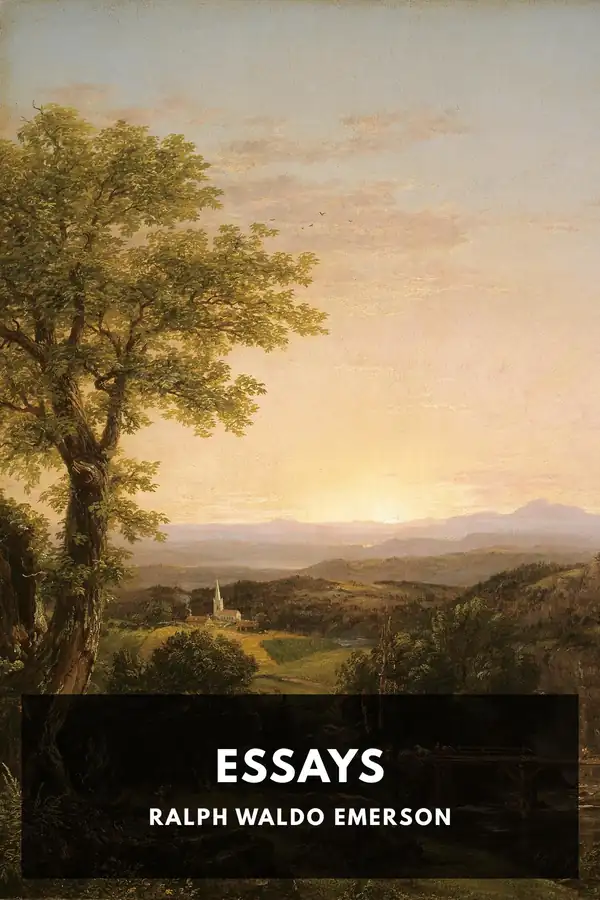
This edition follows the two volumes as Standard Ebooks prepared them: 21 essays, the endnotes, and Emerson’s own headnote to New England Reformers, which records that the lecture was read at Amory Hall on 3 March 1844. The underlying transcription is Project Gutenberg #16643, released in 2001 by Tony Adam and David Widger with the Distributed Proofreaders, and Standard Ebooks has checked it against page scans from the Internet Archive, added the endnotes and set the text in a modern typeface. The cover adapts Thomas Cole’s New England Scenery of 1839, and the three files are straight copies of one text, without digital rights management, so a page noted on a phone matches the page in a Kobo or a Kindle.
Historical Context
In August 1837 Emerson addressed the Phi Beta Kappa Society at Harvard and told the assembled scholars that the country’s long apprenticeship to the learning of other lands was ending. The address, printed as The American Scholar, asked for a literature and a thinking that would be native — not provincial, not defensive, but drawn from the ordinary life the country already lived. It was no isolated gesture: it crowned a decade of lecturing on history, biography and the philosophy of nature, and it gave the coming essays their programme. Emerson was thirty-four, little known outside New England, and entirely certain of the ground he was claiming.
The movement that formed around him took the German and English Romanticism he had absorbed in Europe and made it practical: the divinity of the individual soul, the authority of intuition over inherited doctrine, the correspondence between nature and mind. A year after the Harvard address he spoke again, at the Divinity School, and described the historical churches as cold and the ministry as emptied of life. The scandal was immediate; Harvard did not invite him back for a generation, and the young men in the audience were left to decide for themselves. Out of that quarrel came the Transcendentalist Club, the magazine The Dial, and an appetite for essays that could do in print what a lecture did in a hall.
The First Series of 1841 arrived into that quarrel. Reviewers were divided: some found the style oracular and the theology dangerous, others recognised a new kind of American prose and quoted whole paragraphs as if they were proverbs. The Second Series, in 1844, was harder going — Experience, Character and Nominalist and Realist are darker and less certain of the triumph of the will — and it confirmed the shape of a career that ran on through Representative Men, English Traits and The Conduct of Life. By then the essays had travelled far beyond Boston, and Thomas Carlyle, who had encouraged the American from the first, was reading them in London with approval.
Key Characters & Literary Archetypes
- The Scholar: The presiding figure of the First Series. In History he is the reader of his own record — “Man is explicable by nothing less than all his history” — and in The American Scholar’s programme he is the mind that turns the past into present power. Emerson gives him three teachers: nature, books and action, and warns that books are for the scholar’s idle times. He is not a professional but a type, anyone who lets the general mind work through him. Intellect finishes the portrait coolly: “Entire self-reliance belongs to the intellect.”
- The Self-Reliant Man: Emerson’s most famous creation has no biography. He is defined by an act rather than a history — “Whoso would be a man, must be a nonconformist” — and by a refusal of borrowed judgement. His enemies are consistency and the terror of opinion; his heroes are children and uneducated men, whose nonchalance he admires. He does not renounce society but declines to let society think for him. Compensation tests the creed from the other side: lose the world, and the soul is returned to its own possession.
- The Poet: “The poet is representative. He stands among partial men for the complete man,” Emerson writes, and the essay of 1844 is his portrait of that representative: a speaker who is not original in himself but conducted, whose images make the world visible again. Poets are “liberating gods” because they restore language to things and undo the deadness of custom. Emerson ends by addressing him directly — “Doubt not, O poet, but persist” — and by insisting that the self alone can never be heard too much. The figure is a channel, not a craftsman.
- The Over-Soul: Not a character but a presence, and the one that holds the two volumes together. “We live in succession, in division, in parts, in particles. Meantime within man is the soul of the whole,” Emerson writes, and the sentence is the hinge of all his thinking about God. The Over-Soul is not a person to be petitioned; it is the unanimity into which individual souls open, the reason that history repeats and that strangers understand each other. Intellect approaches the same presence with less heat and calls it mind.
- The Reformer: The reformer of 1844 was a recognisable New England type — abolitionist, temperance advocate, nonresistant, socialist, sabbath reformer — and Emerson read his lecture on them at Amory Hall on 3 March 1844. He is sympathetic and merciless at once. He notes a proposed “society for the protection of ground-worms, slugs and mosquitos”, and concludes that a project is good “when it is the dictate of a man’s genius and constitution” and dull when adopted from another. His reformer is finally the ordinary man who has changed his own life.
- The Friend: Friendship asks whether what we call affection can survive being spoken. “A friend is a person with whom I may be sincere. Before him I may think aloud,” Emerson writes, and the friend is a condition of thought rather than an object of sentiment. The essay is honest about the difficulty of being known: it looks for something better than the friends we have, and it mourns the gap between what men feel and what they manage to say. “We have a great deal more kindness than is ever spoken.”
Core Literary Themes
- Self-trust and nonconformity: The centre of the book’s ethics. Emerson’s test of a life is whether it has been lived from its own centre, and his account of conformity is psychological rather than political: we defer because we are afraid, and we are afraid because we have outsourced our judgement. Self-Reliance states the doctrine, but History, Intellect and The Poet restate it in different keys — the past is usable only when a living mind takes it up, and the intellect is reliable precisely because it is impersonal. The virtue is not independence for its own sake but fidelity to the thought that arrives.
- Compensation: the balance of loss and gain: Emerson’s answer to the problem of suffering is not consolation but arithmetic. Every advantage exacts a price, every privation opens a door, and the law holds in trade, in weather, in friendship and in ambition. Compensation is the essay that states it most symmetrically, with the poem of the black and white wings of time; Spiritual Laws gives the same intuition a religious name. The theme gives the book its poise, and it is the reason Emerson can sound serene about failure: the ledger is longer than a life, and no account closes inside it.
- The one mind: “There is one mind common to all individual men.” The sentence opens History and underwrites everything else: memory, sympathy, genius and the possibility of communication all depend on it. The Over-Soul describes the same unity as a presence, and Intellect describes it as an activity. The theme is the least fashionable part of Emerson and the most load-bearing: without it, his confidence that a stranger’s thought can be finished by another reader, and that history is biography rather than accident, would have no ground to stand on.
- Experience and the limits of knowing: The Second Series’ counterweight to the First. Experience begins with a question and never entirely answers it; temperament, mood and illusion keep dissolving the conclusions a reader has just reached. Circles supplies the method — every position is outflanked by the next — and Nominalist and Realist adds the sceptical footnote that a man is only a representative nature. The theme matters because it keeps the optimism honest: Emerson’s confidence is not certainty, and the essays that sound most assured are usually the ones that have already doubted themselves.
- Character, manners and the visible sign: Emerson is fascinated by how an inward state becomes outward: in a face, a gesture, a house, a sentence. Character describes a force that acts “by presence, and without means”; Manners asks what a gentleman signifies; Gifts measures the distance between a present and the feeling behind it; Art asks the same question about a painting. The theme gives the book its social texture, and it explains why Emerson’s abstractions are always attached to examples — a Lord Chatham in the House of Lords, a friend’s farm, a gift of flowers and fruit.
Why Download Our Custom E-Reader Edition of Essays: First and Second Series?
The edition carries the full two volumes — 21 essays and the endnotes — in one file, in the essay order of the Standard Ebooks text and with Emerson’s original headnote to New England Reformers. Nothing is abridged and no essay is replaced by a summary, so the paragraph you want to quote is where Emerson put it. Navigation runs by essay, and the titles in the table of contents match the headings in the body, which matters in a book where so many essays open with an image rather than a subject.
The text is the faithful one. It descends from the transcription at Project Gutenberg #16643, prepared in 2001, and has been read against the page scans Standard Ebooks used for their typesetting, with the endnotes supplied by their editors. Emerson’s punctuation, often odd by modern standards, has been kept; the paragraphs are his, and so is the abruptness with which they end. The result reads like the 1841 and 1844 volumes rather than like a modern abridgement of them.
Three formats are offered because readers read differently: EPUB for phones, tablets and most readers, AZW3 for Kindles, and KEPUB for Kobo devices, where it keeps page turns and chapter breaks native. All three carry the same text, the same cover and the same essay structure, and none of them needs an account, an app store or a connection once the file is on the device.
- Based on the Standard Ebooks Edition, via Standard Ebooks produced the careful modern text behind this edition, checking the transcription against page scans from the Internet Archive; their essay order, endnotes and cover are followed here without change.
- Free EPUB, AZW3 and KEPUB files Three formats, one text: EPUB for phones and tablets, AZW3 for Kindles, KEPUB for Kobos. Each carries the same essays, the same cover and working links between the contents page and the text.
- Essay-by-essay guide and reading notes The chapter list below keeps the reading order of the two volumes and gives a short note on each argument, so a reader can begin anywhere — Self-Reliance, Experience, The Poet — without losing the thread of the book.
- No sign-up, no paywall No account, no newsletter, no limit on how many files you take. The editions are free because the texts are public domain, and nothing on the page asks who you are or why you want them.
- Walden — free EPUB, AZW3 & KEPUB
- Meditations — free EPUB, AZW3 & KEPUB
- The Souls of Black Folk — free EPUB, AZW3 & KEPUB
Chapter summaries
Twenty-one essays and the endnotes, in the order the two volumes print them. The summaries below pair the shorter pieces so that each entry covers a complete argument, and the numbering follows the sequence of the Standard Ebooks text.
- Essays 1–2 — History; Self-Reliance: History opens with a single claim — “There is one mind common to all individual men” — and reads the record of the past as the biography of that mind, since the Sphinx must solve her own riddle. Self-Reliance turns the argument outward. “Trust thyself,” it begins, then “Whoso would be a man, must be a nonconformist”; the sentence about foolish consistency arrives halfway, and the close is sterner than the opening: “Nothing can bring you peace but yourself.”
- Essays 3–4 — Compensation; Spiritual Laws: Compensation is the most symmetrical essay in the book. Every advantage has its tax, every loss an opening, and Emerson states the law in images of trade, weather and the tides before applying it to friendship and ambition. Spiritual Laws begins more quietly, with the mind looking back on its own life and finding that “our life is embosomed in beauty”, and argues that virtue is a conformity to a law older than the will, whose rewards are already present in the act.
- Essays 5–6 — Love; Friendship: Love treats the passion as a training in something larger: “Every promise of the soul has innumerable fulfilments,” and the lover’s particular attachment rehearses a love that knows “not sex, nor person, nor partiality.” Friendship is cooler and more exacting. Its subject is sincerity — “A friend is a person with whom I may be sincere. Before him I may think aloud” — and its complaint is that “we have a great deal more kindness than is ever spoken.” Both essays end by asking for more than any human relation can supply.
- Essays 7–8 — Prudence; Heroism: Prudence is short and defensive in tone — “What right have I to write on Prudence, whereof I have little?” — but it makes a serious case for the virtue of the senses, “the science of appearances”, and for the household economy that keeps a life standing. Heroism answers it. Its mark is persistency, its material is contempt for safety and opinion, and its claim is aristocratic: “The heroic cannot be the common, nor the common the heroic.” Read together they balance caution against nerve.
- Essays 9–10 — The Over-Soul; Circles: The Over-Soul is the theological centre of the First Series: “We live in succession, in division, in parts, in particles. Meantime within man is the soul of the whole.” Inspiration is described as a visitation that cannot be commanded, and the essay warns that “the faith that stands on authority is not faith.” Circles is its practical twin. Everything admits of being outdone, every circle draws another, and the conclusion is an argument for abandonment: “Nothing great was ever achieved without enthusiasm.”
- Essays 11–12 — Intellect; Art: Intellect portrays thinking as an impersonal act: “Intellect is void of affection and sees an object as it stands in the light of science, cool and disengaged,” and “entire self-reliance belongs to the intellect.” Art draws the consequence for making. Because the soul is progressive and “never quite repeats itself”, imitation is failure, “not imitation but creation is the aim”, and art “must begin farther back in man” than any technique. The two essays are Emerson’s aesthetics in miniature.
- Essays 13–14 — The Poet; Experience: The Poet, first of the Second Series, defines the artist as representative: “the poet is representative. He stands among partial men for the complete man,” and poets are “liberating gods” who restore words to things. It ends by exhorting him — “Doubt not, O poet, but persist.” Experience, the longest and darkest essay, answers with doubt. It opens by asking where we find ourselves, fills its pages with temperament and illusion, and closes without triumph: “the world I converse with in the city and in the farms, is not the world I think.”
- Essays 15–16 — Character; Manners: Character describes a force that works without means: “a reserved force which acts directly by presence”, so that “all force is the shadow or symbol of that.” Emerson tells stories to make the point — Hercules and Iole, Lord Chatham in the House of Lords — and insists that a visible life is the sign of an invisible one. Manners extends the argument to the drawing room: the gentleman is “the creation” of modern history, and manners are worth only what they signify. Together they study how spirit becomes visible.
- Essays 17–18 — Gifts; Nature: Gifts is the shortest essay here and turns a social embarrassment into a rule: “Flowers and fruits are always fit presents,” because “there is no commensurability between a man and any gift”, and a present is worth only what it carries of the giver. Nature reopens the subject of the 1836 book with the perfection of an autumn day and an afternoon of Indian summer, then asks whether that calm is a promise or a deception — “Must we not suppose somewhere in the universe a slight treachery and derision?” — before nature converts itself into “a vast promise.”
- Essays 19–20 — Politics; Nominalist and Realist: Politics is the most topical essay in the Second Series. “In dealing with the State we ought to remember that its institutions are not aboriginal,” Emerson writes; “the State must follow and not lead the character and progress of the citizen,” and “the law is only a memorandum.” Nominalist and Realist is its philosophical companion, an essay about persons and types: “a man is only a relative and representative nature,” and “great men or men of great gifts you shall easily find, but symmetrical men never.”
- Essay 21 — New England Reformers: The lecture Emerson read at Amory Hall on 3 March 1844, printed with his headnote. It surveys the reform movements of the moment — temperance, nonresistance, abolition, socialism, sabbath reform — with sympathy and with mockery, noting a proposed “society for the protection of ground-worms, slugs and mosquitos.” Its judgement is that a project is good “when it is the dictate of a man’s genius and constitution” and dull when adopted from another. It closes on “the wise man wonders at the usual” and on “the life of man is the true romance.”
- Endnotes: The Standard Ebooks endnotes identify the sources Emerson cites, the people and books he names, and the phrases that have gone dark since 1844 — the Swedenborgian and Neoplatonic vocabulary, the reform societies, the painters and poets of the Second Series. They are short and unfussy, keyed to the paragraph they explain. Read them after an essay rather than during it; most of the time the argument does not need them, and when it does, they are the difference between a name and an allusion.
Essays: First and Second Series: Frequently Asked Questions
What are Essays: First and Second Series?
Do the essays need to be read in order?
What is the argument of Self-Reliance?
What does Emerson mean by the Over-Soul?
Where does the Divinity School Address fit?
Why is Experience considered the darkest essay?
Who were the New England reformers?
Where can I get the free EPUB, AZW3 and KEPUB files?
Part of: Philosophy & Essays · 19th century