Fathers and Children by Ivan Turgenev: Free EPUB, AZW3 & KEPUB Download
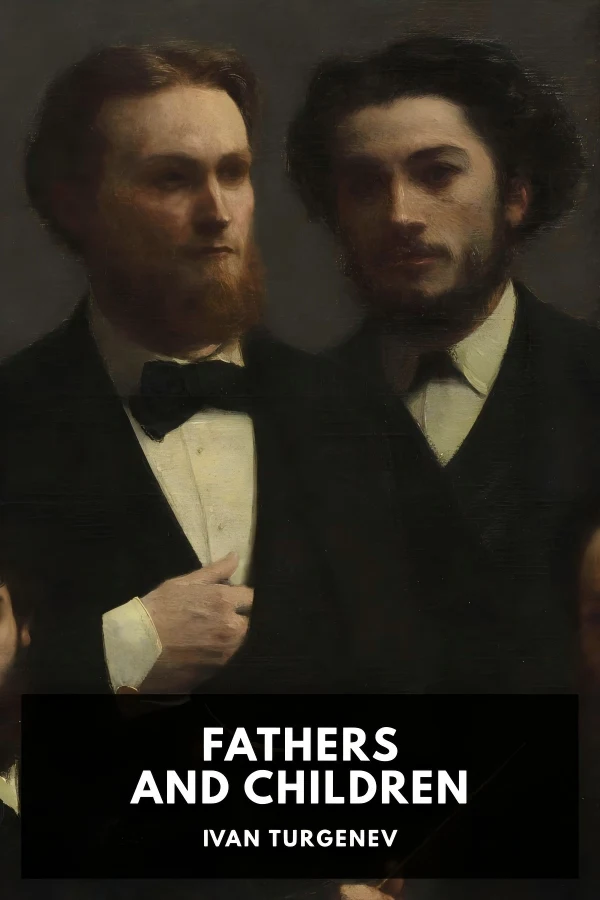
Fathers and Children
📖 Click to Read Chapter I Online Preview
Chapter I
“Well, Piotr, not in sight yet?” was the question asked on May the 20th, 1859, by a gentleman of a little over forty, in a dusty coat and checked trousers, who came out without his hat on to the low steps of the posting station at S——. He was addressing his servant, a chubby young fellow, with whitish down on his chin, and little, lacklustre eyes.
The servant, in whom everything—the turquoise ring in his ear, the streaky hair plastered with grease, and the civility of his movements—indicated a man of the new, improved generation, glanced with an air of indulgence along the road, and made answer:
“No, sir; not in sight.”
Step into the philosophical firestorm that redefined modern Russian thought. Download the complete unabridged edition for your e-reader.
Download Full EPUBFathers and Children is an 1862 novel by Ivan Turgenev, a realist work set in pre-emancipation Russia that stages the generational conflict between the older liberal gentry and the younger nihilist generation through the friendship of Arkady Kirsanov and the radical Yevgeny Bazarov, exploring themes of nihilism, science, love, family, and social change. This Standard Ebooks edition, translated by Constance Garnett (1895), is based on Project Gutenberg eBook #30723 and is in the public domain in the United States; readers outside the US should check their local laws. The text is available via Standard Ebooks.
About Ivan Turgenev’s Fathers and Children: Summary, Characters & Themes
Fathers and Children is an 1862 realist novel by Ivan Turgenev, here translated by Constance Garnett (1895). This summary and analysis follows the generational conflict between the older liberal gentry and the younger nihilist generation, staged through the friendship of Arkady Kirsanov and the radical Yevgeny Bazarov.
Set in the summer of 1859, on the eve of the emancipation of the serfs, the novel opens with Arkady Kirsanov returning home to his father’s provincial estate after graduating from university. He brings with him his mentor and friend, the medical student Yevgeny Bazarov.
Bazarov calls himself a nihilist—a man who bows before no authority, takes no principle on faith, and respects only natural science. His materialism clashes with Arkady’s uncle, Pavel Petrovitch Kirsanov, an aging aristocratic dandy who defends chivalry, art, and the traditions of the Russian nobility.
The conflict deepens when Bazarov meets Anna Sergyevna Odintsov, an elegant and independent wealthy widow. The rationalist doctor finds himself falling in love, against his own convictions. After being rejected by her, and after an absurd pistol duel with Pavel, Bazarov retreats to his elderly parents’ modest country home.
While helping to dissect a peasant who has died of typhus, Bazarov cuts his finger and contracts blood poisoning. He dies with stoic courage, summoning Odintsov for a final farewell. In parallel, Arkady turns away from radicalism toward family life and marriage to Katerina Sergyevna (“Katya”).
Historical Setting
The novel is set in 1859, on the eve of the emancipation of the serfs, a period of deep social change in Russia. It captures the rift between two generations: the older liberal gentry, represented by the Kirsanov brothers, and the younger radical generation, personified by Bazarov. Turgenev depicts both sides with sympathy rather than caricature.
Key Characters
- Yevgeny Vassilyitch Bazarov: An unbending natural scientist who rejects poetry, social conventions, and religious belief. His tragedy lies not in ideological defeat but in the discovery of his own emotional fragility in the face of love and mortality.
- Arkady Nikolaitch Kirsanov: Good-natured and sincere, Arkady enthusiastically follows Bazarov’s radical slogans at first, but his gentle nature ultimately turns toward family devotion and country life.
- Pavel Petrovitch Kirsanov: Dressed in immaculate English suits in the middle of provincial Russia, Pavel clings to dignity and aristocratic honour, making him Bazarov’s natural ideological rival.
- Nikolai Petrovitch Kirsanov: Arkady’s affectionate father, who plays the cello, reads Pushkin, and struggles to manage his estate while worrying about his growing distance from his son.
- Anna Sergyevna Odintsov: A calm, aristocratic widow who values her independence above all else. She is fascinated by Bazarov’s mind, but fears the emotional turbulence his love would demand.
- Vassily Ivanovitch and Arina Vlasyevna Bazarov: Yevgeny’s elderly parents, who adore their son with touching reverence. Their quiet grief at his grave forms the novel’s closing scene.
Core Themes
- Nihilism: Bazarov’s nihilism is not terrorism but a demand that every institution, custom, and belief justify itself before reason. The novel tests this position against love, family, and death.
- Intellect vs. Feeling: Bazarov’s rational armour breaks when romantic passion overwhelms his convictions, suggesting that the instinctive forces of human nature cannot be engineered away.
- Nature and Human Transience: The closing scene at Bazarov’s rural grave sets nature’s indifferent calm against the noisy, fleeting conflicts of human life.
Why Download Our Custom E-Reader Edition of Fathers and Children?
Ivan Turgenev’s Fathers and Children, published in 1862 on the eve of the emancipation of the serfs, introduced Yevgeny Bazarov—the archetypal literary nihilist, a medical student who rejects unproven authority and traditional institutions in favour of empirical materialism. The novel stages the generational rift between the older liberal gentry and the younger radical generation.
Automated web conversions and unformatted public domain transcriptions often mishandle a book of this kind: dropped patronymics and diminutives, flattened ideological exchanges, and lost chapter structure. This edition is built from an archival transcription rather than a re-scan, and is calibrated for modern E-ink displays.
- 1895 Constance Garnett English Translation: The full 1895 translation by Constance Garnett, presented complete in all twenty-eight chapters, without abridgment.
- 28-Chapter NCX/Nav Navigation: A fully indexed table of contents lets you move easily through the novel’s settings—from the debates between Bazarov and Pavel Petrovitch Kirsanov at Maryino, to Bazarov’s unrequited attachment to Anna Sergyevna Odintsov, the pistol duel, and his final illness.
- Typographical Layout for Long Philosophical Dialogue: Calibrated paragraph indentation, distinct formatting for French exchanges in dialogue, and consistent contrast across Kindle (AZW3), Kobo (KEPUB), and open EPUB devices.
- Verified Public Domain Sources: Based on Project Gutenberg eBook #30723 and the Standard Ebooks edition.