Metamorphoses by Ovid: Free EPUB, AZW3 & KEPUB Download
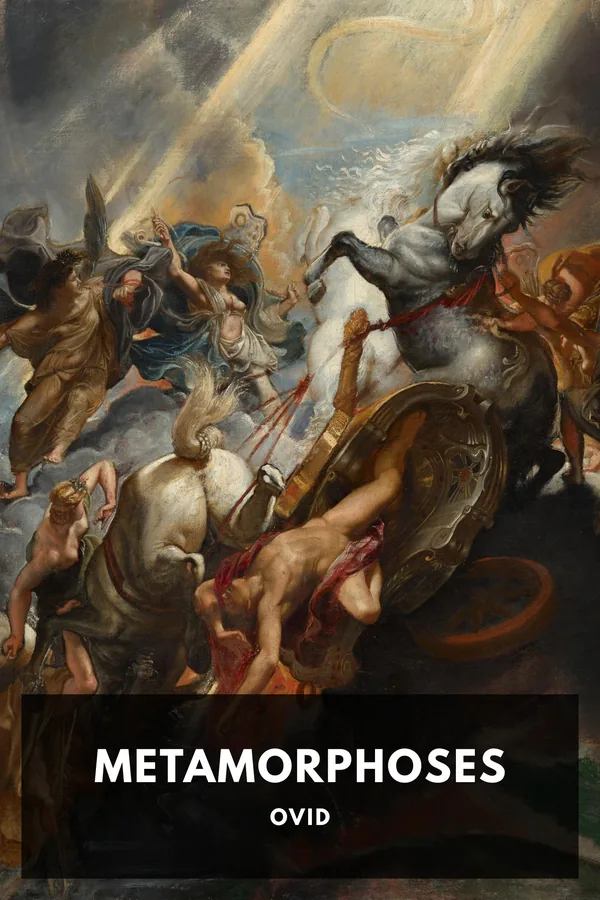
Metamorphoses
📖 Click to Read the Opening Pages Online Preview
The opening of Book I
Of bodies changed to various forms I sing: Ye gods, from whom these miracles did spring, Inspire my numbers with celestial heat, Till I my long laborious work complete; And add perpetual tenor to my rhymes, Deduced from Nature’s birth to Caesar’s times.
Before the seas, and this terrestrial ball, And heaven’s high canopy that covers all, One was the face of Nature; if a face: Rather a rude and indigested mass: A lifeless lump, unfashion’d and unframed, Of jarring seeds, and justly Chaos named. No sun was lighted up the world to view, No moon did yet her blunted horns renew, Nor yet was earth suspended in the sky, Nor poised, did on her own foundations lie, Nor seas about the shores their arms had thrown; But earth, and air, and water were in one. Thus air was void of light, and earth unstable, And water’s dark abyss unnavigable. No certain form on any was impress’d; All were confused, and each disturb’d the rest. For hot and cold were in one body fix’d, And soft with hard, and light with heavy, mix’d.
But God, or Nature, while they thus contend, To these intestine discords put an end. Then earth from air, and seas from earth, were driven, And grosser air sunk from ethereal heaven. Thus disembroil’d, they take their proper place; The next of kin contiguously embrace; And foes are sunder’d by a larger space. The force of fire ascended first on high, And took its dwelling in the vaulted sky: Then air succeeds, in lightness next to fire, Whose atoms from unactive earth retire; Earth sinks beneath, and draws a numerous throng Of ponderous, thick, unwieldy, seeds along. About her coasts unruly waters roar, And, rising on a ridge, insult the shore. Thus when the god, whatever god was he, Had form’d the whole, and made the parts agree, That no unequal portions might be found, He moulded earth into a spacious round: Then, with a breath, he gave the winds to blow, And bade the congregated waters flow. He adds the running springs, and standing lakes; And bounding banks for winding rivers makes. Some part, in earth are swallow’d up, the most In ample oceans disembogued, are lost. He shades the woods, the valleys he restrains With rocky mountains, and extends the plains.
The excerpt is the first three paragraphs of the verse. The invocation promises a song of bodies changed into new forms, from the birth of nature to the times of Caesar. Then Chaos, the rude and indigested mass in which earth, air and water lay in one, with hot and cold, soft and hard, light and heavy mixed together. Then the separation of the elements, each driven to its place, and the moulding of the earth into a round.
Download Full EPUB8 AD
Epic poem
~131,000 words (estimated)
Approx. 7.3 hours
Standalone
The Mediterranean world of myth, from the forming of the world out of Chaos to the death and deification of Julius Caesar
Fifteen books in twelve groups
EPUB · AZW3 · KEPUB
1.19 MB (EPUB) · 1.40 MB (AZW3) · 1.40 MB (KEPUB)
Public domain in the United States
Project Gutenberg #21765 · Standard Ebooks
The Metamorphoses is a poem in fifteen books, finished in 8 AD, running from the making of the world out of Chaos to the death of Julius Caesar and the praise of Augustus. Its subject is stated in its first line: bodies changed into new forms. Nymphs become trees, a boy becomes a flower, a woman becomes a bird, a statue becomes a woman, and the poem moves from one such story to the next, often letting one teller finish and another begin. The changes are punishments, escapes, rewards and memorials, and the last book turns them into a philosophy.
The verse is the 1717 translation by several hands, in rhyming couplets, and the stories are the familiar Greek and Roman ones: Daphne and Apollo, Phaethon, Narcissus and Echo, Pyramus and Thisbe, Medea, Orpheus, Daedalus and Icarus, Baucis and Philemon, and the voyage of Aeneas after Troy. Book XV gives the speech of Pythagoras on the soul passing from body to body, the bringing of Aesculapius to Rome, and the comet of Caesar. The Wikipedia article on the Metamorphoses lists the episodes book by book. — The text is available via Project Gutenberg #21765 and Standard Ebooks.

Metamorphoses by Ovid: Summary, Voices & Forms
This page gives a summary and analysis of the Metamorphoses, with the fifteen books in reading order and the stories that carry the poem from the making of the world to the death of Caesar. Ovid finished the poem in 8 AD. The text here is the verse translation published in 1717 by John Dryden, Joseph Addison, Alexander Pope and fifteen others, in rhyming couplets, with a short prose argument at the head of every book and headings over the individual stories. Those arguments and headings belong to the edition, not to the poet: they tell you in plain prose what the verse is about to do. The groups below follow the books, and the summaries are editorial. It is a long poem, and the summaries are meant to be read beside the verse rather than instead of it.
Book I makes the world, runs the four ages from gold to iron, drowns mankind and repeoples it from stones thrown behind the back, then follows Daphne into a laurel, Io into a heifer and Syrinx into reeds. Book II gives Phaethon the chariot of the sun for a day, and turns his weeping sisters into poplars and Cycnus into a swan after the fall. Book III builds Thebes from the teeth of a dragon, shows Actaeon turned into a stag and torn by his own dogs, brings Bacchus out of the thigh of Jupiter, and leaves Narcissus a flower at the fountain where he saw his face. Book IV is woven by the daughters of Minyas, who tell of Pyramus and Thisbe and the mulberry’s dark fruit, of Leucothoe and Clytie, and of Salmacis and Hermaphroditus made one body. Book IV also brings in Perseus and the head of Medusa, which Book V takes up at the wedding feast.
Book V turns Phineus and his followers to stone with the head of Medusa, and then hands the poem to the Muses, who sing of Proserpine carried off by Pluto, of Cyane dissolved into a fountain and Arethusa into a spring, while the beaten Pierides become magpies. Book VI sets Minerva against Arachne at the loom and leaves the loser a spider, kills the children of Niobe and turns her to stone, changes the peasants of Lycia into frogs, flays Marsyas, and ends with the feast of Itys and the flight of Procne, Philomela and Tereus into birds. Book VII follows Medea from the golden fleece to Athens, restores Aeson to youth and destroys Pelias, then turns the ants of Aegina into men and ends with the death of Procris. Book VIII runs from the betrayal of Nisus to the labyrinth, the wings of Daedalus, the boar of Calydon, the cottage of Baucis and Philemon, and the hunger of Erysichthon.
Book IX begins with the wrestling match between Achelous and Hercules, follows Hercules to the poisoned tunic and the pyre on Oeta, and then narrows to the griefs of Byblis and the change of Iphis on her wedding day. Book X is the book of Orpheus: the descent for Eurydice, the cypress of Cyparissus, the flower of Hyacinthus, the statue of Pygmalion given life, and Adonis gored by the boar. Book XI kills Orpheus, gives Midas the golden touch and then a pair of ass’s ears, builds Troy for a king who cheats the gods, and ends with Ceyx drowned and Alcyone leaping into the sea after him. Book XII opens the Trojan war and ends with the death of Achilles, and the book after it belongs to the quarrel over his armour.
Books XIII and XIV carry the poem from the quarrel over the armour of Achilles to the arrival of Aeneas in Italy: Ajax dead, Polyxena sacrificed, Hecuba turned into a bitch, Memnon’s ashes rising as birds, Acis a fountain, Scylla a line of rocks, the companions of Ulysses telling their stories at table, and the ships of Troy turned into sea nymphs. Book XV puts the whole poem into the mouth of Pythagoras, who argues that nothing dies but only changes shape, and then brings Aesculapius to Rome as a serpent, lifts the soul of Caesar into a comet, praises Augustus, and closes with the poet’s claim that his work will outlast fire and war. The rest of the Poetry & Epics shelf is free here, together with The Divine Comedy, which keeps quoting these transformations, and The Odyssey, the Greek poem the Roman one borrows from; the whole text is at Project Gutenberg #21765 and Standard Ebooks.
Historical Context
The poem ends where its author stood. Book XV brings Aeneas to Italy, traces the line down to Romulus, and then turns to Julius Caesar: Venus carries his soul to the sky and it kindles into a comet, after which the poet praises Augustus, the heir, and prays that the gods delay that death which will send the emperor to the seats of the gods. The edition states that Ovid finished the work in 8 AD. A poem that begins with Chaos and ends with the reigning family is a history of Rome as much as a collection of Greek fables, and the sequence of the stories is also a sequence of dynasties: the gods and heroes of Greece are made to lead into the founding of the city.
The edition is a reading text of that poem in English. Each book opens with a prose argument, a plain synopsis of what the verse will narrate, and most of the individual stories carry a shorter argument of their own under a heading such as Transformation of Daphne Into a Laurel. The arguments string their clauses together with long dashes and name every event in order, so that a reader can see the shape of a book before the couplets begin. They are the edition’s work, printed with the translation, and not Ovid’s. The colophon at the back names the eighteen translators and records that the text was transcribed from digital scans for this edition.
The translation is a composite. The colophon names eighteen translators, from Dryden and Addison to Gay, Congreve and Rowe, so the manner shifts from book to book: some passages are plain and narrative, others declamatory, and the set speeches, such as the contest of Ajax and Ulysses in Book XIII, run for pages. It was printed in 1717, and because each book had its own translator, consecutive books can sound like different poems. The Latin is hexameter, the English heroic couplet, end-stopped and rhymed, which gives the whole work a public, formal sound. The best-known line is the first, Of bodies changed to various forms I sing, which states both the subject and the promise of the poem.
Voices & Forms
- The poet’s voice: First person throughout, and seldom absent for long. It opens by asking the gods for inspiration, promises an unbroken song from the birth of nature to the times of Caesar, and returns at the very end to claim that his nobler part, his fame, shall reach the skies. The transitions between stories are usually its work.
- The rhyming couplet: The whole translation is in heroic couplets, end-stopped and balanced, one clause against another. It is the eighteenth-century English dress of a Latin hexameter poem, and it gives the narration a formal, spoken quality: the second line of a pair commonly turns the first, comments on it, or closes a transformation with a pointed remark.
- The prose argument: Before each book, and before many of the stories, the edition prints a short prose summary in the manner of a synopsis. Its clauses are joined with long dashes, and it names the characters and the changes in order, so that the verse that follows is never quite a surprise. This is editorial prose, and it is the plainest writing in the volume.
- The teller inside the poem: Many stories are told by characters to other characters: the daughters of Minyas weave and narrate in Book IV, the Muses answer the Pierides in Book V, the river Achelous entertains Theseus in Books VIII and IX, Nestor tells of Caeneus in Book XII, and Vertumnus pleads in disguise in Book XIV. The poem is a chain of such occasions.
- The set speech: Direct speech fills the poem, marked off in quotation marks and often running for pages: the council of the gods in Book I, the lament of Inachus over his lowing daughter, the debate of Ajax and Ulysses for the armour of Achilles, the lecture of Pythagoras in Book XV. These are the passages where the couplet is most rhetorical and least narrative.
- The closing token: A transformation rarely ends with the new body alone. The laurel keeps Daphne’s beauty, the peacock’s tail carries the hundred eyes of Argus, the mulberry keeps the dark colour of the lovers’ blood, the hyacinth and the cypress keep a name. The last line of a story usually explains the mark, and that explanation is how the poem ties its fables to the world the reader sees.
Core Themes
- Change as the only constant: The theory comes late, in the speech of Pythagoras in Book XV: the four elements recombine, the soul passes from body to body, and what men call death is a change of figure. All things are altered, nothing is destroyed, the translation says, and that line is the argument of the whole poem. Everything before it has been a demonstration, and the demonstration is not offered as a consolation only: the same principle dissolves cities, rivers and ages, and the poet’s own fame is a change of the same kind. The speech is long, and it is placed at the end, where it can gather up the fables instead of interrupting them.
- Desire and flight: The gods of the poem want what they see, and the nymphs and boys they want run away. Daphne, at the point of being caught, is changed into a laurel; Syrinx becomes reeds; Io becomes a heifer and is given to Juno as a gift. The transformation saves the fugitive and fixes her, and the pursuer takes the new form as a token, a tree, a pipe, a bird, so that the escape becomes the memorial of the pursuit. The pattern repeats so often that a reader learns to expect the prayer and the answer, and the cruelty and the tenderness of the poem come out of the same scene.
- Presumption and the honour of the gods: Lycaon tests Jupiter with a murdered guest and becomes a wolf; Pentheus denies Bacchus and is torn apart by his own family; Arachne challenges Minerva at the loom and hangs as a spider; Niobe boasts of her children and is left weeping as stone; Erysichthon cuts the grove of Ceres and is given a hunger that eats him. The gods are jealous of their worship, and the punishment is made to fit the insult. They are not just, and the poem does not pretend that they are: they are powerful, and their honour is the thing that must be kept. The poem lets the reader feel the weight of the insult before it shows the punishment.
- Grief and remembrance: Not every change is a punishment. Ceyx is drowned and Alcyone leaps into the sea after him, and the two become kingfishers; Baucis and Philemon, offered whatever they wish, ask to die together and become two trees; Pyramus and Thisbe stain the mulberry; Orpheus loses Eurydice twice. In these stories the new form is a monument, and the poem is careful to say what the monument keeps: a colour, a name, a habit of turning towards the sun. The tenderness of the poem is kept for these stories, and its cruelty for the ones above. The mulberry is the plainest case: its fruit is white until the blood of the two lovers darkens it, and that colour is the reason the story is told.
- From Chaos to Caesar: The frame of the poem is historical as well as cosmological. It begins with the world before form and ends with the comet of Julius Caesar and the praise of Augustus, so that the succession of fables arrives at Rome and at the poet’s own day. Book XV makes the point explicit by putting the philosophy of change in the mouth of a Greek philosopher in an Italian town, and then closing with the poet’s own fame, the last transformation the poem claims. The final lines turn from the empire to the book itself, which the poet says neither fire nor war nor age will destroy. It is a strange close for a poem of changes, since the one thing it claims to be permanent is the poem.
Why Download Our Custom E-Reader Edition of Metamorphoses?
The download is the whole poem: the fifteen books in the 1717 verse, each with its prose argument, and the edition’s headings over the individual stories. Nothing is cut, and the same text sits at Project Gutenberg #21765 if you want to compare a passage. The couplets are printed as couplets, so the shape of the verse survives on a small screen, and the arguments keep their place at the head of each book. The text is the Standard Ebooks transcription of the 1717 translation.
Around the text the page supplies what a poem of this length needs: twelve summaries that follow the books and stop where each book stops, six notes on the voices and forms the translation uses, five on the themes that hold the stories together, and a short account of the world the poem was written in. The groups are editorial, but the divisions are the edition’s own. Nothing here is meant to stand in for the verse; the notes are there to keep the stories apart.
The files come in three formats with the same text and the same book divisions. The EPUB opens in Apple Books, Calibre and most Android readers; the AZW3 is the file for a Kindle; the KEPUB is the one Kobo devices handle best. No account is needed, and nothing is locked or watermarked. A note you make in one file sits at the same place in the others, so a reading group can use different devices and still be at the same line.
- Based on the Standard Ebooks Edition, via Standard Ebooks, whose text is set from digital scans from the HathiTrust Digital Library, with the fifteen books, the prose arguments before each book and the story headings in the 1717 verse translation.
- Complete text of the fifteen books Every book from the making of the world in Book I to the poet’s closing claim in Book XV, with the flood, the loves of the gods, the war at Troy, the voyage of Aeneas and the speech of Pythagoras, nothing abridged.
- Twelve groups in the poem’s order Twelve summaries following the books, joining Books I and II, Books XII and XIII, and Books XIV and XV where the narrative runs on, each stopping where its book stops.
- EPUB, AZW3 and KEPUB files The same text in three formats, for Apple Books, Kindle and Kobo, with the book divisions intact and no account needed for any of them.
- Dante’s poem of the afterlife, which keeps quoting the transformations of Ovid and sets several of his figures among the damned and the blessed. — free EPUB, AZW3 & KEPUB
- Homer’s epic of the return from Troy, one of the Greek poems whose stories the Metamorphoses retells and reworks for a Roman audience. — free EPUB, AZW3 & KEPUB
- The shelf where this edition sits, with the rest of our free poetry and epic in English translation. — free EPUB, AZW3 & KEPUB
Canto & book summaries
This edition prints the fifteen books in the 1717 verse translation, each opening with a short prose argument, and with headings over the individual stories. The twelve groups below follow the books and join three pairs where the narrative runs on. The labels are editorial; the book numbers and the story headings are the edition’s own.
- Books I–II — Chaos, the flood, and the chariot of the sun: Book I forms the world out of Chaos, runs the four ages, drowns mankind and repeoples it from stones, then follows Daphne into a laurel, Io into a heifer and Syrinx into reeds. Book II gives Phaethon the chariot of the sun, turns his sisters into poplars and Cycnus into a swan.
- Book III — Cadmus, Actaeon, and the fountain of Narcissus: Cadmus builds Thebes from a dragon’s teeth; Actaeon, seeing Diana bathe, is turned into a stag and torn by his own dogs; Semele is consumed and Bacchus is carried in the thigh of Jupiter; Echo wastes to a voice, Narcissus to a flower, and Pentheus is torn by his mother and her sisters.
- Book IV — Pyramus and Thisbe, and the daughters of Minyas: Three sisters weave and tell tales against Bacchus: Pyramus and Thisbe and the mulberry’s dark fruit, the sun’s love for Leucothoe, Clytie into a sunflower, Salmacis and Hermaphroditus made one body. The sisters become bats, Ino leaps into the sea, Cadmus turns serpent, and Perseus turns Atlas into a mountain.
- Book V — Perseus at the feast of Cepheus, and the song of the Muses: Perseus turns Phineus and his followers to stone with the head of Medusa, then visits the Muses, who sing of Proserpine carried off by Pluto, of Cyane dissolved into a fountain and Arethusa into a spring, while the Pierides, beaten in the contest, are changed into magpies.
- Book VI — Arachne, Niobe, and the feast of Tereus: Minerva and Arachne contend at the loom, and the loser becomes a spider; Niobe, boasting of her children, sees them killed and turns to stone; peasants who refuse Latona water become frogs; Marsyas is flayed; and Procne, Philomela and Tereus end as birds after the feast of Itys.
- Book VII — Jason, Medea, and the isle of Aegina: Medea helps Jason take the fleece, restores Aeson to youth, and destroys Pelias through his own daughters; she then tries to poison Theseus at Athens. Aeacus tells how ants became the Myrmidons after a plague, and Cephalus tells how he killed Procris by mistake in the wood.
- Book VIII — Daedalus, the boar of Calydon, and Baucis: Scylla betrays her father for Minos and becomes a lark; Theseus threads the labyrinth; Daedalus loses Icarus to the sun; Meleager kills the boar and dies with the brand, his sisters becoming birds. Baucis and Philemon entertain the gods and turn into trees, and Erysichthon ends by eating himself.
- Book IX — Hercules, Byblis, and Iphis: Achelous tells of his fight with Hercules, who dies of the poisoned tunic and is made a god; Lychas becomes a rock, Galanthis a weasel, Dryope a lotus tree. Byblis dissolves into a fountain, and Iphis, raised as a boy, is changed into one by Isis before the wedding.
- Book X — Orpheus, Pygmalion, and Adonis: Orpheus goes down for Eurydice and loses her by looking back; after that he sings to the trees and the beasts, and the rest of the book is his song: Cyparissus becomes a cypress, Hyacinthus a flower, the Propoetides stones. Pygmalion’s ivory statue is given life by Venus, and Adonis, gored by the boar, becomes the anemone.
- Book XI — The death of Orpheus, and Midas: The Thracian women tear Orpheus apart and are turned into trees; Midas is given the golden touch and then a pair of ass’s ears; Troy is built for a king who cheats the gods; Thetis yields to Peleus; and Ceyx, drowned at sea, returns to Alcyone, and both become kingfishers.
- Books XII–XIII — Troy, the armour of Achilles, and Aeneas: The war begins with Iphigenia saved and a hind put in her place; Cycnus becomes a swan, Caeneus an eagle, and Achilles falls. Ajax and Ulysses argue over his armour; Hecuba becomes a bitch, the ashes of Memnon birds, and Aeneas sails, while Acis, crushed by the cyclops, becomes a fountain.
- Books XIV–XV — Aeneas in Italy, Pythagoras, and Caesar’s star: Circe turns Scylla into rocks; Aeneas reaches Italy, descends to the dead and is made a god; Pomona is courted by Vertumnus and Anaxarete turns to stone; Romulus becomes Quirinus. Book XV gives the speech of Pythagoras, Aesculapius brought to Rome as a serpent, and the comet of Caesar.
Metamorphoses: Frequently Asked Questions
What is the Metamorphoses about?
Who wrote it, and when?
Whose translation is this?
Why does each book open with a prose paragraph?
How is the poem arranged?
What does Pythagoras say in Book XV?
How does the poem treat the gods?
How do I read the free downloads?
Part of: Poetry & Epics · Ovid