Doctor Faustus by Christopher Marlowe: Free EPUB, AZW3 & KEPUB Download
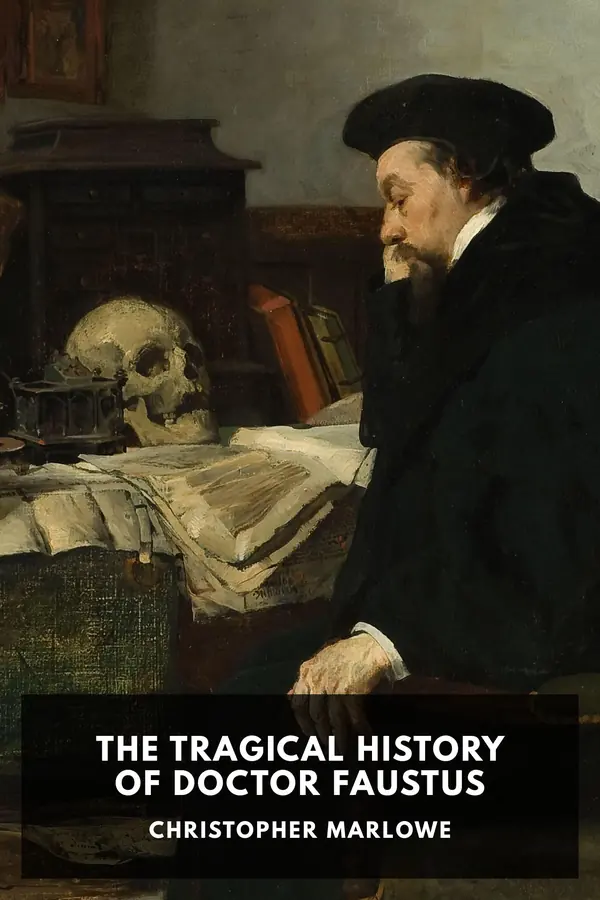
Doctor Faustus
📖 Click to Read the Opening Pages Online Preview
Settle thy studies: the opening of Scene I
Settle thy studies, Faustus, and begin To sound the depth of that thou wilt profess; Having commenced, be a divine in show, Yet level at the end of every art, And live and die in Aristotle’s works. Sweet Analytics, ’tis thou hast ravished me, Bene disserere est finis logices. Is to dispute well logic’s chiefest end? Affords this art no greater miracle? Then read no more; thou hast attained that end; A greater subject fitteth Faustus’ wit: Bid on cai me on6 farewell; Galen come, Seeing, Ubi desinit Philosophus, ibi incipit Medicus; Be a physician, Faustus, heap up gold, And be eternised for some wondrous cure. Summum bonum medicinae sanitas, The end of physic is our body’s health. Why, Faustus, hast thou not attained that end? Is not thy common talk found Aphorisms?7 Are not thy bills8 hung up as monuments, Whereby whole cities have escaped the plague, And thousand desperate maladies been eased? Yet art thou still but Faustus and a man. Couldst thou make men to live eternally, Or, being dead, raise them to life again, Then this profession were to be esteemed. Physic, farewell.—Where is Justinian?
Si una eademque res legatur duobus, alter rem, alter valorem rei, etc.
A pretty case of paltry legacies!
The preview stops after the first three paragraphs of Scene I. All sixteen scenes are in the free download below.
Download Full EPUBc. 1592
~6,000 words (estimated)
Approx. 20 minutes
Standalone
Wittenberg, Rome and the German states
Sixteen scenes and a chorus
EPUB · AZW3 · KEPUB
0.48 MB (EPUB) · 0.45 MB (AZW3) · 0.51 MB (KEPUB)
Public domain in the United States
Project Gutenberg #779 · Standard Ebooks
Doctor Faustus is Christopher Marlowe’s play of the scholar who trades his soul for twenty-four years of power. A doctor of divinity at Wittenberg, Faustus has worked through logic, medicine and law and found each of them too small, so he turns to necromancy. He conjures Mephistopheles in a grove outside the town, signs a deed in his own blood, and asks for the world. What follows is not a triumph but a tour: Rome, the Pope’s table, the Emperor’s court, a horse sold at a fair, a dish of grapes in January. Marlowe keeps the contract in view and the clock running.
The play is also an argument about what learning is for. Marlowe gives the finest poetry to the devil’s side and the plainest sense to the angels, and he lets Faustus talk himself into damnation with real skill. Between the grand scenes are prose comedies — Wagner cheating a clown, an ostler stealing a book, a horse-courser pulling a leg off — that keep the tragedy inside a world of ordinary appetite. Read Wikipedia’s article on Doctor Faustus for the two texts and the stage history. The text is available via Project Gutenberg #779 and Standard Ebooks.
Doctor Faustus by Christopher Marlowe: Summary, Characters & Themes
This page is a summary and analysis of Christopher Marlowe’s Doctor Faustus, the play in which a Wittenberg doctor of divinity sells his soul for twenty-four years of power. Faustus has mastered logic, medicine and law and found each of them too small; he turns to necromancy, conjures Mephistopheles in a grove outside the town, and demands a servant and a term of years. The bargain is written in his own blood, and the blood congeals as he writes. What he does with the time is the play’s joke and its sadness: he travels, he torments a pope, he raises Alexander for an emperor, he sells a horse, he eats grapes in January. The last hour is spent trying to stop a clock.
The terms are simple and repeated: twenty-four years of whatever he asks, with Mephistopheles to wait on him, and his soul to Lucifer at the end. Marlowe keeps the contract in view. Faustus signs it twice, once in the blood that will not flow and once after the Old Man has shamed him, and both times he asks for a book rather than for mercy. The middle of the play is a tour of what the bargain buys: a papal feast interrupted by an invisible scholar, Alexander the Great raised for the Emperor, a horse sold at a fair, a dish of grapes in January. The comedy is not decoration; it measures the price.
Christopher Marlowe was born in Canterbury in 1564, the son of a shoemaker, and took his degree at Corpus Christi College, Cambridge, before turning to the stage. Tamburlaine made his name in the late 1580s; The Jew of Malta and Edward II followed. He was killed in a Deptford tavern in 1593, at twenty-nine, before the play was printed. The dates are uncertain: Doctor Faustus may have been acted by 1592 or 1593, and the first quarto we have is from 1604. Marlowe’s blank verse, the long line that can carry a man’s ambition and then his fear in a single breath, is the instrument the play is written for.
The play has been read as a warning and as a protest, and it supports both. Faustus is a scholar who has run out of subjects, and his first speech is a set of quotations; the tragedy is that he knows exactly what he is doing and does it anyway. The best poetry goes to the devils, which has troubled moral readers for four centuries. Its descendants are easy to trace: Hamlet, written a few years later, takes the soliloquy and the delay; Frankenstein takes the student who overreaches and cannot undo it; Dorian Gray takes the bargain with a hidden cost. Each learned something from this play about putting a mind on stage, and about what it costs to get what you asked for.
This edition follows the Project Gutenberg #779 transcription of the 1604 quarto, prepared for Standard Ebooks and checked against scans of the printed text. It keeps the division into a chorus and sixteen scenes rather than acts, the plan Ward introduced and Bullen adopted, which Ellis retained because, as he says, the play is a dramatic poem rather than a regular drama. Some readings from the 1616 edition are adopted, as the Editor’s Note explains; the note also prints the longer 1616 chorus in an endnote, with the textual notes on the emendations. The Latin is left standing, the prose clowns are uncut, and Ellis’s note is printed in full, with endnotes on the quotations and the allusions.
Historical Context
The play reaches back to a German book. In 1587 Johann Spies printed at Frankfurt the Historia von D. Johann Fausten, a prose life of a wandering scholar-magician who signs away his soul; it sold well, and an English translation appeared in 1592 as The Historie of the Damnable Life and Deserved Death of Doctor John Faustus. Marlowe took the skeleton from it — the contract, the twenty-four years, the tricks at Rome and at the Emperor’s court, the horse, the grapes — and left the moralising narrator behind. The English Faust Book is a pious warning; the play is something colder and stranger.
Marlowe was at Cambridge from 1580 or 1581, took his bachelor’s degree in 1584 and his master’s in 1587, and then disappears into government business. In 1587 the Privy Council wrote to the university asking that he be allowed to take his degree, since he had been employed in matters touching the benefit of his country; the letter is the only firm evidence that he worked for the state, and it has fed a great deal of speculation about espionage. By the early 1590s he was in London writing for companies that played at the Rose, among them the Admiral’s Men, and the play’s stagecraft belongs to that theatre rather than to a printed book.
The text is a problem. The 1604 quarto is short and often ragged; a second quarto of 1609 agrees with it closely; the 1616 quarto adds scenes and rewrites others, and most editors doubt that Marlowe wrote the additions. In 1602 the Admiral’s Men paid William Bride and Samuel Rowley four pounds for additions to Faustus, which is exactly the kind of revision the 1616 text shows. This edition prints the 1604 text with a few readings from 1616, following the precedent of Dyce and Bullen. The result is the play as an Elizabethan audience first had it, with its abrupt jumps and its prose clowns left in place.
Key Characters & Literary Archetypes
- Faustus: A doctor of divinity at Wittenberg, born in Germany of base stock, who has mastered the arts and found them all too small. He is proud, eloquent and genuinely clever, and his tragedy is that he argues better than he believes. He wants power, then pleasure, then a wife, then Helen, then one more hour; each request is smaller than the last. He never quite repents and never quite despairs, and the play keeps him on stage to the end.
- Mephistopheles: A fallen spirit who serves Lucifer and, by contract, Faustus. He arrives first as an ugly devil and is told to return as an old Franciscan friar, which he does. He is courteous, literal and weary: he explains that hell is not a place but a condition, that he is in it wherever he goes, and that he would rather not discuss it. He brings books and tricks and answers, and his finest lines are the ones in which he admits what he has lost.
- The Good and Evil Angels: Two spirits who appear at Faustus’s shoulder, one urging him to read Scripture and repent, the other urging honour and wealth. They speak in short, flat couplets, and they are less characters than the argument of the play made visible. The Good Angel is never allowed to win; the Evil Angel is usually right about what Faustus will do. They are the play’s shorthand for conscience, and they are more frightening for being polite.
- Wagner: Faustus’s servant, a scholar’s man who has learned his master’s tricks and wants the wages of them. He bullies two visiting scholars with logic in the second scene, hires a clown for seven years with conjuring and the promise of lice, and inherits everything when Faustus dies. He is the link between the high tragedy and the prose world, and he is funny in a way that makes the bargain look like a trade like any other.
- Lucifer: The prince of the fallen angels, who comes in person to collect a soul already promised to him. He is majestic, short-tempered and oddly domestic: he brings the Seven Deadly Sins as a show to keep his client amused, hands over a book of shapes, and tells Faustus to think of the devil. He speaks less than Mephistopheles and frightens more, because he arrives when Faustus has begun to pray and stops him.
- Helen of Troy: The spirit of Helen, raised at the scholars’ request to be looked at, and kept afterwards as a paramour. In this text she says nothing; the famous lines are his. Marlowe makes her the last of the bargain’s promises and the most dangerous, because she is not a trick or a book but a person he wants to keep. “Was this the face that launched a thousand ships” is a question about beauty and about what it costs, and it is the play’s last moment of pleasure.
Core Literary Themes
- Knowledge and damnation: Faustus begins as a scholar, and his first soliloquy is a tour of the curriculum: logic, medicine, law, divinity. Each discipline is dismissed with a quotation, and the quotations are accurate, which is the point. Marlowe makes learning the instrument of the fall rather than its antidote. The appetite for more knowledge is not shown as wicked in itself; it becomes damnable when Faustus decides that the only thing left to know is what a devil can tell him. The play never settles whether the fault is in the desire or in the choice.
- The pact and its terms: The bargain is a legal document, and the play treats it as one. Faustus writes a deed of gift, asks for conditions, argues about the small print, and signs a second time when the first begins to look insecure. Marlowe keeps the terms on stage: twenty-four years, a servant, power over the elements, the soul delivered at midnight. The horror is contractual rather than supernatural. Faustus is not ambushed by the devil; he negotiates, and the play’s most chilling line is the one where he says the words of the deed out loud.
- Repentance refused: Again and again the play offers Faustus a way out. The Good Angel tells him to repent; the Old Man tells him that mercy is available; the scholars tell him to look up to Heaven. Each time he turns away, and the turning is always described in the same vocabulary of hardness and despair. Marlowe makes repentance a real possibility and then shows a man choosing not to take it, which is harder to watch than a man who never had the choice. The last hour is one long refusal, and it is the most dramatic thing in the play.
- Spectacle and magic: The play was written for a stage that liked shows, and it gives them: devils, dragons, a papal banquet, Alexander and his paramour, Helen, a leg pulled off and put back. The magic is not an embarrassment to be explained away; it is what the audience came to see, and it is also what Faustus has bought. Marlowe uses spectacle to make the bargain attractive and then to make it hollow. The pageants are beautiful, and every one of them is a receipt for the soul.
- The comic and the grotesque: The prose scenes are usually cut and should not be. Wagner cheating a clown, Robin and Ralph stealing a goblet, the horse-courser with his leg: these are not relief from the tragedy but its mirror, the same bargain at a lower price. The clowns conjure devils for small change and are frightened by squibs; Faustus conjures them for the world and is carried off. Marlowe’s grotesque is a form of measurement. The farce shows how ordinary the appetite for power is, and how little it takes to sell yourself.
Why Download Our Custom E-Reader Edition of Doctor Faustus?
Because the play is short enough to read in a sitting and strange enough to need a second one. The verse is quick, the scenes are short, and the prose comedies are usually the first thing a director cuts; here they are, in place, where the Elizabethan actors put them. Read the whole thing once for the story, then again for the arguments, which are better than most criticism admits.
The text is the 1604 quarto as Standard Ebooks prepares it, with the scene division kept, the Latin left standing and the prose scenes in their places. If you want to check a passage, Project Gutenberg #779 is the transcription behind this edition, and the two agree in the scenes that matter, including the blood pact and the last soliloquy.
One file per format, no account, no sample chapter and no lock on the text. The EPUB opens on a phone or a tablet, the AZW3 on a Kindle, the KEPUB on a Kobo, and all three carry the same scene breaks and the same table of contents. Download it once and it stays on the device, ready for the evening you decide to read the last soliloquy aloud.
- Based on the Standard Ebooks Edition, via Standard Ebooks, whose editors prepared this text from the Project Gutenberg transcription and checked it against scans of the printed quarto, keeping the chorus and sixteen scenes and printing the Editor’s Note that explains the readings taken from the 1616 edition.
- Free EPUB, AZW3 and KEPUB files One download for each format, so the play opens on Kindle, Kobo, Apple Books and every other reader without conversion, with working scene navigation, the dramatis personae in place and the verse lines set so that they do not reflow into prose when the font changes.
- Scene-by-scene summaries and a reading guide Twelve summaries cover the chorus and all sixteen scenes in order, with the character notes and the historical context on this page written to be read before the play or after it, and to be useful to a student, a director or anyone who wants the plot clear before the poetry.
- No sign-up, no paywall Public domain in the United States, with no account, no newsletter and no sample standing in for the book; download it, keep it, copy it to another device, and read the ending without anyone asking for an email address first.
- Hamlet — free EPUB, AZW3 & KEPUB
- Frankenstein — free EPUB, AZW3 & KEPUB
- The Picture of Dorian Gray — free EPUB, AZW3 & KEPUB
Chapter summaries
A chorus and sixteen scenes, printed without act divisions. These twelve summaries follow the play in order, from the scholar alone in his study to the devils who come for him at midnight.
- Chorus and scene 1 — The scholar in his study: The chorus sets the terms: not battles or courts but the fortunes of Faustus, born in Germany, schooled at Wittenberg, graced with a doctor’s name and then swollen with conceit until his waxen wings melt. He sits in his study and audits the curriculum. Logic is dismissed because it only teaches argument; medicine because it cannot raise the dead; law because it is servile; divinity because it says the reward of sin is death. Magic promises omnipotence, so he sends Wagner for Valdes and Cornelius, and the two conjurers promise him spirits, gold and a world.
- Scenes 2–3 — The first bargain: Two scholars ask Wagner where his master is and are answered with school logic and a joke about dinner with Valdes and Cornelius; they go to the Rector, fearing the worst. That night, in a grove, Faustus draws a circle, names Jehovah backwards and calls up Mephistopheles, then makes the devil return in the shape of a friar. The devil explains that he came of his own accord, that he serves Lucifer, and that hell is wherever he is. Faustus offers his soul for twenty-four years of voluptuousness and a servant who will do whatever he commands.
- Scene 4 — The servant’s bargain: Wagner, left behind with the books, hires a clown for seven years on the strength of a conjuring trick and the threat of lice turned into familiars. The clown bargains, takes the money, gives it back, and is finally frightened by two devils named Baliol and Belcher. The scene is a parody of the main contract: a servant buys a servant, the term is seven years instead of twenty-four, and the wage is a shoulder of mutton rather than the world. It also shows how quickly the magic has become a trade.
- Scene 5 — The deed of gift: Faustus talks himself towards the deed — “Now, Faustus, must thou needs be damned” — while the Good and Evil Angels pull at him. He cuts his arm, and the blood congeals; the words “Homo, fuge” appear on the skin, and he reads them as a trick. He signs, and Mephistopheles promises performance. Then the questions begin: where is hell, and what is it? Hell has no limits, the devil says, and wherever they are is hell. Faustus calls that a fable, asks for a wife, and is given a book of spells instead.
- Scene 6 — The seven deadly sins: Faustus repents when he looks at the heavens, and the devils work on him: heaven was made for man, so man is the better thing. The angels return, the Evil Angel insists that he will never repent, and Faustus admits his heart is hardened. He distracts himself with astronomy, then with a demand for the maker of the world, which Mephistopheles refuses. Lucifer and Belzebub arrive to remind him of his promise, and Lucifer stages the Seven Deadly Sins for his amusement, each sin introduced in prose, before handing over a book of shapes.
- Scene 7 — Rome and the Pope: The chorus sends Faustus up in a chariot drawn by dragons to prove cosmography. He reports the cities he has seen — Trier, Paris, Naples, Venice, Padua — and Mephistopheles describes Rome, its seven hills, the Tiber and the castle on the bridge. Faustus asks to be made invisible so that he can make sport at St Peter’s feast, and the scene turns to farce: dishes snatched from the Pope’s table, a friar struck on the head, and a chorus of maledictions with bell, book and candle while the invisible scholar ruins the ceremony.
- Scenes 8–9 — The ostler’s book: The chorus brings Faustus home, famous, and reports that the Emperor Carolus the Fifth has sent for him. Before that, Robin the ostler has stolen a conjuring book and means to use it on the kitchen maid; he and Ralph take a silver goblet from a vintner’s tavern, and when the vintner searches them Robin reads a nonsense spell. Mephistopheles arrives, furious at being called from Constantinople for a prank, sets squibs on their backs and turns one into an ape and the other into a dog.
- Scenes 10–11 — The court and the road: At the imperial court Faustus is asked to raise Alexander the Great and his paramour, and does it; a sceptical knight is given horns for his trouble, and the Emperor promises a reward. Then the road home: Faustus sells a horse to a horse-courser with one warning, not to ride it into water, and falls asleep. The dealer rides into a pond, the horse turns into a bottle of hay, and he comes back to pull Faustus’s leg off. Mephistopheles restores it, and Wagner arrives with an invitation from the Duke of Vanholt.
- Scene 12 — Grapes in January: At the Duke of Vanholt’s court the Duchess, great with child, longs for ripe grapes in the dead of winter. Faustus sends Mephistopheles away and has them brought fresh, then explains, in the flat prose of a lecturer, that the year is divided into two circles, so that it is summer in the other hemisphere while it is January here. The trick is small and domestic, and the duke is delighted. It is the last of the play’s pleasures, and the audience is allowed to enjoy it before the reckoning.
- Scene 13 — The scholars’ supper: Wagner has a short scene to himself. His master, he says, means to die shortly, because he has given away all his goods, and yet he is at supper with the students, carousing as though death were far off. Wagner has never seen such a feast in his life. The speech is a hinge: it tells the audience that the twenty-four years are nearly spent, and it does so from the outside, in the voice of a servant who has watched the whole bargain and will inherit the books.
- Scenes 14–15 — Helen and the Old Man: The scholars ask to see Helen of Greece, and Faustus produces her; the lines about the face that launched a thousand ships are his, and the kiss is the last thing he wants. Then the Old Man appears, offering mercy and a way back, and for a moment Faustus is ready to take it. Mephistopheles threatens him, and he signs the deed again in blood. He asks for Helen as his paramour, and the Old Man, left alone with the devils, answers them with faith and goes to his God.
- Scene 16 — The last hour: Faustus tells the scholars he is damned, and they leave him to pray. Alone, he begs the spheres to stand still, the sun to rise and make perpetual day, and the hour to stretch into a year; the clock strikes and nothing stops. He calls on Christ, then on Lucifer, then on the hills to cover him, and the devils take him off. The chorus returns to say that the branch which might have grown straight is cut, and that the wise should wonder at unlawful things rather than practise them.
Doctor Faustus: Frequently Asked Questions
What is Doctor Faustus about?
What exactly does Faustus bargain for?
How many scenes are there?
Is the 1604 text different from the 1616 text?
Is Doctor Faustus a tragedy or a morality play?
Why is Helen of Troy in the play?
Did Marlowe write the comic scenes?
Where can I download the free EPUB, AZW3 and KEPUB?
Part of: Drama & Theatre · Elizabethan England