A Connecticut Yankee in King Arthur’s Court by Mark Twain: Free EPUB, AZW3 & KEPUB Download
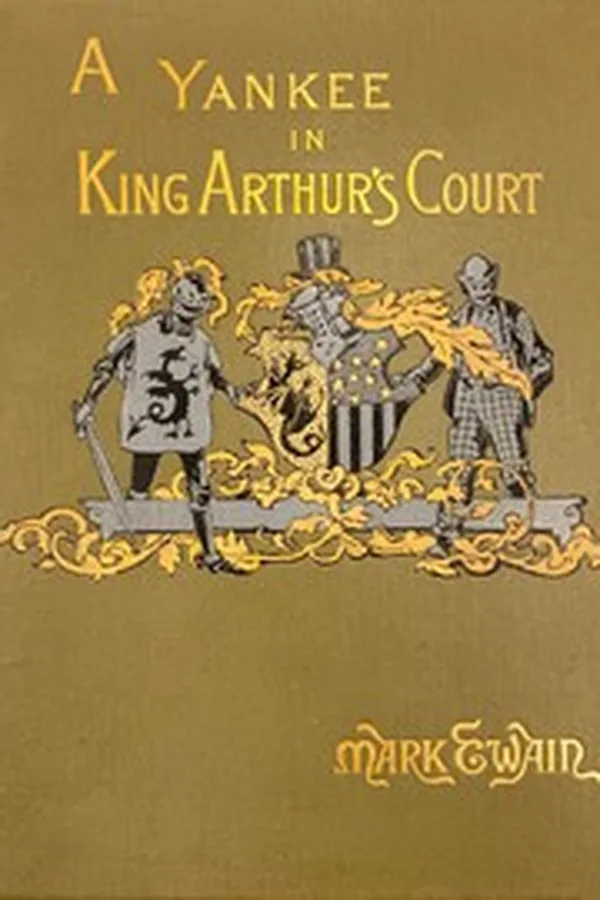
A Connecticut Yankee in King Arthur’s Court
📖 Click to Read the Opening Pages Online Preview
Chapter I: Camelot
“Camelot—Camelot,” said I to myself. “I don’t seem to remember hearing of it before. Name of the asylum, likely.”
It was a soft, reposeful summer landscape, as lovely as a dream, and as lonesome as Sunday. The air was full of the smell of flowers, and the buzzing of insects, and the twittering of birds, and there were no people, no wagons, there was no stir of life, nothing going on. The road was mainly a winding path with hoof-prints in it, and now and then a faint trace of wheels on either side in the grass—wheels that apparently had a tire as broad as one’s hand.
Presently a fair slip of a girl, about ten years old, with a cataract of golden hair streaming down over her shoulders, came along. Around her head she wore a hoop of flame-red poppies. It was as sweet an outfit as ever I saw, what there was of it. She walked indolently along, with a mind at rest, its peace reflected in her innocent face. The circus man paid no attention to her; didn’t even seem to see her. And she—she was no more startled at his fantastic make-up than if she was used to his like every day of her life. She was going by as indifferently as she might have gone by a couple of cows; but when she happened to notice me, then there was a change! Up went her hands, and she was turned to stone; her mouth dropped open, her eyes stared wide and timorously, she was the picture of astonished curiosity touched with fear. And there she stood gazing, in a sort of stupefied fascination, till we turned a corner of the wood and were lost to her view. That she should be startled at me instead of at the other man, was too many for me; I couldn’t make head or tail of it. And that she should seem to consider me a spectacle, and totally overlook her own merits in that respect, was another puzzling thing, and a display of magnanimity, too, that was surprising in one so young. There was food for thought here. I moved along as one in a dream.
The three opening paragraphs of Chapter I are printed here exactly as they stand in the 1889 text. All forty-four chapters, with Twain’s own headings, are in the free EPUB, AZW3 and KEPUB below.
Download Full EPUB1889
~121,000 words (estimated)
Approx. 6.7 hours
Standalone
Sixth-century Britain, seen from Hartford, Connecticut
12 parts
EPUB · AZW3 · KEPUB
0.39 MB (EPUB) · 0.56 MB (AZW3) · 0.43 MB (KEPUB)
Public domain in the United States
Project Gutenberg #86
A Hartford factory foreman named Hank Morgan wakes in sixth-century Britain after a blow on the head, decides the court of King Arthur is an asylum, and then decides to run it. He frightens the kingdom with a predicted eclipse, is made The Boss, and spends years planting schools, mills, a telegraph and a telephone behind the Church’s back. A quest with a talkative damsel, a journey with the king disguised as a peasant, and a spell on the slave block follow, and then the interdict, the war, and a last stand behind an electrified fence.
Twain wrote the book between 1885 and 1889, after Huckleberry Finn, and published it in 1889 with drawings by Dan Beard. Reading it is a strange ride: forty-four short chapters of farce, with a slave auction and a smallpox hut standing in the middle of the jokes, and an ending that lets the machinery loose. The Warwick Castle frame, in which a stranger hands over a manuscript, was part of the design from the start. See Wikipedia’s article on A Connecticut Yankee in King Arthur’s Court for its publication history. The text is available via Project Gutenberg #86.
A Connecticut Yankee in King Arthur’s Court by Mark Twain: Summary, Characters & Themes
This page is a summary and analysis of A Connecticut Yankee in King Arthur’s Court, the 1889 novel in which a Hartford mechanic wakes in the sixth century and sets out to modernize it. It opens at Warwick Castle, where a talkative stranger points out an old hauberk with a round hole punched through the chain-mail, and then at the Warwick Arms, where the same man reads Malory by the fire and afterward hands over a manuscript. The manuscript is Hank Morgan’s own account. Hank had been head superintendent of the great arms factory at Hartford, with a couple of thousand men under him, until a fight with a workman called Hercules and a blow on the head dropped him under an oak in Arthur’s Britain, where a knight in armour takes him prisoner and a page called Clarence tells him that the year is 528.
The author is Mark Twain, and the text of A Connecticut Yankee in King Arthur’s Court itself has a long critical history. The author is Mark Twain, and the text of A Connecticut Yankee in King Arthur’s Court itself has a long critical history. The book is a first-person memoir with a frame: Twain’s own voice opens it at Warwick Castle, hands over the manuscript, and comes back at the end to a delirious stranger. Inside, Hank narrates forty-four short chapters, several of them no more than a single scene, and Clarence closes the book with a postscript. Twain’s method is juxtaposition rather than plot: a Malory pastiche in the headings, a Hartford idiom in the dialogue, and long essays disguised as episodes, such as the dinner at Marco’s, where a blacksmith and a bailiff argue about wages and prices for six pages.
The question the book keeps setting is whether Hank is a reformer or only a showman, and my reading is that Twain makes the second answer the true one. Every improvement arrives as a trick played on credulity: the eclipse is astronomy staged as magic, the fountain is masonry passed off as a miracle, the telephone speaks out of a hermit’s cell, and the wires are buried because poles “would attract too much inquiry”. The mills and schools are real, but they are kept secret and run by a man who calls himself a magician, and when the Church issues its interdict the country goes back to its old beliefs in a day. Hank never converts the sixth century. He out-performs it, and the performance is what finally fails.
Twain worked on the novel between 1885 and 1889, in the years when he was also running a publishing house and sinking money into a typesetting machine, and it appeared in 1889 with drawings by Dan Beard and the Warwick Castle frame already in place. The frame is not an ornament. It lets Twain disown Hank’s opinions, holds the anachronism at one remove, and gives the last page its chill, when the narrator leaves a dying man who believes he is still at Camelot. Reviews were divided; readers who had loved Huckleberry Finn found the massacre at the end hard to take, and the book has been read since as a satire on privilege, on the Church, and on American confidence in machinery.
Read it in the order it was printed. The preface, A Word of Explanation and The Stranger’s History are short, and they set up the manuscript, the hole in the hauberk and the stranger’s collapse, all of which pay off in the last two pages. Then take the chapters as a series of experiments, each testing what a nineteenth-century American can do to a sixth-century kingdom: a school, a mill, a newspaper, a telephone, a trial. Watch the Church, which Hank calls the one power stronger than himself, and watch the slaves, who are the reason the comedy has a floor under it. If you want the same period from other angles, this site also carries Around the World in Eighty Days, The Time Machine and Gulliver’s Travels. The text used here is the Project Gutenberg transcription (#86), which is in the public domain in the United States.
Historical Context
Twain wrote in the 1880s, the decade in which American industry became a spectacle: telephone exchanges, electric light, the Brooklyn Bridge, and a patent office that seemed to grant a new machine every week. The book’s confidence in machinery is the confidence of that decade, and so is its unease. Twain had put his own fortune into the Paige compositor, a typesetting machine of fantastic complexity that never worked reliably, and he knew at first hand how a mechanical dream can hold a man. Hank’s mills, mines and telegraph are the same dream in a cleaner form, and the word that recurs through the novel, civilization, is used the way the age used it: as something a competent man can install.
Twain was born in 1835 in Missouri, grew up in Hannibal, and worked as a printer, a river pilot and a newspaperman. By 1885 he had published Tom Sawyer and Huckleberry Finn, and A Connecticut Yankee reads like a reaction to them: instead of a boy on a raft, a superintendent with a payroll and a grudge against pedigree. For his sixth-century material he went to Sir Thomas Malory’s Morte d’Arthur, printed by Caxton in 1485, and to histories of the early Church; the footnote in the chapter on the hermits credits Lecky and admits the details have been “greatly modified”. The Arthurian chapters quote Malory almost word for word, then let Hank interrupt him, and the joke needs a reader who knows both texts.
The sixth century the novel describes is not a historian’s. Roman Britain had collapsed, towns had shrunk, and the Church was the one institution left with a revenue, a court and a claim on belief, which is why Twain makes it Hank’s real rival. Malory’s Arthur is a fifteenth-century construction of armour, tournaments and courtly love, and Twain takes that machinery as given so that he can test it: knights who cannot be told apart inside their plate, tournaments fought for nothing, a monastery that lives on a miracle, a bishop who wins an heiress’s land. The preface is careful to say that the laws and customs are historical, not that the sixth century had them, a distinction the rest of the book cheerfully ignores.
Key Characters & Literary Archetypes
- Hank Morgan, The Boss: A Hartford mechanic who had been head superintendent of the great arms factory, with two thousand men under him, and who wakes under an oak in 528 convinced at first that he is in an asylum. He is practical, inventive, vain and sentimental, and the name The Boss is given to him by a blacksmith and then taken up by the nation. He ends as president of a short-lived republic, wounded in a cave.
- King Arthur: A king whom Hank likes and privately looks down on, and who turns out to be braver than his court. He insists on staying in a smallpox hut because “it were shame that a king should know fear”, carries a dying girl down a ladder, is sold at auction for seven dollars, and dies at Salisbury against Mordred. His decency is real and entirely powerless.
- Clarence: The page who tells Hank the year is 528 and becomes his chief executive. He is Amyas le Poulet when Hank writes to him in blood, edits the Camelot Weekly Hosannah and Literary Volcano, lays a ground wire to the military school, and brings five hundred knights on bicycles to a scaffold. In the last chapter he writes the postscript, and the voice is his.
- Sandy, or Alisande: The damsel who arrives at court with a tale of forty-five princesses held by three ogres, and who talks without stopping for the length of a book. The princesses turn out to be hogs, which does not shake her faith in the story. She marries Hank, keeps house in a borrowed castle, and names their daughter Hello-Central after a phrase she misunderstands.
- Merlin: The court magician, an old humbug whose one story is the sword in the lake and whose miracles always happen when nobody is looking. Hank humiliates him over the tower and the eclipse, outbids him at the fountain, and takes his lasso. At the end Merlin, disguised as a peasant woman, nurses Hank’s wound and hexes the cave, and dies laughing.
- Morgan le Fay: King Uriens’s queen, beautiful, capricious and murderous. She stabs her own page with a dirk for stumbling, wants an old woman burned for cursing her, and keeps a dungeon of forgotten prisoners that Hank empties. She is a landlord with a dungeon rather than a fairy-tale villain, the novel’s picture of power without law, and she pays for the page she killed only because Hank makes her.
Core Literary Themes
- The miracle as a machine: Hank never argues the sixth century out of its beliefs; he out-performs them. The eclipse is astronomy staged as magic, the ground wires are buried because poles “would attract too much inquiry”, the telephone answers “Hello Central! Is this you, Camelot?” from a hermit’s cell, and the military academy is a secret. Enlightenment arrives as a conjuring trick with a patent pending, and the novel keeps asking who is being enlightened: the crowd that kneels, or the man who needs the crowd to kneel.
- The other power in the kingdom: Hank says it himself after the tower: “there was another power that was a trifle stronger than both of us put together. That was the Church”. The interdict empties Canterbury until “there was not even a priest in sight”, the Church “laid a ban upon the electric light”, and the boys stay loyal because everyone else was born “in an atmosphere of superstition”. Twain gives the Church the one victory no machine can take back, and Hank’s schools, his newspaper and his republic are built on ground she reclaims in a day.
- Freemen who are not free: The poor Hank eats with are “not slaves, not chattels”; by “a sarcasm of law and phrase they were freemen”, bound to the lord’s mill and the lord’s harvest. Then come the coffle on the road, the auction at Cambenet where “the King of England brought seven dollars, and his prime minister nine”, and the law that makes a man prove he is not a slave. Hank’s abolitionism is anachronistic, and he knows it: he will end slavery only “by command of the nation”.
- Dismantling the tournament: The novel attacks chivalry by making it ridiculous rather than by refuting it. Tournaments are “ridiculous human bull-fights”; knights ride about with soap and tooth-brush advertisements on their backs; and in the ring Hank lassoes five of them out of the saddle before he shoots Sir Sagramor through the chain-mail. “Knight-errantry was a doomed institution”, he says, and the march of civilization has begun. The comedy does the argument’s work: once a knight has been laughed at in front of a paying crowd, no spell and no sword can restore him.
- The victory that traps its maker: The sand-belt is the book’s answer to its own fantasy. Mines, twelve concentric wires and thirteen gatling guns kill twenty-five thousand men, and then the corpses stand against the fence and poison the air. “We had conquered; in turn we were conquered”, Clarence writes, and Merlin supplies the verdict: “Ye were conquerors; ye are conquered!” The last page leaves Hank dying in the frame, calling for a drawbridge that is thirteen centuries away. Twain lets the arithmetic stand, and it is not comic: the machine that was to free the kingdom ends as a fence that kills.
Why Download Our Custom E-Reader Edition of A Connecticut Yankee in King Arthur’s Court?
This edition is built from the Project Gutenberg transcription of the first edition, with Twain’s own chapter headings, his prefaces, his footnotes and Clarence’s postscript in their printed order. Nothing is modernised or cut: the Malory pastiches keep their antique spellings, the newspaper advertisement in the tournament chapter keeps its broken type, and the notes crediting Lecky and the Morte d’Arthur stay where Twain put them. A quotation from this page will match a library copy of the 1889 book rather than a modern reset, which matters in a novel that quotes other books on purpose.
The files were made for reading on a phone. Paragraphs are spaced for a small screen, the type is a serif face that holds up in daylight, and the drop capitals of the printed book have been dropped rather than imitated at half scale. The table of contents carries the frame, all forty-four chapters and the postscript, so the reader can move between the Warwick Arms and the sand-belt without scrolling through the middle, and the twelve-part grouping on this page is only a guide to the shape of the story.
Three formats are offered. The EPUB reflows on phones, tablets and most desktop readers. The AZW3 is for Kindles, with a working table of contents and no DRM. The KEPUB is for Kobos, where it keeps page numbers and dictionary lookup. All three carry the same text, about 121,000 words or roughly six and a half hours of reading, and all three download from this page without an account. Pick the file that matches the device you read on and you will not have to convert anything.
- Project Gutenberg transcription, via Project Gutenberg #86 — the complete text, unabridged, with the chapter headings the author set.
- Readable on the reader you already own The EPUB reflows on a phone at any font size, the AZW3 opens on a Kindle, and the KEPUB keeps page numbers and dictionary lookup on a Kobo.
- Chapter marks that work Forty-four chapters, the two framing chapters and Clarence’s postscript are separate entries in the table of contents, so you can jump to the eclipse or the sand-belt without scrolling to find it.
- No DRM, no account, no fee The files download straight from this page and open in Calibre, Apple Books, Kindle or Kobo; nothing checks a licence or phones home.
- Around the World in Eighty Days — free EPUB, AZW3 & KEPUB
- The Time Machine — free EPUB, AZW3 & KEPUB
- Gulliver’s Travels — free EPUB, AZW3 & KEPUB
Chapter summaries
The book runs to forty-four chapters, a preface, two framing chapters and a postscript by Clarence. The groups below follow Twain’s own headings and keep the frame where he put it, so the order of reading matches the order of the printed book.
- Chapters I-III: Camelot and the Table Round: Hank wakes under an oak, is taken prisoner by Sir Kay, and decides that Camelot must be an asylum, since he has never heard of it. Clarence tells him the year is 528. In the great hall he watches the Round Table trade monologues about duels, sees the maimed prisoners and the iron collars, and listens to Merlin’s one story about the sword in the lake.
- Chapters IV-VI: The Eclipse: Sir Dinadan’s jokes are older than the jokes they replaced, and the court sentences Hank to death at noon. In the cell Clarence reports that Merlin has woven a spell over the door; Hank remembers the total eclipse of 21 June 528 and offers to blot out the sun. The court yields, he is made minister with a share of the revenue, and the sky goes black.
- Chapters VII-IX: Merlin’s Tower and the Tournament: Hank inventories what the sixth century lacks, from soap and matches to glass in the windows, and starts inventing. He becomes The Boss, elected by the nation, and his first official act is to open a patent office. At a tournament he watches five hundred knights, has a priest write the report in Malory’s prose, and is challenged by Sir Sagramor le Desirous.
- Chapters X-XIII: Schools in Secret, and the Freemen: Years of quiet industry follow: schools, Sunday schools, mines, a military academy nobody knows about, and telegraph wires buried out of sight. Then the quest for the forty-five princesses, the armour, and the long ride with Sandy. He eats with road-mending freemen, reads the list of their exactions, and writes to Clarence in blood about a factory for making men.
- Chapters XIV-XVII: Morgan le Fay: He smokes his pipe through the bars of his visor and six knights yield to the dragon. Sandy’s tale of Gawaine runs on for chapters while he comments from the saddle. A knight rides past with a soap advertisement on his back. At Morgan le Fay’s castle a page is stabbed for stumbling, and at the banquet the queen sends an old woman to the stake before Hank stops the rack.
- Chapters XVIII-XXI: The Dungeons and the Pigsty: Forty-seven prisoners come out of the dungeons, among them a woman who has been nine years in the dark and a man who watched his own house through an arrow-slit for twenty-two. Then the quest ends: the ogres are swineherds and the princesses are hogs, which Hank buys for sixteen pennies. On the road they fall in with pilgrims, and with a coffle of slaves being driven to market.
- Chapters XXII-XXV: The Fountain and the Examination: The abbey’s holy fountain has stopped, and its miracle is a blocked well. Hank measures the shaft, rebuilds the bath, and the water returns. A rival magician claims to know that the king is asleep; the telephone proves him wrong and he leaves on a rail. At the competitive examination a weaver’s son answers everything, and four generations of nobility decide the appointment anyway.
- Chapters XXVI-XXIX: The Newspaper and the Smallpox Hut: The Camelot Weekly Hosannah and Literary Volcano appears at two cents, and the king’s-evil ceremony is cut down to nickels and small change. King and Boss travel as peasants: Hank drills the king in humility, blows two knights apart with a bomb, and then finds a hut where a family is dying of smallpox, and the king carries the daughter out in his arms.
- Chapters XXX-XXXIII: Slaves, and a Dinner Party: Four corpses at midnight, a manor-house burned, and eighteen hanged in reprisal while the poor hunt the escaped men for their lords. Hank notices how readily the oppressed take the oppressor’s side. At Marco’s table the blacksmith Dowley boasts of his trade and his wages until the bill for the dinner is read aloud, and the argument is settled with the price of a woman’s gown.
- Chapters XXXIV-XXXVII: Sold as Slaves: Earl Grip seizes them in the market square, and they are auctioned on the block: the king for seven dollars, his minister for nine. The king is beaten for his style, sees a mother hanged for linen worth a fourth of a cent, and sees London from the inside. Hank finds a telegraph wire, forces a clerk to call Camelot, and is arrested the same afternoon.
- Chapters XXXVIII-XL: Bicycles and the Lasso: Five hundred mailed knights arrive at the scaffold on bicycles, and the crowd kneels. In the ring Hank lassoes five champions out of the saddle in a row, shoots Sir Sagramor through the chain-mail, and puts an end to knight-errantry in an afternoon. Three years later the schools and mills are public, the railway runs to London, and a duke drives the express.
- Chapters XLI-XLIV: The Interdict and the Sand-Belt: The baby is ill, the sea is empty of sails, and the Church has laid the kingdom under interdict. Launcelot’s corner in railway stock starts a war that ends with Arthur and Mordred dead at Salisbury. Hank and fifty-two boys hold the sand-belt behind mines and live wire until twenty-five thousand are dead, and Clarence writes the postscript in a poisoned cave.
A Connecticut Yankee in King Arthur’s Court: Frequently Asked Questions
Is A Connecticut Yankee in King Arthur’s Court a children’s book?
Do I need to know Malory’s Morte d’Arthur to follow it?
Is it really a time-travel story?
Who is The Boss, and where does the title come from?
How long is the novel, and how long does it take to read?
Why is the ending so violent?
What is the frame story, and does it matter?
Where can I get the complete text?
Part of: Classic fiction · Victorian novels