The Time Machine by H. G. Wells: Free EPUB, AZW3 & KEPUB Download
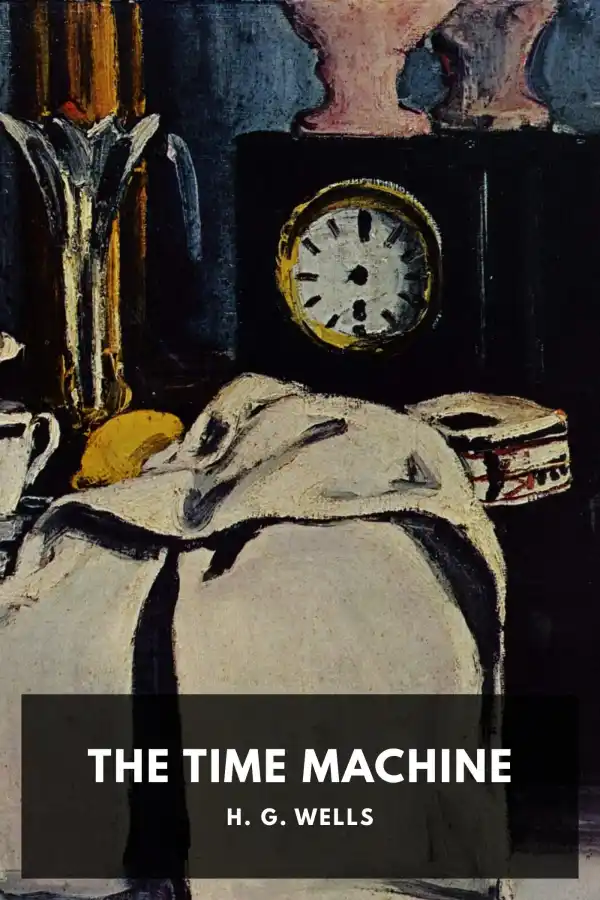
The Time Machine
📖 Click to Read Chapter I Online Preview
I
The Time Traveller (for so it will be convenient to speak of him) was expounding a recondite matter to us. His grey eyes shone and twinkled, and his usually pale face was flushed and animated. The fire burnt brightly, and the soft radiance of the incandescent lights in the lilies of silver caught the bubbles that flashed and passed in our glasses.
Our chairs, being his patents, embraced and caressed us rather than submitted to be sat upon; and there was that luxurious after-dinner atmosphere when thought roams gracefully free of the trammels of precision. And he put it to us in this way—marking the points with a lean forefinger—as we sat and lazily admired his earnestness over this new paradox (as we thought it) which he was delving into.
“You must follow me carefully. I shall have to controvert one or two ideas that are almost universally accepted. The geometry, for instance, they taught you at school is founded on a misconception.” “Is not that rather a large thing to expect us to begin upon?” said Filby, an argumentative person with red hair. “I do not mean to ask you to accept anything without reasonable ground for it. You will soon admit as much as I need from you.”
Journey into the year A.D. 802,701 and witness humanity’s twilight fate. Download the complete unabridged edition for your e-reader.
Download Full EPUBThe Time Machine is an 1895 science fiction novella by H. G. Wells, narrated by a Victorian inventor who travels to the year A.D. 802,701 and encounters the Eloi and the Morlocks—two evolved branches of humanity. The novel explores themes of evolution, class division, and the fate of civilization. This Standard Ebooks edition is based on Project Gutenberg eBook #35 and is in the public domain in the United States.
About The Time Machine: Summary, Characters & Themes
Published in 1895 by William Heinemann in London, The Time Machine is H. G. Wells’s ground-breaking debut novella. This summary and analysis covers its plot, key characters, and major themes. It coined the very term “time machine” and permanently established the genre of fourth-dimensional time travel in world literature.
Written by Wells with a background in evolutionary biology under Thomas Henry Huxley, the work is far more than a technical fantasy. It presents a dark, chilling critique of Victorian industrial class divisions and the ultimate fate of human civilization.
The framing narrative begins in a comfortable Victorian drawing room in Richmond, where an eccentric inventor known simply as the Time Traveller demonstrates a working scale model of his fourth-dimension mechanism to a gathering of skeptical dinner guests.
Hurtling into the deep future, the Time Traveller arrives in the year 802,701 AD. He discovers that the Earth has become a sun-drenched, idyllic paradise of monumental palaces and lush gardens, populated by the Eloi—a gentle, child-like, and vegetarian humanoid race.
However, the utopian illusion shatters when his time apparatus is dragged into the hollow pedestal of the White Sphinx. Investigating the subterranean depths of the planet, the Traveller confronts the Morlocks, a grotesque, nocturnal species bred in eternal dark machine tunnels.
Humanity has not ascended into enlightened perfection, but cleaved into two divergent evolutionary paths: the fragile Eloi grazing helplessly above ground, bred as cattle to feed the predatory subterranean Morlocks below. Narrowly escaping with his life and two wilting white flowers, the Traveller makes a final leap into a dying Earth’s crimson twilight before returning to recount his warning.
Key Characters & Literary Archetypes
The novella’s main characters are defined by how each embodies a stage or consequence of humanity’s evolutionary and social trajectory.
- The Time Traveller is an ingenious, intellectually daring Victorian natural philosopher who embodies humanity’s thirst for knowledge confronting the indifferent, entropic reality of cosmic evolution.
- The Eloi are child-like, emotionally shallow, and physically delicate beings living above ground. They represent the ultimate evolutionary fate of the leisure class: stripped of intellect, strength, and survival instincts by centuries of artificial ease and unchallenged comfort.
- The Morlocks are a pale, light-fearing carnivore species working mechanical machinery in the dark. Descended from the industrial working class banished underground, they embody the grim, predatory vengeance of the exploited turning to feed on their former masters.
- Weena is a young Eloi woman rescued from drowning by the Time Traveller, who bonds with him through simple affection and flower garlands. Her heartbreaking death in the forest fire emphasizes the tragic fragility of innocence in an indifferent evolutionary universe.
- The Narrator / Hillyer is the sole dinner guest willing to believe the Time Traveller’s incredible journey. Retaining the two strange alien white flowers, he serves as the emotional proxy for humanity, holding onto quiet hope while gazing into the cosmic dark.
Core Literary Themes & Historical Significance
Three major themes structure the novella’s speculative and moral argument.
- Evolutionary Degeneration vs. Social Progress: Wells directly refuted Victorian complacency and blind belief in perpetual human progress, warning that extreme capitalist class stratification would physically split mankind into two monstrous, biological sub-species.
- Thermodynamics and Cosmic Entropy: In the novella’s haunting climax, the Traveller journeys thirty million years ahead to witness a dying, frozen red sun over a silent beach populated only by giant crustaceans, illustrating the inevitable physical death of our solar system.
- The Fourth Dimension and Scientific Plausibility: Wells revolutionized speculative fiction by discarding magic, spells, or dream sequences, grounding time travel entirely in rigorous theoretical physics and modern geometry.
Why Download Our Custom E-Reader Edition of The Time Machine?
H. G. Wells’s 1895 masterpiece The Time Machine laid the foundational blueprint for modern science fiction, inventing the concept of selective chronological displacement and postulating the dark evolutionary splintering of Victorian society into Eloi and Morlocks.
Cheap automated conversions frequently wreck the text by collapsing Wells’s complex nested frame narratives, stripping the scientific dialogue formatting in Chapter I regarding the fourth dimension, or utilizing corrupted text versions that omit the final Epilogue. Our bespoke digital edition restores this seminal classic with absolute typographic precision.
- Faithful Text Based on the 1895 Edition (via Project Gutenberg #35): Sourced from a Standard Ebooks transcription of the 1895 William Heinemann text, reflecting Wells’s preferred structural sequence, philosophical pacing, and chilling final contemplation.
- Frame Narrative & Dialogue Typographical Hierarchy: Features custom CSS styling that distinctly demarcates the Victorian drawing-room dinner frame from the Time Traveller’s first-person recollection of A.D. 802,701, preventing reader disorientation and preserving crisp paragraph rhythm on low-refresh E-Ink screens.
- Engineered Multi-Format Hardware Binaries: Reflowable EPUB with clean font metrics for Apple Books and Android readers; Amazon-native AZW3 tailored with native page flow and margin kerning for Kindle Paperwhite, Oasis, and Scribe; and dedicated KEPUB enabling granular chapter progress and live reading velocity analytics across all 12 chapters and the Epilogue on Rakuten Kobo ereaders.
- Verified Public Domain Sources: The text is in the public domain in the United States and is based on Project Gutenberg eBook #35, with this edition produced by Standard Ebooks. Users outside the United States should check their local laws.