White Fang by Jack London: Free EPUB, AZW3 & KEPUB Download
White Fang
📖 Click to Read the Opening Pages Online Preview
The story begins
Dark spruce forest frowned on either side the frozen waterway. The trees had been stripped by a recent wind of their white covering of frost, and they seemed to lean towards each other, black and ominous, in the fading light. A vast silence reigned over the land. The land itself was a desolation, lifeless, without movement, so lone and cold that the spirit of it was not even that of sadness. There was a hint in it of laughter, but of a laughter more terrible than any sadness—a laughter that was mirthless as the smile of the sphinx, a laughter cold as the frost and partaking of the grimness of infallibility. It was the masterful and incommunicable wisdom of eternity laughing at the futility of life and the effort of life. It was the Wild, the savage, frozen-hearted Northland Wild.
But there was life, abroad in the land and defiant. Down the frozen waterway toiled a string of wolfish dogs. Their bristly fur was rimed with frost. Their breath froze in the air as it left their mouths, spouting forth in spumes of vapour that settled upon the hair of their bodies and formed into crystals of frost. Leather harness was on the dogs, and leather traces attached them to a sled which dragged along behind. The sled was without runners. It was made of stout birch-bark, and its full surface rested on the snow. The front end of the sled was turned up, like a scroll, in order to force down and under the bore of soft snow that surged like a wave before it. On the sled, securely lashed, was a long and narrow oblong box. There were other things on the sled—blankets, an axe, and a coffee-pot and frying-pan; but prominent, occupying most of the space, was the long and narrow oblong box.
In advance of the dogs, on wide snowshoes, toiled a man. At the rear of the sled toiled a second man. On the sled, in the box, lay a third man whose toil was over,—a man whom the Wild had conquered and beaten down until he would never move nor struggle again. It is not the way of the Wild to like movement. Life is an offence to it, for life is movement; and the Wild aims always to destroy movement. It freezes the water to prevent it running to the sea; it drives the sap out of the trees till they are frozen to their mighty hearts; and most ferociously and terribly of all does the Wild harry and crush into submission man—man who is the most restless of life, ever in revolt against the dictum that all movement must in the end come to the cessation of movement.
The preview stops after the opening paragraphs of Part I. The complete text — all twenty-five chapters, from the frozen wild to the Santa Clara valley — is in the free download below.
Download Full EPUB1906
~75,000 words (estimated)
Approx. 4.2 hours
Standalone
Yukon Territory and the Santa Clara Valley, California
Chapter summaries
EPUB · AZW3 · KEPUB
0.41 MB (EPUB) · 0.51 MB (AZW3) · 0.43 MB (KEPUB)
Public domain in the United States
Project Gutenberg #910
A wolf-dog is born in a cave above a frozen creek, taken from it by a man with a club, harnessed to a sled, sold for whisky to a man who stages dogfights, and finally carried half dead into a cabin by a stranger who will not give up on him. Jack London keeps the story close to the animal: White Fang knows scent, weight and the will of the gods, and is never once handed a human thought to explain himself with. What holds the book together is that the world arrives in the order he learns it, as meat, then fire, then laughter, then law.
Published in 1906, it is the mirror of The Call of the Wild: Buck is a dog pulled back towards the wild, White Fang a wolf pushed into the Southland, and both are settled less by breed than by the hands around them. The Klondike here is a working country of fish camps, fur bales, steamers and dog pens, and its cruelties are ordinary rather than gothic, which is why they still land. White Fang has stayed in print for a century on that plainness. Few adventure novels of the period are so unsentimental about their own hero. The text is available via Project Gutenberg #910.
White Fang by Jack London: Summary, Characters & Themes
This summary and analysis of White Fang follows one animal from a clay cave above a frozen tributary to a ranch lawn in the Santa Clara Valley, where the last page leaves him drowsing in the sun. He is not a dog and not quite a wolf: his mother Kiche is half dog, his father One Eye a full wolf, and London gives the quarter of dog in him almost no outward sign — “The quarter-strain of dog he had inherited from Kiche had left no mark on him physically, though it had played its part in his mental make-up.” What the novel traces instead is how a creature without words is shaped by hands, whips, laughter and meat, and how much of what he becomes is decided before his first birthday. Jack London had been in the Yukon himself in 1897 and 1898, and the cold in the book is remembered rather than researched. That quarter of dog is the novel’s quiet argument, tested to the last page.
The first two parts belong to the wolves. Two freighters, Bill and Henry, haul a long narrow box down the frozen river through a famine winter, with six dogs, three cartridges and a pack shadowing them; the box holds a dead man being taken home for burial, and the men talk about him as freight. The she-wolf calls the dogs out one at a time, Bill goes after the last one and is eaten, and Henry is rescued with a story nobody believes until he tells it. The same she-wolf then leads the pack, is courted by a young leader and an old one-eyed wolf, and takes the old wolf north. Their cub is born in a cave in an overhanging bank, learns his mother’s nose and paw as law, loses his father to a lynx, and finds that the world beyond the cave mouth is a wall of light and teeth. Nothing in these first parts is explained; it is simply watched.
Part three belongs to men. Five Indians sit at the cave mouth, a hand is bitten and a club answers it, and the she-wolf is recognised by her old name and tied to a stick. The cub is named in a sentence — “His fangs be white, and White Fang shall be his name” — and from that moment the book is about ownership. Lip-lip, a larger puppy, makes his life a persecution, and White Fang answers it by becoming a thief, a killer of stragglers and a runaway. He hides in the woods on purpose when the village moves to the fall hunt, finds himself alone in a country he has never had to feed himself in, and follows the river for thirty hours on cut feet. The man who should beat him for it gives him half a lump of tallow instead, and the covenant is made. The camp gives him a name, a harness and a grudge, in that order.
Part four belongs to the gold rush and to a man called Beauty Smith. At Fort Yukon in the summer of 1898 White Fang meets white men for the first time and decides that they are superior gods; their dogs, he decides, are worth nothing at all. Grey Beaver drinks himself into a thirst, refuses money, and finally sells the dog for bottles of whisky. Beauty Smith keeps him chained in a pen, teases him, laughs at him until the laughter is the worst thing in the world, and turns him into the Fighting Wolf, five feet long and over ninety pounds, unbeaten until a faro-dealer brings the first bull-dog in the Klondike. The fight with Cherokee is the turning point of the novel, and the man who prises the jaws apart is not a dog man but a mining engineer with a revolver, a temper and a dog-musher called Matt. The turn from fair fight to farce is one of the book’s coldest jokes.
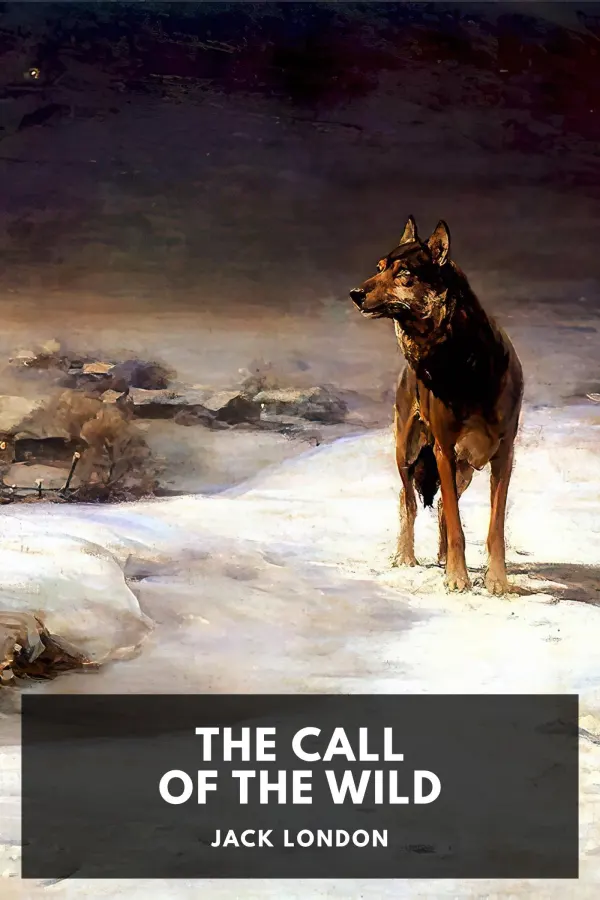
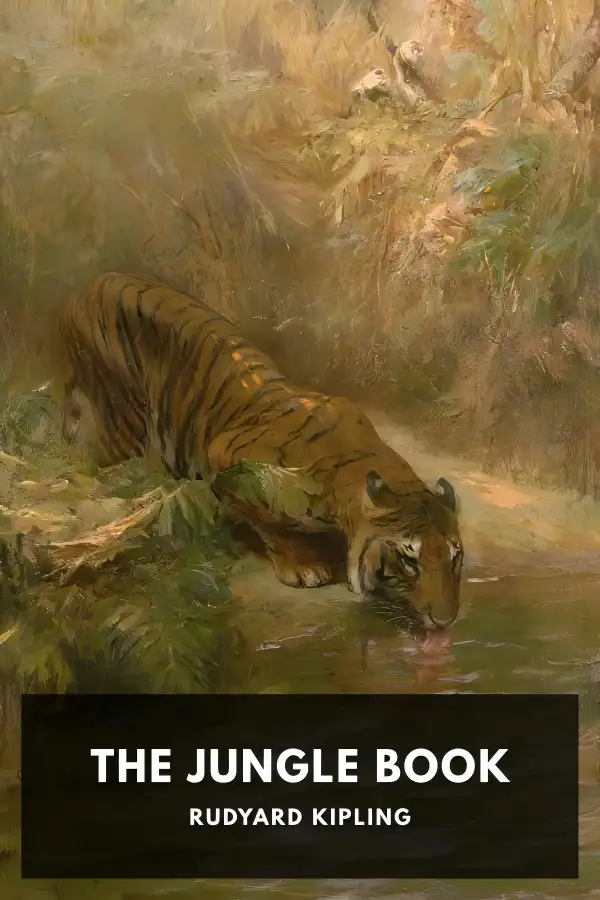
Part five belongs to California, which White Fang finds loud, crowded and thick with laws. Chickens are not meat, a judge’s sheep-dog may bite him without reprisal, and a household of people has to be sorted by favour before it can be obeyed. The novel ends with an escaped convict on the stairs, three bullet wounds, a long convalescence, and the animal the women call the Blessed Wolf lying still while Collie’s puppies tumble over him. Readers who want It is a domestic ending for a book that began with a wolf pack on a frozen river, and the contrast is meant to be felt. the other direction of the same journey can take The Call of the Wild, where a dog goes north into the wild, or The Jungle Book, where a boy is raised by wolves and taught their law. The text used here is the complete transcription at Project Gutenberg #910.
Historical Context
The Klondike strike came in August 1896 on Bonanza Creek, and by the summer of 1898 some thirty thousand stampeders had crossed the passes to Dawson, most of them far too late for a claim and many of them ruined by the cost of getting there. Dog teams carried the freight that horses could not feed, and in a country where money was short and meat was the real currency a good sled-dog was worth three hundred dollars, as Matt the dog-musher says in the novel. London’s Fort Yukon, with its steamers, fur bales, whisky and soft southern dogs coming ashore, is that economy seen from the landing, where a man’s fortune can be a case of bottles. Whisky, not coin, is what finally buys White Fang, a fair measure of how the fur trade settled its accounts.
London had been in the Yukon for the winter of 1897 and 1898 and came home with scurvy and no gold. He used the trip for The Call of the Wild in 1903, for White Fang three years later, and for dozens of stories in between, and by 1906 he was among the most widely read writers in the United States. The animal story was a popular form that year, and London wrote against its softness: his wolves starve, his dogs are sold, his men are mostly after money, and the violence is usually described as work somebody is paid to do. He wrote most of it in California, from notes and memory, which is one reason the cold in the book is felt rather than merely described.
Contemporaries read White Fang as a boys’ adventure and a companion to the earlier dog book, and it sold on both counts. Later criticism noticed how systematically it argues about heredity and environment, the questions Darwin had put into general circulation, and how carefully it keeps human interiority out of the frame. The Klondike it describes is also a reported one: the steamers, the fur trade and the dogfights staged outside Dawson at night to stay clear of the mounted police were all newspaper material, which is part of why the cruelty reads as reportage rather than as invention. The novel’s success helped fix the wolf-dog in the popular imagination, and the stage and film versions that followed kept it there.
Key Characters & Literary Archetypes
- White Fang: Three-quarters wolf and one-quarter dog, grey as his father and with two eyes to One Eye’s one. He is quick, tenacious and dangerous, and the novel’s real subject is how much of that is made by other hands: a cave, a club, a whip, a fire, a laugh. By the last chapters he can be gentle, but only where gentleness has been proved safe, and the process by which he decides that is the plot. His body is the record of every beating it took to make him obedient.
- Kiche: White Fang’s mother, half wolf and half dog, the she-wolf who takes the sled dogs one at a time in Part I and later kills a lynx to keep her cub fed. Called back to the fire by her own name, she accepts the harness and then a debt-sale that takes her away from her son; when he meets her again a year later she has forgotten him entirely and drives him off with her teeth, three times, while he stands his ground and does not fight back. She does not turn her head.
- One Eye: White Fang’s father, an old wolf with a single eye who wins Kiche by letting the young leader stop to lick a wound, and then taking his throat. He is “wise, very wise, in love even as in battle”, a provider who robs rabbit snares and learns that there is “such a thing as Chance”. A lynx kills him before his cub is properly weaned, and the family’s luck turns with him. He is the only provider the cub ever has, and the loss is total.
- Grey Beaver: The Mackenzie hunter and trader who names the cub, feeds him, harnesses him and finally sells him. He is not cruel in Beauty Smith’s way; he is an owner, and the book is careful about his justice — he beats White Fang himself and will not let other men’s dogs do it. Whisky costs him a dog he had sworn was not for sale at any price, and he goes home up the Porcupine without him. He is a trader before he is a master.
- Beauty Smith: The Fort Yukon cook, a coward with a heavy jaw and yellow teeth, who buys White Fang with bottles of whisky and turns him into a fighting dog for money. Laughter is his instrument, and the novel is precise about why it works on this animal. He is cruelty in a weak man, revenging himself on creatures weaker than he is, and his godhead over White Fang is real to the dog even when it is contemptible to every other man in the fort. He wins every fight he bets on except the last.
- Weedon Scott: The mining engineer who pulls Cherokee off White Fang, pays for the dog where he stands, and then spends weeks proving that a hand can be safe. His patience is the counter-argument to the club, and his father’s ranch in California is where the wolf has to learn that chickens are not meat and that a sheep-dog may bite him without reprisal. He is also the first man in the book to talk to White Fang rather than at him. His father’s ranch is a world with more laws than the trail.
Core Literary Themes
- Heredity and the clay: London keeps returning to the metaphor of clay: “The clay of him had been so moulded.” White Fang is three-quarters wolf, but the book refuses to let blood settle the outcome. Environment presses the shape — a cave, a camp, a cage, a cabin — and the animal that killed for Beauty Smith can lie still while puppies climb over him. The argument is naturalist without being fatalist, since the whole last part is a demonstration that a creature made vicious by one set of hands can be remade by another. London calls the process moulding, and the potter is never named.
- The covenant with man: Domestication is described as a bargain rather than a friendship: the ancient covenant the first wolf made when it came in from the Wild. White Fang trades liberty for food, fire and protection, and gives service of “duty and awe, but not of love”; he does not know what love is when the bargain is struck. The book is honest that a covenant can be one-sided, with a club behind the god, and that a dog may keep faith with a master who has already sold him twice. The dog keeps his side of it long after the man has broken his.
- Cruelty, laughter and the mad god: Beauty Smith rules by torment, and his sharpest tool is derision: laughter sends White Fang into transports of rage, and the man works out the trick early. London ties this to powerlessness, since Smith is a coward who revenges himself on creatures weaker than he is, and makes the point that cruelty needs no intelligence, only an audience and a victim who cannot answer back. The dogfighting chapters are the darkest in the book and are written as business, with bets, exhibitions and fifty cents a head in gold dust. The crowd is as much a part of it as the man with the stick.
- The Wild and the Southland: The North is a law rather than scenery: “the Wild, the savage, frozen-hearted Northland Wild.” The last part moves to orchards, electric cars, a judge’s lawn and a kitchen full of hens, and the question is whether a creature shaped by the trail can learn a garden’s rules. The chickens episode makes the point as comedy, with a bet and a counting judge; Jim Hall makes it seriously, when the old violence turns out to be exactly what the household needs and the only thing standing between a family and a man with a gun. The garden turns out to need the wolf quite as much as the wolf needs the garden.
- A life told from inside an animal: The narrative stays inside White Fang’s senses. He has no word for justice or love, only for what smells of safety and what tastes of meat, and London names his feelings in the animal’s own currency: awe, law, the will of the gods, the thing that must be obeyed. That is why the cruelties land without commentary. The reader judges what White Fang can only endure, and the gap between the two carries most of the novel’s moral weight, along with most of its suspense. Sentence by sentence the prose stays at the level of smell and weight and heat.
Why Download Our Custom E-Reader Edition of White Fang?
This is the complete novel: five parts, twenty-five chapters, from the trail of the meat to the last afternoon in the sun, in the order London published them. Nothing is abridged, no chapter is replaced by a summary, and the named chapters keep the titles they were given in 1906, from The She-Wolf to The Sleeping Wolf. The book still opens on the trail of the meat and closes in the sun, exactly as London ordered it.
The text is set for reading rather than for scanning. Paragraphs reflow, dialogue keeps its own lines, and the part headings stay visible, so the five-part shape of the book does not disappear on a phone screen. EPUB for most readers, AZW3 for Kindle, KEPUB for Kobo; all three come from the same transcription. Headings mark the five parts, so a reader can see at a glance when the story has left the Yukon for California.
The guide on this page is meant to be checked against the book, not to stand in for it: every quotation can be found in the text you download, the chapter summaries stop short of the last page’s image, and nothing here is invented to fill a gap in the story or in London’s life. It is short enough to read in an evening or two, and long enough that the last chapters have to be earned.
- Project Gutenberg transcription, via Project Gutenberg #910 — the complete 1906 text, all five parts and twenty-five chapters, checked line by line against the transcription.
- Unabridged, twenty-five chapters The whole narrative, including the chapters adaptations tend to cut: the famine, the puppy team, the days in the pen at Fort Yukon, and the long convalescence at Sierra Vista.
- Three formats, one text EPUB, AZW3 and KEPUB are built from the same transcription, so chapter breaks and part headings match on every device and every reader app.
- Free and DRM-free No payment, no account, no copy protection, no email address. Download once and keep it for as long as you want it.
- The Call of the Wild — free EPUB, AZW3 & KEPUB
- The Jungle Book — free EPUB, AZW3 & KEPUB
- Treasure Island — free EPUB, AZW3 & KEPUB
Chapter summaries
Twenty-five chapters in five parts; this guide groups them into twelve movements.
- Part I, Chapters –: The Trail of the Meat: Bill and Henry haul a long, narrow box down the frozen Yukon (it holds a man being taken home for burial) with six dogs, three cartridges and a starving pack behind them. The she-wolf calls the dogs out one at a time, and a feeding count comes to seven shapes and only six dogs. Bill goes after the last one and does not come back. Henry holds camp with firebrands and a pine-knot tied to his hand until a relief party reaches him and hears his story. The dead man is freight to them, and they argue about him.
- Part II, Chapters –: The Battle of the Fangs: The she-wolf runs with the pack, and three suitors follow her. After the pack pulls down a bull moose of over eight hundred pounds, One Eye lets the young leader pause to lick a wound and takes his throat, then leads her north. They rob rabbit snares, loiter near an Indian camp and are driven off by a rifle shot, and she finds a cave in an overhanging clay bank above a frozen tributary. Five cubs are born there; only the grey one matters. The courtship is decided by patience, not strength.
- Part II, Chapters –: The Grey Cub: The grey cub takes his father’s colour and has two eyes to One Eye’s one. His mother’s nose and paw are the first law he knows; famine takes the rest of the litter, then his father, killed by a lynx. He breaks through the wall of light at the cave mouth by accident and learns the outside with a woodpecker’s beak, seven ptarmigan chicks swallowed in a nest, a ducking in the creek, and a weasel’s teeth closing on his throat until his mother arrives. Everything he meets is either meat or danger.
- Part II, Chapter 5: The Law of Meat: A lynx kitten is the bait and the mother lynx comes to the cave; Kiche kills it in a fight that leaves her sick for a day and a night and opens the cub’s shoulder with one paw. The lesson is stated plainly: “The aim of life was meat. Life itself was meat. Life lived on life.” The cub grows, hunts for himself, and is proud of it, and the section ends on a small, happy animal who has learned what he is for. The law arrives as a fact of the body, not as an idea.
- Part III, Chapters –: The Makers of Fire: Five Indians sit at the cave mouth, and a clout on the head teaches the cub what a god is. A man names him — “His fangs be white” — and the woman who calls Kiche by name takes her back to the fire. In camp, Lip-lip makes his life a persecution, and White Fang answers by learning to steal and to fight. Then Grey Beaver pays a debt with Kiche, and the cub is left behind with a god who can be bought. He is owned twice in the same chapter, and only notices once.
- Part III, Chapters –: The Outcast: Hated by the dogs and feared by the children, White Fang becomes a sneak who waylays stragglers and kills one young dog by the throat. When the village moves to the fall hunt he hides in the woods on purpose, then finds the camp gone and follows the river for thirty hours on cut feet. He comes back expecting a beating and is given half a lump of tallow instead, and the man’s hand on his head is the beginning of a loyalty he will not break. The tallow scene is the hinge of the whole novel.
- Part III, Chapters –: The Covenant and the Famine: Harnessed beside Mit-sah’s puppy team, White Fang pulls all day, and Lip-lip, tied at the end of the longest rope, is whipped by the driver and hated by the team he seems to lead. In April he comes home a year old, beats old Baseek over a shin-bone and is accepted by the grown dogs. Famine in his third year drives him into the woods, where he lives on squirrels and mice, robs snares, kills a young wolf, and finally meets Lip-lip at a corner of rock. The team is whipped into line behind a dog it hates.
- Part IV, Chapters –: The Enemy of His Kind: As sled leader he is hated by the team and hates back. At Fort Yukon in the summer of 1898 he meets white men, decides they are superior gods, and finds their dogs soft and badly made; he kills them for sport and lets the Indian pack take the beating. Beauty Smith watches and wants him. Grey Beaver drinks himself into a thirst and sells the dog for bottles of whisky, and White Fang is beaten, chained, and bought by a man he cannot respect. He is sold for whisky, which is what the fort actually trades in.
- Part IV, Chapter 3: The Reign of Hate: In a pen behind the fort Beauty Smith teases him, laughs at him and teaches him to hate without reason. White Fang becomes the Fighting Wolf, five feet long and over ninety pounds, and beats a mastiff, three dogs in succession, a trapped wolf and two at once. At Dawson he is exhibited for fifty cents in gold dust and stirred awake with a stick when he tries to sleep. When nothing left can beat him, a faro-dealer arrives with the first bull-dog in the Klondike.
- Part IV, Chapters –: The Clinging Death: Cherokee’s jaws close on White Fang’s throat and shift upwards by slow chewing while the crowd bets. Weedon Scott comes out of the crowd, knocks Beauty Smith down, prises the jaws apart with his revolver muzzle and buys the dog for a hundred and fifty dollars, half the price of a good sled-dog. In the cabin, White Fang’s first answer to an offered hand is to tear it open, and Matt reaches for the rifle that would end him. The price is half the going rate, and the man who pays it is not a dog man.
- Part IV, Chapter 6 and Part V, Chapter 1: The Love-Master: Scott feeds him from the hand, sits at a distance and waits, and the growl slowly changes register. When Scott leaves for Circle City, White Fang stops eating and howls as dogs howl when their masters lie dead; he cuts himself getting out and is taken aboard the Aurora. On deck Scott asks him to growl a last good-bye, and White Fang refuses, pushes his head under the man’s arm, and goes south. It is the last place in the book where the club is still an option, and the rifle is on the table.
- Part V, Chapters –: The Southland: San Francisco terrifies him. At Sierra Vista he learns the law of the domain the hard way, with fifty dead Leghorn hens and a judge who says a chicken-killer can never be cured. Collie bites him and he cannot answer a female. Jim Hall, out of San Quentin to kill the judge, comes up the stairs at night, and White Fang takes him down and nearly dies of three bullets. The book ends with him drowsing in the sun while Collie’s puppies tumble over him.
White Fang: Frequently Asked Questions
What is White Fang about?
Who wrote White Fang?
Is White Fang a wolf or a dog?
Is it a sequel to The Call of the Wild?
Where is White Fang set?
Is White Fang suitable for children?
How does White Fang end?
Where can I read the complete text of White Fang?
Part of: Classic Fiction · Adventure and Sea Stories