The Theory of the Leisure Class by Thorstein Veblen: Free EPUB, AZW3 & KEPUB Download
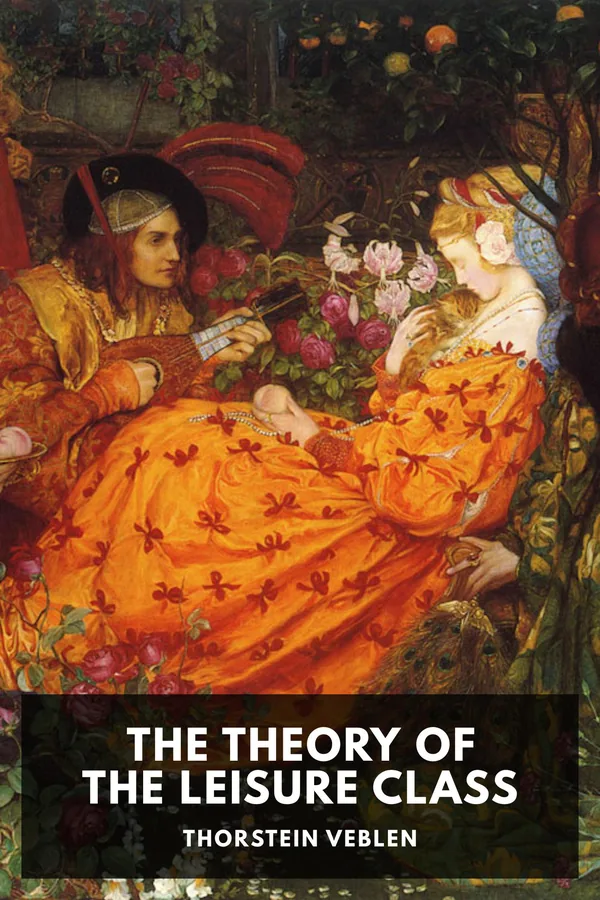
The Theory of the Leisure Class
📖 Click to Read the Opening Pages Online Preview
The opening of Chapter 1
The institution of a leisure class is found in its best development at the higher stages of the barbarian culture; as, for instance, in feudal Europe or feudal Japan. In such communities the distinction between classes is very rigorously observed; and the feature of most striking economic significance in these class differences is the distinction maintained between the employments proper to the several classes. The upper classes are by custom exempt or excluded from industrial occupations, and are reserved for certain employments to which a degree of honour attaches. Chief among the honourable employments in any feudal community is warfare; and priestly service is commonly second to warfare. If the barbarian community is not notably warlike, the priestly office may take the precedence, with that of the warrior second. But the rule holds with but slight exceptions that, whether warriors or priests, the upper classes are exempt from industrial employments, and this exemption is the economic expression of their superior rank. Brahmin India affords a fair illustration of the industrial exemption of both these classes. In the communities belonging to the higher barbarian culture there is a considerable differentiation of subclasses within what may be comprehensively called the leisure class; and there is a corresponding differentiation of employments between these subclasses. The leisure class as a whole comprises the noble and the priestly classes, together with much of their retinue. The occupations of the class are correspondingly diversified; but they have the common economic characteristic of being nonindustrial. These nonindustrial upper-class occupations may be roughly comprised under government, warfare, religious observances, and sports.
At an earlier, but not the earliest, stage of barbarism, the leisure class is found in a less differentiated form. Neither the class distinctions nor the distinctions between leisure-class occupations are so minute and intricate. The Polynesian islanders generally show this stage of the development in good form, with the exception that, owing to the absence of large game, hunting does not hold the usual place of honour in their scheme of life. The Icelandic community in the time of the Sagas also affords a fair instance. In such a community there is a rigorous distinction between classes and between the occupations peculiar to each class. Manual labour, industry, whatever has to do directly with the everyday work of getting a livelihood, is the exclusive occupation of the inferior class. This inferior class includes slaves and other dependents, and ordinarily also all the women. If there are several grades of aristocracy, the women of high rank are commonly exempt from industrial employment, or at least from the more vulgar kinds of manual labour. The men of the upper classes are not only exempt, but by prescriptive custom they are debarred, from all industrial occupations. The range of employments open to them is rigidly defined. As on the higher plane already spoken of, these employments are government, warfare, religious observances, and sports. These four lines of activity govern the scheme of life of the upper classes, and for the highest rank—the kings or chieftains—these are the only kinds of activity that custom or the common sense of the community will allow. Indeed, where the scheme is well developed even sports are accounted doubtfully legitimate for the members of the highest rank. To the lower grades of the leisure class certain other employments are open, but they are employments that are subsidiary to one or another of these typical leisure-class occupations. Such are, for instance, the manufacture and care of arms and accoutrements and of war canoes, the dressing and handling of horses, dogs, and hawks, the preparation of sacred apparatus, etc. The lower classes are excluded from these secondary honourable employments, except from such as are plainly of an industrial character and are only remotely related to the typical leisure-class occupations.
If we go a step back of this exemplary barbarian culture, into the lower stages of barbarism, we no longer find the leisure class in fully developed form. But this lower barbarism shows the usages, motives, and circumstances out of which the institution of a leisure class has arisen, and indicates the steps of its early growth. Nomadic hunting tribes in various parts of the world illustrate these more primitive phases of the differentiation. Any one of the North American hunting tribes may be taken as a convenient illustration. These tribes can scarcely be said to have a defined leisure class. There is a differentiation of function, and there is a distinction between classes on the basis of this difference of function, but the exemption of the superior class from work has not gone far enough to make the designation “leisure class” altogether applicable. The tribes belonging on this economic level have carried the economic differentiation to the point at which a marked distinction is made between the occupations of men and women, and this distinction is of an invidious character. In nearly all these tribes the women are, by prescriptive custom, held to those employments out of which the industrial occupations proper develop at the next advance. The men are exempt from these vulgar employments and are reserved for war, hunting, sports, and devout observances. A very nice discrimination is ordinarily shown in this matter.
The excerpt below quotes the first three paragraphs of Chapter 1, which place the leisure class at the higher stages of the barbarian culture, in feudal Europe or feudal Japan, describe the exemption of the upper classes from industrial employments, and then step back to Polynesia, to Iceland in the time of the sagas and to the hunting tribes of North America.
Download Full EPUB1899
Treatise
~106,000 words (estimated)
Approx. 5.9 hours
Standalone
Industrial America and the tribal societies Veblen compares it to
Fourteen chapters grouped into eleven parts
EPUB · AZW3 · KEPUB
0.68 MB (EPUB) · 0.77 MB (AZW3) · 0.70 MB (KEPUB)
Public domain in the United States
Project Gutenberg #833 · Standard Ebooks
The Theory of the Leisure Class is Thorstein Veblen’s argument, published in 1899, that the wealthy are not merely richer than other people but are organised by their ownership into a class with a code of its own. Veblen begins in the barbarian past, where able-bodied men were exempt from work and reserved for war, government, sport and worship, and follows that exemption into the industrial America of his own day. Wealth, he argues, has to be put in evidence, and the evidence is waste: time spent unproductively, goods consumed past use, servants, dress, ritual and dead languages. The book is a chain of definitions rather than a narrative, and each chapter takes one piece of the code apart.
Veblen writes as an economist and an ethnologist at once, and his method is comparison: feudal Japan and Brahmin India beside the Icelandic sagas, the Andamans and the Todas of the Nilgiri Hills beside the American moneyed class. Wikipedia’s article on the book traces its reception and the later career of the phrase conspicuous consumption. There is no plot and there are no characters in the novelistic sense; the persons of the book are classes, and its events are habits of thought. — The text is available via Project Gutenberg #833 and Standard Ebooks.

The Theory of the Leisure Class by Thorstein Veblen: Summary, Ideas & Arguments
This page offers a summary and analysis of The Theory of the Leisure Class, with its fourteen chapters set out in reading order, the classes and types it defines described, and the argument followed from the predatory stage of culture to the higher learning. Thorstein Veblen published the book in 1899. It is a treatise rather than a story: its persons are classes, its events are habits of thought, and its evidence is taken from everyday life. The subject, as the preface states it, is the place and value of the leisure class as an economic factor in modern life, and the method is to define a term and then apply it to the nearest familiar fact. The page follows the argument chapter by chapter, so that it can be read beside a copy rather than instead of one.
The argument begins in the past. The leisure class, Veblen says, is found in its best development at the higher stages of the barbarian culture, in feudal Europe or feudal Japan, where the upper classes are exempt from industrial employments and reserved for government, warfare, religious observances and sports. From that exemption he derives the distinction between exploit and drudgery, and from the distinction the vocabulary on which the rest of the book depends: invidious comparison, pecuniary emulation, conspicuous waste, industrial exemption. The move that makes the book an argument rather than a description is to treat these as surviving institutions, habits of thought carried into an industrial community that no longer has any use for them. The past, on this account, is not a stage left behind; it is a set of dispositions still doing work in the present.
The middle chapters turn from origin to operation. Ownership, Veblen argues, is not founded on consumption but on emulation, and the earliest property was property in persons. Leisure comes to mean the nonproductive consumption of time, and consumption becomes conspicuous when goods are valued as evidence rather than for use. A standard of living is then shown to be a habit that is easier to raise than to lower, and taste is shown to be shaped by the canon of waste until beauty and expensiveness are difficult to tell apart. Dress gives the argument its clearest case, because clothing is always visible and can suggest both expense and abstention from work. The text this page describes is the Standard Ebooks edition, set from a Project Gutenberg transcription, and a complete reading text also sits at Project Gutenberg #833.
The last chapters turn to character and to institutions. Veblen treats the leisure class as a sheltered class, sheltered from the economic exigencies that press on everyone else, and therefore as the conservative class by position rather than by temperament. From there he follows the survival of archaic traits into modern fighting, the duel, sport and the belief in luck, and then into devout observance, where the canon of waste governs churches, vestments and the rule that the priest should not put his hand to productive work. The book closes with the higher learning, which he derives from the priestly office and reads as a display of archaism and waste. Readers who want the other side of the ledger can set it beside The Jungle, Sinclair’s novel of the workers whose labour paid for the spending, and How the Other Half Lives, Riis’s survey of the tenements.
The style is part of the argument. Veblen writes long sentences, coins or borrows a technical vocabulary, and keeps a straight face while describing absurdities, so that a reader who expects indignation is given taxonomy instead. The preface says that the usage of citing sources and authorities has not been observed, and that the data are drawn by preference from everyday life rather than from recondite sources, which is why the book moves so easily from Polynesian islanders to the silver spoon on a modern table. The phrase conspicuous consumption has outlived the system that produced it and is now used for almost any expensive display. The book itself is more exacting than the phrase suggests, and it is best read as a piece of social theory with a fixed set of terms. It sits on the philosophy classics shelf for that reason.
Historical Context
The book appeared in 1899, and its vocabulary belongs to that moment. Veblen writes of barbarian culture, of savage groups, of ethnic types and of the dolicho-blond, and he takes his comparative material from the anthropology and the travel literature of the period. The tribes of the Andamans, the Todas of the Nilgiri Hills, the Ainu of Yezo and some Bushman and Eskimo groups serve him as instances of communities without a leisure class; the Polynesian islanders and the Icelandic community of the sagas serve as instances of its earlier forms. The preface concedes that some of the theoretical ground may be unfamiliar, and it asks the reader to judge the argument on its own terms rather than on the authority of its sources.
The economic setting is the industrial community, in which the possession of wealth has become the basis of commonplace reputability and accumulated property has replaced the trophies of predatory exploit as the conventional evidence of success. Veblen describes the stages before it as predatory and quasi-peaceable, and he keeps the words status and status system for the older ordering of society by rank. Chattel slavery, the patriarchal household and the retinue of servants are treated as the earlier machinery of the same display, and the modern survivals are traced in the duel, in college athletics, in the ritual of the church and in the ceremonial of the campus. The leisure class is described as living by the industrial community rather than in it, which is the sentence on which the politics of the book turns.
The method is announced in the preface and can be checked against the chapters. Veblen says that he has not observed the usage of citing sources and authorities, and that the facts used to illustrate or enforce the argument have been drawn by preference from everyday life, by direct observation or through common notoriety. He refers the reader who wants the theoretical position stated more explicitly to a series of papers published in Volume IV of the American Journal of Sociology, on the instinct of workmanship and the irksomeness of labour, the beginnings of ownership, and the barbarian status of women. The argument does not rest on those papers, he adds, and would keep its value as economic theory even if they fell away. That is an unusually candid account of a book’s own foundations.
Key Ideas & Arguments
- The leisure class: The class that is exempt from industrial employments and reserved for government, warfare, religious observances and sports. It lives by the industrial community rather than in it, and admission is gained by pecuniary aptitudes rather than by serviceability. Veblen treats it as a survival of the predatory stage, sheltered from economic exigency and therefore conservative by position.
- The industrial classes: The body of people whose work produces the goods the leisure class consumes. Veblen says they are relatively apathetic about warlike interests, that labour is their recognised mode of life, and that within their own class they take an emulative pride in efficiency. Their standard of decency in expenditure is set, by insensible gradations, from the usages of the class above them.
- The vicarious leisure class: Servants, and the wife at the head of the household, whose office is to perform leisure and consume goods on behalf of the reputability of the master. Their leisure is of an ostensibly laborious kind, and the first requisite of a good servant is that he should conspicuously know his place. Veblen calls this a subsidiary or derivative leisure class.
- The predatory barbarian: The human type formed in the predatory stage of culture, when the able-bodied men lived by exploit, war and the hunting of large game, and drudgery was left to women and dependents. Veblen treats this type as still present by survival and reversion, and finds its traces in fighting, in the duel, in sport and in the belief in luck.
- The sporting man: The modern variant in whom the barbarian temperament survives most readily. He is given to contests of strength and skill, to betting and to the belief in luck, which Veblen defines as a sense of fortuitous necessity in the sequence of phenomena. The same animistic sense, he argues, underlies the anthropomorphic cult, which is why sport and devout observance keep such similar company.
- The learned class: The priests and scholars who inherit the higher learning from the priestly office. Veblen derives the scholar from the mediator between the powers and ordinary men, and reads the classics, the cap and gown, the ritual of the school and the conventional spelling of English as displays of archaism and waste rather than of serviceability.
Core Arguments & Influence
- Conspicuous waste: The book’s central canon. Goods and time are wasted in order to show that they can be afforded, and the waste is honorific precisely because it is waste. Veblen’s instance is the hand-wrought silver spoon, worth some ten to twenty dollars, which is not more serviceable than a machine-made spoon of base metal worth ten to twenty cents, and is often a less effective contrivance for its ostensible purpose. The same canon governs lawns, which are imitations of the pasture kept by grazing, and the whole code of what is called good taste. Waste, on this account, is not an abuse of the system but the system itself, and the canon works through habit rather than through calculation.
- Invidious comparison and pecuniary emulation: Veblen uses invidious in a technical sense, as a comparison of persons with a view to rating and grading them in respect of relative worth, and he insists that the word carries no reproach. Ownership, he argues, rests on emulation rather than on consumption, and the desire for wealth cannot be satiated because the standard is relative. Each class envies and emulates the class next above it, while it rarely compares itself with those below, so that the canons of decency are set by the usages of the highest class and travel downward by insensible gradations. The standard aimed at is not the average expenditure already achieved but an ideal of consumption that lies just beyond reach.
- Vicarious consumption and the household: The leisure class does not display its wealth only in person. Wives and servants consume and abstain on its behalf, and the ceremonial differentiation of the diet is the clearest case: costly stimulants are reserved for the men of gentle birth, while women and inferiors practise an enforced continence. The lady’s leisure differs from the gentleman’s in being ostensibly laborious, and domestic duties are described as the largest manifestation of vicarious leisure in modern life. The household, in this reading, is an instrument of reputability rather than a unit of consumption, and the master’s person and the household’s establishment are the two poles of the display.
- Industrial exemption and conservatism: Institutions are habits of thought, and habits of thought are received from the past, so that the accepted scheme of life never quite fits the situation of the day. The leisure class is sheltered from the economic exigencies that force adjustment on everyone else, and its usages become a prescriptive canon for the rest of society. That is why the wealthiest class is also the conservative class, and why conservatism comes to be recognised as a mark of respectability. Because the class sets the canon, its conservatism reaches the whole community and not only itself. Veblen calls the effect an arrested spiritual development, and he means it as a structural fact rather than an insult.
- Archaism and the higher learning: The last chapter applies the canon of waste to scholarship. Learning began as a byproduct of the priestly class, kept its ritual and its recondite element, and retained the classics as a body of wasteful and archaic learning. Veblen notes that classic always carries this connotation of wasteful and archaic, whether it names the dead languages or an obsolete diction, and he cites the conventional spelling of English as a felicitous instance of futile classicism. The establishments dedicated to the conservation of the higher learning, on this account, keep what is archaic and expensive rather than what is serviceable, and the chapter is the last application of a test that has been used on spoons, lawns and coats.
Why Download Our Custom E-Reader Edition of The Theory of the Leisure Class?
The download is the whole treatise: the preface, the fourteen chapters with the titles this edition prints, and the closing chapter on the higher learning, with nothing abridged or summarised away. The preface is included because the method of the book is stated there. Veblen’s argument is cumulative and its terms are defined once and used throughout, so a reader who skips a chapter loses the sense of the next one. The chapter titles make the sequence easy to follow, and every chapter is here in full.
Around the text the page supplies what an argument of this length needs: eleven grouped summaries that stop where their chapters stop, six notes on the classes and types the book defines, five themes, a note on the ethnological and economic setting, and eight questions with answers. The groups are ours; the chapters and their titles are the edition’s. The page is meant to be used beside the book, not instead of it.
The text is the Standard Ebooks edition, set from the Project Gutenberg transcription and from digital scans, and its spelling and punctuation are the edition’s. The three files carry the same text and the same chapter breaks. The EPUB opens in Apple Books, Calibre and most Android readers; the AZW3 is the file for a Kindle; the KEPUB is the one Kobo devices read best. No account is needed for any of them.
- Based on the Standard Ebooks Edition, via Standard Ebooks, whose text of The Theory of the Leisure Class is set from a Project Gutenberg transcription and from digital scans of the printed book.
- Complete text in fourteen chapters The preface and all fourteen chapters, from the opening account of the barbarian leisure class to the closing chapter on the higher learning, with no chapter text abridged.
- Chapter groups keyed to the edition’s titles Eleven grouped summaries that use the chapter titles this edition prints, each group beginning and ending with the chapters it names.
- EPUB, AZW3 and KEPUB files The same text in three formats, for Apple Books, Kindle and Kobo, with the chapter breaks and the chapter titles intact.
- Upton Sinclair’s novel of 1906, set in the Chicago stockyards, and the book usually read beside this one for the labour that paid for the spending Veblen describes. — free EPUB, AZW3 & KEPUB
- Jacob Riis’s survey of 1890, with its photographs and its tenement courts, and the other side of the ledger that Veblen’s leisure class spends against. — free EPUB, AZW3 & KEPUB
- The shelf of argument and social theory on this site, where the books that describe how a society orders itself are kept together. — free EPUB, AZW3 & KEPUB
Chapter summaries
The book has fourteen chapters and this edition prints a title for each of them, from Introductory and Pecuniary Emulation to The Higher Learning. The eleven groups used on this page are ours, added for navigation, and each one begins and ends with the chapters it names. Chapters are cited by number and title throughout, so a passage can be found in any edition that prints the same order. The numbering and the titles are the same in all three downloads.
- Chapters 1–2 — Introductory and Pecuniary Emulation: The leisure class is placed at the higher barbarian stage, in feudal Europe and Japan, exempt from industry and reserved for government, war, worship and sport. Lower stages are then reviewed, from Polynesia and Iceland to the hunting tribes. Ownership is said to begin with the ownership of women, and emulation is named as its motive.
- Chapter 3 — Conspicuous Leisure: Abstention from labour becomes a mark of decency, and leisure is defined as the nonproductive consumption of time. Manners, decorum and the punctilios are read as evidence of time spent, and personal service is described as a ceremonial office. The chapter ends with the vicarious leisure performed by housewives and servants for the reputability of the master.
- Chapters 4–5 — Conspicuous Consumption and the Standard of Living: Consumption becomes evidence of wealth, and the ceremonial differentiation of the diet reserves costly stimulants for the men of gentle birth. The standard of living is then treated as a habit, easier to raise than to lower, whose norm is set by the class next above. Failure to spend when means allow is put down to miserliness.
- Chapter 6 — Pecuniary Canons of Taste: The canon of waste is followed into devout consumption, into sanctuaries and vestments, and then into the sense of beauty. A silver spoon is compared with a machine-made one, and the lawn is described as a cow pasture kept for show. The chapter ends with the Kelmscott Press, whose books are costly, handsome and less convenient than machine-made ones.
- Chapter 7 — Dress as an Expression of the Pecuniary Culture: Dress is the clearest evidence of pecuniary standing, since it is always visible. Apparel must show expense and must also show that the wearer does no useful work, which is the office of the polished shoe, the high hat and the walking stick. Women’s dress goes further, with the French heel, the skirt and long hair making work difficult.
- Chapters 8–9 — Industrial Exemption and Archaic Traits: Institutions are defined as habits of thought received from the past, and the leisure class is shown to be sheltered from the exigencies that force adjustment. Its conservatism follows from its position. The argument then turns to survival and reversion, to the peaceable savage and the predatory type, and to the arrested development the institution produces.
- Chapter 10 — Modern Survivals of Prowess: The class lives by the industrial community rather than in it, and admission is gained by pecuniary aptitudes. The fighting propensity survives as the martial spirit and as patriotism, and the industrial classes are said to be relatively apathetic about warlike interests. The duel, sport and the predaceousness of boys are read as the same trait in other forms.
- Chapter 11 — The Belief in Luck: Gambling is treated as a subsidiary trait of the barbarian temperament. The belief in luck is defined as a sense of fortuitous necessity in the sequence of phenomena, an animistic apprehension that lowers industrial efficiency wherever it prevails. The chapter connects the sporting temperament with the habit of accounting for facts in other terms than causation.
- Chapter 12 — Devout Observances: The anthropomorphic cults are related to the barbarian temperament, and the devout consumption of goods and services is read as conspicuous waste. The priest should not put his hand to productive work but should consume in large measure, and the divinity is conceived after the likeness of a chieftain. College athletics and the devout habit recruit the same temperament, and the chapter closes on the class differences in devoutness.
- Chapter 13 — Survivals of the Non-Invidious Interests: As the system of status decays, charity, sociability and social amelioration enter the devout scheme, and the women of the class take a more active part in them. Veblen calls this a reversion to non-invidious impulses, and finds the instinct of workmanship behind it. The chapter closes with the new-woman movement, which he reads as a reversion to a more generic type of human character.
- Chapter 14 — The Higher Learning: Learning is derived from the priestly office, and the scholar from the mediator between the powers and ordinary men. Ritual survives in the school, in cap and gown and in the cult of the humanities. The classics are retained as evidence of waste and archaism, and classic itself is said to carry the connotation of wasteful and archaic.
The Theory of the Leisure Class: Frequently Asked Questions
What is The Theory of the Leisure Class about?
What does conspicuous consumption mean?
What is conspicuous leisure?
Who belongs to the leisure class?
Is the book a novel or a treatise?
What is pecuniary emulation?
Why is the book difficult to read?
How do I read the free downloads?
Part of: Philosophy Classics · 1890s