The Scarlet Letter by Nathaniel Hawthorne: Free EPUB, AZW3 & KEPUB Download
The Scarlet Letter
📖 Click to Read Chapter I Online Preview
I — The Prison-Door
A throng of bearded men in sad-colored garments and steep steeple-crowned hats assembled before the heavily studded door of seventeenth-century Boston’s wooden jail. In a community where civil law and divine ordinance were indistinguishable, the threshold of punishment stood as the focal point of collective moral discipline.
Directly beside this somber portal, surviving amidst the uncultivated weeds and rough earth, bloomed a wild rosebush. Its vivid petals and fragrant air seemed to offer pity and consolation to prisoners entering or departing their confinement, presenting nature’s boundless sympathy against the unyielding sternness of human justice.
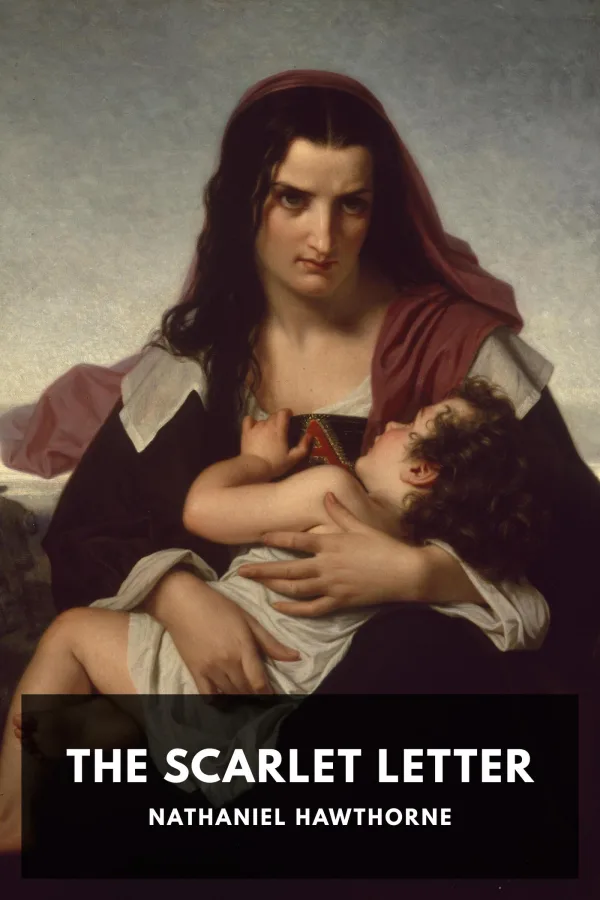
Through this portal stepped Hester Prynne into the blinding noon sunlight, clutching her infant daughter Pearl. Displayed boldly upon her bosom was the scarlet letter “A”—embroidered with such intricate golden stitches and luminous elegance that it transformed an instrument of statutory dishonor into an unforgettable monument to personal dignity and endurance.
Follow Hester Prynne’s defiant path through guilt, solitude, and redemption. Download the complete unabridged edition for your e-reader.
Download Full EPUBThe Scarlet Letter is an 1850 historical romance by Nathaniel Hawthorne, set in 17th-century Puritan Boston. It follows Hester Prynne, who is publicly shamed and forced to wear a scarlet “A” for adultery, while her secret lover—the Reverend Arthur Dimmesdale—suffers in hidden guilt. This Standard Ebooks edition is based on Project Gutenberg eBook #25344 and is in the public domain in the United States.

About The Scarlet Letter: Summary, Characters & Themes
Published in Boston in March 1850 by Ticknor, Reed & Fields, The Scarlet Letter: A Romance is Nathaniel Hawthorne’s defining masterpiece. This summary and analysis covers its plot, key characters, and major themes. It stands as the foundational triumph of American dark romanticism and historical psychological fiction.
Set in seventeenth-century Puritan Boston between 1642 and 1649, Hawthorne explores his own ancestral heritage and deep guilt connected to the Salem witch trials. The novel investigates the destructive collision between institutional dogmatism and the secret human heart.
The story opens on the town scaffold, where young Hester Prynne is publicly displayed holding her illegitimate infant, Pearl. Condemned by the Puritan elders for adultery, Hester is sentenced to wear a scarlet cloth letter “A” embroidered upon her breast for the remainder of her days.
Steadfastly refusing to name her lover, Hester lives in an isolated cottage on the edge of the forest, sustaining herself through exquisite needlework. Unknown to the community, her secret partner in sin is Arthur Dimmesdale, the town’s revered, saintly young minister.
Meanwhile, Hester’s missing elderly husband arrives in disguise under the alias Roger Chillingworth, dedicating his existence to psychological vengeance. Posing as Dimmesdale’s physician, Chillingworth methodically tortures the guilt-wracked pastor’s soul.
While open ignominy purifies Hester into an emblem of compassion and quiet defiance, secret concealment eats away at Dimmesdale’s body and spirit, culminating in a dramatic public confession upon the very scaffold where Hester’s ordeal began.
Key Characters & Literary Archetypes
The novel’s main characters are defined by how each responds to sin, shame, and concealment.
- Hester Prynne is the novel’s protagonist, condemned to wear the scarlet letter “A” and transformed by her public shame into a symbol of spiritual grace, independence, and charity (“Able”). She embodies quiet moral courage against crushing social dogma.
- Reverend Arthur Dimmesdale is a charismatic, spiritually gifted clergyman whose hidden adultery fractures his conscience. While his agonizing guilt makes his sermons profoundly moving to his flock, the hypocrisy of his silent concealment physically and mentally destroys him.
- Roger Chillingworth is Hester’s estranged, deformed husband who assumes a false identity to seek revenge. Transitioning from scholar to parasite, his intellectual obsession with probing Dimmesdale’s secret guilt transforms him into the archetypal embodiment of unpardonable malice.
- Pearl is Hester’s lawless, perceptive daughter who grows up attuned to the natural forest rather than human church dogma. She functions as the physical incarnation of the scarlet letter, a living question mark that continually compels her parents toward moral truth.
- Governor Bellingham and Reverend John Wilson are the elderly magistrates who represent the rigid, unforgiving legalism of the Massachusetts Bay Colony, confusing human authoritarian control with divine righteousness.
Core Literary Themes & Historical Significance
Three major themes structure the novel’s moral argument.
- Open Penitence vs. Hidden Guilt: Hawthorne demonstrates that Hester’s open, endured ignominy grants her emotional strength and clear moral vision, whereas Dimmesdale’s concealed guilt festering beneath public sanctity rots his soul from within.
- The Forest Wilderness vs. The Puritan Town: The enclosed town represents legalistic conformity, surveillance, and repression, while the untamed forest offers a sanctuary of natural innocence, freedom, and unfiltered passion outside civic constraints.
- The Mutation of Symbols and Identity: The letter “A” evolves across the novel—from “Adulterer” to “Able,” and ultimately into a symbol of angelic reverence—revealing how human dignity and perseverance can overcome collective social condemnation.
Why Download Our Custom E-Reader Edition of The Scarlet Letter?
Nathaniel Hawthorne’s The Scarlet Letter stands as America’s preeminent romance of psychological guilt, moral hypocrisy, and spiritual resilience in 17th-century Puritan Boston. Generic digital conversions frequently mangle this complex work.
They often excise Hawthorne’s autobiographical preface, flatten the typographic styling of the scarlet token, and create navigation bottlenecks across the 24 chapters. Our custom digital release delivers a refined reading experience tailored specifically for E-Ink displays.
- Faithful Text Based on the 1850 Edition (via Project Gutenberg #25344): Sourced from a Standard Ebooks transcription of the 1850 Ticknor, Reed & Fields text, preserving Hawthorne’s archaic syntax, distinctive capitalization, and unexpurgated historical prose without modern editorial sanitization.
- Dual-Tier Structural Hierarchy & Preface Integrity: Retains the full, unabridged “The Customhouse” introductory sketch as a distinct contextual anchor, complete with a secondary nested table of contents that prevents accidental skips directly into Chapter I and preserves the atmospheric framing intended by Hawthorne.
- Engineered Multi-Format Hardware Binaries: Reflowable EPUB with elegant typographic hierarchy for Apple Books and Android readers; Amazon-native AZW3 tailored with native page layout and margin kerning for Kindle Paperwhite, Oasis, and Scribe; and dedicated KEPUB enabling real-time reading progress and live chapter statistics across all 24 chapters on Rakuten Kobo ereaders.
- Verified Public Domain Sources: The text is in the public domain in the United States and is based on Project Gutenberg eBook #25344, with this edition produced by Standard Ebooks. Users outside the United States should check their local laws.