The Red Badge of Courage by Stephen Crane: Free EPUB, AZW3 & KEPUB Download
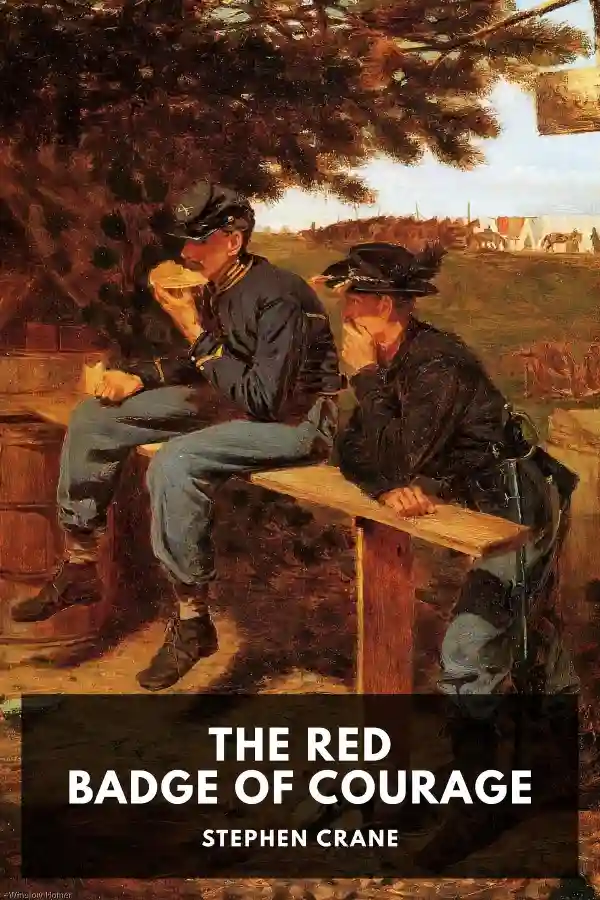
The Red Badge of Courage
📖 Click to Read Chapter 1 Online Preview
I
The cold passed reluctantly from the earth, and the retiring fogs revealed an army stretched out on the hills, resting. As the landscape changed from brown to green, the army awakened, and began to tremble with eagerness at the noise of rumors. It cast its eyes upon the roads, which were growing from long troughs of liquid mud to proper thoroughfares. A river, amber-tinted in the shadow of its banks, purled at the army’s feet; and at night, when the stream had become of a sorrowful blackness, one could see across it the red, eyelike gleam of hostile campfires set in the low brows of distant hills.
Once a certain tall soldier developed virtues and went resolutely to wash a shirt. He came flying back from a brook waving his garment bannerlike. He was swelled with a tale he had heard from a reliable friend, who had heard it from a truthful cavalryman, who had heard it from his trustworthy brother, one of the orderlies at division headquarters. He adopted the important air of a herald in red and gold.
“We’re goin’ t’ move t’morrah—sure,” he said pompously to a group in the company street. “We’re goin’ ’way up the river, cut across, an’ come around in behint ’em.”
Follow Henry Fleming through terror, shameful retreat, and the chaotic smoke of combat toward self-realization. Download the complete unabridged edition for your e-reader.
Download Full EPUBThe Red Badge of Courage is an 1895 novel by Stephen Crane. It follows Henry Fleming, a young Union soldier, as he flees his first battle, struggles with shame and fear, and eventually returns to fight with unexpected courage. This Standard Ebooks edition is based on Project Gutenberg eBook #73 and is in the public domain in the US.
About Stephen Crane’s The Red Badge of Courage
Serialized in newspapers in late 1894 and published in book form in October 1895 by D. Appleton and Company, The Red Badge of Courage: An Episode of the American Civil War is Stephen Crane’s revolutionary masterpiece. Written when the author was only twenty-three and had never witnessed combat, it permanently transformed modern war literature.
Discarding romantic martial glory and patriotic pageantry, Crane deployed an intense, impressionistic realism to explore the visceral terror, chaotic confusion, and psychological alienation experienced by an ordinary soldier on the front lines.
Set during an unnamed Civil War engagement closely resembling the Battle of Chancellorsville in 1863, the story follows young farm recruit Henry Fleming, known simply as “the youth.” Enlisting with visions of Homeric glory, Henry spends grueling months waiting in muddy winter camps, consumed by a gnawing fear that he will flee when bullets fly.
When the regiment is suddenly thrust into the deafening smoke and carnage of a Confederate charge, Henry initially fights with mechanical fury. However, upon facing an unexpected second assault, raw panic overwhelms him, and he drops his rifle to flee blindly into the rear forest.
Wandering through woods where nature remains chillingly indifferent to human slaughter, Henry encounters the horrific agony of dying comrades, including his beloved friend Jim Conklin. Wracked with guilt and longing for a wound—a “red badge of courage”—to legitimize his presence among the casualties, he is ironically struck on the head with a rifle butt by a retreating Union soldier.
Rejoining his unit under the cover of this accidental wound, Henry channels his accumulated shame and fury into reckless ferocity during subsequent engagements. Seizing the fallen regimental colors, he charges through the battle smoke, shedding boyhood vanity to confront the grim mechanics of survival as a battle-hardened man.
Key Characters & Literary Archetypes
- Henry Fleming / “The Youth” (The Disillusioned Recruit & Reluctant Warrior): A naive farm boy intoxicated by literary dreams of classical heroism. His journey traces a harrowing psychological arc—from anxious self-doubt and shameful flight to blind animal ferocity, ultimately arriving at a quiet, unglamorous stoicism in the face of mortality.
- Jim Conklin / “The Tall Soldier” (The Stoic Veteran & Sacrificial Martyr): An experienced, calm soldier whose initials (J.C.) and agonizing ritual death in an open field evoke Christ-like suffering. His gruesome demise shatters Henry’s romantic illusions, forcing him to witness the unvarnished reality of violent death.
- Wilson / “The Loud Soldier” (The Boastful Greenhorn & Grounded Brother-in-Arms): Initially loud, arrogant, and terrified of dying, Wilson undergoes a profound transformation after his first trial under fire. Evolving into a compassionate, quiet caretaker for Henry, he represents the rapid emotional maturation demanded by warfare.
- The Tattered Soldier (The Unsparing Conscience & Ghostly Indictment): A wounded, simple-minded infantryman who repeatedly asks Henry where he was hit. His innocent, persistent inquiries torment Henry’s guilty soul, functioning as a walking, externalized manifestation of conscience that Henry cowardly abandons in the fields.
- Henry’s Mother (The Pragmatic Rural Anchor): A sensible, unromantic farm woman who refuses to glorify her son’s enlistment, advising him instead to do his duty, avoid bad company, and pack extra wool shirts. Her quiet skepticism stands as an early reality check against military mythmaking.
Core Literary Themes & Historical Significance
- The Deconstruction of Martial Heroism: Crane strips warfare of noble rhetoric, presenting combat as a blinding, mechanized slaughterhouse driven by chaos, rumor, and chance, where heroism is often born of panic, shame, or instinctive rage rather than pure virtue.
- Cosmic Indifference of Nature: In a famous scene, Henry discovers a decomposing corpse in a serene chapel-like clearing of pine trees; Crane emphasizes that nature is entirely neutral and untroubled by human warfare, neither mourning nor rejoicing over human catastrophe.
- Impressionism and Psychological Subjectivity: Using vivid, sensory color imagery—describing war as a “red animal” and regiments as writhing serpents—Crane placed readers directly inside the fragmented, adrenaline-soaked consciousness of a panicking soldier.
About Stephen Crane’s The Red Badge of Courage: Summary, Characters & Themes
The Red Badge of Courage is an 1895 novel by Stephen Crane, a psychological war novel that follows a young Union soldier from fear and desertion to a hard-won, unglamorous courage. This summary and analysis covers the novel’s plot, key characters, and core themes, including fear, shame, heroism, and the indifference of nature.
This edition is based on a transcription from Project Gutenberg and produced by Standard Ebooks.
Set during the American Civil War, the story follows young farm recruit Henry Fleming, known simply as “the youth.” Enlisting with visions of glory, Henry spends grueling months waiting in muddy winter camps, consumed by a gnawing fear that he will flee when bullets fly.
When the regiment is suddenly thrust into the deafening smoke and carnage of a Confederate charge, Henry initially fights with mechanical fury. Upon facing an unexpected second assault, raw panic overwhelms him, and he drops his rifle to flee blindly into the rear forest.
Wandering through woods where nature remains indifferent to human slaughter, Henry encounters the horrific agony of dying comrades, including his friend Jim Conklin. Wracked with guilt and longing for a wound — a “red badge of courage” — he is ironically struck on the head with a rifle butt by a retreating Union soldier.
Rejoining his unit under the cover of this accidental wound, Henry channels his accumulated shame and fury into reckless ferocity during subsequent engagements. Seizing the fallen regimental colors, he charges through the battle smoke, shedding boyhood vanity as he confronts the grim mechanics of survival.
Key Characters & Literary Archetypes
- Henry Fleming / “The Youth” (The Disillusioned Recruit & Reluctant Warrior): he is a naive farm boy intoxicated by dreams of classical heroism, whose journey traces a psychological arc from anxious self-doubt and shameful flight to blind ferocity and, finally, quiet stoicism.
- Jim Conklin / “The Tall Soldier” (The Stoic Veteran & Sacrificial Martyr): he is an experienced, calm soldier whose agonizing death in an open field shatters Henry’s romantic illusions and forces him to witness the reality of violent death.
- Wilson / “The Loud Soldier” (The Boastful Greenhorn & Grounded Brother-in-Arms): he is initially loud, arrogant, and terrified of dying, but matures after his first trial under fire into a compassionate caretaker for Henry.
- The Tattered Soldier (The Unsparing Conscience & Ghostly Indictment): he is a wounded infantryman whose innocent, persistent questions about Henry’s wound torment Henry’s guilty soul, functioning as an externalized conscience that Henry abandons in the fields.
- Henry’s Mother (The Pragmatic Rural Anchor): she is a sensible, unromantic farm woman who refuses to glorify her son’s enlistment, advising him instead to do his duty, avoid bad company, and pack extra shirts.
Core Literary Themes & Historical Significance
- The Deconstruction of Martial Heroism (Combat as Chaos, Not Glory): Crane strips warfare of noble rhetoric, presenting combat as a blinding, mechanized slaughterhouse driven by chaos, rumor, and chance, where heroism is often born of panic, shame, or instinct.
- The Indifference of Nature (Cosmic Neutrality): in a famous scene, Henry discovers a decomposing corpse in a serene clearing of pine trees, emphasizing that nature is entirely neutral and untroubled by human warfare.
- Impressionism and Psychological Subjectivity (The Soldier’s Inner Chaos): using vivid sensory imagery, Crane placed readers directly inside the fragmented, adrenaline-soaked consciousness of a panicking soldier.
The Red Badge of Courage: FAQ, Summary & Analysis
What kind of novel is The Red Badge of Courage?
It is not a children’s book, though it is widely taught as a landmark of American war fiction and psychological realism.
What is The Red Badge of Courage about?
He returns to his regiment under the cover of an accidental head wound, and eventually fights with a ferocity that earns him praise, though his inner growth remains ambiguous.
Who are the main characters in The Red Badge of Courage?
Henry is the protagonist; Wilson is his fellow soldier; Jim Conklin is the veteran whose death haunts him; and the tattered soldier is the wounded man whose questions provoke Henry’s guilt.
How does Henry Fleming receive his “red badge of courage,” and why is it ironic?
His own head injury is not received while facing the enemy, but while fleeing from battle. A panicked retreating Union soldier strikes him with a rifle butt, and his comrades later mistake the wound for an enemy bullet.
What are the main themes of The Red Badge of Courage?
Crane presents combat as chaos rather than glory, and in one famous scene Henry discovers a decomposing corpse in a serene clearing, suggesting that nature is entirely neutral toward human slaughter.
How is The Red Badge of Courage narrated, and what narrative style does it use?
The style is often called impressionistic, using vivid sensory imagery and fragmented color to place readers inside the consciousness of a panicking soldier.
When was The Red Badge of Courage published, and what is its publication history?
This edition is based on Project Gutenberg eBook #73 and produced by Standard Ebooks.
Is The Red Badge of Courage in the public domain, and where can I download the free EPUB?
You can download the free EPUB above, or choose AZW3 for Amazon Kindle and KEPUB for Rakuten Kobo.