The Odyssey by Homer: Free EPUB, AZW3 & KEPUB Download
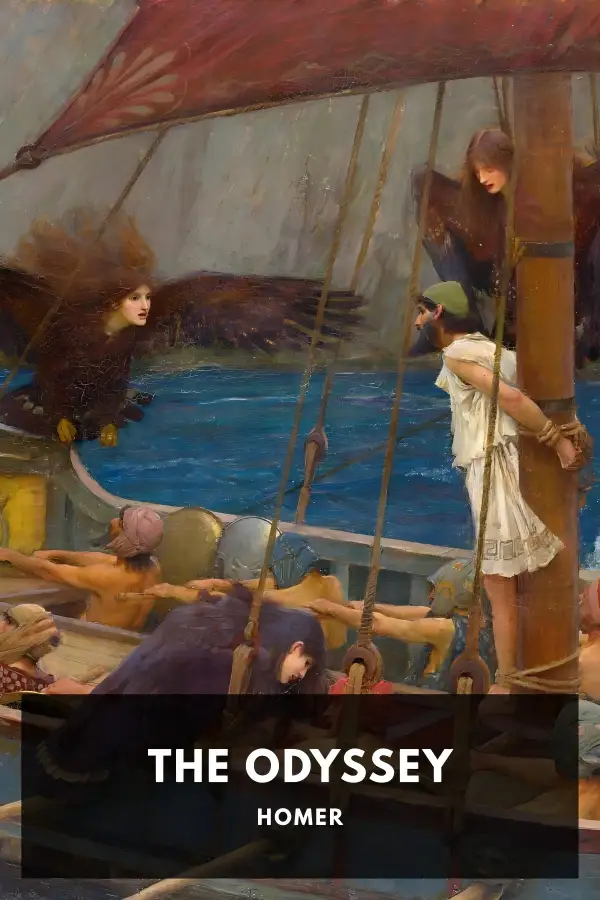
The Odyssey
📖 Click to Read Book I Online Preview
Book I — Visit of Pallas to Telemachus
Tell me, O Muse, of that sagacious man who, having overthrown the sacred town of Ilium, wandered far and visited the capitals of many nations, learned the customs of their dwellers, and endured great suffering on the deep.
His life was oft in peril, as he labored to bring back his comrades to their homes. He saved them not, though earnestly he strove; they perished all, through their own folly; for they banqueted, madmen, upon the oxen of the Sun—the all-o’erlooking Sun, who cut them off from their return.
O goddess, virgin-child of Jove, relate some part of this to me. Now all the rest, as many as escaped the cruel doom of death, were at their homes safe from the perils of the war and sea, while him alone, who pined to see his home and wife again, Calypso, queenly nymph, great among goddesses, detained within her spacious grot, in hope that he might yet become her husband.
Follow Odysseus across perilous seas, mythical monsters, and the long journey home to Ithaca. Download the complete unabridged edition for your e-reader.
Download Full EPUBThe Odyssey is an ancient Greek epic poem attributed to Homer, composed between 800 and 700 BC and presented here in William Cullen Bryant’s 1879 English translation. It follows Odysseus, the cunning king of Ithaca, as he struggles home from the Trojan War across ten years of shipwrecks, monsters, and divine hostility, while his wife Penelope and son Telemachus hold off a crowd of suitors in his absence. This Standard Ebooks edition is in the public domain in the United States; its central themes are homecoming, endurance, and the cost of loyalty.
About Homer’s The Odyssey: Summary, Characters, and Themes
Composed near the end of the eighth century BCE and preserved through centuries of oral performance, The Odyssey attributed to Homer is the foundational epic of Western narrative art. This Standard Ebooks edition presents William Cullen Bryant‘s 1879 English translation.
While The Iliad immortalizes the tragic violence of the Trojan War, The Odyssey shifts focus to survival, psychological cunning, and the sacred yearning for home (nostos). What follows is a summary and analysis of its story, its major characters, and its enduring themes.
Summary: The Ten-Year Journey Home
The epic chronicles the ten-year wanderings of Odysseus, King of Ithaca, as he strives to reunite with his faithful queen Penelope and son Telemachus after the fall of Troy.
Along the perilous Mediterranean, Odysseus confronts cosmic obstacles: the one-eyed Cyclops Polyphemus, the sorceress Circe who transforms men into swine, the alluring songs of the Sirens, and the terrifying chasm between Scylla and Charybdis.
Arriving at last in Ithaca disguised as a ragged beggar, Odysseus tests the loyalty of his household before stringing his ancient bow and executing divine vengeance upon the arrogant suitors who consumed his palace.
Characters: Key Figures and Literary Archetypes
- Odysseus / Ulysses (The Cunning Trickster & Wandering Hero): Renowned for his metis (resourceful intelligence) rather than mere brute strength. He survives by wit, disguise, and endurance, establishing the universal archetype of the voyager seeking his homeland.
- Penelope (The Patient Weaver & Faithful Constant): Queen of Ithaca and Odysseus’s intellectual equal. She fends off 108 predatory suitors by weaving and unraveling her father-in-law’s burial shroud, embodying steadfast loyalty and tactical restraint.
- Telemachus (The Coming-of-Age Prince): Odysseus’s son, who begins as a helpless youth overshadowed by arrogant usurpers. Guided by Athena, he embarks on his own journey to seek news of his father, transitioning from boyhood into confident leadership.
- Athena / Minerva (The Divine Mentor): The goddess of wisdom and strategic war who champions Odysseus throughout his trials. She serves as the archetypal supernatural guide, offering divine counsel while demanding that human heroes exercise their own ingenuity.
- Circe & Calypso (The Enchantress & The Seductive Trap): Powerful immortals who detain Odysseus on isolated islands. They symbolize the temptation to abandon human struggle and civic duty in exchange for passive paradise or eternal youth.
- The Suitors / Antinoüs (The Parasitic Usurpers): A predatory pack of young noblemen occupying Odysseus’s hearth, violating the sacred Greek laws of hospitality (xenia), and orchestrating their own inevitable doom through hubris.
Themes and Historical Significance
- The Supremacy of Cunning over Force (Metis vs. Biē): Homer highlights that while raw physical force conquered Troy, only intellectual adaptability and self-restraint allow a hero to survive the unpredictable forces of nature and society.
- The Sacred Ethics of Hospitality (Xenia): The epic serves as a profound moral exploration of host-guest relationships. Civilizations that honor travelers (the Phaeacians) prosper under the gods, while those that abuse guests (Polyphemus and the suitors) bring destruction upon themselves.
- Identity, Memory, and Homecoming (Nostos): Odysseus repeatedly rejects the divine immortality offered by Calypso, choosing mortal aging and domestic labor to maintain his authentic identity, community memory, and marital bond.
Why Download Our Custom E-Reader Edition of The Odyssey?
Composed near the dawn of Western literature in the late eighth century BCE, Homer’s The Odyssey endures as civilization’s archetype of epic adventure, resourceful intelligence (metis), and the yearning for home (nostos).
Odysseus’s ten-year wandering across enchanted Mediterranean waters—outwitting Polyphemus the Cyclops, enduring Circe’s enchantments, descending into the dark House of Hades, and resisting the deadly song of the Sirens before reclaiming his home in Ithaca—deserves an immersive, uncompromised presentation.
Many free web transcriptions and automated conversions mishandle Homer’s grand oral architecture: they mangle Greek patronymics and Latinized names, strip William Cullen Bryant’s preface and book summaries, and compress dramatic poetic dialogue into dense walls of text.
Our edition provides an archival, unabridged reading experience calibrated for modern E-ink displays.
- 1879 William Cullen Bryant Verse Translation Fidelity: Faithfully preserves the celebrated 1879 blank-verse translation by William Cullen Bryant, as produced for the Standard Ebooks edition. All twenty-four books are included in complete, unabridged form.
- Granular 24-Book Navigation Structure: Easily navigate the non-linear timeline of Odysseus’s journey through a structured table of contents. Jump between pivotal arcs—the opening “Telemachy” in Books I–IV, Odysseus’s recounting of monsters to King Alcinous in Phaeacia, the bow-stringing contest, the slaughter of the suitors, and the olive-tree bed recognition with Penelope.
- Calibrated Typography for Ancient Epics and Epithets: Homer’s formulaic epithets (“rosy-fingered Dawn,” “much-enduring noble Odysseus”) and invocations require visual breathing room. Our edition applies calibrated paragraph spacing, clean drop-caps, and balanced contrast across Kindle Paperwhite (AZW3), Kobo Libra/Clara (KEPUB), and open EPUB devices.
- Verified Public Domain Sources: Built on the Standard Ebooks edition of William Cullen Bryant’s 1879 translation. The source text is in the public domain in the United States; readers outside the US should check their local laws.