The Valley of Fear by Arthur Conan Doyle: Free EPUB, AZW3 & KEPUB Download
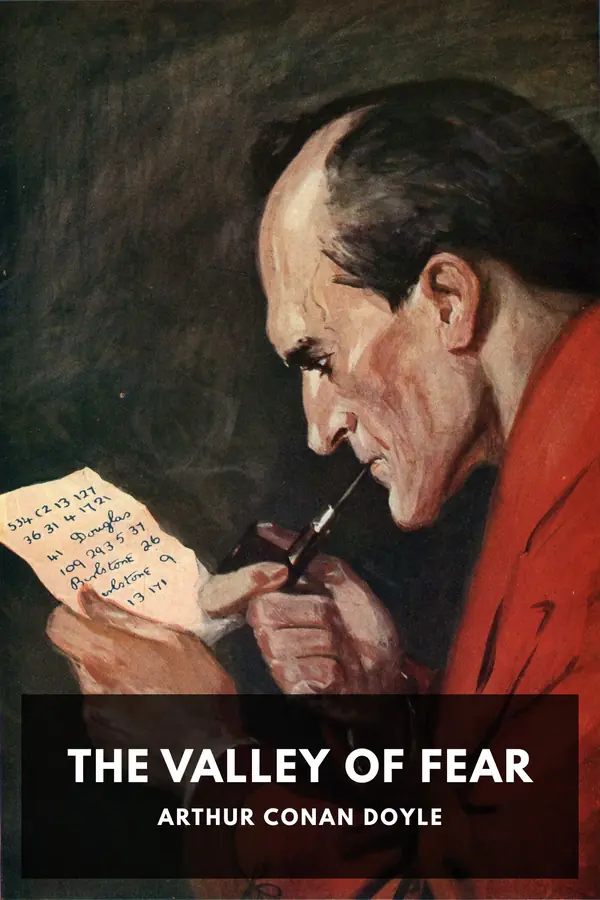
The Valley of Fear
📖 Click to Read the Opening Pages Online Preview
Part I, Chapter I: The Warning
I believe that I am one of the most long-suffering of mortals; but I’ll admit that I was annoyed at the sardonic interruption.
“Really, Holmes,” said I severely, “you are a little trying at times.”
He was too much absorbed with his own thoughts to give any immediate answer to my remonstrance. He leaned upon his hand, with his untasted breakfast before him, and he stared at the slip of paper which he had just drawn from its envelope. Then he took the envelope itself, held it up to the light, and very carefully studied both the exterior and the flap.
These are the opening paragraphs of Part I, Chapter I, with Holmes still at his breakfast and Porlock’s letter on the table. Download the complete novel to read on.
Download Full EPUB1915
~58,000 words (estimated)
Approx. 3.2 hours
Sherlock Holmes
Sussex, England, and the Pennsylvania coalfields
Two parts, fourteen chapters and an epilogue
EPUB · AZW3 · KEPUB
0.19 MB (EPUB) · 0.29 MB (AZW3) · 0.21 MB (KEPUB)
Public domain in the United States
Project Gutenberg #3776
The Valley of Fear opens with a cipher, a warning from a frightened informer, and a murder in a Sussex manor house that has a moat, a drawbridge and no obvious way in. John Douglas, an American who has grown rich and retired into English country life, is found shot at close range with his own sawn-off shotgun, and a card marked V. V. 341 lies beside the body. Holmes and Inspector MacDonald have a sealed room, a household whose accounts do not agree, and a brand on the dead man’s forearm. Halfway through, Doyle abandons them, goes back twenty years and several thousand miles, and shows what kind of men produce that sort of murder.
That second half is not a digression but the point. The Valley of Fear is built as two stories that explain each other: a detective problem in the English 1880s, and, in 1875, the making of the men who made it. Doyle wrote it late, after he had killed Holmes and brought him back, and it is the fourth and last of the four Holmes novels. Readers who come for the locked room stay for the coalfields. See Wikipedia’s article on The Valley of Fear for its publication history. The text is available via Project Gutenberg #3776.

The Valley of Fear by Arthur Conan Doyle: Summary, Characters & Themes
This summary and analysis of The Valley of Fear takes the novel as the two-part machine Doyle built, not as a Holmes story with an odd American appendix attached. Part I is a country-house murder: Watson narrating, Holmes reading a room he has not yet seen, Inspector MacDonald of Scotland Yard and White Mason of the Sussex constabulary doing the legwork, and a household of five whose accounts will not fit together. Part II abandons all of them for the Pennsylvania anthracite country in 1875, where a young Irishman named Jack McMurdo joins a secret society and discovers that membership is a sentence as much as a privilege. The halves are usually called unequal, and they are, but not in the way most readers expect: the American story is not a footnote to a clue, it is the novel’s centre of gravity.
The author is Arthur Conan Doyle, and The Valley of Fear is the last of the four Sherlock Holmes novels. Doyle was born in Edinburgh in 1859, trained as a physician, and made Holmes famous in 1887 with A Study in Scarlet; by 1893 he had grown tired enough of the character to throw him into the Reichenbach Falls, and by 1903 he had brought him back. This book belongs to the second, more comfortable phase of that history. It was serialised in The Strand Magazine from September 1914 to May 1915, with a European war on, and published in volume form in 1915. Doyle by then was writing historical novels, plays and spiritualist argument, and treating Holmes as a reliable annuity rather than a literary ambition.
Formally the novel is two stories bolted together, and the joint is deliberate. Part I runs seven chapters and never leaves Sussex; it is a closed-circle problem with a moat, a drawbridge, a household and a card marked V. V. 341. At the end of it Douglas hands Watson a written account of his life, and Part II is that account, told in the third person across seven chapters and an epilogue: the coal valley, the lodge, the oath, the long campaign of murder, and the night the campaign ends. Doyle had done something similar in A Study in Scarlet, where a London murder gives way to a Utah flashback, and the method here is more disciplined. The American chapters carry their own suspense, their own villain and their own detective, and the English story waits quietly for them to finish.
The American half is a fictionalised account of a real war. In the anthracite counties of Pennsylvania in the 1860s and 1870s an Irish secret society known as the Molly Maguires fought the mine owners with arson, beatings and murder, and the owners answered with the Coal and Iron Police, private detectives and a long series of prosecutions; the trials of 1876 and 1877 sent twenty men to the gallows, largely on the evidence of a Pinkerton operative, James McParland, who had lived among them for two years. Doyle moves the calendar and invents the names: his valley is Vermissa, his lodge is 341, his operative is Birdy Edwards. The texture, though, is documentary: company houses, company stores, coroners who can find no witness, and a town where the word Scowrers is said in a whisper. The text used here is the Project Gutenberg transcription (#3776).
Its reputation is uneven, and the unevenness is the interesting part. Readers who want the drawing room and the deduction often find Part II slow, and critics have complained since 1915 that the book changes horses halfway. In fact the American chapters are the most original thing in the Holmes canon: a study of how a secret society works on the people inside it, written with a coldness Doyle rarely allowed himself. The English chapters are the better-made detective story, and the epilogue, in which a cable arrives from the other side of the world and Holmes names the hand behind it, is one of the shortest and most sinister endings he wrote. Readers who finish it usually go back to The Hound of the Baskervilles for the moor, to A Study in Scarlet for the first appearance, and to The Sign of the Four for the other puzzle built on a locked room.
Historical Context
Between 1865 and 1877 the anthracite counties of Schuylkill, Carbon, Luzerne and Columbia were the scene of a low, dirty war. The Molly Maguires were less a single organisation than a name for Irish miners who answered the operators with intimidation, beatings and shootings; the operators answered with the Coal and Iron Police, hired gunmen and the Pinkerton agency. Allan Pinkerton put James McParland into the region in 1873 under the name James McKenna, and McParland’s testimony at the trials of 1876 and 1877 broke the society and hanged twenty of its members. Doyle read about the case, moved it to a fictional county and a fictional valley, and kept the machinery: the oath, the bodymaster, the paid assassination, and the town that has learned not to see anything.
Doyle wrote the book in 1914, and the war is just outside the window of every page without ever coming in. The Strand serialisation began in September 1914, a month after Britain declared war, and the volume appeared in 1915, when the Holmes industry was at its height and Doyle was writing propaganda and organising a volunteer force. The novel turns away from contemporary Europe to two older conflicts: an American labour war of the 1870s and an English country-house murder of the 1880s. That double remove is characteristic. Doyle’s late Holmes stories increasingly treat London as a system of information rather than a city, and this one opens with a cipher arriving by post, which is the purest form of that interest: a crime reduced to a slip of paper before anybody has been killed.
The English half belongs to a long tradition of the sealed house, and Doyle uses its furniture with evident pleasure: a moat forty feet across, a drawbridge raised every evening, and a house old enough to have sheltered a king during the Civil War. The frame is Professor Moriarty, who appears in the first chapter as a name and in the epilogue as a handwriting. Doyle’s decision to put him at both ends of the book and never in the middle is what makes the ending work. The murder is solved, the household is accounted for, the law has done its business, and the reader is left with a note that says nothing and a hand that has not been caught.
Key Characters & Literary Archetypes
- Sherlock Holmes: is the consulting detective of the Sussex half, and never leaves England. He reads the case from a cipher, a card and a brand before he has seen the room, refuses to theorise on insufficient data, and treats the murder as part of a design that belongs to Professor Moriarty. His method here is patient: he spends a night alone in the study, fishes a bundle out of a moat, and lets a suspect incriminate himself. “I can tell a Moriarty when I see one,” he says at the end.
- Dr. John Watson: is the narrator of Part I and the reason the book has a voice at all. He is annoyed at breakfast, sceptical of his friend’s theatrics, and useful in the field: he interviews the wife, watches the household, and carries the manuscript that becomes Part II. His function here is not comic. Watson is the reader’s measure of how strange the case is, and his account of the moat, the branded arm and the missing dumb-bell keeps the prose at the level of observed fact while Holmes works at the level of theory.
- John Douglas: is the master of Birlstone Manor: about fifty, strong-jawed and wiry, with a grizzled moustache and keen grey eyes. He made his money in the California gold fields, married an Englishwoman twenty years younger than himself, and settled into five years of county life. He is fearless, generous and evidently frightened of something he will not name; he keeps a revolver by his bed. The novel’s whole argument about the past is contained in the fact that a man can be both of those things at once.
- Ivy Douglas: is Douglas’s wife, thirty years old, tall and dark and reserved, and the most watchful person in the house. She asks whether Holmes must give whatever he learns to the police, keeps her own counsel, and answers a question about her husband’s past with the sentence that gives the novel its title: “I have been in the Valley of Fear. I am not out of it yet.” Her composure is not coldness. It is the discipline of someone who has been frightened for a long time and has learned to be frightened quietly.
- Jack McMurdo: is the young Irishman who gets off the train at Vermissa in 1875 with a bookkeeper’s skills, an enormous revolver and a Chicago lodge card. He is quick, charming, violent when it suits him, and, which is the novel’s real interest, never quite at ease inside the society he joins. He takes the oath, wears the brand, makes himself useful to the Bodymaster and falls in love with his landlord’s daughter. Whether he is what he appears to be is the question Part II asks, and it declines to answer until the last chapter.
- Boss McGinty: is the Bodymaster of the Vermissa valley: a black-maned giant with a slow, heavy walk, dead black eyes slightly out of line and a diamond pin in his collar. He is a saloon keeper, a municipal councillor and a commissioner of roads, which is to say that the society and the town are the same apparatus seen from two sides. He rules by fear and by arithmetic, pays for murders out of the lodge funds, and is at his most dangerous when he is being reasonable. His vanity is the one crack in him.
Core Literary Themes
- The sealed house and the staged room: Part I is a locked-room puzzle in which the room has been arranged rather than locked. The moat, the drawbridge and the priest hole make Birlstone look like a fortress, and the evidence, the open window, the bloody sill, the missing dumb-bell, is a story somebody wants told. Doyle is interested in how quickly a household’s agreed account becomes a fact for the police, and in how one physical discrepancy, a boot mark too broad for the man who claims to have made it, undoes the whole thing. The country house here is a machine for producing appearances, and the detective’s job is to take it apart in the right order.
- Two countries and one crime: The novel’s structure is its argument. Doyle gives the English murder seven chapters and then refuses to solve it until the reader has spent seven more in 1875, learning what kind of men the killers are and what made them. The effect is to move the question from who to why, and to make the solution feel like history rather than revelation. Part II is not an interlude; it is the load-bearing half, and the epilogue’s return to Baker Street is a reminder that the two countries are still connected by post, by cable and by the patience of a criminal organisation that does not forget a debt.
- Oaths, terror and the economics of a secret society: The Scowrers are run like a benefit society and a killing business at once: minutes, dues, widows’ pensions, paid contracts, a treasury and a committee. Doyle is precise about the bookkeeping, and the precision is the horror. Murder is budgeted, debated, delegated and rewarded; a man is shot in front of a hundred witnesses and no one sees it. The lodge gives its members status, insurance and a share of the fear it produces, which is why it is hard to break: it is not only a threat from outside but a career inside. Morris’s warning that the corporations are buying up the men they have ruined is where the economics turns political.
- Men with two names: Everyone important in this book carries an identity that does not quite fit. Douglas is an American in an English manor; McMurdo is an Irishman in a coal town with a Chicago past; the valley keeps producing men known by one name in one place and another elsewhere. Doyle uses this as plot machinery, but the theme is larger: a society built on oaths and secrets makes disguise a normal condition of life, and the detective’s advantage is that he is willing to ask who a man was before he became who he is. The best scenes are interviews in which two people are each deciding how much of a name to admit to.
- Law, self-defence and the case that will not close: The Valley of Fear ends twice. The first ending is legal: a police trial, a reference to quarter sessions, an acquittal on the ground of self-defence, and a quiet arrangement in which a man leaves the country. The second ending is not legal at all: a cable from the South Atlantic, an unsigned note, and Holmes recognising a hand he has met before. Doyle’s point is that the law can close a file without closing the story, and that private vengeance, once it has been organised, outlives the courts that broke it. The final line is not a solution but a request for time, and it is the most modern sentence in the book.
Why Download Our Custom E-Reader Edition of The Valley of Fear?
This edition gives you the whole book, both halves of it: Part I’s seven chapters, Part II’s seven, and the epilogue, under the part headings and chapter titles the 1915 volume carries. Nothing is cut, softened or rearranged, and the American chapters are here at full length, which is not always true of adaptations and classroom extracts. That matters, because the novel only works as a pair. The murder in Sussex is a small late consequence of the war in the coalfields, and a version that skips the coalfields is a different and much thinner story.
It is also a better book than its reputation suggests. The Holmes chapters are a clean, cold locked-room problem with one of Doyle’s most satisfying pieces of physical detection, and the American chapters are a study of a secret society from the inside, written without much mercy and with a good deal of documentary detail. If you have only met this title as a footnote between The Hound of the Baskervilles and His Last Bow, the two-part structure will surprise you, and so will the epilogue.
The files are made for reading rather than for print. The text is set for small screens and e-ink, the contents are navigable by part and chapter, and the download is DRM-free in EPUB, AZW3 and KEPUB, so it opens on a Kindle, a Kobo, an iPad or a phone without conversion. The source is the Project Gutenberg transcription of the 1915 text, checked against the chapter divisions of the printed volume.
- Project Gutenberg transcription, via Project Gutenberg #3776 — the complete text, both parts and the epilogue, with the chapter divisions of the 1915 volume.
- Both halves in one file Part I and Part II with their part headings, so the American chapters stand as the second movement they were written to be rather than as an appendix.
- Built for small screens Line length, margins and heading sizes set for phones and e-ink readers, so the long paragraphs of a 1915 novel do not turn into walls of type.
- No conversion, no DRM EPUB for Kobo and Apple Books, AZW3 for Kindle, KEPUB for Kobo’s own reader, all three in one download.
- The Adventures of Sherlock Holmes — free EPUB, AZW3 & KEPUB
- The Memoirs of Sherlock Holmes — free EPUB, AZW3 & KEPUB
- The Sign of the Four — free EPUB, AZW3 & KEPUB
Chapter summaries
The Valley of Fear is two books under one cover: a Sussex murder in seven chapters, and the Pennsylvania coal country in seven more plus an epilogue. The twelve summaries below follow both parts in order and stay with the evidence as the characters find it. The last two chapters of Part I and the epilogue are left for you to read.
- Part I, Chapter I: The Warning: A coded letter reaches Baker Street from a frightened informer inside Professor Moriarty’s network, and Holmes reads it with last year’s Whitaker’s Almanac: danger, soon, one; Douglas, rich, country, Birlstone. Before he can act, Inspector Alec MacDonald arrives with the news that the master of Birlstone Manor was shot in his own study the night before. The chapter sets the two ends of the case, a brain in London and a body in Sussex, and shows Holmes thoroughly annoyed at being interrupted over breakfast.
- Part I, Chapter II: Sherlock Holmes Discourses: Holmes explains why he has never pushed harder against Moriarty, recounts his visits to the professor’s study and the painting above the desk, and argues that a man of that order draws a percentage from every crime in London. MacDonald cannot square the theory with the plain facts of a country murder, and White Mason of the Sussex police writes that the case is a snorter. Holmes refuses to build on insufficient data and takes the train down with Watson and MacDonald to see the house for himself, which is where the novel’s second half of geography begins.
- Part I, Chapter III: The Tragedy of Birlstone: Watson describes the village, the moated manor with its drawbridge and its Jacobean brick, and the household: Douglas, his much younger wife, his friend Cecil Barker, the butler Ames and the housekeeper. Then the body. Dressing gown and slippers, a sawn-off shotgun wired to fire both barrels, the face destroyed, a card marked V. V. 341, and on the forearm a brand, a triangle inside a circle. The drawing-room window stands open, the sill carries a bloody boot mark, the candle has burned half an inch, and one dumb-bell is missing from under the table.
- Part I, Chapter IV: Darkness: White Mason arrives from the county police and the professionals begin to disagree. The gun is a Pennsylvania weapon, cut down; the hammer on the rug is clean; the marks on the sill are broad and splayed while the prints behind the curtain are narrower; a dumb-bell lies under the table and its fellow is gone. A bicycle is found in the evergreens a hundred yards from the door, and the household remembers that Douglas had been restless and excited and had a small shaving cut on his jaw the day before he died.
- Part I, Chapter V: The People of the Drama: The household gives evidence. Ames heard Barker shout from the study; Mrs. Allen heard a door slam half an hour earlier; Barker tells of California, of a mining partnership sold up, of the hard-looking men who came asking after Douglas, and loses his temper when the questions turn personal. Mrs. Douglas says only that money is no object, and when the talk touches her husband’s past she answers from somewhere else: “I have been in the Valley of Fear.” Holmes ends the day by fitting a bloodstained slipper to the mark on the sill.
- Part II, Chapter I: The Man: The scene changes to February 1875 and a train climbing into the Gilmerton mountains, where the coal country closes round the line. A young Irishman named Jack McMurdo gets out at Vermissa, answers a stranger’s pass-word, and is directed to a lodging house in Sheridan Street. He carries the largest navy revolver in the shop, a Chicago lodge card and a temper; the town has mud, saloons and a name it will not say aloud. At the Shafters’ table he meets Ettie, and the valley begins to show its manners.
- Part II, Chapter II: The Bodymaster: McMurdo is warned off the Shafter house by the old man, who tells him what the Scowrers are and who Ettie’s other suitor is; he refuses to go. At the Union House saloon he meets Boss McGinty, the black-maned giant who is also a councillor and a commissioner of roads, and is examined on his lodge, his record and a Chicago shooting he can produce a newspaper cutting for. The chapter ends with champagne, a quarrel over the girl, and a toast that sounds like a threat dressed up as a joke.
- Part II, Chapter III: Lodge 341, Vermissa: McMurdo takes the oath in a room where the lights are out and a branding iron waits, and becomes a member of Lodge 341 with a mark on his forearm and a promise for men who talk. The lodge’s business is read out like a committee’s minutes: a neighbouring lodge asks for two men to kill a coal owner, a widow is voted a pension, and payments from mining companies are counted and chased. An old shopkeeper called Morris warns that the corporations are buying up the men they have ruined, and is told to mind his own counter.
- Part II, Chapter IV: The Valley of Fear: The Vermissa Herald prints an editorial against the reign of terror, and the lodge answers it with sticks rather than bullets: the editor is beaten in his own office and the town is expected to notice. McMurdo is arrested, kept in a cell with the men who did the work, tried before a bench that has already made up its mind, and released when six witnesses, the Bodymaster among them, swear he was playing cards at the time. A stranger in the court calls the defendants murderers and promises to settle with them.
- Part II, Chapter V: The Darkest Hour: McMurdo is promoted, and the promotion frightens Ettie more than the danger did. Two quiet gunmen from another county are lodged in the house and taken out to a mine, where a manager and an engineer are shot in front of a hundred men who see nothing. A good employer is killed for sacking a drinker, a foreman’s house is blown up after the family has moved out, and the lodge laughs about both. McMurdo promises Ettie that they will leave within a year, and the reader is left to wonder what he is waiting for.
- Part II, Chapter VI: Danger: A letter reaches McMurdo through the old shopkeeper: five corporations and two railroads have hired the Pinkertons, and a man called Birdy Edwards is in the valley. McMurdo takes the news to the lodge, claims the matter as his own, and asks for a committee of seven to handle it. He describes the detective, gives him a name and a lodging, and lays out a plan to bring him to a house at ten o’clock and take him alive. The chapter is all preparation, and the preparation is going somewhere.
- Part II, Chapter VII: The Trapping of Birdy Edwards: Seven men sit in a lamplit parlour with the stove hot and a story ready for the visitor who is due at ten. Three knocks come, the door is closed and locked, and the evening stops being what the lodge thought it was. The chapter is the ambush, and it settles the account of Lodge 341 in a single night without a shot fired indoors. It also closes Part II, and leaves the English story to be finished in a Sussex study, with a bundle of papers and a woman who has done enough.
The Valley of Fear: Frequently Asked Questions
Is The Valley of Fear a Sherlock Holmes novel?
Do I need to read the earlier Holmes books first?
Why does the novel move to America halfway through?
Is the Pennsylvania part based on real events?
Who is Birdy Edwards?
How long does it take to read?
Is this edition complete and unabridged?
Where can I get The Valley of Fear as a free EPUB?
Part of: Detective & Mystery Classics · The Hound of the Baskervilles