Through the Looking-Glass by Lewis Carroll: Free EPUB, AZW3 & KEPUB Download
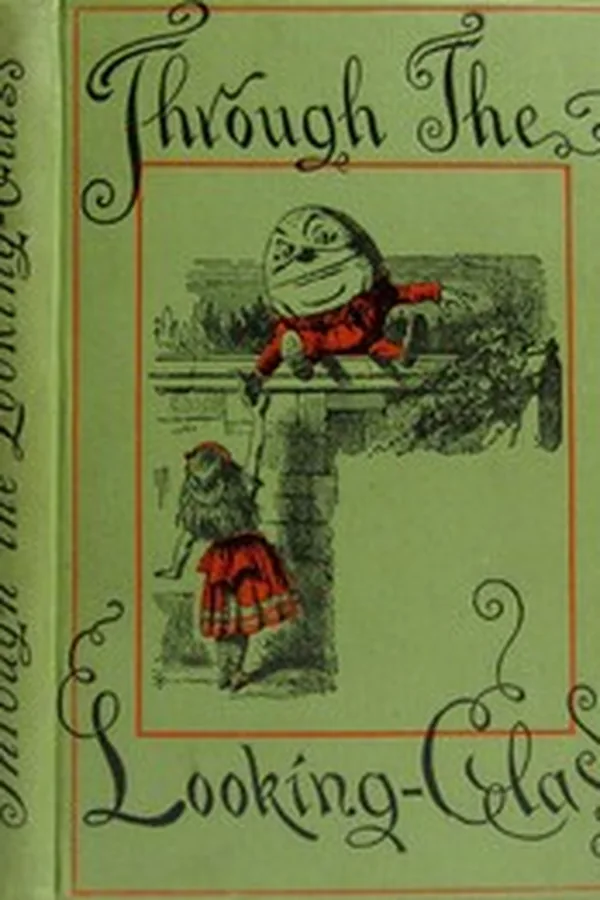
Through the Looking-Glass
📖 Click to Read the Opening Pages Online Preview
Chapter I: Looking-Glass House
One thing was certain, that the white kitten had had nothing to do with it:—it was the black kitten’s fault entirely. For the white kitten had been having its face washed by the old cat for the last quarter of an hour (and bearing it pretty well, considering); so you see that it couldn’t have had any hand in the mischief.
The way Dinah washed her children’s faces was this: first she held the poor thing down by its ear with one paw, and then with the other paw she rubbed its face all over, the wrong way, beginning at the nose: and just now, as I said, she was hard at work on the white kitten, which was lying quite still and trying to purr—no doubt feeling that it was all meant for its good.
But the black kitten had been finished with earlier in the afternoon, and so, while Alice was sitting curled up in a corner of the great arm-chair, half talking to herself and half asleep, the kitten had been having a grand game of romps with the ball of worsted Alice had been trying to wind up, and had been rolling it up and down till it had all come undone again; and there it was, spread over the hearth-rug, all knots and tangles, with the kitten running after its own tail in the middle.
Only the opening paragraphs fit here; the book runs to twelve chapters and about 30,000 words. Take the complete text in EPUB, AZW3 or KEPUB with the button below.
Download Full EPUB1871
~30,000 words (estimated)
Approx. 1.7 hours
Alice
The looking-glass house, a chessboard country, the Eighth Square
12 chapters, seven squares and a kitten
EPUB · AZW3 · KEPUB
0.14 MB (EPUB) · 0.21 MB (AZW3) · 0.15 MB (KEPUB)
Public domain in the United States
Project Gutenberg #12
Through the Looking-Glass sends Alice through the drawing-room mirror into a house where the clock has a face and the chessmen walk two by two, and from there onto a country laid out as a chessboard. She is made a White Pawn and told to walk to the Eighth Square, where she will be a queen; the squares in between are a garden of talking flowers, a railway carriage, a wood where nothing has a name, a sheep’s shop, Humpty Dumpty on his wall, and a lion and a unicorn fighting for a crown. Twelve chapters, one move at a time.
Carroll’s second Alice book is colder and more formal than the first. The jokes are about language rather than manners, and the child is told what she is and what she may not do: a pawn, a visitor, a girl who has lost her name. The best scenes are arguments. Humpty Dumpty explains that a word means what he chooses it to mean, the White Queen promises jam every day except today, the Red Queen runs hard to stay in one place, and two fat men ask whether Alice is only something in the Red King’s dream. See Wikipedia’s article on Through the Looking-Glass for its publication history. The text is available via Project Gutenberg #12.
Through the Looking-Glass by Lewis Carroll: Summary, Characters & Themes
This page is a summary and analysis of Through the Looking-Glass, the 1871 book in which Alice climbs through a mirror and plays a game of chess across an entire country. It is a sequel and does not repeat the first book. The opening is domestic: a cat, a ball of worsted, a snowy afternoon and a child pretending. Then the glass dissolves, and the house behind it turns out to be furnished with living pictures and walking chess pieces. From the Second Square Alice moves outward, meeting flowers that criticise her looks, insects with absurd names, twins who argue by formula, a sheep who knits, an egg who defines words, and two queens who examine her before dinner. The book keeps the shape of a game: every episode is a square, and every square is somebody’s argument with the rules.
The author is Lewis Carroll, the pen name of Charles Lutwidge Dodgson, a mathematics lecturer at Christ Church, Oxford, who wrote the Alice books for the daughters of a colleague and published them under a name he kept separate from his academic one. Through the Looking-Glass appeared in 1871, six years after Alice’s Adventures in Wonderland, and Dodgson built it around a chess problem rather than a card game: the front matter prints the moves, with Alice as the white pawn who wins in eleven. The winter of the opening chapter answers the summer picnic of the first book. The dedication poem at the front is a grown man’s address to a child, and it is the warmest writing in the volume, which otherwise keeps its feelings behind its manners. Its construction is more careful than its predecessor’s, and its jokes are more argumentative.
Nothing in the book is arbitrary, because the game supplies the rules. Alice begins as a pawn in the Second Square, is told that the Third Square will come by railway, that the Fifth is mostly water and the Sixth belongs to Humpty Dumpty, and reaches the Eighth Square to find a crown on her head. The squares divide the chapters, and the brooks between them are the points where the story jumps. The effect is a plot that moves without the heroine choosing: she is carried, railed, rowed and finally shaken, and her only weapon is the question. Readers who want the first game can begin with Alice’s Adventures in Wonderland, where the board is a pack of cards and the rules are worse. Between the two books the board changes and the rules stay impossible, and because Alice is a pawn she can be promoted, so the whole plot is a promotion.
The book is also a laboratory of language. Alice reads a poem printed backwards and calls it a Looking-glass book, and the poem turns out to be Jabberwocky, which she admires without understanding. Humpty Dumpty later glosses it, slithy as ‘lithe and slimy’ and mimsy as ‘flimsy and miserable’, and claims the right to make words mean whatever he likes. Tweedledee’s recitation of The Walrus and the Carpenter runs the other way: every word is ordinary and the story is still horrible, a picnic that ends with the guests eaten. Between them the two poems set the book’s range, nonsense that behaves like sense. The mirror itself is a third kind of joke: text, time and causality all run backwards, and the White Queen remembers next week better than last week.
Its reputation has settled a little below the first book’s, which is partly a matter of temperature. Wonderland is warm and greedy; Looking-Glass is formal and cold, and its comedy is closer to logic than to farce. What it has instead is structure: the chess game gives it a spine the earlier book lacked, and the ending, in which the Red Queen is shaken until she turns into a kitten, closes the frame without explaining it. The last poem is an acrostic that spells a name, and its final line asks whether life is anything but a dream, a question the Red King’s sleep has already raised. Children took to the book at once, and adults have been arguing about the chess ever since. For another talking-animal classic of the same shelf, try The Wind in the Willows, and for a later, gentler one, Winnie-the-Pooh. The text used here is the Project Gutenberg transcription (#12), which is in the public domain in the United States.
Historical Context
Charles Lutwidge Dodgson was a mathematics lecturer at Christ Church, Oxford, and a logician by training; the Alice books began as stories told to the daughters of the college dean on a river picnic in 1862. The first book was published in 1865 and became a success, which gave him the unusual position of a don with a children’s bestseller. Through the Looking-Glass followed in 1871, illustrated by John Tenniel as the first had been, and Dodgson again supplied the structure himself: the front matter sets out a chess problem, and the chapters are the moves. He kept his academic name for mathematics and his pen name for fiction, and the two careers ran in parallel for the rest of his life.
Children’s books in the 1870s were expected to instruct, and a great many of them did: short tales with a moral, poems about obedience, rewards for good behaviour. Carroll had grown up inside that tradition and sends it up rather than abandoning it. Alice is endlessly examined, by the Red Queen on sums, by Humpty Dumpty on words and by the flowers on her looks, and she fails every test and is promoted anyway. The etiquette of the period is everywhere in the book as material: curtseying while you think, speaking only when spoken to, being introduced to a leg of mutton before eating it. The nonsense works because the manners are accurate.
Chess was a Victorian parlour enthusiasm, and the book assumes a reader who knows how pawns move, what castling is and why a queen is worth more than a bishop. The mirror is the other half of the joke, and a topical one: reversible text, backwards clocks and a queen who lives from next week to last week are all puzzles a Victorian child might meet in a puzzle book. The novel was popular at once, and its phrases left the book: jam to-morrow, six impossible things before breakfast and Jabberwocky were all in circulation long before the stage adaptations that followed. The chess game also gave later critics a ready vocabulary for reading the book as a formal game rather than a dream.
Key Characters & Literary Archetypes
- Alice: The pawn of the book. She is seven and a half, polite by training and blunt by temperament, and she spends the story being told what she is: a pawn, a visitor, a child who has forgotten her name, something in a dream. Her one reliable move is the question, and her one outburst of feeling, ‘I am real!’, is answered by two fat men with a rhyme. She wins the game by walking, not by playing it, and she is the only character who changes.
- The Red Queen: The examiner. She appears in the garden to inform Alice that all the ways about here belong to her, sets the pawn on its route in measured pegs, and returns at the coronation to test her on arithmetic and manners. She is the book’s voice of authority: brisk, unanswerable and faintly absurd, since her questions cannot be answered and her corrections cannot be applied. She never sits down when she can stand, and she is never kind for long. At the end she is small enough to be shaken, and turns into a kitten.
- The White Queen: The gentlest and strangest of the queens. She runs with her arms out ‘as if she were flying’, keeps her shawl on with pins, offers jam that is only ever for tomorrow, and remembers next week as easily as last. Her grief over a pawn, her scream before the pin pricks her finger and her belief in six impossible things before breakfast make her the book’s most sympathetic adult; she then turns into a Sheep and knits with fourteen pairs of needles. Her kindness is real and useless, the book’s hardest joke about adults.
- Humpty Dumpty: An egg on a wall who has read too much theory. He explains that his name means his shape, that a word means what he chooses it to mean, and that the question is which is to be master; he pays words extra when they work hard. He is the book’s clearest portrait of a certain kind of clever man: delighted by definitions, careless of the person he is defining, and offended when Alice says she would not know him again. His fall is promised by the rhyme and never shown.
- Tweedledum and Tweedledee: A pair, and a parody of a pair: two fat men who finish each other’s sentences, agree to fight over a rattle, and dress in bolsters and saucepans for the battle. Tweedledee recites The Walrus and the Carpenter and then asks Alice whether she is only something in the Red King’s dream, which is the least funny question in the book. They agree about everything except the rattle, and they are the first characters who make Alice cry.
- The White Knight: Alice’s last companion, and the one adult who helps without testing her. He wears ill-fitting tin armour, carries a box upside down so that the rain cannot get in, and has invented anklets against sharks and a scheme for hair that will not fall off. He comes off his horse at every opportunity and calls it practice. His farewell song is the longest poem in the book, and Alice does not cry until he has gone, which is how the book says goodbye to childhood.
Core Literary Themes
- The game and the rules: The chessboard is not decoration; it is the book’s theory of how the world works. Every character Alice meets is inside a rule they cannot explain, and she moves by being moved: railed to the Fourth Square, rowed to the Fifth, pushed towards the Eighth. The comedy and the unease come from the same place, because a game can be won only by following rules nobody has shown you. When she finally becomes a queen the rules do not relax; they become an examination and a dinner party, with a menu she is not allowed to refuse.
- Dream and waking: Tweedledee tells Alice she is only a thing in the Red King’s dream, and the book spends its last pages refusing to settle the question. Alice wakes with a kitten in her lap; the Red Queen insists that the kitten was the queen; and the final poem asks whether life is anything but a dream. Carroll keeps all three explanations available at once, which is why the ending feels like a joke and a verdict at the same time. The dream is not an escape from the rules, it is where the rules come from.
- Language and meaning: Names are unstable in this book. Alice loses hers in the wood, the Fawn forgets what Alice is, Humpty Dumpty defines words by decree, and Jabberwocky means something Alice cannot name. Carroll, a logician, is testing the ordinary assumption that a word carries its meaning with it. The poems are the experiments: one is nonsense that behaves like sense, the other is plain sense that turns into horror. The lesson, if there is one, is that meaning is a bargain between speakers, and the book is full of bad bargains, and most of them are struck by people who are sure they are being clear.
- Time running backwards: The White Queen lives from next week to last week, screams before the pin goes in, and remembers the future better than the past. Jam is always for tomorrow, punishment is saved up, and the Messenger is sentenced before the crime is committed. Carroll takes the ordinary grammar of time, yesterday and tomorrow, memory and intention, and runs it in reverse to show how much of it is convention. Alice’s complaint that a memory working both ways is useless is the sane response, and it gets her nowhere.
- Becoming a queen: The game’s stated prize is a crown, and the book treats it as a rite of passage with an examination attached. Alice is made a pawn because a younger girl is too small to play; she crosses the board, is tested on sums and manners, and arrives at a dinner where she is introduced to the food. Adulthood in Looking-Glass is a set of formalities that nobody explains and everybody enforces. That Alice survives them without becoming one of the queens is the book’s quiet argument, and the reason the last chapter is about a kitten rather than a crown; the crown arrives, and it is the kitten that has to be dealt with.
Why Download Our Custom E-Reader Edition of Through the Looking-Glass?
The book is a better-constructed novel than its reputation suggests. The chess problem in the front matter is not a joke to be skimmed: the chapters follow the moves, and once you have the board in your head the plot stops looking like a series of episodes and starts looking like a game with a winner. Every chapter is marked, including the two that are only a few lines long, so the tenth and the eleventh keep their place instead of being folded into a summary of the ninth. That structure is the reason the book repays a second reading more than the first one does.
Carroll’s chapter titles are kept exactly as he set them, including the joke ones, and the text is the 1871 one rather than a retelling: no abridgement, no modernised spelling, and the ambiguous end left ambiguous. The nonsense is allowed to work on its own, which matters more here than in most children’s books, because half the pleasure is the sound of a sentence you cannot parse, and that sound disappears in a paraphrase. The front matter is included, so the game can be followed move by move while reading.
This edition is built for readers who want to move between the two Alice books. It carries the complete text with the front matter and the chess problem, and it sits alongside Alice’s Adventures in Wonderland so that the rules of each game can be compared: cards in the first book, chess in the second. The download is a single EPUB, AZW3 or KEPUB file with no account and no payment, and it is the same public-domain text that the Gutenberg transcription carries. Nothing is abridged, and nothing has been rewritten in a modern voice.
- Project Gutenberg transcription, via Project Gutenberg #12 — the complete text, unabridged, with the chapter headings the author set.
- Readable on any device EPUB, AZW3 and KEPUB files with real chapter marks, so each of the twelve chapters opens where it should, including the two that are only a line long.
- The 1871 text no abridgement and no modernised spelling, with Carroll’s chapter titles and the poems exactly as he set them.
- A companion to the first book the same Alice, the other game, and a shelf of free classics to read after it.
- Alice’s Adventures in Wonderland — free EPUB, AZW3 & KEPUB
- The Wind in the Willows — free EPUB, AZW3 & KEPUB
- Winnie-the-Pooh — free EPUB, AZW3 & KEPUB
Chapter summaries
Twelve chapters, and the chess game runs through all of them: Alice begins as a pawn in the Second Square and ends as a queen at a dinner party. Carroll’s chapter titles are kept exactly. Each summary below follows a single chapter and quotes it where a phrase is worth keeping.
- I. Looking-Glass House: Alice is scolding a black kitten for tangling her worsted and pretending that it is the Red Queen when she notices the mirror has gone soft ‘like a bright silvery mist’. She steps through into the room behind it, where the fire is real, the clock has an old man’s face and the chessmen are walking two by two. She picks up the White Queen and then the White King, who can neither see nor hear her, and reads a poem printed backwards: Jabberwocky. ‘Somebody killed something: that’s clear, at any rate,’ she decides, and floats downstairs.
- II. The Garden of Live Flowers: The path will not take Alice to the hill; every turn brings her back to the front door. In the flower-bed the Tiger-lily, the Rose and the daisies talk, and criticise her hair, her colour and her petals. The Red Queen arrives, tells her that all the ways about here belong to her, and shows her the country laid out like a chessboard. Alice is made the White Queen’s Pawn and must reach the Eighth Square. They run until they are out of breath and stay under the same tree, and the Queen measures out the route in pegs.
- III. Looking-Glass Insects: Alice jumps the first brook and finds herself in a railway carriage where the Guard wants a ticket and the passengers chorus that his time is worth a thousand pounds a minute. The train jumps the brook, and a Gnat introduces her to the Rocking-horse-fly, the Snap-dragon-fly and the Bread-and-Butterfly. In the wood beyond, nothing has a name, and Alice forgets hers, ‘L, I know it begins with L!’ A Fawn walks with her until they leave the trees, when it remembers that she is a human child and runs.
- IV. Tweedledum And Tweedledee: Two fat men in identical suits, one with DUM and one with DEE on his collar, stand under a tree. They explain that they are not wax-works, recite the Walrus and the Carpenter, and then show Alice the Red King asleep on the grass: she is only something in his dream, and would go out ‘like a candle’ if he woke. Alice cries and says she is real. Tweedledum’s new rattle is spoiled, the brothers arm with saucepans, and a monstrous crow scatters them.
- V. Wool and Water: The White Queen comes running with her arms out and her shawl flying, and talks while Alice pins her: jam every other day, a memory that works both ways, a finger that hurts before it is pricked. She becomes a Sheep, and the Sheep’s shop is dark and its shelves empty themselves as Alice looks at them. Rowing, the knitting needles turn into oars, and the rushes Alice picks fade in her hands, ‘The prettiest are always further!’ Back in the shop she buys an egg, which retreats along the shelf until it becomes a tree.
- VI. Humpty Dumpty: The egg on the wall is a talker. He settles that his name means his shape, that a word means whatever he chooses, and that the question is which is to be master; he mentions the King’s promise about his horses and his men, and pays his words extra when they work hard. He also explains Jabberwocky: brillig is four o’clock, slithy is ‘lithe and slimy’, mimsy is ‘flimsy and miserable’. He recites a poem, says goodbye, and would not know Alice again.
- VII. The Lion and the Unicorn: White soldiers and horses tumble through the wood, and the White King counts them in a memorandum-book: four thousand two hundred and seven. His messengers, Haigha and Hatta, bring news that the Lion and the Unicorn are fighting for the crown, and the King sends for a ham sandwich and then eats hay. The fight stops for refreshments, the Unicorn declares Alice a fabulous monster, and she cuts the cake the Looking-glass way, hand it round first and cut it afterwards.
- VIII. “It’s my own Invention”: The Red Knight takes Alice prisoner and the White Knight rescues her, coming off his horse at every charge. He is dressed in ill-fitting tin, carries a box upside down so that the rain cannot get in, wears anklets against sharks and has invented a gate that opens by standing on your head. He explains that his song is called ‘Haddocks’ Eyes’, though its name is really ‘A-sitting On A Gate’, sings it, and leaves her at the last brook. She crosses it, and finds a crown on her head.
- IX. Queen Alice: Alice is a queen, and the two queens beside her examine her: sums, subtraction, a bone taken from a dog, the French for fiddle-de-dee. She fails everything and is told that she cannot do sums a bit. The White Queen falls asleep on her shoulder, the Red Queen snores, and Alice opens a door marked QUEEN ALICE onto a dinner of about fifty guests. The soup is missed, the mutton and then the pudding are introduced to her, the pudding speaks, and the whole table ends up in the air.
- X. Shaking: The shortest chapter in the book, fifty-nine words long, and the only one that is pure action. Alice takes the Red Queen off the table, shakes her backwards and forwards with all her might, and watches her face grow very small and her eyes large and green as she grows shorter, fatter, softer and rounder. Nothing is explained, and the chapter ends in the middle of the transformation so that the next one can finish it. After nine chapters of formalities, the book spends fifty-nine words on the act that ends them.
- XI. Waking: One line: ‘and it really was a kitten, after all.’ The transformation completes, the chess game is over, and Alice is back in the armchair with a kitten in her lap. The chapter exists so that the waking is a chapter of its own rather than a sentence at the end of another one, which is the kind of formality the book has been teaching her all along. Carroll gives the waking a heading of its own so that the jolt of it reads as structure rather than narrative.
- XII. Which Dreamed it?: Alice talks to the kitten, holds up the Red Queen and asks whether the queen was the kitten or the kitten the queen, and decides that it must have been either her dream or the Red King’s. The kitten licks its paw and pretends not to hear. The final poem is an acrostic, and its last line asks whether life is anything but a dream, which leaves the question exactly where Tweedledee put it.
Through the Looking-Glass: Frequently Asked Questions
Is Through the Looking-Glass a sequel to Alice’s Adventures in Wonderland?
Do I need to know the first book to follow this one?
Why is the book organised as a chess game?
What does Jabberwocky mean?
Who is Humpty Dumpty, and why does he argue about words?
Is the book suitable for children?
How long does it take to read?
Where can I download Through the Looking-Glass for free?
Part of: Children’s Classics · Classic Fiction