A Farewell to Arms by Ernest Hemingway: Free EPUB, AZW3 & KEPUB Download
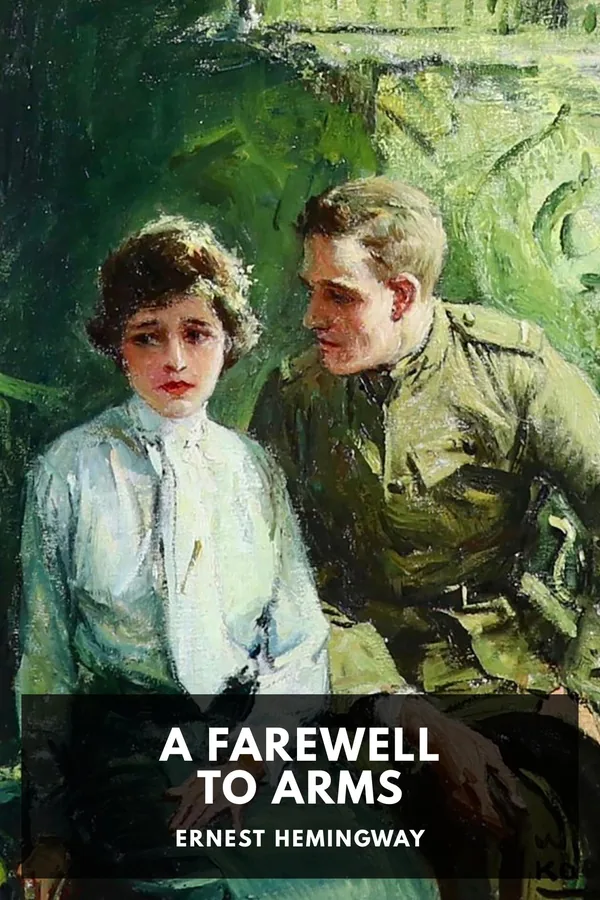
A Farewell to Arms
📖 Click to Read the Opening Pages Online Preview
The opening of Chapter 1
In the late summer of that year we lived in a house in a village that looked across the river and the plain to the mountains. In the bed of the river there were pebbles and boulders, dry and white in the sun, and the water was clear and swiftly moving and blue in the channels. Troops went by the house and down the road and the dust they raised powdered the leaves of the trees. The trunks of the trees too were dusty and the leaves fell early that year and we saw the troops marching along the road and the dust rising and leaves, stirred by the breeze, falling and the soldiers marching and afterward the road bare and white except for the leaves.
The plain was rich with crops; there were many orchards of fruit trees and beyond the plain the mountains were brown and bare. There was fighting in the mountains and at night we could see the flashes from the artillery. In the dark it was like summer lightning, but the nights were cool and there was not the feeling of a storm coming.
Sometimes in the dark we heard the troops marching under the window and guns going past pulled by motor-tractors. There was much traffic at night and many mules on the roads with boxes of ammunition on each side of their packsaddles and gray motortrucks that carried men, and other trucks with loads covered with canvas that moved slower in the traffic. There were big guns too that passed in the day drawn by tractors, the long barrels of the guns covered with green branches and green leafy branches and vines laid over the tractors. To the north we could look across a valley and see a forest of chestnut trees and behind it another mountain on this side of the river. There was fighting for that mountain too, but it was not successful, and in the fall when the rains came the leaves all fell from the chestnut trees and the branches were bare and the trunks black with rain. The vineyards were thin and bare-branched too and all the country wet and brown and dead with the autumn. There were mists over the river and clouds on the mountain and the trucks splashed mud on the road and the troops were muddy and wet in their capes; their rifles were wet and under their capes the two leather cartridge-boxes on the front of the belts, gray leather boxes heavy with the packs of clips of thin, long 6.5 mm. cartridges, bulged forward under the capes so that the men, passing on the road, marched as though they were six months gone with child.
The excerpt below quotes the opening three paragraphs of Chapter 1, in which the narrator describes the house in the village, the troops and the dust on the road, the plain and the mountains, and the artillery flashing at night above the chestnut forest.
Download Full EPUB1929
~88,000 words (estimated)
Approx. 4.9 hours
Standalone
North-eastern Italy and Switzerland, 1915–1918.
Forty-one chapters grouped into twelve movements
EPUB · AZW3 · KEPUB
0.64 MB (EPUB) · 0.71 MB (AZW3) · 0.69 MB (KEPUB)
Public domain in the United States
Project Gutenberg #75201 · Standard Ebooks
A Farewell to Arms is Ernest Hemingway’s novel of the First World War on the Italian front, published in 1929. Frederic Henry, an American serving with the Italian ambulance service, is posted at Gorizia, where the fighting in the mountains is distant enough to be watched like summer lightning. He falls in with Rinaldi, a surgeon, and with Catherine Barkley, a British nurse whose fiancé was killed on the Somme. A shell wounds him during an attack above Plava; he recovers in a Milan hospital and the affair becomes a private world. Then the army collapses at Caporetto, and Henry’s war ends in a flooded river.
The novel follows the affair from its careless beginning to its end in a Lausanne hospital. Its prose is bare, its chapter endings are abrupt, and the war is reported in the flat register of a man doing a job; Hemingway leaves out more than he explains, and the omissions are the point. Wikipedia’s entry on the book summarises its reception and the long argument about its ending. — The text is available via Project Gutenberg #75201 and Standard Ebooks.

A Farewell to Arms by Ernest Hemingway: Summary, Characters & Themes
This page offers a summary and analysis of A Farewell to Arms, with the novel’s five books and forty-one chapters laid out in order, its characters described, and the retreat that breaks its narrator set beside the war that produced it. Ernest Hemingway published the book in 1929, a decade after the armistice, and it was his second novel. Ernest Hemingway had already written The Sun Also Rises and a book of stories, and the flat, spare sentences he had been refining since In Our Time are here turned on a subject he knew at first hand: an ambulance section on the Italian front, the wounded carried down at night, and the talk of men waiting for an attack. Nothing in the novel is explained twice, and the notes below try not to explain it more than once either.
The story is told by Frederic Henry, an American serving in the Italian army who drives an ambulance section. At Gorizia he shares a room with Rinaldi, a surgeon, drinks with the officers, avoids the priest, and falls in with Catherine Barkley, a British nurse who has already lost a fiancé on the Somme. The affair begins as a game and stops being one. A trench-mortar shell wounds Henry in the legs during an attack above Plava; the driver beside him, Passini, is killed and another driver is hit. Henry is sent to Milan, where an American hospital has just opened in a villa, and Catherine is transferred there as well. The war is still in the papers and in the streets, but the hospital keeps its own hours.
The convalescence is the book’s happiest stretch: an operation on the knee, dinners at Biffi’s and the Gran Italia, the races at San Siro, and a pregnancy that both of them treat as a private happiness in a country that has other uses for them. Then Henry returns to the front, the Austrians and Germans break the line at Caporetto, and the army comes apart on the roads. In the retreat Henry shoots a sergeant who refuses to help free a bogged car, sees Aymo killed by Italian fire, and is pulled out of a column by the battle police on the Tagliamento. He dives into the river and the war is over for him. The retreat takes a third of the book and is the finest thing in it.
What follows is the novel’s second half in a different key. Henry reaches Milan in civilian clothes, learns that Catherine has gone to Stresa, and joins her there; a barman finds them a boat and they row across the lake to Switzerland in the rain. The last book is quiet, and it is the quiet that makes the ending bearable and then unbearable. Hemingway’s method is to leave out the explanation and keep the object: the wet leaves on the road, the empty bottles in the armoire, the cast on the leg. The passage about abstract words belongs to this book, and so does the sentence that the world breaks everyone and afterward many are strong at the broken places. Nothing is argued; the reader is given the furniture of a life and left to draw the conclusion.
This edition follows the Standard Ebooks text, which is prepared from the Project Gutenberg transcription, and the numbering is the novel’s own: forty-one chapters in five books, with no titles and no preface. The novel can be read beside Stephen Crane’s The Red Badge of Courage, the short war book that stands behind this one, whose hero runs from his first battle and spends the rest of the book living with it. F. Scott Fitzgerald’s The Great Gatsby appeared four years earlier and is also built on a love affair that ends badly, and Kate Chopin’s The Awakening is the other short American novel of a woman who will not be kept. The full text is at Project Gutenberg and at Standard Ebooks.
Historical Context
The war in the novel is the Italian front of 1915 to 1918, where the army fought along the Isonzo and in the mountains above it. The narrator is not a soldier but a driver, and the book is careful about the difference: his unit waits behind the line, carries the wounded down, and hears the guns at night as summer lightning. The village where the book opens has a house, a river, a road and troops passing all day; the front is close enough to see and far enough to survive. Gorizia, where the section is posted, is a town with a fountain and a walled garden, and the officers’ mess is a room where the priest is baited and the war is a job with rations and leave.
The retreat that fills the third book is the collapse after Caporetto in October 1917, when the Austrians and Germans broke the Italian line and the army fell back to the Piave. The novel shows that retreat from the inside: the roads blocked with guns, carts and peasants, the trucks abandoned, the officers shot by their own battle police, the soldiers shouting that the war is over and throwing away their rifles. The figures the novel gives are part of the text: 150,000 lost on the Bainsizza and San Gabriele, 40,000 on the Carso, and riots against the war in Turin. The police on the Tagliamento bridge are executing officers who have lost their units. Caporetto is never a slogan here; it is a place men drive toward and then away from.
A Farewell to Arms appeared in 1929, and the distance matters. The war is remembered in it rather than announced; the sentences are short because the narrator has stopped explaining. The novel also records the war’s last year from the rear: newspapers with their advertisements blacked out, the German offensive in France in March 1918, hospitals full of malaria and shrapnel cases, the singers and the profiteers in Milan. By the time the book appeared the front it describes had been a victory for eleven years, and it keeps no trace of that language: no parade, no monument, no speech. Its ending is not a judgement on the war but the last thing the war does to two people who had made a private peace, and it is given without consolation.
Key Characters & Literary Archetypes
- Frederic Henry: The narrator, an American lieutenant in the Italian ambulance service, posted at Gorizia and wounded at Plava. He drinks, lies about his feelings, and admits that the affair begins as a game. After the retreat he cuts the stars from his sleeves, decides that he has no obligation left, and the last chapters are the bill for that decision.
- Catherine Barkley: A British V.A.D. in Gorizia, blonde, with a riding crop that belonged to her fiancé, killed on the Somme. She asks Henry to be good to her before she has any reason to trust him, puts off the wedding because she shows too plainly, and dies of a hemorrhage in Lausanne, saying that it is just a dirty trick.
- Rinaldi: The surgeon Henry shares a room with, from Amalfi, vain about his hands and his medals, generous with cognac. He operates all summer, drinks Austrian brandy, jokes at the mess that the priest’s meat is God-meat, and by the autumn believes he has syphilis and calls it an industrial accident. He is the person Henry looks for when he comes back to Gorizia.
- The priest: A young priest from the Abruzzi, mocked at the mess by the officers, who call him a fraud and ask why he does not go to the front. He invites Henry to his family’s house at Capracotta and is hurt when the leave goes elsewhere. He hates the war, says that Henry is nearer the officers than the men, and argues that it is in defeat that men become Christian.
- Passini: One of Henry’s drivers, a socialist from Imola, who argues in the dugout that there is nothing worse than war and that defeat only means going home. Henry tells him that defeat is worse. He is killed by the same shell that wounds Henry, his legs smashed, and his death is the first of the book’s gratuitous ones. He is not made a symbol: he is a man with an opinion, eating macaroni and cheese.
- Count Greffi: A ninety-four-year-old diplomat at Stresa, a contemporary of Metternich, who plays billiards for a franc a point and drinks champagne before dinner. He tells Henry that the war is stupid, that Italy will win because it is a younger nation, and that old men do not grow wise, only careful. He has outlived his religious feeling and asks Henry to pray for him.
Core Literary Themes
- The words that make war: The most quoted passage in the novel is Henry’s list of words he can no longer bear: sacred, glorious, sacrifice, and the expression in vain. Beside them he sets the concrete names, the villages, the roads, the rivers, the regiments and the dates. The book is built on that distinction. It gives the retreat in the names of places and the numbers of men, and it distrusts every sentence that tries to make the killing mean something. Even the medal Henry is promised arrives as valorous conduct in a report, a phrase with no weight in it at all. It is a rule the novel applies to itself: it never tells the reader what the deaths mean.
- Love as a separate peace: Henry and Catherine make a country of two in a hospital room, a hotel, a chalet. They tell the nurses they were married the day she arrived and count the months from it, and Catherine refuses the ceremony because she thinks the formalities would separate them. Her claim that there is no me, only you, is both the book’s tenderest line and its warning. The affair is a private armistice, and the war does not recognise it; the ending is the proof that a separate peace is not a shelter. Catherine’s fear is not that Henry will leave her but that the arrangement will be noticed.
- Courage, medals and shame: The novel keeps asking what courage is and keeps giving unsatisfactory answers. Henry is recommended for a silver medal for being wounded while eating; Ettore Moretti has three wound stripes and bores everyone at dinner; the battle police prove their courage by shooting unarmed officers; Bonello says he has wanted to kill a sergeant all his life. The men who talk about honour are the ones furthest from the line. Henry’s own courage is mostly endurance, and the book is honest about how little that is worth once the army needs a reason. Its judgement falls on the men who award the medals.
- Obligation and the deserter: The river is the novel’s one clean decision. Lying on the flatcar, Henry says that anger was washed away with any obligation, that he has made a separate peace. The book does not celebrate the desertion and does not condemn it: it shows the army’s justice at the bridge, the lieutenant-colonel shot with the sign of the cross, and then shows a man swimming away from it. The army’s answer to the retreat is to shoot its own officers, and Henry’s answer is to swim. What is left is not freedom but the absence of a job.
- Rain, weather and the end of things: Weather does the work of foreshadowing in this novel, and it does it without comment. The dust and the leaves of the first chapter give way to the permanent rain and the cholera, and to the snow that falls on the retreat. Catherine is afraid of the rain because she sees herself dead in it, and the rain is falling when Henry walks back from the hospital at the end. Hemingway never says that the weather means anything; he only makes sure that it is raining whenever something is about to be lost. The first chapter’s dust and falling leaves are the same trick in reverse.
Why Download Our Custom E-Reader Edition of A Farewell to Arms?
The text here is complete, in the novel’s own five books and forty-one numbered chapters, and the summaries below follow that order so that a reader can stop after any chapter and check what has happened without meeting the next movement first. The guide also names the places, so that Gorizia, Plava, the Bainsizza, Caporetto and the Tagliamento are not just words in a list: each one is a stop on a road the book actually travels.
The edition is the Standard Ebooks text, prepared from the Project Gutenberg transcription and corrected against the printed book; the punctuation, the Italian and the dialect of the retreat are that edition’s. Nothing has been modernised or cut, and the chapter numbers are the novel’s own rather than an editor’s. If you want the source itself, or want to compare a passage, the same text is at Project Gutenberg #75201. The byline and the publication details at the top of this page come from that edition too, so the page and the file agree.
Everything on the page is free: the EPUB, the AZW3 and the KEPUB, with no account, no email and no sample chapter. The files are the whole novel, and the chapter guide exists because the chapter endings here are abrupt, and a reader who puts the book down for a week can lose the thread of the retreat and of the two people walking away from it. There is no paywall and no newsletter at the end of the download.
- Based on the Standard Ebooks Edition, via Standard Ebooks, whose text is prepared from the Project Gutenberg transcription and checked against scans of the printed novel; the chapter numbers and the byline follow that edition.
- Complete text in five books All forty-one chapters, the dedication included, with the book divisions kept where the novel prints them and no chapter text abridged.
- Chapter summaries in reading order Twelve grouped summaries from the village on the Isonzo to the Lausanne hospital, each keyed to the numbered chapters it covers.
- EPUB, AZW3 and KEPUB files The same text in three formats, for Apple Books, Kindle and Kobo, with the chapter breaks and the Italian left intact.
- Stephen Crane’s 1895 novel of a young soldier at Chancellorsville, a short book about fear and shame in action that reads well beside the attack at Plava. — free EPUB, AZW3 & KEPUB
- F. Scott Fitzgerald’s novel of 1925, the other American book of the decade about a love affair that cannot be kept, and a study in what a narrator chooses not to say. — free EPUB, AZW3 & KEPUB
- Kate Chopin’s 1899 novel of a woman who refuses the life arranged for her, a short American book from the same shelf of endings that do not console. — free EPUB, AZW3 & KEPUB
Chapter summaries
The novel has forty-one chapters and no titles: the Standard Ebooks edition numbers them and divides them into five books, at chapters 13, 25, 33 and 38. The twelve groups below follow those divisions rather than inventing new ones, and the names are ours, added for navigation. Each summary covers what happens in the chapters named and stops at the end of them, so the page can be read alongside the novel without giving away the next movement. Chapters are cited by number throughout, and the places are spelled as the text spells them.
- Chapters 1–2 — The village on the Isonzo: The narrator describes the house in the village, the troops and the dust, the plain and the mountains, and the artillery at night; winter brings the permanent rain and cholera, which kills seven thousand in the army. The next year the Italians cross the river, and the section is posted at Gorizia, where the officers bait the priest at the mess and Henry admits that his leave went to the cities of Italy rather than to the Abruzzi.
- Chapters 3–4 — Rinaldi and Catherine Barkley: Henry comes back from leave and Rinaldi takes him to the British hospital in a villa, where Catherine Barkley and Helen Ferguson are on duty. Rinaldi is in love with Miss Barkley; Henry calls on her, is slapped for trying to kiss her, and is then kissed and asked to be good to her. He tells himself that the affair is a game, like bridge.
- Chapters 5–6 — The game they play: The visits continue and the game becomes harder to keep up. Catherine sees through him and calls it a rotten game; she is not mad, she says, only a little sometimes. Henry goes back to the mountain posts, comes down to find her, and then gets drunk with the officers and nearly forgets her. The chapter ends with him lonely and hollow, which is the first sign that the game has stopped being one.
- Chapters 7–9 — The attack above Plava: The section waits at the mountain posts, and Catherine gives Henry a Saint Anthony medal before the night attack up the river. Four cars are needed; the roads are screened with cornstalk and matting, and the drivers wait in a dugout eating macaroni and cheese. A trench-mortar shell lands among them: Passini is killed, Gordini is hit, and Henry’s legs and head are opened.
- Chapters 10–12 — The field hospital and Milan: In the ward Rinaldi brings cognac and talk of the silver medal, and the priest comes at dusk with mosquito netting and English papers, saying that he hates the war and that Henry is nearer the officers than the men. The major tells him he is going to the American hospital in Milan. The last night at the front is a drunken farewell, and the train leaves in the dark.
- Chapters 13–17 — The American hospital: Milan: a villa hospital with Miss Gage, Miss Van Campen and the elderly Mrs. Walker, and the house doctor’s opinion that the knee must wait six months. Valentini, a major who laughs at the other doctors, operates and promises to make Henry better than new. Catherine arrives, the affair becomes the centre of the book, and the night of the bat and the vermouth is the closest thing to a home either of them has.
- Chapters 18–20 — The summer of victories: Henry is on his feet and they ride in the park, eat at Biffi’s and the Gran Italia, and tell the nurses they were married in September. The papers report victories, the front takes the Bainsizza, and Ettore Moretti, an Italian from San Francisco with three wound stripes, bores Catherine at dinner. At the races Japalac wins at long odds, and Catherine says she is afraid of the rain.
- Chapters 21–24 — The pregnancy and the last night: In September Catherine tells him she is pregnant, almost three months along, and both of them pretend not to be afraid. Henry’s three weeks of leave are cancelled when Miss Van Campen finds the empty bottles and jaundice and accuses him of drinking to avoid the front. On his last night they take a room across from the station and buy a pistol.
- Chapters 25–27 — Gorizia and the Bainsizza: The town is nearly empty and the major says that it is all over. Rinaldi has operated all summer, drinks cognac and believes he has syphilis, which he calls an industrial accident; the priest comes to the mess and the two talk in the dark. Henry drives up to the Bainsizza, where Gino has the cars and there are no prepared positions. Snow falls, and word comes that Caporetto has broken.
- Chapters 28–32 — The retreat from Caporetto: The column crawls through the rain with guns, carts and peasants. Aymo picks up two girls, Bonello two engineers, and when the sergeants refuse to help free a bogged car Henry shoots one and Bonello finishes him. They abandon the trucks. Aymo is killed by Italian fire, the battle police are shooting officers at the Tagliamento, and Henry dives into the river and swims, having made his separate peace.
- Chapters 33–37 — Stresa and the lake: In Milan Simmons lends him civilian clothes and the porter’s wife tells him that Catherine has gone to Stresa. He finds her there with Helen Ferguson, plays billiards with Count Greffi, and is warned by the barman that he will be arrested in the morning. The barman’s boat takes them thirty-five kilometres up the lake through the storm, and they are arrested at Brissago.
- Chapters 38–41 — Switzerland and the end: A chalet above Montreux, the Guttingens living downstairs: snow, cards, long walks and the last happiness in the book. In March the rain comes and they move to Lausanne, where after a long labour the doctors perform a Caesarean, the boy is born dead with the cord caught around his neck, and Catherine hemorrhages and dies. Henry turns off the light and finds it is like saying goodbye to a statue.
A Farewell to Arms: Frequently Asked Questions
What is A Farewell to Arms about?
Who are Frederic Henry and Catherine Barkley?
What happens at Caporetto in the novel?
Why does Frederic Henry desert?
Does Catherine die at the end?
Is it a love story or a war novel?
Is A Farewell to Arms hard to read?
Where can I get the free EPUB, AZW3 and KEPUB files?
Part of: Classic Fiction · 1920s